

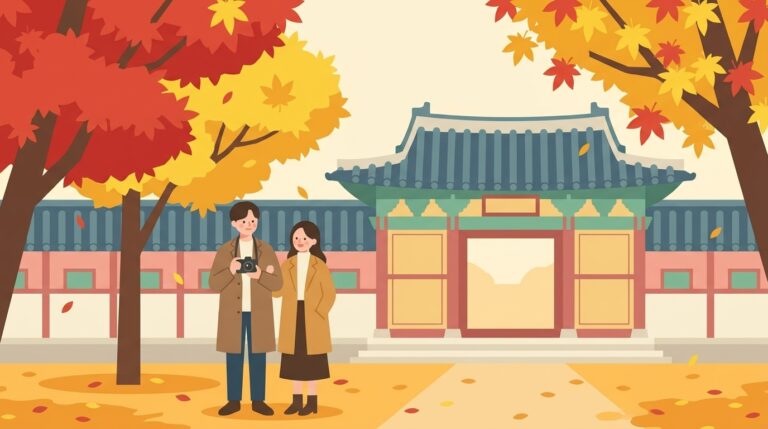
Talk About Autumn Foliage Like a True Korean Friend!
Phase 1: Empathy (Welcome to the Autumn Magic!)
안녕하세요! (Annyeonghaseyo!) I’m your Daily Hangul editor and your Korean bestie.
Imagine this: The crisp autumn air brushes against your cheeks, and the mountains of Seoul are suddenly painted in brilliant hues of crimson red and golden yellow. You want to share this breathtaking view with your Korean friends on Instagram or during a weekend chat. But when you open your mouth, the only phrase that comes out is: “날씨가 좋습니다” (The weather is good).
Oh, how frustrating! You want to sound poetic, enthusiastic, and truly local.
Many of my students tell me, “I know the basic weather words, but I don’t know how to invite someone to see the leaves or express that cozy, melancholic autumn vibe!” Don’t worry. Today, we are going to unlock the magical world of 단풍놀이 (Danpungnori – Autumn foliage excursions). By the end of this guide, you’ll be expressing your autumn sentiments like a real Seoulite! Let’s dive in!
Phase 2: Three Key Expressions to Sound Instantly Local
1. 단풍이 예쁘게 물들었어요. (Danpung-i yeppeuge muldeureosseoyo.)
- Pronunciation: dan-poong-ee yeh-bbyu-geh mool-deul-uh-ssuh-yo (Think of “mool-deul” sounding like “mul” in multiple, and “deul” as in dull.)
- Meaning: The autumn leaves have turned beautifully. (Literally: “The autumn foliage is beautifully dyed.”)
- K-Culture Moment: You will hear this expression constantly in K-Dramas whenever characters walk through paths lined with maple leaves, like the iconic scenes in Goblin (도깨비).
- Editor’s Insight: Koreans use the verb 물들다 (muldeulda), which means “to be dyed” or “stained.” Instead of saying the leaves just “changed colors,” we view nature as an artist painting the trees with watercolor dye! Isn’t that beautiful?
- Situation Spectrum:
- Casual (단풍 예쁘게 물들었어!) ✅
- Semi-formal (단풍이 예쁘게 물들었어요.) ✅
- Formal (단풍이 아름답게 물들었습니다.) ✅
- 🤔 Think About It: How does your language describe the changing autumn leaves? Do you use a word related to painting or dyeing like Korean does?
2. 단풍놀이 가고 싶어요. (Danpungnori gago sipeoyo.)
- Pronunciation: dan-poong-noh-ree gah-goh sheep-uh-yo
- Meaning: I want to go leaf-viewing / autumn foliage sightseeing.
- K-Culture Moment: During October and November, Korean social media feeds are flooded with photos tagged #단풍놀이. It’s a national pastime where families, couples, and friends pack lunch boxes and head to the mountains.
- Editor’s Insight: The word 놀이 (nori) means “play” or “recreation” (like 어린이날 – Children’s Day play). So, “단풍놀이” literally translates to “autumn leaf play.” It treats appreciating nature as an active, festive game!
- Situation Spectrum:
- Casual (단풍놀이 가고 싶어!) ✅
- Semi-formal (단풍놀이 가고 싶어요.) ✅
- Formal (단풍놀이를 가고 싶습니다.) ✅
- 🤔 Think About It: Is looking at autumn leaves considered a major social event or “play” in your culture as well?
3. 가을 타나 봐요. (Gaeul tana bwayo.)
- Pronunciation: gah-eul tah-nah bwah-yo
- Meaning: I guess I’m feeling the autumn blues / getting sentimental.
- K-Culture Moment: If you suddenly start listening to sad ballads, drinking warm coffee by the window, or feeling a bit lonely when the leaves fall, your Korean friends will tease you with this phrase.
- Editor’s Insight: 타다 (tada) usually means “to ride” (a bus, a bike), but when paired with seasons, it means to be highly sensitive to the seasonal changes. If you are prone to melancholic feelings in autumn, you are “riding autumn”!
- Situation Spectrum:
- Casual (나 가을 타나 봐.) ✅
- Semi-formal (저 가을 타나 봐요.) ✅
- Formal (가을을 타는 것 같습니다.) ⚠️ (Slightly unnatural because emotions are usually shared casually)
- 🤔 Think About It: Why do you think we “ride” autumn? Does the change of weather affect your emotions in a similar way?
Phase 3: Textbook Korean vs. Real-Life Korean
Let’s upgrade your textbook Korean to sound like a natural speaker!
Situation 1: Commenting on the cool autumn breeze
- 📖 Textbook Korean: “날씨가 시원합니다.” (The weather is cool.)
- 🗣️ Real-Life Korean: “날씨가 선선해서 걷기 딱 좋아요!” (The weather is breezy and cool, so it’s absolutely perfect for walking!)
- 💡 Why the difference? “시원하다” can refer to cold drinks, hot soup, or weather. But “선선하다” is the specific, cozy word for that refreshing autumn breeze. “딱 좋아요” (exactly perfect) is a super common native way to say something is just right.
Situation 2: Suggesting an autumn hike/trip
- 📖 Textbook Korean: “가을 산에 가십시오.” (Go to autumn mountains.)
- 🗣️ Real-Life Korean: “이번 주말에 단풍 구경 갈래요?” (Would you like to go see the autumn foliage this weekend?)
- 💡 Why the difference? Standard textbooks love using imperatives like “가십시오.” But in reality, Koreans use 구경 (gugyeong – sightseeing/viewing) combined with the polite suggestion ending -을래요? (-eullaeyo?) to make friendly plans.
Phase 4: K-Culture Deep-Dive & Non-Verbal Manners
4-1. Nunchi & Photoshoot Etiquette
When you go for a Danpungnori (단풍놀이), you will see hundreds of people taking photos. To blend in seamlessly with your “Nunchi” (social sense):
1. The fallen leaf pose: Hold a beautiful red maple leaf up to your face, covering one eye, and smile warmly. It’s the ultimate cute autumn pose!
2. Be quick and polite: Popular photo spots on mountain trails often have long lines. Quickly take 2-3 shots, say “감사합니다” (Thank you) to those waiting, and step aside.
4-2. The Post-Hiking Feast (K-Food Connection)
In Korea, Danpungnori is never just about walking. The real highlight happens at the bottom of the mountain!
After sweating and enjoying the cold air, hikers gather at local restaurants to eat 파전 (Pajeon – Green onion pancake) and drink 막걸리 (Makgeolli – Sweet rice wine). It is a cultural ritual that warms your body and soul. Don’t skip this step!
Phase 5: Real-Life Roleplay Scenario
Meet Minjun (민준), your energetic Korean friend who loves nature, and Sarah (새라), an A2 learner who wants to enjoy autumn without getting too tired!
- Background: They are chatting over coffee on a breezy October afternoon.
민준: 새라 씨, 요즘 날씨 진짜 좋지 않아요?
      (Sarah-ssi, yo-jeum nal-ssi jin-jja jot-ji ah-nah-yo?)
      "Sarah, isn't the weather really great lately?"

새라: 🎭 (Smiling warmly) 네! 날씨가 선선해서 걷기 딱 좋아요.
      (Ne! Nal-ssi-ga seon-seon-hae-seo geot-gi ttak jo-ah-yo.)
      "Yes! The weather is breezy and cool, so it's perfect for walking."

민준: 맞아요. 혹시 요즘 마음이 싱숭생숭하지 않아요?
      (Ma-ja-yo. Hok-si yo-jeum ma-eum-i sing-sung-saeng-sung-ha-ji ah-nah-yo?)
      "Exactly. By any chance, does your heart feel a bit restless lately?"

새라: 🎭 (Laughing softly) 네, 맞아요. 저 가을 타나 봐요.
      (Ne, ma-ja-yo. Jeo gae-ul ta-na bwah-yo.)
      "Yes, that's right. I guess I'm feeling the autumn blues."

민준: 하하, 원래 가을은 그런 계절이에요! 우리 주말에 단풍 구경 갈래요?
      (Ha-ha, won-rae gae-ul-eun geu-reon gye-jeol-i-e-yo! Uri ju-mal-e dan-pung gu-gyeong gal-rae-yo?)
      "Haha, autumn is originally that kind of season! Do you want to go leaf-viewing this weekend?"

새라: 🎭 (Clapping hands with excitement) 단풍놀이요? 정말 가고 싶어요!
      (Dan-pung-no-ri-yo? Jeong-mal ga-go si-peo-yo!)
      "An autumn foliage trip? I really want to go!"

민준: 좋아요! 북한산으로 갈까요, 아니면 경복궁으로 갈까요?
      (Jo-ah-yo! Buk-han-san-eu-ro gal-kka-yo, a-ni-myeon Gyeong-bok-gung-eu-ro gal-kka-yo?)
      "Great! Should we go to Bukhansan Mountain, or to Gyeongbokgung Palace?"

새라: 🎭 (Nodding happily) 음... 산은 힘드니까 경복궁으로 가요! 끝나고 파전 먹어요!
      (Eum... san-eun him-deu-ni-kka Gyeong-bok-gung-eu-ro ga-yo! Kkeut-na-go pa-jeon meog-eo-yo!)
      "Hmm... mountains are tiring, so let's go to Gyeongbokgung Palace! Let's eat green onion pancake afterward!"
🔀 Choose Your Response!
If Minjun asks you: “주말에 같이 단풍놀이 갈래요?” (Do you want to go leaf-viewing together this weekend?)
- Option A: “네, 단풍놀이 정말 가고 싶어요!”
- 💖 Best! You used the specific term “단풍놀이” and showed enthusiastic interest. Your Korean friend will be thrilled to plan the trip!
- Option B: “네, 등산합시다.”
- ⚠️ Stiff. “등산합시다” (Let’s hike) is grammatically correct but sounds like a strict military order. Keep it friendly with “-을래요?” or “-어요.”
- Option C: “아니요, 저는 가을을 타요.”
- 🚫 Awkward. Saying “No, I ride autumn” as a rejection makes it sound like you are locking yourself in a dark room. Instead, say “집에서 쉬고 싶어요” (I want to rest at home).
Phase 6: 10-Second Emotional Shadowing Drill
To sound natural, you need the right rhythm and emotion. Try speaking these sentences aloud, pausing at the / marks!
- [😊 Excited & Bright]
- “단풍이 / 예쁘게 / 물들었어요!”
- Dan-pung-i / yep-beu-ge / mul-deul-eoss-eo-yo!
- [🥺 Melancholic & Cute]
- “요즘 / 자꾸 외로워요. / 저 / 가을 타나 봐요…”
- Yo-jeum / ja-kku oe-ro-wo-yo. / Jeo / gae-ul ta-na bwah-yo…
Phase 7: K-Culture Mini Dictionary
| Word (Korean) | Romanization | Meaning & Real-Life Usage |
|---|---|---|
| 단풍 | Danpung | Autumn leaves / foliage. Used to describe the colorful trees in autumn. |
| 단풍놀이 | Danpungnori | Autumn foliage excursion. The actual activity of traveling to see leaves. |
| 가을 타다 | Gaeul tada | Feeling sentimental or lonely due to the autumn season. |
| 억새 | Eoksae | Silver grass. Another gorgeous autumn sight in Korea, especially on Sky Park (하늘공원) in Seoul. |
Phase 8: Traveler’s Survival Kit
Survival Phrases TOP 3
- 여기 단풍 명소예요? (Yeo-gi dan-pung myeong-so-yeo-yo?)
- “Is this a famous spot for autumn foliage?”
- Pro Tip: Use this to ask locals if you are looking for the best photo zones!
- 사진 좀 찍어 주실 수 있어요? (Sa-jin jom jjig-eo ju-sil su iss-eo-yo?)
- “Could you take a picture of me, please?”
- Pro Tip: Hand your phone to a Korean in their 20s or 30s—they are masters of finding the perfect angles!
- 날씨가 딱 좋네요. (Nal-ssi-ga ttak jot-ne-yo.)
- “The weather is absolutely perfect.”
🗺️ Editor’s Travel Note
Before heading out, download the Naver Map App to check transport routes. Places like Hwadam Forest (화담숲) require online reservations months in advance for autumn foliage viewing, so make sure to check early!
(Note: Seasonal operational details and ticket bookings can change, so check official tourist portals before traveling.)
Phase 9: “One Step Deeper” (Reflective Thoughts)
In Korea, there is a deep cultural appreciation for the transition of seasons. The peak of red maple leaves lasts only about two weeks before winter winds sweep them away. Because this beauty is so fleeting, Koreans call it 찰나의 미학 (the aesthetics of a fleeting moment). This is why we don’t just say “the leaves are pretty”; we gather with loved ones to “play in the leaves” (단풍놀이) before they vanish.
💬 Your Turn: Is there a seasonal change in your country that people celebrate with such enthusiasm? Tell me in the comments below!
Phase 10: FAQ & Common Mistakes
Q: What is the difference between “단풍” and “낙엽”?
A: 단풍 (Danpung) refers to the colorful autumn leaves still hanging beautifully on the trees. 낙엽 (Nagyeop) refers to the fallen leaves lying dry on the ground.
Q: Can I use “가을 타다” for other seasons like Spring?
A: Yes! You can say “봄 타다” (Bom tada) if you get restless and excited when spring flowers bloom. However, “가을 타다” is used far more often because of the emotional weight of autumn.
Q: How do I reply when someone says “가을 타나 봐요”?
A: You can say “맛있는 거 먹으러 가요!” (Let’s go eat something delicious!) or “같이 단풍놀이 가요!” to cheer them up.
🚨 Common Mistakes Alert!
- Wrong: “날씨가 추워요 단풍놀이 가요.” (The weather is cold, let’s go leaf-viewing.)
- Correct: “날씨가 선선하니까 단풍놀이 가요.” (Since the weather is cool/breezy, let’s go leaf-viewing.)
- Why: “추워요” means freezing cold (winter vibe). Autumn leaves are best enjoyed when it’s cozy and breezy (선선하다).
Phase 11: Action Mission!
- Bronze Medal 🥉: Write “단풍이 예뻐요” (The autumn leaves are pretty) on a piece of paper and read it out loud 3 times.
- Silver Medal 🥈: Share a photo of autumn on your social media and caption it: “날씨가 선선해서 걷기 딱 좋아요! 🍁”
- Gold Medal 🥇: The next time a Korean friend asks how you are doing in October/November, reply: “요즘 가을 타나 봐요. 단풍놀이 가고 싶어요!”
Phase 12: Interactive Quiz Challenge
1. Fill in the blank:
“The leaves are colored so beautifully!”
* 단풍이 예쁘게 ___________.
🔍 Click to reveal the answer!
Answer: 물들었어요 (muldeureosseoyo)
Explanation: Remember, nature “dyes” the leaves in Korea!
2. True or False?
In Korea, “단풍놀이” (Danpungnori) is strictly a serious mountain climbing activity with professional gear.
🔍 Click to reveal the answer!
Answer: False!
Explanation: While many climb mountains, many simply visit palaces like Gyeongbokgung, parks, or tree-lined streets to take photos and eat delicious food!







