

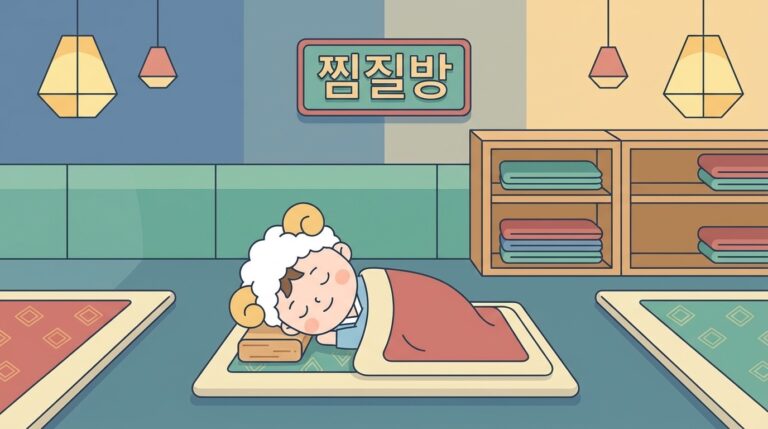
Phase 1: Empathy (Your Cozy Jjimjilbang Escape!)
안녕하세요! (An-nyeong-ha-se-yo!) Hello! It’s your favorite Daily Hangul editor, your local Korean bestie, here to guide you through one of the most relaxing yet slightly nerve-wracking experiences in Korea: the Jjimjilbang (찜질방) sleeping room (수면실 – Sumyeon-sil)!
Imagine this: You’ve spent hours sweating out your stress in the hot charcoal room, eaten a delicious boiled egg, and now you are super sleepy. You walk into the quiet, dark sleeping room. Everyone is lying down on thin floor mats. Suddenly, you freeze. Where do I sleep? What if I make too much noise? How do I politely ask someone if a spot is free?
Don’t worry! Many of our beginner students have told us they felt too scared to enter the sleeping room because they didn’t know the words or the quiet manners. Today, we’ll give you the perfect, easy A1 phrases to help you find your spot and sleep peacefully like a true local!
Phase 2: Core Expressions (A1 Level)
1. 조용히 해주세요 (Jo-yong-hi hae-ju-se-yo)
- Pronunciation: “Jo-yong-he hae-joo-seh-yo” (Sounds like “Yo-yo” with a ‘J’ at the start: Jo-yong + hae-joo-seh-yo)
- Meaning: “Please be quiet.”
- K-Culture Moment: In K-Dramas, when characters sneak into the Jjimjilbang to hide or sleep, someone always whispers this with a finger on their lips when someone talks too loudly.
- Editor’s Insight: This is a polite way to ask someone to lower their voice. Even though you are a beginner, saying this softly with a polite head nod works wonders.
- Situation Spectrum: Casual: ⚠️ | Semi-formal: ✅ | Formal: 🚫 (Perfect for cozy, public spaces!)
- 🤔 Think About It: In your country, do people sleep together in public saunas, or is sharing sleeping spaces a new concept for you?
2. 자리 있어요? (Ja-ri is-seo-yo?)
- Pronunciation: “Jah-ree eet-suh-yo?” (Sounds like “Jury” but with an “Ah” sound: Jah-ree + eet-suh-yo)
- Meaning: “Is this spot taken?” (Literally: “Does a seat/spot exist?”)
- K-Culture Moment: When the sauna is crowded on a Friday night, finding a mat is gold! You will see people pointing at empty mats and asking this to neighbors.
- Editor’s Insight: If you see an empty floor mat but a pillow is nearby, always ask this first to avoid accidentally stealing someone’s spot while they are in the restroom!
- Situation Spectrum: Casual: ✅ | Semi-formal: ✅ | Formal: ⚠️
- 🤔 Think About It: How does asking before taking space show respect in Korean culture?
3. 불 좀 꺼주세요 (Bul jom kkeo-ju-se-yo)
- Pronunciation: “Bool jom kker-joo-seh-yo” (Bool sounds like “Bull” + jom + kkeo-joo-seh-yo)
- Meaning: “Please turn off the light.”
- K-Culture Moment: Often in small, shared sleeping rooms, the last person near the door or light switch is asked to do this.
- Editor’s Insight: “좀” (jom) means “please” or “a little.” It softens your request, making you sound very polite and natural!
- Situation Spectrum: Casual: ⚠️ | Semi-formal: ✅ | Formal: 🚫
- 🤔 Think About It: Why is using softening words like “좀” so important in Korean requests?
Phase 3: Textbook Korean vs Real Korean
Situation 1: Asking if you can sleep here
- 📖 Textbook: “여기에서 잠을 자도 괜찮습니까?” (Yeo-gi-e-seo jam-eul ja-do gwaen-chan-seup-ni-ka? – Is it acceptable to sleep here?)
- 🗣️ Real Korean: “여기서 자도 돼요?” (Yeo-gi-seo ja-do dwae-yo? – Can I sleep here?)
- 💡 Why is it different? Textbook Korean is too long and formal for a cozy sauna. Real Koreans shorten “여기에서” to “여기서” and use the simple, friendly “해도 돼요?” form.
Situation 2: Asking someone to stop talking
- 📖 Textbook: “이곳에서 잡담을 금지해 주십시오.” (I-got-e-seo jap-dam-eul geum-ji-hae ju-sip-si-o. – Please prohibit chatting in this place.)
- 🗣️ Real Korean: “조금만 살살 말씀해 주세요.” (Jo-geum-man sal-sal mal-sseum-hae ju-se-yo. – Please speak a bit more softly.)
- 💡 Why is it different? The textbook is way too robotic! Using “살살” (sal-sal – softly/gently) makes you sound incredibly friendly while still getting your point across.
Phase 4: K-Culture Deep Dive & Non-verbal Manners
4-1. Nunchi (눈치) & Gestures
In the sleeping room, silence is golden. Use these non-verbal tricks to show great manners:
* The “Shh” Hand: Place your index finger over your lips lightly. Give a small, apologetic smile.
* The Polite Bow: When walking past sleeping people, slightly bend your upper body forward to show you are trying not to disturb their peace.
4-2. The Sheep Head (양머리 – Yang-meori)
You cannot sleep in a Korean sauna without making the famous “Sheep Head” towel! It’s the ultimate K-Culture symbol. It protects your hair from the dry heat of the hot rooms and keeps your head cozy while sleeping on the cool floor.
Phase 5: Real-Life Roleplay Scenario
Scenario: You are at a beautiful seaside Jjimjilbang in Busan. You want to take a nap in the cozy “Ondol” (heated floor) sleeping room, but it’s very crowded. You spot an empty mat near Min-ji, a friendly local.
- Min-ji (Local Resident): 😴 (Resting quietly on her mat)
- You (A1 Beginner): 🚶♂️ (Approaching slowly, holding a foam pillow)
[Dialogue]
1. You: 실례합니다… 여기 자리 있어요? (Sil-rye-hap-ni-da… yeo-gi ja-ri is-seo-yo? / Excuse me… is this spot taken?)
2. Min-ji: 앗, 아니요! 비어 있어요. 쓰세요. (At, a-ni-yo! Bi-eo is-seo-yo. Sseu-se-yo. / Oh, no! It’s empty. Please use it.)
3. You: 감사합니다. 매트 한 장 더 써도 돼요? (Gam-sa-hap-ni-da. Mae-teu han jang deo sseu-do dwae-yo? / Thank you. Can I use one more mat?)
4. Min-ji: 네, 저쪽에 매트 많아요. 가져오세요! (Ne, jeo-jjo-ge mae-teu man-a-yo. Ga-jyeo-o-se-yo! / Yes, there are many mats over there. Go bring one!)
5. You: (Bringing a mat and lying down) 아, 따뜻하다! (A, tta-tteut-ha-da! / Oh, it’s so warm!)
6. Min-ji: (Smiling) 좋지요? 온돌방이라 따뜻해요. (Jot-ji-yo? On-dol-bang-i-ra tta-tteut-hae-yo. / Nice, right? It’s warm because it’s an Ondol heated floor room.)
7. You: 네, 너무 좋아요! 혹시 불 좀 꺼도 돼요? (Ne, neo-mu jo-a-yo! Hok-si bul jom kkeo-do dwae-yo? / Yes, I love it! By the way, is it okay if I turn off the light?)
8. Min-ji: 네, 꺼주세요. 잘 자요! (Ne, kkeo-ju-se-yo. Jal ja-yo! / Yes, please turn it off. Sleep well!)
🔀 Interactive Branching Points
You are ready to sleep, but the person next to you is snoring very loudly. What do you do?
- Choice A: Gently tap their shoulder and say, “저기요, 조용히 해주세요.” (Jeo-gi-yo, jo-yong-hi hae-ju-se-yo. – Excuse me, please be quiet.)
- 🔴 Feedback (Risk): While polite, saunas are shared spaces. Tapping a sleeping stranger might startle them! It’s usually better to just move mats if space is available.
- Choice B: Move your mat quietly to another corner without saying anything.
- 🟢 Feedback (Best): Perfect choice! This shows high “Nunchi” (situational awareness). It avoids conflict and lets everyone keep resting.
- Choice C: Loudly sigh “아, 진짜!” (Ah, jin-jja! – Oh, seriously!) so they wake up.
- ❌ Feedback (Bad): Oh no! This is too aggressive and ruins the peaceful atmosphere of the sleeping room.
Phase 6: 10-Second Emotional Shadowing Drill
Let’s practice speaking with real Korean emotion! Pause at the / marks.
- [🥺 Politely and softly]
- “여기 / 자리 / 있어요?” (Yeo-gi / ja-ri / is-seo-yo? – Is this spot taken?)
- [🤫 Whispering in a quiet room]
- “조용히 / 해주세요…” (Jo-yong-hi / hae-ju-se-yo… – Please be quiet…)
- [☺️ Happy and relaxed]
- “아, / 진짜 / 따뜻하다!” (A, / jin-jja / tta-tteut-ha-da! – Oh, it is truly warm!)
Phase 7: K-Culture Mini Dictionary
- 수면실 (Sumyeon-sil) | Sleeping Room | A dedicated, quiet, and darkened room in a Jjimjilbang for overnight stays or short naps.
- 매트 (Maeteu) | Floor Mat | Lightweight leather or foam mats provided for free to sleep comfortably on the hard floor.
- 베개 (Begae) | Pillow | Hard plastic block pillows. Tip: Wrap your towel around it to make it softer!
- 온돌 (Ondol) | Floor Heating | Korea’s traditional underfloor heating system. It warms the body directly from the floor up.
Phase 8: Traveler’s Survival Kit
Survival Phrases TOP 3
- 담요 있어요? (Dam-yo is-seo-yo?)
- Pronunciation: “Dam-yo eet-suh-yo?”
- Pro Tip: “Do you have blankets?” Some saunas rent cozy blankets for a small fee (usually 1,000 to 2,000 KRW).
- 추워요 (Chu-wo-yo)
- Pronunciation: “Choo-wo-yo”
- Pro Tip: “I’m cold.” Use this if the air conditioning is too strong.
- 더워요 (Deo-wo-yo)
- Pronunciation: “Duh-wo-yo”
- Pro Tip: “I’m hot.” If the heated floor is too warm.
Editor’s Travel Note 🗺️
Before heading out, make sure to use the KakaoMap App Download link to find 24-hour Jjimjilbangs near you. Not all saunas allow overnight sleeping, so check the “24시” (24 Hours) sign before entering!
Disclaimer: Operating hours and blanket rental fees may change depending on the location.
Phase 9: ” 한 발 더 깊이 ” (A Deeper Look)
Why do Koreans sleep so comfortably in a giant room full of strangers? It all goes back to Korea’s deep-rooted “community culture” (공동체 문화 – Gong-dong-che mun-hwa) and incredibly high level of public safety. In Korea, leaving your phone or wallet next to you while sleeping in a public space is very common. This mutual trust makes the Jjimjilbang a safe haven for travelers and locals alike.
💬 Your Turn: Would you feel safe sleeping in a shared room in your home country? Tell us in the comments!
Phase 10: FAQ & Common Mistakes
Q: Can I lock my belongings before sleeping?
A: Yes! Always keep your high-value items in your main locker. Keep your locker key wristband on your wrist or ankle at all times—even while sleeping!
Q: What should I wear in the sleeping room?
A: You must wear the Jjimjilbang uniform (sweatshirt and shorts) provided at the front desk. Sleeping in your own clothes or towels is not allowed.
Q: Can I charge my phone in the sleeping room?
A: Most sleeping rooms have wall outlets, but they are limited. Bring a portable charger (보조배터리) to be safe!
🚨 Common Mistakes Board
- Mistake 1: Taking more than 2 mats per person (mats are shared; taking too many is rude!).
- Correct Action: Only use one mat for your body and one pillow.
- Mistake 2: Talking in a normal speaking voice.
- Correct Action: Always whisper, or step outside to the main hall to chat.
- Mistake 3: Snoring loudly in the quiet zone.
- Correct Action: If you know you snore, look for special “Snoring Rooms” (코골이방) which some big saunas provide!
Phase 11: Action Mission
- 🥉 Bronze Mission: Practice saying “자리 있어요?” (Is this spot taken?) 3 times in front of the mirror.
- 🥈 Silver Mission: Screenshot this guide and share your favorite expression on Instagram, tagging
@DailyHangul. - 🥇 Gold Mission: Next time you visit a Korean sauna, find the sleeping room, check for a spot, and politely ask a neighbor: “여기 자리 있어요?”
Phase 12: Interactive Quiz Challenge
1. What does “불 좀 꺼주세요” mean?
- A) Please give me some water.
- B) Please turn off the light.
- C) Is this spot taken?
👉 Click to see the Answer!
Correct Answer: B) Please turn off the light. “불” (Bul) means light/fire, and “꺼주세요” (Kkeo-ju-se-yo) means please turn off!
2. True or False: You can wear your own pajamas in the Jjimjilbang sleeping room.
- A) True
- B) False
👉 Click to see the Answer!
Correct Answer: B) False. You must wear the uniform given by the sauna.
Ready to sleep peacefully in Korea? Bookmark this page and sleep tight! 잘 자요! (Jal ja-yo!)







