

Master the Art of Getting Attention: The Ultimate Guide to ‘Jeogiyo’ and ‘Yeogiyo’
안녕하세요! (Annyeonghaseyo!) Welcome back to Daily Hangul, your favorite digital corner for all things Korean language and culture. I’m your lead editor, and today we’re tackling a huge milestone in your Korean learning journey.
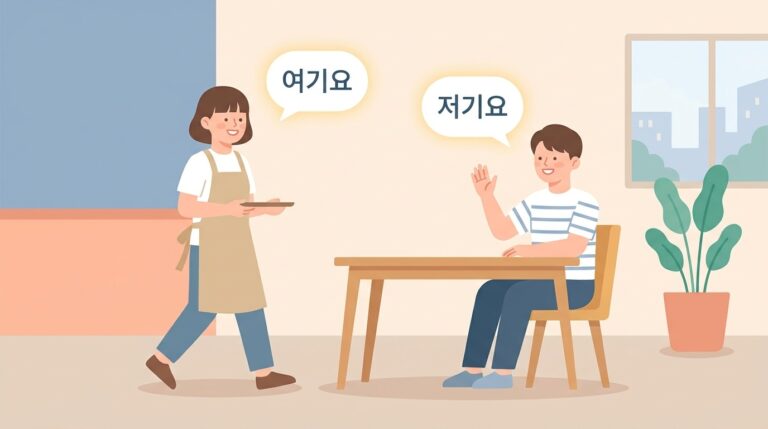
Picture this: You are sitting in a bustling, lively Korean BBQ restaurant in Seoul. The delicious smell of sizzling pork belly fills the air. You want to order another round of meat, but your server is rushing past. You open your mouth to call out, but you freeze. Should I say “Sillyehamnida”? Or is it “Jeogiyo”? Wait, did I hear someone else yell “Yeogiyo”?
If you’ve ever felt this restaurant stage fright, you are definitely not alone! This is one of the most common “pain points” our intermediate (B1) students share with us. Today, we are going to decode the micro-nuances of 저기요 (Jeogiyo) and 여기요 (Yeogiyo) so you can dine out like a true Seoul local!
Phase 2: Deep Dive into 3 Key Expressions
1. 저기요 (Jeogiyo)
- Pronunciation: Jeo-gi-yo (Sounds like “juh-ghee-yo“)
- Meaning: Literally “Over there, please” / Practical meaning: “Excuse me” (to get attention)
- K-Culture Moment: Think of your favorite romance K-drama. The female lead drops her glove, and the male lead picks it up, jogging after her while calling out, “저기요! (Jeogiyo!) You dropped this!”
- Editor’s Insight: This word is built from 저기 (jeogi), which means “over there” (away from both you and the listener). By adding the polite ending 요 (yo), you are gently calling out to someone who is physically or mentally in a different space than you. It is the absolute safest, most polite way to initiate contact with a stranger in public.
- Situation Spectrum: Casual ✅ / Semi-formal ✅ / Formal ⚠️
- 🤔 Think About It: In English, we say “Excuse me” to apologize for interrupting. In Korean, we use a spatial word (“over there”). Why do you think Korean uses spatial distance as a tool for politeness?
2. 여기요 (Yeogiyo)
- Pronunciation: Yeo-gi-yo (Sounds like “yuh-ghee-yo“)
- Meaning: Literally “Here, please” / Practical meaning: “Over here!” (to summon someone to your location)
- K-Culture Moment: You are in a crowded, noisy Pocha (street tavern). You need more pickled radish. You raise your hand confidently and say, “여기요! (Yeogiyo!)”
- Editor’s Insight: Derived from 여기 (yeogi), meaning “here.” When you say “Yeogiyo,” you are drawing the speaker’s attention directly to your current physical spot. It is incredibly efficient in busy service environments, essentially signaling: “My table needs assistance right here.”
- Situation Spectrum: Casual ✅ / Semi-formal ✅ / Formal ⚠️
- 🤔 Think About It: Calling “Here!” in a Western restaurant might sound slightly demanding. However, in Korea’s fast-paced service culture, it is viewed as helpful and direct. How does this reflect the different speeds of daily life?
3. 사장님 / 이모님 (Sajangnim / Imonim)
- Pronunciation: Sa-jang-nim (sah-jahng-neem) / I-mo-nim (ee-mo-neem)
- Meaning: “Mr./Ms. President (Owner)” / “Auntie”
- K-Culture Moment: In food alleyways, calling a middle-aged female restaurant owner “이모님! (Imonim!)” instantly melts the ice and often lands you free extra side dishes (서비스 – seobiseu).
- Editor’s Insight: Korean culture loves kinship terms. Calling a server “Auntie” (이모님) or “Store Owner” (사장님) treats them with high social respect or warm familial closeness. Use “Sajangnim” regardless of their actual role; it makes everyone feel respected!
- Situation Spectrum: Casual ✅ / Semi-formal ⚠️ / Formal 🚫
- 🤔 Think About It: How does calling a stranger “Auntie” change the dynamic of customer service compared to your home country?
Phase 3: Textbook Korean vs. Real-Life Korean
Let’s compare what dusty grammar books teach you versus what Koreans actually say in the wild!
Scenario 1: Getting a server’s attention
- 📖 Textbook Korean: “종업원분, 이리로 오십시오.” (Jongeobwonbun, iriro osipsio)
- Translation: “Worker, please come this way.”
- Why it’s weird: Nobody talks like this! It sounds incredibly robotic, overly dramatic, and slightly condescending.
- 🗣️ Real-Life Korean: “여기요~ 주문할게요!” (Yeogiyo~ jumunhalgeyo!)
- Translation: “Over here, please! We’d like to order!”
- 💡 Why it works: It’s warm, natural, and matches the fast-paced energy of Korean dining.
Scenario 2: Squeezing past people on a crowded subway
- 📖 Textbook Korean: “실례합니다, 제가 가야 합니다.” (Sillyehamnida, jega gaya hamnida)
- Translation: “Excuse me, I must go.”
- Why it’s weird: It sounds like you are delivering a formal speech in a historical drama.
- 🗣️ Real-Life Korean: “잠시만요~ 지나갈게요!” (Jamsimanyo~ jinagalgeyo!)
- Translation: “Just a moment, passing through!”
- 💡 Why it works: It’s incredibly polite but quick enough to keep the subway traffic moving smoothly.
Phase 4: K-Culture Deep Dive & Non-Verbal Manners
4-1. The Art of Nunchi & Gestures
Calling out is only 50% of the equation; the other 50% is your body language! When you want to call a server in Korea, never snap your fingers or whistle. This is considered highly disrespectful.
Instead, use your 눈치 (Nunchi – situational awareness). Wait until the server is not carrying a heavy tray of hot soup. Then, raise your hand halfway (elbow bent, palm open and facing down or slightly tilted toward them) while making eye contact and saying “저기요~” with a gentle rising intonation.
4-2. The “Ppalli-Ppalli” Food Culture
In Korea, food service is incredibly fast. Most casual restaurants will actually have a call bell (벨) installed right on the edge of the wooden table. If there’s a bell, you don’t even need to speak! Just press the bell (it will make a Ding-dong! sound) and wait. When the server arrives, you can simply say “여기요” as you point to the menu.
Phase 5: Interactive Roleplay Scenario
Let’s put you in a live scenario! You are at a legendary Korean BBQ spot called “Mapo Galbi” with your friends.
- Setting: A bustling, smoky restaurant filled with the aroma of charcoal and roasted meat.
- NPC Character: Min-ji (민지) – An energetic, super-friendly server wearing a red apron.
[Scene Start]

1. You: (Slightly raising your hand, smiling)
   "저기요, 여기 물 좀 더 주실 수 있나요?"
   (Jeogiyo, yeogi mul jom deo jusil su innayo? / Excuse me, could we get some more water here?)

2. Min-ji: (Nods warmly while holding a tray)
   "아, 네! 바로 갖다 드릴게요!"
   (Ah, ne! Baro gatda deurilgeyo! / Oh, yes! I'll bring it right away!)

3. You: (Grill starts smoking heavily)
   "저기요, 판 좀 갈아주시겠어요?"
   (Jeogiyo, pan jom garajusigessoyo? / Excuse me, could you change our grill plate?)

4. Min-ji: (Swiftly swapping the hot grill plate with tongs)
   "네, 지금 갈아드릴게요. 맛있게 드세요!"
   (Ne, jigeum garadeurilgeyo. Masitge deuseyo! / Yes, I'll swap it now. Enjoy your meal!)

5. You: (Wanting to order more meat)
   "여기요! 삼겹살 일인분 더 주세요!"
   (Yeogiyo! Samgyeopsal irinbun deo juseyo! / Over here! One more serving of pork belly, please!)

6. Min-ji: (Jotting it down on her pad)
   "네, 삼겹살 일 인분 추가요!"
   (Ne, samgyeopsal irinbun chugayo! / Got it, one more pork belly added!)

7. You: (Ready to wrap up the dinner)
   "저기요, 계산은 어디서 하나요?"
   (Jeogiyo, gyesaneun eodiseo hanayo? / Excuse me, where do we pay?)

8. Min-ji: (Points to the front counter)
   "계산은 입구 쪽 카운터에서 도와드릴게요!"
   (Gyesaneun ipgu jjok kaunteo-eseo dowadeurilgeyo! / I can help you pay at the counter near the entrance!)

[Scene End]
🔀 Choose Your Path!
What would you do if the restaurant is incredibly busy and the servers are running around?
* A) Wait silently for 20 minutes without saying a word.
* B) Wait for eye contact, raise your hand slightly, and call “저기요!”
* C) Stand up, snap your fingers, and shout “여기요!!!”
💡 Feedback on Your Choice:
- If you chose A (Bad): You will stay hungry! Korean service is responsive, but you have to initiate the contact. Don’t be shy!
- If you chose B (Best!): Perfect! This shows excellent nunchi and polite confidence. You’ll get your side dishes in no time.
- If you chose C (Risk): Oh no! Snapping your fingers is considered quite rude in Korea. You might get cold stares from neighboring tables!
Phase 6: 10-Second Emotion Shadowing Drill
To sound natural, you must master the correct intonation. Practice saying these aloud, paying attention to the pauses (/) and emotional cues!
- [😊 Friendly & Polite – Rising Tone]
“저기요~ / 물 좀 / 주세요!”
(Jeo-gi-yo~ / mul jom / ju-se-yo!)
Try to stretch the “요~” slightly to sound extra polite. -
[🙋 Confident & Energetic – Clear Tone]
“여기요! / 주문할게요!”
(Yeo-gi-yo! / ju-mun-hal-ge-yo!)
Say “여기요” with a clean, falling finish to grab attention in a noisy room.
Phase 7: K-Culture Mini Dictionary
- 벨 (Bel): The magic table bell. Found in casual dining spots to summon servers without shouting.
- 반찬 (Banchan): Korean side dishes. Most of these are unlimited and free to refill when you call out “여기요!”
- 서비스 (Seobiseu): Free items or treats given by the house as a gesture of hospitality.
- 계산 (Gyesan): The bill or payment. Always done at the front counter when leaving, rather than at the table.
Phase 8: Traveler’s Survival Kit
Survival Expressions TOP 3
- “저기요, 메뉴판 좀 주세요.” (Jeogiyo, menyupan jom juseyo.)
- Pro Tip: Use this to get both the server’s attention and the menu at the same time.
- “여기요, 이거 더 주세요.” (Yeogiyo, igeo deo juseyo.)
- Pro Tip: Point to any empty side dish plate while saying this to get an instant refill.
- “저기요, 화장실 어디예요?” (Jeogiyo, hwajangsil eodiyeyo?)
- Pro Tip: Essential for finding the restroom in public spaces or restaurants.
✈️ Editor’s Travel Note
When navigating streets or looking for top-rated local dining spots, avoid global mapping apps which can be outdated in Korea. Instead, install the Naver Map App for the most accurate, real-time walking and transit paths. Also, remember that tipping is not practiced in South Korea; a polite “감사합니다” (Gamsahamnida) as you leave is the best way to show your appreciation!
Phase 9: One Step Deeper (Reflective Essay)
In Western cultures, language often isolates the individual—we use pronouns like “you” or “he/she.” In Korea, however, language is deeply relational and spatial. By addressing strangers through terms like “over there” (저기요) or using family titles like “Auntie” (이모님), Korean society actively softens the boundary between “me” and “strangers.” It turns a transaction into a connection.
💬 Your Turn: How do people get a server’s attention in your culture? Is it quiet, loud, or do you use specific titles? Let us know in the comments below!
Phase 10: FAQ & Common Mistakes
Q: Can I call a young female server “이모님” (Imonim)?
A: It is best not to! “Imonim” is reserved for middle-aged women. Calling a younger server “Imonim” might make them feel older than they are. For younger staff, stick to “저기요” or a polite “사장님.”
Q: Is “여기요” ruder than “저기요”?
A: Not at all! They simply have different functions. “저기요” is great for initiating first contact or getting past someone, while “여기요” is perfect for calling someone to your physical table.
Q: Can I use “저기요” to apologize if I bump into someone?
A: No, “저기요” is only used to get someone’s attention. If you bump into someone, say “죄송합니다” (Joesonghamnida – I’m sorry) or “죄송해요” (Joesonghaeyo).
🚨 Common Mistakes Warning Panel
- Mistake 1: Yelling “야! (Ya!)” or “너! (Neo!)” to get attention.
- Correct Action: These mean “Hey!” and “You!” and are incredibly rude to strangers. Always use “저기요!”
- Mistake 2: Calling a young woman “아줌마 (Ajumma)”.
- Correct Action: “Ajumma” (middle-aged married woman) can sometimes sound insulting. Use “사장님” instead.
- Mistake 3: Snapping fingers or waving hands frantically.
- Correct Action: Keep your hand raised slightly at chest level with a friendly smile.
Phase 11: Action Mission & Engagement
- 🥉 Bronze Mission: Practice pronouncing “저기요” and “여기요” 5 times in front of the mirror with a polite smile.
- 🥈 Silver Mission: Share this post on your social media and tell your friends which expression you find easier to pronounce!
- 🥇 Gold Mission: Next time you visit a Korean restaurant or store in your town, use “저기요” to call the cashier or server!
🎮 K-Culture Mission
Watch one episode of a K-drama today and try to spot how many times characters say “저기요!” Write down the scene in the comments!
Phase 12: Interactive Quiz Challenge
Test your knowledge before you go!
Q1. You want to ask a stranger on the street for directions. What do you say?
a) 여기요!
b) 저기요!
c) 아줌마!
Click to see the correct answer and explanation!
Correct Answer: b) 저기요!
Since you are getting the attention of a stranger who is away from your personal space,







