Master the Convenience Store Checkout: How to Say ‘Yes’ or ‘No’ to Bags in Korean!
Phase 1: Oh No, Checkout Panic! 🛍️
안녕하세요! (An-nyeong-ha-se-yo!) Your favorite Daily Hangul Editor and local culture navigator is back!
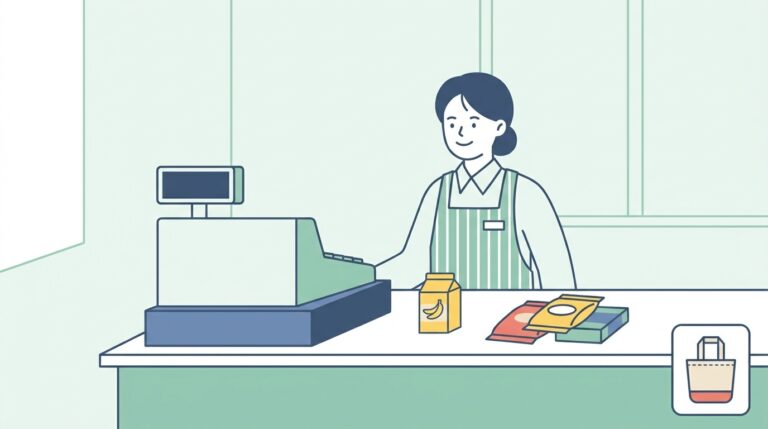
Picture this: You just had the most amazing evening strolling through the neon-lit streets of Hongdae. You pop into a local GS25 convenience store to grab some late-night snacks—maybe some spicy fire noodles, a sweet banana milk, and a bag of honey butter chips. You place your treasures on the counter, ready to pay. The clerk rings them up, looks at you, and asks a fast, rhythmic question:
“Bong-tu piryohaseyo?” (봉투 필요하세요?)
Suddenly, your mind goes blank. You know bongtu means bag, but how do you say “Yes, please” or “No, I’m okay” without sounding like a robot or accidentally starting a staring contest?
Don’t worry! This is one of the most common “mini-boss battles” our actual students face when they first arrive in Korea. Today, we’re going to give you the exact Cheat Codes to breeze through the checkout line like a true Seoulite.
Phase 2: The Big 3 Checkout Expressions 🗣️
Let’s break down the three most important phrases you’ll hear and use at the register. Keep in mind: in Korea, plastic bags carry a small fee (usually 50 to 100 KRW) by law to protect the environment. Here is how to navigate it!
1. “봉투 필요하세요?” (Bong-tu pi-ryo-ha-se-yo?)
- Pronunciation: Bong-too pee-ryoh-hah-seh-yo? (Sounds like “Bong-too” + “period” but with an “h” sound!)
- Meaning: “Do you need a bag?”
- K-Culture Moment: You’ll hear this in literally every single K-drama scene where a character buys something—from Crash Landing on You to Our Beloved Summer!
- Editor’s Insight: The word “필요 (pi-ryo)” means “need.” Because Korean is a high-context language, they drop the pronoun “you.” They are politely asking, “Is a bag needed?”
- Situation Spectrum:
- Casual: 🚫 (Don’t say this to clerks as a customer; it’s what they ask you!)
- Semi-formal: ✅
- Formal: ✅
- 🤔 Think About It: In your home country, do stores automatically give you plastic bags, or do they charge for them too? How does language reflect a society’s changing laws?
2. “봉투 하나 주세요.” (Bong-tu ha-na ju-se-yo.)
- Pronunciation: Bong-too ha-nah Joo-seh-yo.
- Meaning: “Please give me one bag.”
- K-Culture Moment: Use this when you bought way too many cups of instant Tteokbokki and need a safe way to carry them back to your Airbnb.
- Editor’s Insight: “주세요 (ju-se-yo)” is the magic word in Korea for “please give me.” “하나 (ha-na)” is the native Korean word for “one.”
- Situation Spectrum:
- Casual: ⚠️ (Only with close friends)
- Semi-formal: ✅ (Perfect for clerks!)
- Formal: ✅
- 🤔 Think About It: Why do you think Korean uses different number systems? “하나 (ha-na)” is used for counting physical items like bags!
3. “괜찮아요, 그냥 가져갈게요.” (Gwen-chan-a-yo, geu-nyang ga-jeo-gal-ge-yo.)
- Pronunciation: Gwen-chahn-ah-yo, guh-nyahng gah-juh-gahl-geh-yo. (Blend “gwen-chahn-ah” smoothly!)
- Meaning: “No thanks, I’ll just carry it.”
- K-Culture Moment: Perfect when you just bought a single milk carton or can of coffee that easily fits in your hand or pocket.
- Editor’s Insight: “괜찮아요 (gwen-chan-a-yo)” means “It’s okay/No thank you.” “그냥 (geu-nyang)” means “just,” and “가져갈게요 (ga-jeo-gal-ge-yo)” means “I will take it/carry it.”
- Situation Spectrum:
- Casual: 🚫 (Too informal for a shop worker)
- Semi-formal: ✅ (Extremely polite and natural)
- Formal: ✅
- 🤔 Think About It: Why does saying “It’s okay” sound softer and more polite than a flat “No” in both Korean and English?
Phase 3: Textbook Korean vs. Real-Life Korean 📖 vs 🗣️
Many textbooks teach you stiff, overly formal grammar. Let’s see how real people actually talk!
Situation 1: Declining a bag
- 📖 Textbook Korean: “아니요, 봉투가 필요하지 않습니다.” (An-ni-yo, bong-tu-ga pi-ryo-ha-ji an-seub-ni-da.)
- Why it’s stiff: This sounds like a robot reading a legal contract!
- 🗣️ 진짜 (Real) Korean: “아니요, 괜찮아요!” (An-ni-yo, gwen-chan-ah-yo!)
- 💡 Why it’s different: It’s short, warm, and highly natural for daily interactions.
Situation 2: Asking for a bag at the start
- 📖 Textbook Korean: “봉투를 저에게 주십시오.” (Bong-tu-reul jeo-e-ge ju-sip-si-o.)
- Why it’s stiff: Super historical drama vibes. Don’t sound like a Joseon Dynasty king buying chips!
- 🗣️ 진짜 (Real) Korean: “봉투 하나만 주세요.” (Bong-tu ha-na-man ju-se-yo.)
- 💡 Why it’s different: Adding “만 (man)” (only/just) softens the request to sound like “Just one bag, please.”
Phase 4: K-Culture Deep Dive & Non-Verbal Manners 🌍
4-1. The Art of
Frequently Asked Questions (FAQ)
Q: What does ""봉투 필요하세요?" (Bong-tu pi-ryo-ha-se-yo?)" mean in Korean and how do you pronounce it?
A: In Korean, ""봉투 필요하세요?" (Bong-tu pi-ryo-ha-se-yo?)" is pronounced [Bong-too pee-ryoh-hah-seh-yo? (Sounds like "Bong-too" + "period" but with an "h" sound!] and means: "Do you need a bag?"
Q: What does ""봉투 하나 주세요." (Bong-tu ha-na ju-se-yo.)" mean in Korean and how do you pronounce it?
A: In Korean, ""봉투 하나 주세요." (Bong-tu ha-na ju-se-yo.)" is pronounced [Bong-too ha-nah Joo-seh-yo.] and means: "Please give me one bag."
Q: What does ""괜찮아요, 그냥 가져갈게요." (Gwen-chan-a-yo, geu-nyang ga-jeo-gal-ge-yo.)" mean in Korean and how do you pronounce it?
A: In Korean, ""괜찮아요, 그냥 가져갈게요." (Gwen-chan-a-yo, geu-nyang ga-jeo-gal-ge-yo.)" is pronounced [Gwen-chahn-ah-yo, guh-nyahng gah-juh-gahl-geh-yo. (Blend "gwen-chahn-ah" smoothly!] and means: "No thanks, I'll just carry it."