

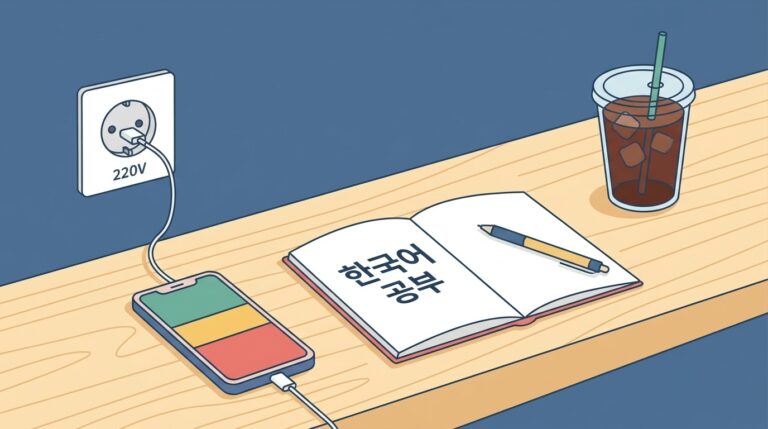
Save Your Battery! How to Plug in Your Phone Charger in Korea Like a Local
Phase 1: Empathy (The 3% Battery Panic in Seoul!)
안녕하세요! (An-nyeong-ha-se-yo!) Hello! It’s your Korean bestie and Daily Hangul’s Lead Editor here.
Imagine this: You are sitting in a gorgeous, Instagram-worthy Hanok cafe in Ikseon-dong, Seoul. You’ve been taking gorgeous photos all day. Suddenly, your screen flashes red: 3% battery remaining. Your T-money transit map, your Google translate, and your way back to the hotel are all on that dying phone!
You look around. You see an electrical outlet on the wall, and you have your charger in your bag. But how do you ask the staff if it’s okay to plug it in? Saying nothing might feel rude, and gesturing wildly can be awkward.
Don’t worry! Today, we are learning the absolute essential, survival-level Korean for “plugging in a charger” (충전기 꽂다). This guide is based on real questions from our A1 beginner students who survived their first trip to Seoul. By the end of this post, you’ll be charging your phone with confidence and local flair!
Phase 2: Core Expressions Deep Dive
Let’s look at the three most crucial phrases you need to plug in and power up!
1. 충전기 꽂다 (Chung-jeon-gi kkot-da)
- Pronunciation: Choong-jeon-gee kkot-da (Sounds like “choong” as in “choose” + “jeon” as in “junction” + “gee” + “kkot” as in the English word “coat” with a sharp ending + “da”).
- Meaning: To plug in a charger.
- K-Culture Moment: You will hear this in K-dramas when characters are working in cafes or offices, looking for a spot to plug in their laptops.
- Editor’s Insight: 충전기 means “charger” and 꽂다 means “to plug in” or “to insert”. In Korean, we don’t say “put in the charger,” we specifically use the verb 꽂다 (to insert/plug in).
- Situation Spectrum: Casual ✅ | Semi-formal ⚠️ | Formal 🚫 (This is the dictionary/base form. We need to conjugate it for real life!)
- 🤔 Think About It: In English, we “plug in” a charger. In Korean, we “insert” (꽂다) it. Think about how physically inserting something securely is represented by this strong, sharp sound kkot!
2. 여기 충전기 꽂아도 돼요? (Yeo-gi chung-jeon-gi kko-ja-do dwae-yo?)
- Pronunciation: Yuh-ghee choong-jeon-gee kko-jah-doh dweh-yo?
- Meaning: Can I plug my charger in here?
- K-Culture Moment: The polite way to ask a cafe barista or a restaurant owner before using their wall outlet.
- Editor’s Insight: This uses the grammar pattern -아/어도 돼요? which means “Is it okay to do…?” It is extremely polite and friendly for daily use.
- Situation Spectrum: Casual ✅ | Semi-formal ✅ | Formal ⚠️
- 🤔 Think About It: Why do Koreans ask permission even if the outlet is right next to their seat? It shows respect for the shop’s property, and it’s a sweet way to start a brief, warm interaction!
3. 충전 좀 해주실 수 있어요? (Chung-jeon jom hae-ju-sil su isseo-yo?)
- Pronunciation: Choong-jeon johm hae-joo-sil soo ees-suh-yo?
- Meaning: Could you charge this for me?
- K-Culture Moment: In many traditional Korean restaurants or bars, outlets aren’t near the tables. Instead, you hand your phone to the staff at the counter, and they charge it behind the desk for free!
- Editor’s Insight: 좀 (jom) means “a little” or “please”—it softens your request to make you sound super polite and natural.
- Situation Spectrum: Casual ⚠️ | Semi-formal ✅ | Formal ✅
- 🤔 Think About It: Handing your expensive phone to a stranger behind a counter to charge it might feel scary back home, but in Korea, it is incredibly common and safe!
Phase 3: Textbook Korean vs. Real Korean
Let’s compare what dusty grammar books teach you versus what Koreans actually say in real life.
Situation 1: Asking to plug in your charger near your table
- 📖 Textbook: “제가 여기에 충전기를 꽂아도 되겠습니까?” (Je-ga yeo-gi-e chung-jeon-gi-reul kko-ja-do doe-gess-seup-ni-ka?)
- Why it’s weird: It sounds like you are requesting formal permission from a military general!
- 🗣️ Real Korean: “여기 꽂아도 돼요?” (Yeo-gi kko-ja-do dwae-yo?)
- 💡 Why it’s better: Short, sweet, and perfectly natural for an A1 learner. Baristas will instantly understand and smile.
Situation 2: Asking the staff to charge your phone behind the counter
- 📖 Textbook: “휴대전화의 배터리를 충전해 주십시오.” (Hyu-dae-jeon-hwa-ui bae-teo-ri-reul chung-jeon-hae ju-sip-si-o.)
- Why it’s weird: Way too long and mechanical. It sounds like a robot manual.
- 🗣️ Real Korean: “충전 좀 부탁드려요!” (Chung-jeon jom bu-tak-deu-ryeo-yo!)
- 💡 Why it’s better: Literally translates to “Charging, please!” It’s polite and highly efficient.
Phase 4: K-Culture Deep Dive & Non-Verbal Manners
4-1. The “Charger” Gesture & Eye Contact
When asking to plug in, hold up your charger slightly with both hands (or a slight head nod). Showing the physical object makes it 100% clear what you need, even if your pronunciation isn’t perfect yet!
When handing your phone to a barista to charge behind the counter, always hand it over with both hands. Using two hands to give or receive items is one of the most important polite gestures in Korean culture!
4-2. Korea’s Amazing Cafe Charging Culture
In Korea, cafe culture is next-level. Many cafes have dedicated seating with built-in outlets (콘센트 – kon-sen-teu). However, some small, aesthetic cafes might block them or not have them available to encourage faster table turnover. Always look around for a “콘센트” first, and if you see one, ask politely using the phrases we learned!
Phase 5: Real-Life Roleplay Scenario
Let’s practice! You are at a trendy cafe in Hongdae. Your phone is at 5%. You walk up to the friendly barista, Min-ji.
Characters:
* 민지 (Min-ji): The warm, helpful cafe barista.
* You (The eager learner)
1. You: (Smiling warmly) 저기요, 혹시 여기 충전기 꽂아도 돼요?
   (Jeo-gi-yo, hok-si yeo-gi chung-jeon-gi kko-ja-do dwae-yo?)
   "Excuse me, by any chance, can I plug my charger in here?"

2. 민지: 아, 네! 저기 테이블 밑에 콘센트 있어요. 편하게 쓰세요.
   (Ah, ne! Jeo-gi te-i-beul mit-e kon-sen-teu is-seo-yo. Pyeon-ha-ge sseu-se-yo.)
   "Oh, yes! There is an outlet under that table. Please feel free to use it."

3. You: 앗, 제 충전기 줄이 너무 짧아서 안 닿아요...
   (At, je chung-jeon-gi jul-i neo-mu jjal-ba-seo an da-ha-yo...)
   "Ah, my charger cable is too short, so it doesn't reach..."

4. 민지: 아, 정말요? 그러면 저한테 주시면 카운터에서 충전해 드릴게요!
   (Ah, jeong-mal-yo? Geu-reo-myeon jeo-han-te ju-si-myeon ka-un-teo-e-seo chung-jeon-hae deu-ril-ge-yo!)
   "Oh, really? In that case, if you give it to me, I’ll charge it for you at the counter!"

5. You: (Handing over your phone and cable with both hands) 와, 정말 감사합니다! 여기요.
   (Wa, jeong-mal gam-sa-hap-ni-da! Yeo-gi-yo.)
   "Wow, thank you so much! Here it is."

6. 민지: 네, 완료되면 말씀해 주세요!
   (Ne, wan-ryo-doe-myeon mal-sseum-hae ju-se-yo!)
   "Sure, just let me know when you want it back!"

7. You: (After 30 minutes, walking back to the counter) 저기요, 제 핸드폰 좀 받을 수 있을까요?
   (Jeo-gi-yo, je haen-deu-pon jom ba-deul su is-seul-kka-yo?)
   "Excuse me, could I get my phone back?"

8. 민지: (Handing the phone back with both hands) 여기 있습니다! 충전 다 됐어요.
   (Yeo-gi is-seup-ni-da! Chung-jeon da dwaes-seo-yo.)
   "Here you go! It's fully charged."
🔀 Interactive Choice Point!
What should you say to Min-ji as you receive your fully charged phone?
- A. “고마워!” (Go-ma-wo!)
- B. “정말 감사합니다. 좋은 하루 보내세요!” (Jeong-mal gam-sa-hap-ni-da. Jo-eun ha-ru bo-nae-se-yo!)
- C. “충전기 주세요.” (Chung-jeon-gi ju-se-yo.)
Feedback:
- Selection A (Bad): “고마워” is informal (반말). Even though you are friendly, saying this to a staff member is too casual and might sound slightly rude.
- Selection B (Best!): Perfect! It means “Thank you so much. Have a nice day!” in polite, warm Korean. Min-ji’s day will be made!
- Selection C (Risk): “Give me my charger.” It sounds too demanding and direct. Try to avoid this!
Phase 6: 10-Second Emotion Shadowing Drill
Speak like a true local by adding emotion to your words. Pause at the slashes (/).
- [🥺 Looking desperate and hopeful]
“여기… / 혹시 / 충전기 / 꽂아도 / 돼요?”
(Yeo-gi… / hok-si / chung-jeon-gi / kko-ja-do / dwae-yo?) -
[😊 Filled with gratitude]
“와! / 정말 / 감사합니다!”
(Wa! / jeong-mal / gam-sa-hap-ni-da!)
Phase 7: K-Culture Mini Dictionary
| Korean Word | Pronunciation | English Meaning | Local Culture Context |
|---|---|---|---|
| 충전기 | Chung-jeon-gi | Charger | In Korea, asking for a “C-type” (C타입) or “8-pin” (8핀 – iPhone) charger is common. |
| 콘센트 | Kon-sen-teu | Power outlet | Derived from “concentric plug.” Do not say “outlet”; locals say “콘센트”! |
| 보조배터리 | Bo-jo bae-teo-ri | Power bank / Portable battery | Essential for travelers. You can rent them at many subway stations and convenience stores! |
| 와이파이 | Wa-i-pa-i | Wi-Fi | Cafes usually print the Wi-Fi password on the receipt or near the pickup counter. |
Phase 8: Traveler’s Survival Kit
Survival Phrases TOP 3
- 혹시 충전기 있어요? (Hok-si chung-jeon-gi is-seo-yo?)
- “Do you happen to have a charger?” (If you forgot yours!)
- 와이파이 비밀번호가 뭐예요? (Wa-i-pa-i bi-mil-beon-ho-ga mwo-yeo-yo?)
- “What is the Wi-Fi password?”
- C타입 충전기 빌릴 수 있을까요? (C-ta-ip chung-jeon-gi bil-ril su is-seul-kka-yo?)
- “Can I borrow a USB-C charger?”
Editor’s Travel Note ✈️
To find cafes that are laptop-friendly and have plenty of plugs, download the Naver Map App (the ultimate navigation tool in Korea). Search for “노트북 하기 좋은 카페” (Cafes good for laptop use) or look at photos of the seating to spot outlets!
(Note: App features and layouts can be updated by providers over time.)
Phase 9:
Frequently Asked Questions (FAQ)
Q: What does "충전기 꽂다 (Chung-jeon-gi kkot-da)" mean in Korean and how do you pronounce it?
A: In Korean, "충전기 꽂다 (Chung-jeon-gi kkot-da)" is pronounced [Choong-jeon-gee kkot-da (Sounds like "choong" as in "choose" + "jeon" as in "junction" + "gee" + "kkot" as in the English word "coat" with a sharp ending + "da"] and means: To plug in a charger.
Q: What does "여기 충전기 꽂아도 돼요? (Yeo-gi chung-jeon-gi kko-ja-do dwae-yo?)" mean in Korean and how do you pronounce it?
A: In Korean, "여기 충전기 꽂아도 돼요? (Yeo-gi chung-jeon-gi kko-ja-do dwae-yo?)" is pronounced [Yuh-ghee choong-jeon-gee kko-jah-doh dweh-yo?] and means: Can I plug my charger in here?
Q: What does "충전 좀 해주실 수 있어요? (Chung-jeon jom hae-ju-sil su isseo-yo?)" mean in Korean and how do you pronounce it?
A: In Korean, "충전 좀 해주실 수 있어요? (Chung-jeon jom hae-ju-sil su isseo-yo?)" is pronounced [Choong-jeon johm hae-joo-sil soo ees-suh-yo?] and means: Could you charge this for me?







