

Cast Your Line Safely: Master Korea’s Fishing Rules and Avoid Heavy Fines Like a Pro
Phase 1: Empathy (스토리 몰입형 오프닝)
안녕하세요! Hello, my dear Daily Hangul family! It’s your favorite Chief Editor and local culture guide here. Have you ever dreamed of sitting by the peaceful Han River (한강) at sunset, casting a line, and waiting for that thrilling tug of a fish? 🌅
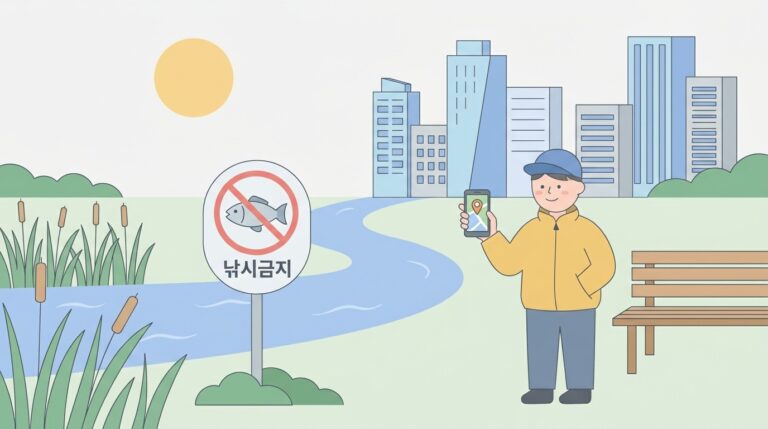
Fishing (낚시 – nak-si) has become an absolute sensation in South Korea over the last few years. However, before you pack your tackle box and head out, there’s a crucial legal and cultural reality you must know: Korea has very strict environmental regulations regarding designated No-Fishing Zones (낚시 금지 구역).
Just last month, one of our intermediate learners, Alex, went to a beautiful stream in Gyeonggi-do. He set up his gear, feeling excited, only to be approached by a local district officer who pointed at a faded yellow sign. Alex almost faced a whopping 3 million KRW ($2,200 USD) administrative fine! He told me, “I knew the word for fishing, but I didn’t understand the warning signs or how to explain myself to the officer!”
Don’t worry, Alex got off with a warning after packing up immediately—but we don’t want you to rely on luck! Today, we’ll dive deep into intermediate-level Korean expressions about fishing restrictions, civil fines, and the cultural nuances that will keep you safe, respectful, and speaking like a true local angler.
Phase 2: Core Expressions Deep-Dive (핵심 표현 3선 심층 분석)
Let’s master three highly essential, intermediate-level expressions that will protect your wallet and boost your conversational flow.
1. 낚시 금지 구역 (Naksi Geumji Guyeok)
- Pronunciation: nak-si geum-ji gu-yeok (sounds like “knock-see gum-jee goo-yuck”)
- Meaning: No-Fishing Zone (Restricted Fishing Area)
- K-Culture Moment: You’ll see this bold red-and-yellow text on metal signs posted near ecological recovery zones along the Han River or delicate mountain streams in K-Dramas.
- Editor’s Insight: While ‘금지’ (geum-ji) means prohibition, ‘구역’ (gu-yeok) refers to a designated zone or district. If you see this sign, pack your gear immediately. There are also ‘낚시 제한 구역’ (Restricted Fishing Zones), where you can fish but only under specific rules (e.g., no live bait, limit of one rod).
- Situation Spectrum: Casual ✅ | Semi-formal ✅ | Formal ✅
- 🤔 Think About It: How does your home country label areas where fishing or hunting is restricted? Is it a recommendation or a strict legal zone?
2. 과태료를 물다 (Gwa-tae-ryo-reul mul-da)
- Pronunciation: gwa-tae-ryo-reul mool-da (sounds like “gwah-teh-ryoh-reul mool-dah”)
- Meaning: To pay/be hit with an administrative fine (civil penalty)
- K-Culture Moment: On popular Korean lifestyle variety shows like I Live Alone (나 혼자 산다), celebrities often get playfully teased or worried when they make minor public mistakes that could lead to “과태료를 물다.”
- Editor’s Insight: In Korean, ‘물다’ (mul-da) literally means “to bite.” However, in a financial context, it means “to pay up/compensate for a mistake or loss.” Note that ‘과태료’ is an administrative fine for civil violations, whereas ‘벌금’ (beol-geum) is a criminal fine.
- Situation Spectrum: Casual ✅ | Semi-formal ✅ | Formal ⚠️ (In highly formal contexts, use the verb ‘납부하다’ – to pay/settle a fine)
- 🤔 Think About It: Why do you think the verb “to bite” (물다) is used for paying a fine? Does your native language use physical action verbs to describe losing money?
3. 손맛을 보다 (Son-maseul boda)
- Pronunciation: son-ma-seul bo-da (sounds like “sohn-mah-seul boh-dah”)
- Meaning: Literally “to taste/experience the hand-taste” ➔ to feel the thrilling vibration and pull of a fish on your line.
- K-Culture Moment: This is the most famous catchphrase from the legendary Korean fishing variety show The Fishermen and the City (도시어부). Whenever someone hooks a big one, they yell about the incredible ‘손맛’!
- Editor’s Insight: Koreans love using the word ‘맛’ (taste/flavor) metaphorically. ‘손맛’ can refer to a grandmother’s touch in delicious cooking, or in this case, the tactile thrill of reeling in a fish. It’s a great intermediate idiom to show you really understand local hobby culture.
- Situation Spectrum: Casual ✅ | Semi-formal ✅ | Formal 🚫
- 🤔 Think About It: What sensory metaphor does your native language use to describe the excitement or satisfaction of a successful hobby?
Phase 3: Textbook Korean vs. Real Korean (교과서 한국어 vs 진짜 한국어)
Let’s bridge the gap between dry classroom grammar and the lively, natural language used on the riverbanks.
Situation 1: Asking if fishing is permitted in a certain spot
- 📖 Textbook: “여기서 낚시를 해도 됩니까?” (Yeogiseo naksireul haedo doemnikka? / “Is it permissible to engage in fishing activities here?”)
- 🗣️ Real Korean: “여기 낚시 던져도 돼요?” (Yeogi naksi deonjyeodo dwaeyo? / “Can I cast a line here?”)
- 💡 Why the difference? The textbook sentence is too rigid and formal. Local anglers use the verb ‘던지다’ (deon-ji-da – to throw/cast) to refer to casting their lines. It sounds incredibly natural and instantly builds rapport with locals.
Situation 2: Warning a friend about the consequences of fishing in a banned zone
- 📖 Textbook: “이곳에서 낚시를 하면 벌금을 냅니다.” (Igoseseo naksireul hamyeon beolgeumeul naemnida. / “If you fish in this place, you will pay a fine.”)
- 🗣️ Real Korean: “여기서 낚시하다 걸리면 과태료 장난 아니에요.” (Yeogiseo naksihada geollyeomeon gwa-tae-ryo jangnan anieyo. / “If you get caught fishing here, the fine is no joke.”)
- 💡 Why the difference? Real-life Korean utilizes grammar like ‘-다가 걸리다’ (to get caught in the middle of doing something) and the common conversational intensifier ‘장난 아니다’ (to be no joke/incredible) to emphasize danger and severity.
Phase 4: K-Culture Deep-Dive & Non-verbal Manners (K-Culture 딥다이브)
4-1. The Art of ‘Nunchi’ (눈치) on the Water
In Korea, fishing isn’t just a quiet solo sport; it’s a shared social ecosystem. If you are exploring a potential spot, use your Nunchi (눈치 – situational quick-wittedness). Look at what other anglers are doing.
* Non-verbal Signposts: Yellow flags or ropes along the water signify protected fish spawning areas.
* The “Bowing” Culture: If a local angler (낚시 아저씨 – Naksi Ajeossi) approaches you, a polite 15-degree bow accompanied by “안녕하세요!” (An-nyeong-ha-se-yo!) instantly establishes you as a respectful guest. If you are accidentally in a bad spot, they will likely warn you kindly before the municipal rangers arrive.
4-2. The “Urban Angler” (도시어부) Phenomenon
Historically, fishing in Korea was seen as a hobby for middle-aged men sitting quietly by reservoirs. However, with the massive success of TV shows like The Fishermen and the City (도시어부), fishing has undergone a major rebrand! It is now a trendy, highly social hobby among millennials and Gen Z. Many young Koreans practice ‘짬낚’ (jjam-nak – squeezing in a quick fishing session during work breaks or weekends) along the Han River, making understanding urban fishing zones more critical than ever.
Phase 5: Real-Life Roleplay Scenario (실전 롤플레이 시나리오)
Setting: Mangwon Han River Park (망원한강공원). Chris, an eager expat angler, is unpacking his rod. Mr. Kang (강 아저씨), a seasoned local angler, walks by and spots him casting near an ecological zone.
1. 강 아저씨: (황급히 다가오며 손사래를 친다) 아이고, 총각! 여기 낚시 던지면 안 돼요!
             (Aigo, chong-gak! Yeogi naksi deon-jyeo-myeon an dwaeyo!)
             "Oh, young man! You can't cast your line here!"

2. 크리스:   (깜짝 놀라며) 네? 아, 안녕하세요! 여기 낚시 금지 구역인가요?
             (Ne? Ah, an-nyeong-ha-se-yo! Yeogi naksi geum-ji gu-yeok-in-ga-yo?)
             "Huh? Oh, hello! Is this a No-Fishing Zone?"

3. 강 아저씨: (빨간 안내판을 가리키며) 그래요. 저기 표지판 보이죠? 여기서 던지다 걸리면 과태료 물어야 해요.
             (Geu-rae-yo. Jeo-gi pyo-ji-pan bo-i-jyo? Yeo-gi-seo deon-ji-da geol-ri-myeon gwa-tae-ryo mool-eo-ya hae-yo.)
             "Yes. See that sign over there? If you get caught casting here, you have to pay a fine."

4. 크리스:   (가슴을 쓸어내리며) 아, 정말요? 알려주셔서 감사해요. 벌금이 얼마인데요?
             (Ah, jeong-mal-yo? Al-려-ju-shyeo-seo gam-sa-hae-yo. Beol-geum-i eol-ma-in-dae-yo?)
             "Ah, really? Thank you for letting me know. How much is the fine?"

5. 강 아저씨: (손가락 세 개를 펴며) 처음 걸려도 한 삼십만 원 나와요. 세 번 걸리면 삼백만 원이에요!
             (Cheo-eum geol-ryeo-do han sam-ship-man won na-wa-yo. Se beon geol-ryeo-myeon sam-baek-man won-i-e-yo!)
             "Even for the first offense, it's about 300,000 KRW. Three strikes, and it's 3,000,000 KRW!"

6. 크리스:   (당황하며 낚싯대를 접는다) 헉, 장난 아니네요. 바로 접을게요. 혹시 낚시 가능한 구역은 어디에 있나요?
             (Heok, jang-nan a-ni-ne-yo. Ba-ro jeob-eul-ge-yo. Hok-shi nak-si ga-neung-han gu-yeok-eun eo-di-e in-na-yo?)
             "Gasp, that's no joke. I'll pack up right away. By any chance, where is a zone where fishing is allowed?"

7. 강 아저씨: (미소를 지으며 저 멀리 다리 아래를 가리킨다) 저기 성산대교 아래쪽은 괜찮아요. 거기는 손맛 좀 볼 수 있을 거예요.
             (Jeo-gi Seong-san-dae-gyo a-rae-jjok-eun gwaen-chan-ha-yo. Geo-gi-neun son-mat jom bol su is-seul geo-ye-yo.)
             "Under the Seongsan Bridge over there is fine. You might be able to feel some good tugs (taste the hand-taste) there."

8. 크리스:   (고개를 숙여 인사하며) 좋은 정보 정말 감사합니다! 저쪽으로 가볼게요.
             (Jo-eun jeong-bo jeong-mal gam-sa-ham-ni-da! Jeo-jjok-eu-ro ga-bol-ge-yo.)
             "Thank you so much for the great info! I'll head over that way."
🔀 Interactive Choice Points (인터랙티브 분기점)
If the officer approaches you instead of a friendly Ajeossi, how should you react?
* Choice A: “외국인이라 법을 잘 몰랐어요!” (I didn’t know the law because I’m a foreigner!)
* 🚫 Bad: While officers may sometimes be lenient, playing the “ignorant foreigner” card too aggressively can come across as disrespectful of local laws.
* Choice B: “몰라뵀습니다. 몰라서 그랬는데 바로 정리하겠습니다! 죄송합니다.” (I didn’t recognize the rule. I did it out of ignorance, but I will pack up immediately! I’m sorry.)
* 🏆 Best: Polite, accountable, and proactive. Showing immediate cooperation (정리하다) is the best way to get a formal warning instead of an official ticket.
* Choice C: “다른 사람들도 다 여기서 하던데요?” (But everyone else was fishing here too?)
* ⚠️ Risk: Extremely risky! Pointing fingers at other anglers (who might actually be in a slightly different legal zone) will likely frustrate the officer and guarantee you a fine.
Phase 6: 10-Second Emotion Shadowing Drill (10초 감정 섀도잉 드릴)
To master natural Korean flow, practice mimicking the stress and emotional weight of these phrases. Try pronouncing the slashes (/) as brief, natural pauses.
- [😰 Shocked & Anxious]
- Sentence: 여기서 / 낚시하다가 / 걸리면 / 과태료 / 장난 아니에요!
- Romanization: Yeo-gi-seo / nak-si-ha-da-ga / geol-ri-myeon / gwa-tae-ryo / jang-nan a-ni-e-yo!
- Key Point: Stress the word 장난 아니에요 (jang-nan a-ni-e-yo) by lowering your pitch slightly to emphasize seriousness.
- [🤩 Excited & Hopeful]
- Sentence: 오늘 / 드디어 / 엄청 큰 놈으로 / 손맛 좀 / 봤어요!
- Romanization: O-neul / deu-di-eo / eom-cheong keun nom-eu-ro / son-mat jom / bwas-seo-yo!
- Key Point: Raise the pitch on 손맛 (son-mat) to convey the sheer joy of catching a massive fish.
Phase 7: K-Culture Mini Dictionary (핵심 키워드 미니 사전)
| Word (Korean + Romanization) | English Translation | Real-Life Usage Note |
|---|---|---|
| 입질 (Ip-jil) | A nibble / bite | Used when you feel the fish biting. “드디어 입질이 온다!” (Finally, I got a bite!) |
| 짬낚 (Jjam-nak) | Quick/Snack fishing | Short for ‘짬나는 시간에 하는 낚시’ (fishing in spare moments). A super trendy slang word. |
| 과태료 vs 벌금 (Gwa-tae-ryo vs Beol-geum) | Administrative Fine vs Criminal Fine | ‘과태료’ is for administrative rules (like illegal parking or fishing). ‘벌금’ is a criminal sentence recorded on your file. |
| 찌 (Jji) | Float / Bobber | Crucial for indicating bites. “찌가 들어갔어요!” (The bobber went under!) |
Phase 8: Travel Survival Kit (여행자를 위한 생존 키트)
Survival Expressions TOP 3
- “여기 낚시 구역인가요?” (Yeogi naksi gu-yeok-in-ga-yo?)
- Pro Tip: Use this to ask locals if a spot is a legally cleared fishing area before unpacking.
- “낚시 금지 구역 표지판이 어디에 있어요?” (Naksi geumji guyeok pyojipani eodie isseoyo?)
- Pro Tip: Ask this if you want to locate the warning sign to read the official rules.
- “바로 정리하겠습니다. 정말 죄송합니다.” (Baro jeongrihagesseumnida. Jeongmal joesonghamnida.)
- Pro Tip: Use this magic phrase if a river ranger approaches you. It shows immediate obedience and deep politeness.
📝 Editor’s Travel Note
Before heading out, never rely solely on your instincts! Always search on Korean navigation apps like Naver Map (네이버 지도) or KakaoMap (카카오맵) for designated “낚시터” (fishing ponds) or check the official Seoul Han River Park Division website for updated zoning charts. Disclaimer: Local fishing laws and designated ecological recovery zones are subject to change seasonally, so always double-check local signage.
Phase 9: “One Step Deeper” (생각 질문 – 한 발 더 깊이)
In Korea, public waters are treated as collective resources requiring intense civic responsibility. This reflects the deep-rooted social value of 공동체 의식 (gong-dong-che ui-sik – collective community consciousness). When a Korean angler respects a No-Fishing Zone, they aren’t just avoiding a fine; they are actively preserving the public space for everyone to enjoy. Unlike extreme individualistic sports, Korean outdoor hobbies are highly regulated to ensure harmony among millions of city dwellers living closely together.
💬 Your Turn: Does your country have strict environmental boundaries for recreational activities? How are civil violations handled back home compared to Korea’s administrative fines? Let us know in the comments below!
Phase 10: FAQ & Avoiding Mistakes (FAQ Schema)
Q: Can I fish anywhere on the Han River as long as there is no “No-Fishing” sign?
A: No! Large stretches of the Han River are default restricted zones. Only specific areas designated by the Seoul Metropolitan Government allow fishing. Always verify your location on local municipal charts first.
Q: What is the difference between ‘벌금’ and ‘과태료’?
A: Excellent question! 벌금 (Beol-geum) is a criminal punishment for serious offenses (which goes on your criminal record). 과태료 (Gwa-tae-ryo) is a administrative/civil fine for breaking public order rules. Fishing in a prohibited zone will result in a 과태료.
Q: Is catch-and-release fishing always allowed?
A: Not necessarily. In ecological preservation zones, even catch-and-release is strictly forbidden to protect fragile species. Always check local regulations.
🚨 Common Mistakes Board (흔한 실수 경고판)
- Mistake 1: Assuming that seeing others fishing means it’s legal.
- Correct Action: Locals sometimes fish illegally and gamble on not getting caught. Do not copy them; you might be the one getting ticketed!
- Mistake 2: Leaving trash (쓰레기) at the fishing spot.
- Correct Action: Littering at a fishing site can triple your fine under waste management laws. Carry a trash bag with you.
- Mistake 3: Using multiple rods in restricted zones.
- Correct Action: Even in permitted zones, rules often limit anglers to 1 or 2 rods maximum.
Phase 11: Action Mission & Participation (액션 미션 & 참여 유도)
Complete these levels to fully master today’s lesson!
- 🥉 Bronze Mission: Write a comment below using the phrase “낚시 금지 구역” in a simple sentence.
- 🥈 Silver Mission: Share this post on your Instagram or Twitter and tag us, using the slang word “짬낚” (snack fishing) in your caption!
- 🥇 Gold Mission: Next time you visit a river park in Korea, take a picture of a warning sign, translate the rules, and explain them to a friend using “과태료를 물다”.
🎮 K-Culture Mission: Watch an episode of the Korean variety show The Fishermen and the City (도시어부) and see if you can spot the word “손맛” being screamed by the cast members!
Phase 12: Interactive Quiz Challenge (인터랙티브 퀴즈 챌린지)
Test your knowledge before you cast your line!
1. What does the verb “물다” mean when paired with “과태료”?
- A) To bite the fish
- B) To pay/foot the bill for a fine
- C) To catch a cold
2. Fill in the blank:
“여기서 낚시하면
🔍 Click to reveal the Answer & Explanation
Answers:
- B) To pay/foot the bill for a fine. In Korean financial idioms, ‘물다’ means paying up for damages or penalties.
- 과태료 (or 벌금). “여기서 낚시하면 과태료를 물어야 해요.” (If you fish here, you have to pay a fine.)
True or False Culture Quiz:
- Question: Is ‘손맛’ only used when talking about the taste of delicious Korean food cooked by hand?
- Answer: False! While it can refer to homemade food, in fishing culture, it refers to the exciting physical sensation of a fish pulling the line.







