

Master Late-Night Debates: How to Discuss the Decriminalization of Prostitution in Sophisticated Korean (C1)
안녕하세요! Your premium Korean culture navigator and Daily Hangul senior editor is here. Talking about daily life—like ordering a caramel macchiato or buying a transit card—is great. But if you truly want to bridge the gap between an advanced learner and a near-native speaker (C1 level), you must step into the realm of deep, late-night social debates (심야 토론).
Today, we are diving into one of the most polarizing and taboo topics in modern Korean society: The Legalization and Decriminalization of Prostitution (성매매 합법화 이슈).
In Korea, discussing “sex trade” (성매매) can feel like walking on eggshells. Many advanced learners freeze up because they lack the sophisticated, analytical vocabulary to express their thoughts without sounding overly blunt or culturally insensitive. By the end of this guide, you will master the elegant vocabulary needed to debate this sensitive “hot potato” like a polished Korean policy analyst.
Phase 2: Deep Dive into 3 Core Debate Expressions
To sound analytical rather than emotional, you need high-tier vocabulary. Let’s dissect the three most critical expressions for any societal debate in Korea.
1. 공론화하다 (gong-ron-hwa-hada)
- Pronunciation: gong-ron-hwa-hada (sounds like “gong-rohn-wah-hah-dah”)
- Meaning: To bring a taboo or hidden topic into public discussion / To open for public debate.
- K-Culture Moment: You’ll hear this constantly in Korean news debates and courtroom dramas like Stranger (비밀의 숲). When a systemic issue is kept secret, activists demand to gong-ron-hwa-hada the issue.
- Editor’s Insight: It carries a very formal, active nuance. It implies that a topic has been swept under the rug for too long and needs the public spotlight.
- Situation Spectrum: Casual 🚫 | Semi-formal ⚠️ | Formal ✅
- 🤔 Think About It: Why does Korean society often hesitate to gong-ron-hwa-hada issues related to personal morality? Is it similar in your home country?
2. 찬반양론이 팽팽하다 (chan-ban-yang-ron-i paeng-paeng-hada)
- Pronunciation: chan-ban-yang-ron-i paeng-paeng-hada (sounds like “chan-bahn-yahng-rohn-ee paeng-paeng-hah-dah”)
- Meaning: Pros and cons are neck-and-neck / The debate is tightly contested.
- K-Culture Moment: Used on political talk shows when tracking public opinion polls on highly sensitive bills.
- Editor’s Insight: The word paeng-paeng-hada (팽팽하다) visually describes a rope pulled incredibly tight from both ends. It perfectly illustrates a society locked in a high-tension deadlock.
- Situation Spectrum: Casual ⚠️ | Semi-formal ✅ | Formal ✅
- 🤔 Think About It: When a rope is too tight, it snaps. How does Korean society release this paeng-paeng-han tension without breaking social harmony?
3. 음성적으로 이루어지다 (eum-seong-jeok-euro i-ru-eo-jida)
- Pronunciation: eum-seong-jeok-euro i-ru-eo-jida (sounds like “eum-sung-juk-eu-roh ee-roo-uh-jee-dah”)
- Meaning: To be carried out covertly / in the shadows (underground).
- K-Culture Moment: Think of K-dramas exposing illegal gambling rings or underground cartels operating behind the neon lights of Seoul.
- Editor’s Insight: Eum-seong (음성) literally means “shade/shadow.” In legal debates, it refers to illegal black markets that escape taxation and safety regulations.
- Situation Spectrum: Casual ⚠️ | Semi-formal ✅ | Formal ✅
- 🤔 Think About It: Does pushing vice activities “into the shadows” make them safer, or does it invite more exploitation?
Phase 3: Textbook Korean vs. Real Native Korean
At the C1 level, simple translations like “I agree” or “I disagree” make you sound too basic. Let’s upgrade your speech patterns.
Situation 1: Expressing that vice industries should be regulated by law rather than outright banned.
- 📖 Textbook Korean: “저는 법으로 규제하는 것에 찬성합니다.” (I agree with regulating it by law.)
- 🗣️ Real Native Korean: “무조건 금지하기보다는 제도권 안으로 들여와야 한다고 봐요.” (Instead of an outright ban, I believe we should bring it into the institutional framework.)
- 💡 Why the difference? “제도권 안으로 들여오다” (to bring into the institutional fold) is the ultimate policy-maker phrase. It shows you understand structural solutions rather than just moral arguments.
Situation 2: Pointing out that an opposing argument is too idealistic.
- 📖 Textbook Korean: “당신의 의견은 현실적이지 않습니다.” (Your opinion is not realistic.)
- 🗣️ Real Korean: “그건 이상적인 주장일 뿐, 현실적인 부작용을 간과한 것 같아요.” (That is merely an idealistic claim; it seems to overlook the realistic side effects.)
- 💡 Why the difference? Telling a Korean debater “You are unrealistic” can sound overly confrontational. Saying they “overlooked the side effects” (부작용을 간과하다) shifts the focus from their intelligence to the logical gaps in their argument.
Phase 4: K-Culture Deep-Dive & Non-verbal Manners
4-1. Nunchi (눈치) & Hand Gestures in Sensitive Debates
When discussing topics related to the sex trade in Korea, extreme physical composure is required.
* Avoid pointing fingers: Pointing is considered highly aggressive. Instead, keep your palms flat, facing slightly upward when gesturing toward your debate partner.
* The “Half-Nod” of Acknowledgment: Before refuting an opponent, do a slow, slight nod. This tells them, “I hear your point (and respect your dignity), even though I am about to tear your argument apart.”
4-2. The Cultural Reality: “The Special Law on Sex Trade”
In Korea, prostitution has been completely illegal under the Special Act on Sex Trade (성매매 특별법) since 2004. Unlike in some European countries, both the seller and the buyer are punishable by law. The dark underbelly of this issue was brilliantly depicted in the hit Netflix series Extracurricular (인간수업), which highlighted how minors get trapped in underground rings when the industry operates entirely in the shadows (음성적으로).
Phase 5: Late-Night Debate Roleplay
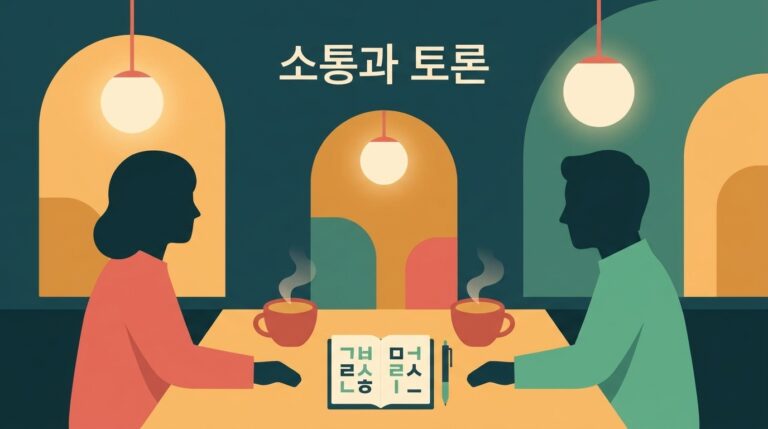
Imagine you are at a high-level Korean language debate club in Sinchon, Seoul. You are discussing the decriminalization of the sex trade with Min-jun (민준), a pragmatic law student.
- Setting: A quiet, dimly lit study cafe. Mug of warm black tea on the table.
- Tone: Serious, intellectually charged, polite.
민준: 성매매를 양성화하면 범죄율이 정말 줄어들까요?
      [🎭 진지한 표정으로 턱을 괴며]
      (If we formalize the sex trade, will the crime rate really decrease?)

You: 저는 무조건 금지하는 것이 오히려 문제를 음성적으로 만들 뿐이라고 생각해요.
      [🎭 차분한 목소리로 고개를 끄덕이며]
      (I believe that banning it unconditionally only pushes the issue into the shadows.)

민준: 하지만 성을 상품화하는 것을 국가가 공식적으로 허용하는 꼴이 되잖아요.
      [🎭 미간을 살짝 찌푸리며 신중하게]
      (But wouldn't that mean the state is officially permitting the commodification of sex?)

You: 그 우려도 이해하지만, 제도권 안으로 들여오면 종사자들의 인권을 더 보호할 수 있어요.
      [🎭 상대방의 눈을 부드럽게 마주 보며]
      (I understand that concern, but bringing it into the system can better protect workers' human rights.)

민준: 과연 법 테두리 안에서 완벽한 통제가 가능할지 의문이 드네요.
      [🎭 안경을 고쳐 쓰며 고개를 갸웃거린다]
      (I doubt if perfect control is truly possible within the boundaries of the law.)

You: 현실적인 한계는 있겠지만, 찬반양론이 팽팽한 만큼 이 문제를 공론화해서 합의점을 찾아야 해요.
      [🎭 양손을 가볍게 펴서 제스처를 취하며]
      (There will be practical limits, but as the pros and cons are hotly debated, we must bring this into public discussion to find a consensus.)

민준: 맞아요. 마냥 피할 수만은 없는 뜨거운 감자니까요.
      [🎭 공감한다는 듯 고개를 깊게 끄덕이며]
      (True. It's a hot potato we can't just avoid forever.)

You: 네, 그러니까 이제라도 음성적인 피해를 막기 위한 대책이 시급합니다.
      [🎭 확신에 찬 어조로 차분하게 마무리하며]
      (Yes, which is why measures to prevent underground damages are urgent starting now.)
🔀 Interactive Choice Point
How would you respond if Min-jun asks: “Do you think Korean society is morally ready for this?”
* Choice A: “한국 사회는 아직 보수적이라서 갈 길이 멀어요.” (Korean society is still conservative, so we have a long way to go.)
* 👉 Feedback (Risk): True, but slightly cliché. It lacks C1 analytical depth.
* Choice B: “유교적 가치관이 여전히 강하게 작용하고 있어서, 국민 정서상의 합의를 이끌어내기 쉽지 않을 것입니다.” (Because Confucian values still act strongly, drawing a consensus on public sentiment won’t be easy.)
* 👉 Feedback (Best!): Perfect. Using terms like “유교적 가치관” (Confucian values) and “국민 정서상” (public sentiment-wise) proves you understand Korea’s cultural psychology.
* Choice C: “도덕적인 것과 법적인 것은 분리해야죠.” (We must separate morality from legality!)
* 👉 Feedback (Bad): Too direct and dismissive of Korea’s deeply interconnected view of law and social morality.
Phase 6: 10-Second Emotion Shadowing Drill
Practice saying these out loud with the correct emotional beats. Pause briefly at the slashes (/).
- “이 문제를 / 공론화해서 / 합의점을 / 찾아야 해요.”
- [⚖️ Calm, analytical, and highly persuasive tone]
- “무조건 금지하는 건 / 오히려 문제를 / 음성적으로 만들 뿐이에요.”
- [🔥 Firm, confident tone, projecting absolute conviction]
Phase 7: K-Culture Mini Dictionary
- 뜨거운 감자 (tteu-geo-un gam-ja) | Hot Potato (A highly controversial issue that everyone talks about but no one wants to handle).
- 양성화 (yang-seong-hwa) | Formalization / Legalization (Bringing something dark into the clear sunlight).
- 인권 침해 (in-gwon chim-hae) | Human rights violation.
- 사각지대 (sa-gak-ji-dae) | Blind spot (Areas unprotected by welfare or law).
Phase 8: Traveler’s Survival Kit for Intellectuals
If you find yourself invited to a dynamic debate club or talking with intellectual Korean friends over drinks, keep these in your pocket:
* 일리가 있는 말씀입니다. (il-ri-ga in-neun mal-sseum-im-nida)
* Pro Tip: Use this to say “You have a point” before you gracefully introduce your counter-perspective.
* 현실 정치를 고려했을 때… (hyeon-sil jeong-chi-reul go-ryeo-haesseul ttae…)
* Pro Tip: Use this when you want to pivot from theories to practical reality.
* 우려하시는 바는 잘 알겠지만… (u-ryeo-ha-si-neun ba-neun jal al-ge-jiman…)
* Pro Tip: “I fully understand what you are worried about, but…”
Editor’s Travel Note:
To find brilliant spaces where these conversations happen naturally, search for Sinchon Study Cafes (신촌 스터디카페) on Naver Map, where college students host weekly mock tribunals and social debate groups.
Phase 9: Go One Step Deeper (Confucianism vs. Pragmatism)
Korean legal philosophy is a fascinating battlefield. On one hand, modern Korea is a cutting-edge technological democracy. On the other hand, the deep-rooted Neo-Confucian morality (유교 사상) dictates that laws must uphold moral standards. This is why issues like the legalization of adultery (간통죄) were only abolished recently, and why legalized sex trade remains highly taboo. To discuss these topics requires looking at Korea not just through a Western legal lens, but through a cultural lens where law and ethics are deeply intertwined.
💬 Your Turn: Do you think legalizing vice industries makes a society safer, or does it erode its moral foundation? Leave a comment in Korean below!
Phase 10: FAQ & Avoiding Misunderstandings
Q: Is it okay to bring up the topic of ‘성매매’ (prostitution) in casual dinners?
A: No, absolutely avoid this during casual company dinners (회식) or first meetings. It should only be discussed in academic, debate, or very close late-night friend circles where intellectual topics are mutually welcomed.
Q: What is the difference between ‘합법화’ (hap-beop-hwa) and ‘양성화’ (yang-seong-hwa)?
A: 합법화 simply means making it legal. 양성화 goes a step further, meaning to bring it fully under state surveillance, taxation, and administrative frameworks.
🚨 Common Mistakes Warning Board
- Saying “성매매는 나빠요” (Prostitution is bad): Too simplistic for C1. Instead, say: “성매매는 윤리적인 논쟁을 불러일으킵니다.” (It arouses ethical debates).
- Confusing ‘성매매’ with ‘성교육’ (Sex education): Pronunciations are similar, but getting them mixed up in a debate will completely throw off your argument!
Phase 11: Action Mission for Mastery
- Bronze Medal: Write 3 sentences in the comments using the term 공론화하다.
- Silver Medal: Read a Korean editorial article on “성매매 특별법” and write a 50-word summary using 찬반양론이 팽팽하다.
- Gold Medal: Join a Korean language exchange meet-up and politely ask your partner: “성매매 합법화에 대해 어떻게 생각하시나요?” using our non-verbal manners.
Phase 12: Interactive Quiz Challenge
Test your knowledge before you go!
1. Which term describes “the debate is tightly contested like a stretched rope”?
👉 See Answer
Answer: 찬반양론이 팽팽하다.
Explanation: This expression perfectly captures a high-tension public debate where neither side is backing down.
2. Fill in the blank: “문제를 숨기지 말고, 이제는 ( )해야 합니다.”
👉 See Answer
Answer: 공론화 (공론화해야 합니다).
Explanation: We must bring the hidden issue into the public forum/discussion.
3. True or False: Prostitution is currently legal and regulated in Korea.
👉 See Answer
Answer: False.
Explanation: Prostitution is completely illegal under the Special Law on Sex Trade enacted in 2004.






