

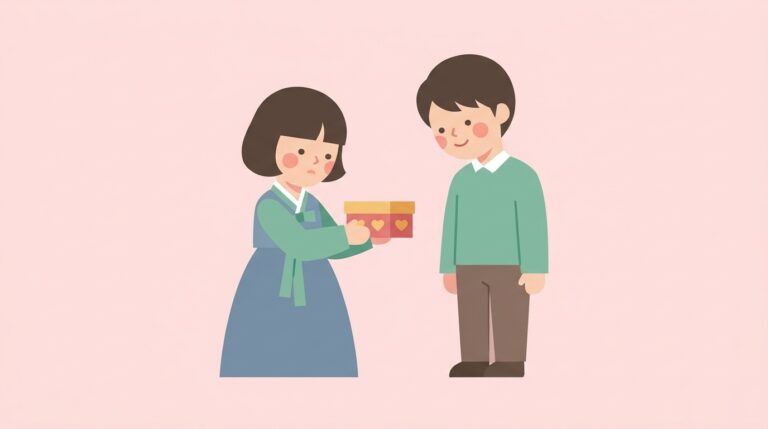
Valentine’s Day in Seoul: Handing Over Chocolates Like a K-Drama Lead
Phase 1: 안녕하세요! (Hello!) Welcome to Daily Hangul
Have you ever found yourself staring at a beautifully wrapped box of chocolates, your heart beating like a K-pop bassline, wondering: “How on earth do I say this in Korean without sounding like a dry grammar textbook?”
If you are crushing on someone in Korea, Valentine’s Day (February 14th) is your golden opportunity! But unlike in many Western countries where everyone exchanges gifts, in Korea, Valentine’s Day is traditionally when women give chocolates to men (don’t worry, men return the favor a month later on White Day!).
Handing over a gift to someone you like (your ‘ssom’ or crush) is a high-stakes emotional tightrope. You want to sound natural, sweet, and maybe a little playful. Today, we are going to dive into the exact phrases, cultural nuances, and body language secrets that will turn your nerve-wracking Valentine’s confession into a beautiful K-drama moment.
Phase 2: Key Expressions for Your Sweet Confession
Here are three essential B1-level expressions to use when handing over your Valentine’s chocolates. Each carries a different emotional flavor!
1. 이거 오다가 주웠어. (I picked this up on the way.)
- Pronunciation: I-geo o-da-ga ju-wot-eo (Sounds like: “Ee-geo oh-dah-gah joo-wut-uh”)
- Meaning: “I just picked this up on the way here.” (The ultimate nonchalant gift delivery)
- K-Culture Moment: This is the legendary “Tsundere” (츤데레) phrase. Picture a cool, slightly aloof lead in a drama looking away, handing a gift over with one hand, pretending they didn’t spend three hours wrapping it.
- Editor’s Insight: Do not use this in formal situations! It is a playful lie. Everyone knows you didn’t just find a beautifully wrapped box of artisanal chocolates on the street. It is a cute way to hide your shyness and lower the pressure for both of you.
- Situation Spectrum: Casual ✅ | Semi-formal ⚠️ | Formal 🚫
- 🤔 Think About It: Why do you think showing extreme effort can sometimes feel burdensome in Korean dating culture? How does pretending it’s “no big deal” help protect both people’s feelings?
2. 이거 제 마음이에요. 받아주세요. (This is my heart/feeling. Please accept it.)
- Pronunciation: I-geo je ma-eum-i-e-yo. Ba-da-ju-se-yo. (Sounds like: “Ee-geo jeh mah-eum-ee-eh-yo. Bah-dah-joo-seh-yo.”)
- Meaning: “This is a token of my feelings. Please accept it.”
- K-Culture Moment: A classic, sincere confession. Imagine standing in a quiet cafe corner, looking into their eyes, and handing over the box with both hands.
- Editor’s Insight: Ma-eum (마음) translates to “heart,” “mind,” or “feelings.” By saying this, you are elevating the gift from mere sugar to a symbol of your genuine affection. It’s polite yet deeply personal.
- Situation Spectrum: Casual ⚠️ | Semi-formal ✅ | Formal ✅
- 🤔 Think About It: In your culture, would you directly tell someone “this is my heart” when giving a gift? Or do you prefer more casual phrases?
3. 초콜릿 직접 만들었어요. 맛없어도 다 먹어야 돼요! (I made these chocolates myself. Even if they taste bad, you have to eat them all!)
- Pronunciation: Cho-kol-rit jik-jeob man-deul-eot-eo-yo. Mat-eob-seo-do da meog-eo-ya dwae-yo! (Sounds like: “Cho-kol-rit jeek-jup mahn-deul-ut-uh-yo. Maht-ub-suh-do dah mug-uh-yah dweh-yo!”)
- Meaning: “I made these chocolates myself. Even if they don’t taste great, you have to eat every single one!”
- K-Culture Moment: The DIY romantic. Hand-making chocolates (su-je-cho-kol-rit) is a huge trend for B1-level romantics in Korea, showing high investment and sincerity.
- Editor’s Insight: The second sentence is a classic Korean aegyo (playful cuteness). It playfully demands appreciation while showing a sweet vulnerability about your cooking skills.
- Situation Spectrum: Casual ✅ | Semi-formal ✅ | Formal 🚫
- 🤔 Think About It: How does adding a playful “threat” like “you must eat it all” make the atmosphere lighter and less awkward?
Phase 3: Textbook Korean vs. Real-Life Korean
Let’s compare the sterile sentences you find in old grammar books with the vibrant language Koreans actually use!
Situation 1: Giving the gift
- 📖 Textbook Korean: “발렌타인데이를 축하합니다. 초콜릿을 드립니다.” (Bal-ren-ta-in-de-i-reul chuk-ha-ham-ni-da. Cho-kol-rit-eul deu-rim-ni-da. – “Happy Valentine’s Day. I give you chocolate.”)
- 🗣️ Real Korean: “이거 주려고 기다렸어요. 발렌타인데이 선물이에요!” (I-geo ju-ryeo-go gi-da-ryeot-eo-yo. Bal-ren-ta-in-de-i seon-mul-i-e-yo! – “I waited to give you this. It’s a Valentine’s gift!”)
- 💡 Why is it different? The textbook version sounds like an official corporate announcement. Real life is personal; saying “I waited to give you this” adds anticipation and sweetness.
Situation 2: Dropping a hint about your feelings
- 📖 Textbook Korean: “저는 당신을 아주 좋아합니다.” (Jeo-neun dang-sin-eul a-ju jo-a-ham-ni-da. – “I like you very much.”)
- 🗣️ Real Korean: “요즘 오빠/너 자꾸 생각나요. 이거 먹고 내 생각 해요!” (Yo-jeum oppa/neo ja-kku saeng-gak-na-yo. I-geo meog-go nae saeng-gak hae-yo! – “Lately, I keep thinking of you. Eat this and think of me!”)
- 💡 Why is it different? Koreans rarely use the word dang-sin (당신) in speech—it can sound stiff or even confrontational. Using natural pronouns like oppa or neo, combined with a cute request, is much more natural.
Phase 4: K-Culture Deep-Dive & Non-Verbal Manners
4-1. The Art of the Delivery (Body Language)
In Korea, how you physically give a gift is just as important as what you say.
1. The Two-Handed Handover: Even if you are trying to be cool (using the “I picked this up” phrase), hold the box with both hands when they actually reach for it. It shows respect and sincerity.
2. Eye Contact and Shy Smiles: Give eye contact when saying their name, but look down slightly at the box when handing it over. This mix of confidence and shyness is considered incredibly charming (gwi-yeop-da).
4-2. The Korean Romantic Calendar
Did you know Valentine’s Day is just the beginning? Korea has an entire calendar of romantic days on the 14th of every month!
* February 14 (Valentine’s Day): Women give chocolates to men.
* March 14 (White Day): Men return the favor by giving candy/gifts to women.
* April 14 (Black Day): Single people who didn’t get gifts wear black and eat Jjajangmyeon (black bean noodles) together to comfort each other!
Phase 5: Real-Life Roleplay Scenario
Set the scene: It’s February 14th, after work. You and your crush, Minjun (a kind but slightly shy coworker), are leaving the office together. You have a box of handmade chocolates in your bag.
Characters:
- You (A brave B1 Korean speaker)
- Minjun (민jun) (Your handsome, sweet coworker)
Dialogue:
- You: 민준 씨, 퇴근하고 바빠요?
(Min-jun ssi, toe-geun-ha-go ba-ppa-yo?)
“Minjun, are you busy after work?”
🎭 (Fidgeting with your bag strap nervously) -
Minjun: 아니요, 특별한 약속은 없어요. 왜요?
(A-ni-yo, teuk-byeol-han yak-sok-eun eob-seo-yo. Wae-yo?)
“No, I don’t have any special plans. Why?”
🎭 (Looking curious and tilting his head) -
You: 아… 잠깐 시간 괜찮으면 카페 갈래요? 드릴 게 있어서요.
(Ah… jam-kkan si-gan gwaen-chan-eu-myeon ka-pe gal-rae-yo? Deu-ril ge is-seo-seo-yo.)
“Ah… if you have a moment, want to go to a cafe? I have something to give you.”
🎭 (Looking up with a shy smile) -
Minjun: 오, 좋아요! 저기 앞 카페로 가요.
(Oh, jo-a-yo! Jeo-gi ap ka-pe-ro ga-yo.)
“Oh, sure! Let’s go to that cafe over there.”
(At the cafe, after ordering drinks…)
- You: 짜잔! 이거… 오다가 주웠어요. 발렌타인데이잖아요.
(Jja-jan! I-geo… o-da-ga ju-wot-eo-yo. Bal-ren-ta-in-de-i-ja-na-yo.)
“Ta-da! This… I picked it up on the way. You know, since it’s Valentine’s Day.”
🎭 (Sliding the box across the table with both hands, blushing) -
Minjun: 진짜요? 와, 직접 만든 거예요? 감동이에요…
(Jin-jja-yo? Wa, jik-jeob man-deun geo-ye-yo? Gam-dong-i-e-yo…)
“Really? Wow, did you make this yourself? I’m so touched…”
🎭 (Eye widening as he looks at the hand-wrapped box) -
You: 맛은 보장 못 해요! 맛없어도 다 먹어야 돼요, 알겠죠?
(Mat-eun bo-jang mot hae-yo! Mat-eob-seo-do da meog-eo-ya dwae-yo, al-get-jyo?)
“I can’t guarantee the taste! Even if it tastes bad, you have to eat it all, okay?”
🎭 (Winking and laughing softly) -
Minjun: 당연하죠. 하나도 안 남기고 다 먹을게요. 고마워요.
(Dang-yeon-ha-jyo. Ha-na-do an nam-gi-go da meog-eul-ge-yo. Go-ma-wo-yo.)
“Of course. I’ll eat it all without leaving a single piece. Thank you.”
🎭 (Smiling warmly, staring gently into your eyes)
🔀 Interactive Choice Point
Minjun asks: “근데 왜 저한테 주시는 거예요?” (Geun-de wae jeo-han-te ju-si-neun geo-ye-yo? – “By the way, why are you giving this to me specifically?”)
- Choice A: “친하니까 그냥 주는 거예요! 오해하지 마세요!” (We’re close so I’m just giving it! Don’t misunderstand!)
- Choice B: “특별한 사람한테 특별한 선물을 주고 싶었어요.” (I wanted to give a special gift to a special person.)
- Choice C: “초콜릿 남아서요. 버리기 아까웠어요.” (I had leftovers. It felt like a waste to throw away.)
Feedback:
- Choice A (Risk): You played the tsundere card a bit too hard! Minjun might think you are puting him firmly in the friend zone. Use this only if you want to keep playing hard-to-get.
- Choice B (Best!): Perfect! It is direct, honest, and romantic. This transitions your relationship from “coworkers” to “potential partners” instantly.
- Choice C (Bad): Ouch! Calling your gift “leftovers” might hurt his feelings or make him feel unimportant. Avoid this!
Phase 6: 10-Second Emotional Shadowing Drill
Read these aloud with emotional intent! The / represents a tiny pause for dramatic effect.
- [😊 Confident & Flirty]
“이거 / 오다가 주웠어. / 그러니까 / 꼭 다 먹어!”
(I-geo / o-da-ga ju-wot-eo. / Geu-reo-ni-kka / kkok da meog-eo!) - [🥺 Shy & Sincere]
“제가 / 직접 만든 건데… / 맛없어도 / 다 / 먹어줄래?”
(Je-ga / jik-jeob man-deun geon-de… / mat-eob-seo-do / da / meog-eo-jul-rae?) - [💖 Warm & Direct]
“내 마음이니까 / 받아줘. / 해피 발렌타인!”
(Nae maeum-i-ni-kka / ba-da-jwo. / Hae-pi bal-ren-ta-in!)
Phase 7: K-Culture Mini Dictionary
- 썸 (Ssom) | Some: The magical, ambiguous phase before two people officially start dating. There is “some”thing between them.
- 고백 (Gobaek) | Confession: The official act of declaring your feelings to your crush. In Korea, a relationship doesn’t officially start until someone makes a clear gobaek.
- 츤데레 (Tsundere) | Tsundere: Adopted from Japanese, this describes someone who acts cold and distant on the outside but is warm and caring on the inside.
- 내숭 (Naesung) | Fake innocence/shyness: Acting shy, innocent, or weak around a crush to appear cute (e.g., pretending you can’t open a jar of jam so he can do it for you).
Phase 8: Traveler’s Survival Kit
Are you in Korea right now shopping for chocolates? Use these survival lines!
- “이거 발렌타인데이 세트 포장되나요?”
- I-geo bal-ren-ta-in-de-i se-teu po-jang-doe-na-yo?
- “Can you wrap this as a Valentine’s Day gift set?”
- Pro Tip: Korean stores often offer incredibly beautiful wrapping services for a small fee!
- “초콜릿 추천해 주실 수 있어요? 너무 안 단 걸로요.”
- Cho-kol-rit chu-cheon-hae ju-sil su is-seo-yo? Neo-mu an dan geol-ro-yo.
- “Can you recommend chocolates? Something not too sweet.”
- Pro Tip: Many Korean adults prefer high-cocoa, less-sweet dark chocolates.
- “메시지 카드도 하나 같이 살게요.”
- Me-si-ji ka-deu-do ha-na gat-i sal-ge-yo.
- “I’ll buy a message card together as well.”
📌 Editor’s Travel Note:
To find the best, most beautiful chocolate boutiques in Seoul, don’t just search on English engines. Download the 카카오맵 (KakaoMap) App Store Link or Naver Map and search for “수제 초콜릿” (handmade chocolate) or “가로수길 디저트” (Garosugil desserts). You’ll find hidden gems that locals adore!
Phase 9: Go One Step Deeper
In Western cultures, being incredibly direct in love is often seen as confident and sexy. However, Korean affection historically values 간접적인 표현 (indirect expressions) and Jeong (정)—a deep, shared emotional bond. Giving handmade chocolates with a slightly bashful “I picked this up on the way” is a perfect reflection of this culture: it shows massive effort while maintaining a polite, low-pressure humble stance. It gives the other person space to react without feeling cornered.
💬 Your Turn: Would you prefer to confess directly, or do you like the indirect, playful Korean style? Let us know in the comments below!
Phase 10: FAQ & Common Mistakes
Q: Is it weird if a guy gives a girl chocolates on Valentine’s Day in Korea?
A: Not at all! While tradition says women give to men, global trends are catching up. However, if you give a gift on February 14th, she might feel pressured to prepare something even better for you just one month later on White Day (March 14th)!
Q: What is the best way to address my male crush when giving chocolates?
A: If he is slightly older, call him Oppa (오빠) to sound close and cute. If you are in a professional environment, stick to [Name] 씨 (e.g., Minjun ssi) to remain respectful while showing personal affection through your gift.
Q: What if I don’t know if we are in a ‘썸’ (some) relationship or just friends?
A: Valentine’s Day is the perfect boundary-tester. If he accepts your handmade chocolates with excitement and buys you a great gift on White Day (March 14), you are officially out of the friend zone!
🚨 The “Common Mistakes” Warning Board
- Mistake 1: Calling him “당신” (Dang-sin).
- Why: It feels like a translated movie script or an old couple fighting.
- Correct Action: Use his name + 씨 (e.g., Minjun ssi) or 오빠 (Oppa).
- Mistake 2: Writing a 3-page English confession letter.
- Why: It can be overwhelming and hard to translate for a Korean speaker.
- Correct Action: Keep the card short, sweet, and mostly in natural Korean.
- Mistake 3: Giving cheap, plain convenience store chocolates to a long-time crush.
- Why: It looks like a last-minute formality (uiri-cho-kol-rit – obligation chocolate).
- Correct Action: Opt for boutique chocolates or handmade ones to show actual intent.
Phase 11: Action Mission & K-Culture Challenge
Your 3-Step Mission:
- Bronze: Write down the phrase “이거 제 마음이에요” on a sticky note and practice saying it looking at a mirror.
- Silver: Send a message to your Korean language partner or friend: “벌써 발렌타인데이네요!”
- Gold: This February 14th, use one of our three main phrases to hand over a small sweet treat to someone you care about!
🎮 K-Culture Mission:
Watch your favorite romantic K-Drama (like Crash Landing on You or Business Proposal) and find a scene where someone gives a gift. Did they use both hands? Did they act like a tsundere? Write down what they said!
Phase 12: Interactive Quiz Challenge
Test your Valentine’s survival skills!
1. Which phrase should you say if you want to be a cool “tsundere”?
- A) 이거 제 마음이에요.
- B) 이거 오다가 주웠어.
- C) 초콜릿 직접 만들었어요.
Reveal Answer
Answer: B
“이거 오다가 주웠어” translates to “I picked this up on the way,” which is the classic nonchalant tsundere line!
2. Fill in the blank: “맛은 보장 못 해요! 맛없어도 _____ 먹어야 돼요!” (Even if it tastes bad, you have to eat it all!)
- A) 조금 (a little)
- B) 절대 (never)
- C) 다 (all)
Reveal Answer
Answer: C
“다” (da) means “all” or “everything.” Saying “맛없어도 다 먹어야 돼요” is a cute, playful way to tell your crush to eat everything you made!
3. True or False: In Korea, men give chocolates to women on Valentine’s Day (Feb 14).
- A) True
- B) False
Reveal Answer
Answer: B (False)
On Valentine’s Day (Feb 14), women traditionally give chocolates to men in Korea. Men return the favor on White Day (March 14)!







