

안녕하세요! 매일한글 에디터입니다.
Have you ever watched a K-Drama where the main characters, fresh from moving into a new apartment, sit on the floor surrounded by boxes and happily slurp thick, dark noodles from a plastic bowl? If yes, you’ve witnessed one of the most iconic Korean food traditions: ordering Jjajangmyeon (짜장면 – Black Bean Noodles)!
As a beginner in Korean, ordering food over the phone or navigating a delivery app can feel absolutely terrifying. You might worry, “What if they speak too fast?” or “What if I say the wrong thing?” Don’t worry! Our Daily Hangul community of learners has faced these exact fears, and today, we’re handing you the ultimate cheat sheet. By the end of this guide, you’ll order your Jjajangmyeon like a true Seoulite!
Phase 2: Core Expressions Deep Dive
1. 짜장면 하나 배달해 주세요. (Jjajangmyeon hana baedal-hae juseyo.)
- Pronunciation: Jjah-jahng-myeon ha-na bae-dahl-hae joo-seh-yo. (Think of “hana” like “hah-nah” and “baedal” like “bay-dahl”).
- Meaning: Please deliver one Jjajangmyeon.
- K-Culture Moment: This is the absolute golden line you hear in every neighborhood-based K-Drama. It’s simple, direct, and universally understood.
- Editor’s Insight: In Korean, we use native numbers like 하나 (hana – one), 둘 (dul – two) when counting bowls of food, instead of Sino-Korean numbers (일, 이).
- Situation Spectrum: Casual ✅ | Semi-formal ✅ | Formal ⚠️
- 🤔 Think About It: Why do you think Korean culture separates numbers for counting items (like food) versus counting money or phone numbers?
2. 단무지 많이 주세요. (Danmuji manhi juseyo.)
- Pronunciation: Dahn-moo-jee mah-nee joo-seh-yo. (The “h” in “manhi” is silent, so it sounds just like “mah-nee”!)
- Meaning: Please give me a lot of yellow pickled radish.
- K-Culture Moment: Jjajangmyeon and Danmuji are inseparable soulmates. If you ever watch a mukbang, you’ll see creators crunching on these bright yellow radishes between bites of rich noodles.
- Editor’s Insight: Don’t be shy! Koreans love generous side dishes, and asking for extra Danmuji is completely normal and free.
- Situation Spectrum: Casual ✅ | Semi-formal ✅ | Formal 🚫
- 🤔 Think About It: Does your culture have a specific side dish that must accompany certain main courses?
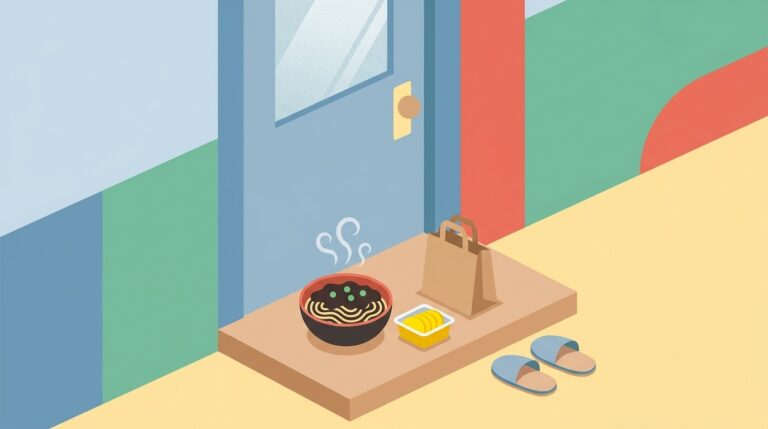
3. 문 앞에 두고 벨 눌러 주세요. (Mun appe dugo bel nulleo juseyo.)
- Pronunciation: Moon ahp-peh doo-go bell nool-luh joo-seh-yo. (Think of “bel” just like the English word “bell”!)
- Meaning: Please leave it at the door and ring the bell.
- K-Culture Moment: Perfect for modern, contactless delivery! This phrase is highly used by introverted characters in web dramas who want their food without the social interaction.
- Editor’s Insight: Korea’s delivery system is extremely safe. Leaving food outside your door is the standard practice now, and nothing ever gets stolen!
- Situation Spectrum: Casual ⚠️ | Semi-formal ✅ | Formal ✅
- 🤔 Think About It: How does the trust in leaving food unattended at the door reflect Korean neighborhood community values?
Phase 3: Textbook Korean vs. Real Korean
Let’s look at how textbooks teach delivery, and how real Koreans actually say it!
Situation 1: Telling them you want to make an order
- 📖 Textbook: 음식을 주문하고 싶습니다. (Eumsigeul jumunhago sipseumnida. – I would like to order food.)
- 🗣️ Real Korean: 주문할게요! (Jumun-hal-ge-yo! – I’ll order now! / I’d like to order!)
- 💡 Why the difference? The textbook version sounds like a formal robot writing an email. Real Koreans prefer the light, active, and friendly ending -게요 (-ge-yo) to start a transaction smoothly.
Situation 2: Asking for a card payment
- 📖 Textbook: 신용카드로 결제하겠습니다. (Sinyong-kadeuro gyeolje-hagesseumnida. – I shall pay via credit card.)
- 🗣️ Real Korean: 카드로 결제할게요. (Kadeu-ro gyeolje-hal-ge-yo. – I’ll pay by card.)
- 💡 Why the difference? Shortening “신용카드” (credit card) to just “카드” (card) is much more natural and efficient for daily conversations.
Phase 4: K-Culture Deep Dive & Non-verbal Manners
4-1. Nunchi (눈치) & Gesture Manners
When receiving food in Korea, even if it is a quick handoff, using two hands to take the plastic bag is a huge sign of respect! If you meet the delivery rider, give a polite, quick bow (around 15 degrees) and say “감사합니다! (Gam-sa-ham-ni-da!)” with a smile. It shows great Nunchi (social awareness) and brightens their busy day!
4-2. The Soul of Jjajangmyeon
Did you know Jjajangmyeon is actually a Chinese-Korean fusion dish? It originated in Incheon’s Chinatown over a century ago. Today, it’s the ultimate comfort food. On Black Day (블랙데이 – April 14th), singles who did not receive chocolates on Valentine’s or White Day gather to eat dark Jjajangmyeon together to comically “mourn” their single status. It’s also the mandatory meal on moving day!
Phase 5: Real-Life Roleplay Scenario
Let’s practice a phone call with Minjun (You) and the owner of a local Chinese restaurant named Guryonggak (구룡각)!
- Owner: 구룡각입니다~ (Guryonggak-imnida~ – This is Guryonggak!)
- Minjun: 🎭 (Politely) 안녕하세요! 짜장면 하나 배달해 주세요. (Annyeonghaseyo! Jjajangmyeon hana baedal-hae juseyo. – Hello! Please deliver one Jjajangmyeon.)
- Owner: 네, 주소 어떻게 되세요? (Ne, juso eotteoke doeseyo? – Sure, what is your address?)
- Minjun: 🎭 (Reading carefully) 한국아파트 101동 202호예요. (Hanguk-apateu baek-il-dong i-baek-i-ho-yeyo. – It’s Hanguk Apartment, Building 101, Apartment 202.)
- Owner: 결제는 어떻게 하실 건가요? (Gyeoljeneun eotteoke hasil geongayo? – How would you like to pay?)
- Minjun: 카드로 할게요. 단무지 많이 주세요! (Kadeu-ro halgeyo. Danmuji manhi juseyo! – I’ll pay by card. Please give me lots of yellow pickled radish!)
- Owner: 알겠습니다. 30분 정도 걸려요~ (Algetseumnida. Samsip-bun jeongdo geollyeoyo~ – Understood. It will take about 30 minutes!)
- Minjun: 🎭 (Happy) 감사합니다! 문 앞에 두고 벨 눌러 주세요. (Gamsahamnida! Mun appe dugo bel nulleo juseyo. – Thank you! Please leave it at the door and ring the bell.)
🔀 Choose Your Path!
If the owner suddenly asks: “나무젓가락 필요하세요? (Namu-jeotgarak piryo-haseyo? – Do you need disposable wooden chopsticks?)” How do you reply?
* Option A: “네, 주세요!” (Ne, juseyo! – Yes, please give me some!) ➔ [Best Choice] Clear, polite, and you’ll get your chopsticks!
* Option B: “아니요, 괜찮아요.” (Aniyo, gwaenchanayo. – No, I’m fine.) ➔ [Good Choice] Perfect if you already have chopsticks at home and want to save the environment.
* Option C: “몰라요.” (Mollayo. – I don’t know.) ➔ [Risk Choice] Sounds a bit blunt and might confuse the busy restaurant owner!
Phase 6: 10-Second Shadowing Drill
Let’s practice speaking with local rhythm! Pause briefly at the slashes (/).
- [😊 Excited and hungry]
짜장면 / 하나하고 / 단무지 / 많이 주세요!
(Jjajangmyeon / hana-hago / danmuji / manhi juseyo!)
“One Jjajangmyeon and lots of pickled radish, please!” -
[🥺 Polite and gentle]
문 앞에 / 두고 / 벨 / 눌러 주세요~
(Mun appe / dugo / bel / nulleo juseyo~)
“Please leave it at the door and ring the bell~”
Phase 7: K-Culture Mini Dictionary
- 짬뽕 (Jjambpong) | Spicy seafood noodle soup. Jjajangmyeon’s eternal rival!
- 짬짜면 (Jjamjjamyeon) | A genius invention! A bowl split right down the middle with Jjajangmyeon on one side and Jjambpong on the other.
- 탕수육 (Tangsuyuk) | Sweet and sour crispy pork. It’s the ultimate side dish to share when ordering Jjajangmyeon.
- 배달의민족 (Baedal-ui Minjok) | Literally “The Delivery Nation,” but famously known as Baemin, Korea’s number one food delivery app.
Phase 8: Traveler’s Survival Kit
Top 3 Survival Phrases:
- “젓가락 빼주세요.” (Jeotgarak pae-juseyo.) – Please exclude disposable chopsticks. (Eco-friendly option for app orders!)
- “얼마나 걸려요?” (Eolmana geollyeoyo?) – How long will it take?
- “맛있게 드세요!” (Masitge deuseyo!) – Enjoy your meal! (What delivery riders or restaurant owners will say to you!)
Editor’s Travel Note: To order food like a local, download 네이버 지도 (Naver Map) to find the nearest highly-rated Chinese restaurants. If delivery apps require local phone verification, don’t hesitate to politely ask your hotel front desk or Airbnb host for help using these phrases! Note: Delivery fees and app interfaces are subject to change depending on local provider policies.
Phase 9: “One Step Deeper” Reflection
Korea’s delivery speed and efficiency are heavily tied to the cultural concept of “빨리빨리 (Palli-Palli – Hurry, Hurry)”. This desire for fast service has created one of the most advanced delivery infrastructures in the world, where warm food can arrive at your door or even a public park within 20 minutes.
💬 Your Turn: What is your country’s ultimate comfort food when you are too tired to cook? Tell us in the comments below!
Phase 10: FAQ & Avoiding Common Mistakes
Q: Can I order Jjajangmyeon even if I am alone?
A: Yes! While some restaurants have a minimum delivery price (최소 주문 금액), most places let you order single portions, especially if you add a side of Danmuji or turn it into a set meal with Tangsuyuk.
Q: How do I tell the rider to just knock and leave?
A: You can say “노크하고 문 앞에 두고 가세요” (Nokeu-hago mun appe dugo gaseyo – Please knock and leave it at the door).
🚨 Common Mistakes Alert!
- Mistake: Saying “일 짜장면” (Il Jjajangmyeon) to order one bowl.
- Correct Action: Always use Native Korean numbers for counting dishes: 하나 (hana – 1), 둘 (dul – 2), 셋 (set – 3). Say “짜장면 하나”!
Phase 11: Action Mission
- 🥉 Bronze Medal: Read the 3 Core Expressions out loud 3 times in front of a mirror.
- 🥈 Silver Medal: Take a screenshot of the “10-Second Shadowing Drill” and practice it before your next meal!
- 🥇 Gold Medal: Watch an episode of a K-Drama featuring a Jjajangmyeon eating scene, and spot if they say “단무지” (Danmuji)!
Phase 12: Interactive Quiz Challenge
1. Which number system should you use to order “one” bowl of Jjajangmyeon?
* A) Sino-Korean (일)
* B) Native Korean (하나)
2. What does “단무지 많이 주세요” mean?
* A) Please deliver quickly.
* B) Please give me lots of yellow pickled radish.
3. True or False: It is considered rude in Korea to ask the delivery rider to leave food at the door.
* A) True
* B) False
🔍 Click here to check the answers!
- B) Native Korean (하나) – Always use native numbers like ‘하나’ for counting food bowls!
- B) Please give me lots of yellow pickled radish. – Your noodles’ best friend!
- B) False – It is extremely common and polite, especially with the phrase “문 앞에 두고 벨 눌러 주세요.”







