

Talk Tech Like a Pangyo Insider: Mastering AI & Machine Learning in Korean
Phase 1: Empathy (스토리 몰입형 오프닝)
안녕하세요! Welcome back to Daily Hangul, your premium Korean learning companion. I’m your head editor, bringing you the freshest linguistic insights straight from Seoul!
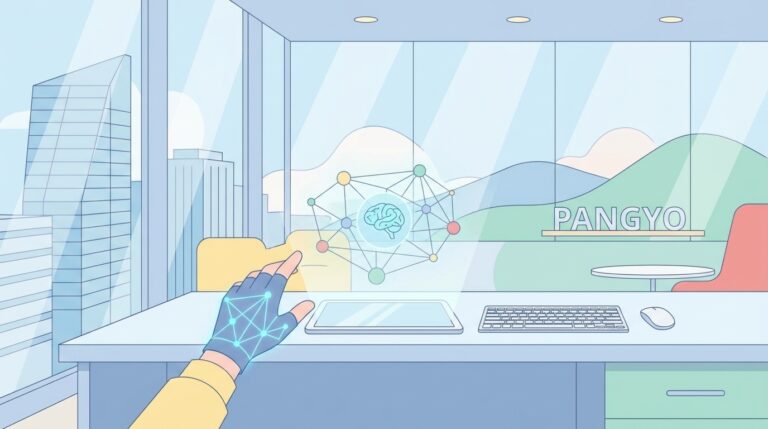
Imagine you are sitting in a sleek, glass-walled cafe in Pangyo Techno Valley (판교테크노밸리)—Korea’s Silicon Valley. To your left, a group of startup developers are gesturing animatedly over their laptops, debating neural networks. To your right, a tech lead is pitching a new AI service to an investor. You understand the English words “AI,” “Machine Learning,” and “Prompt,” but the rest of their high-level Korean discussion feels like a completely different language.
At the C1 (Advanced) level, textbooks often let you down. They teach you rigid, dry translations of technical terms that real industry professionals never actually use. Today, we are going to bridge that gap. Based on real coaching feedback from foreign developers working at Kakao and Naver, we’ve designed this guide to help you sound like a natural, deeply knowledgeable tech insider who can comfortably discuss artificial intelligence and machine learning in Korean. Let’s dive in!
Phase 2: Core Expressions (핵심 표현 3선 심층 분석)
1. 알고리즘을 고도화하다 (Algorijeumeul godohwahada)
- Pronunciation: al-go-ri-jeum-eul go-do-hwa-ha-da (Sounds like: “al-go-rhythm-ool go-do-hwa-ha-da”)
- Meaning: To optimize / To sophisticatedly refine an algorithm
- K-Culture Moment: In the hit K-Drama Start-Up (스타트업), you often hear the characters talking about making their image recognition AI faster and more accurate. Instead of just saying “improve” (개선하다), they use “고도화하다” to sound highly professional.
- Editor’s Insight: “고도(高度)” means high altitude or high level, and “화(化)” means “-ization.” Combining them with “하다” means to raise something to a highly sophisticated state. If you tell a Korean colleague, “우리 추천 알고리즘을 조금 더 고도화해야 할 것 같아요,” they will instantly view you as a high-level specialist.
- Situation Spectrum: Casual 🚫 | Semi-formal ⚠️ | Formal ✅ (Perfect for presentations, code reviews, and business meetings)
- 🤔 Think About It: How does your native language express the concept of “making technology more sophisticated”? Does it carry the same visual nuance of raising something to a “higher altitude”?
2. 학습 데이터 편향 (Hakseup deiteo pyeonhyang)
- Pronunciation: hak-seup de-i-teo pyeon-hyang (Sounds like: “hak-soop day-ee-tuh pyun-hyang”)
- Meaning: Training data bias
- K-Culture Moment: This term is frequently discussed in Korean tech podcasts and YouTube channels like EO (태용) when talking about ethical AI development and preventing social prejudices in machine learning models.
- Editor’s Insight: “학습 (Learning/Training)” and “편향 (Bias/Skewness)” come together to describe the inherent bias in datasets. In C1 discussions, addressing ethical concerns is key. Saying “데이터 편향 문제를 해결해야 합니다” shows you are not just thinking about coding, but also about the societal impact of AI.
- Situation Spectrum: Casual ⚠️ | Semi-formal ✅ | Formal ✅
- 🤔 Think About It: In Korean culture, harmony and fairness are deeply valued. Discussing AI bias in Korean often opens up deep cultural conversations about social representation and equity.
3. 초거대 AI 모델 (Chogeodae AI model)
- Pronunciation: cho-geo-dae AI mo-del (Sounds like: “cho-guh-dae AI mo-del”)
- Meaning: Hyperscale AI model (like GPT-4, HyperCLOVA X)
- K-Culture Moment: This is a buzzword across all Korean media outlets daily. Korea prides itself on having its own sovereign hyperscale AI models developed by local giants like Naver.
- Editor’s Insight: “초 (超)” is a prefix meaning “super-” or “hyper-“, and “거대 (巨大)” means “colossal.” While English speakers say “Hyperscale AI,” Koreans literally call it “Colossal/Super-giant AI.”
- Situation Spectrum: Casual ✅ | Semi-formal ✅ | Formal ✅
- 🤔 Think About It: Why do you think Korea is one of the few countries actively building its own “sovereign” hyperscale models instead of relying solely on US tech? How does this reflect their national drive for IT independence?
Phase 3: Textbook Korean vs. Real Korean (교과서 한국어 vs 진짜 한국어)
Situation 1: Discussing AI replacing human jobs
- 📖 Textbook Korean: “인공지능이 인간의 일자리를 대체할 것입니다.” (Artificial intelligence will replace human jobs.)
- 🗣️ Real Korean: “결국 단순 반복 업무는 AI가 다 먹지 않을까요?” (In the end, won’t AI take over/consume all the simple repetitive tasks?)
- 💡 Why the difference? While “대체하다” (to replace) is grammatically flawless, native speakers in casual/semi-formal settings use the highly expressive verb “먹다” (literally: to eat) to convey the vivid nuance of one technology absorbing or taking over a market/role.
Situation 2: Praising a machine learning model’s performance
- 📖 Textbook Korean: “이 모델은 기계 학습 성능이 매우 뛰어납니다.” (This model’s machine learning performance is very excellent.)
- 🗣️ Real Korean: “이 모델, 가성비랑 성능 둘 다 완전 미쳤어요.” (This model’s cost-to-performance ratio and power are absolutely insane.)
- 💡 Why the difference? C1 level means knowing when to drop the textbook politeness to build rapport. In startup culture, using words like “가성비” (cost-effectiveness) and “미쳤다” (crazy/insane) when talking about computing power shows you are in tune with everyday workplace lingo.
Phase 4: K-Culture Deep Dive & Non-verbal Manners
4-1. Nunchi & Gestures: The “Pangyo” Communication Style
When discussing tech trends in Korea, especially in Pangyo, the atmosphere is highly dynamic. Unlike traditional Korean corporate settings that require deep bowing and highly formal honorifics (하십시오체), tech sectors heavily utilize “해요체” (polite casual) combined with confident hand gestures.
* The Laptop Angle: During a tech discussion, it’s common to spin your laptop toward the other person, gently tapping the screen to point out a graph while saying “보시다시피…” (As you can see…).
* The Thoughtful Nod: When someone talks about complex algorithms, do a slow, deep nod with a slight frown of concentration. This non-verbal cue signals that you are intellectually engaged in their technical explanation.
4-2. Cultural Code: Sovereign AI and Korean Pride
In Korea, artificial intelligence is not just a technological tool; it is a matter of cultural preservation. Because the Korean language has unique linguistic nuances, honorifics, and cultural contexts (like Nunchi or generational slang), local tech companies developed sovereign AI models like Naver’s HyperCLOVA X to process Korean emotions and social context better than foreign models. When discussing AI with Koreans, acknowledging this effort shows deep cultural awareness and respect.
Phase 5: Interactive Roleplay Scenario (실전 롤플레이 시나리오)
Setting: A modern, trendy coffee shop in Pangyo. You are meeting with Min-woo (민우), a brilliant lead AI researcher at a prominent Korean startup.
- Min-woo (민우): (Adjusts his glasses and points at his laptop screen) 이번에 저희가 새로 런칭할 초거대 AI 모델 데모 버전이에요. 한번 보실래요?
- You: 우와, 신기하네요! UI도 깔끔하고 속도도 진짜 빠른데요?
- Min-woo (민우): (Smiles proudly) 감사해요. 그런데 아직 한국어 자연어 처리 부분에서 약간 어색한 문장이 나오더라고요.
- You: 아, 그래요? 🎭 아쉬운 표정을 지으며 혹시 학습 데이터 편향 때문일까요?
- Min-woo (민우): 맞아요! 정확히 짚으셨네요. 특정 커뮤니티 데이터가 많이 들어가서 뉘앙스가 조금 편향되게 학습됐어요.
- You: 그렇군요. 그럼 이 문제를 해결하려면 알고리즘을 좀 더 고도화해야겠네요?
- Min-woo (민우): 네, 그래서 필터링 알고리즘을 고도화하는 작업을 이번 주 내로 끝내려고 밤새고 있어요.
- You: 와, 진짜 대단하세요. 몸 상하지 않게 쉬엄쉬엄 하세요! 피땀 눈물로 만드신 만큼 대박 날 거예요.
🔀 Choose Your Response! (인터랙티브 분기점)
What would you say next to Min-woo to keep the tech discussion flowing smoothly?
- Option A: “맞아요. 요즘 대세는 초거대 AI인데, 한국어 특화 모델이라니 정말 시장성이 있어 보여요.”
- Option B: “제가 코딩을 좀 아는데, 제가 직접 알고리즘 고도화 작업을 도와드릴까요?”
- Option C: “인공지능이 너무 발전하면 우리 일자리를 다 먹을까 봐 솔직히 좀 무서워요.”
🔍 Feedback on Your Choice:
- Option A (Best): 🌟 Excellent! You highlighted the business viability (“시장성”) and linked it with the buzzword “초거대 AI.” This is incredibly encouraging for a startup developer.
- Option B (Risk): ⚠️ Unless you are their hired senior engineer, offering to code their core algorithm out of nowhere might come off as overstepping boundaries, even if well-intentioned.
- Option C (Bad): 🚫 While a valid philosophical concern, bringing up existential dread right when a developer is proudly showing you their hard work might kill the positive vibe of the conversation.
Phase 6: 10-Second Emotional Shadowing Drill (10초 감정 섀도잉 드릴)
Practice saying these high-level sentences with the exact rhythm and emotion of a native speaker! / indicates a slight pause.
- [😎 Confident & Professional]
“이번에 / 우리 추천 알고리즘을 / 고도화하면서 / 매칭 성공률이 / 진짜 많이 올라갔어요.”
(As we refined our recommendation algorithm this time, the matching success rate went up drastically.) -
[🥺 Exhausted but Proud]
“학습 데이터 편향 잡느라고 / 어제 팀원들이랑 / 진짜 밤새웠거든요 / 그래도 결과가 잘 나와서 다행이에요.”
(We pulled an all-nighter trying to fix the training data bias, but thankfully, the results turned out great.)
Phase 7: K-Culture Mini Dictionary (핵심 키워드 4개)
| Word (한글) | Romanization | English Translation | Real-world Usage Tip |
|---|---|---|---|
| 딥러닝 | dip-reoning | Deep Learning | Used universally in both casual and formal tech conversations. |
| 판교 | pang-yo | Pangyo | Known as Korea’s Silicon Valley. Saying “판교 스타일” refers to a casual, tech-savvy corporate lifestyle. |
| 프롬프트 | peu-rom-peu-teu | Prompt | Used when discussing inputs for generative AI. E.g., “프롬프트를 잘 짜야 해요.” |
| 튜닝 | tyu-ning | Tuning (Fine-tuning) | Often combined with “파인(Fine)” as “파인튜닝” to describe refining AI models. |
Phase 8: Survival Kit for Tech Travelers
Survival Tech Phrases TOP 3
- “와이파이 비밀번호가 어떻게 돼요?” (What is the Wi-Fi password?)
- “콘센트 있는 자리 있을까요?” (Is there a seat with a power outlet?)
- “노트북 충전기 혹시 빌릴 수 있나요?” (Could I borrow a laptop charger by any chance?)
Editor’s Travel Note
If you plan to visit Pangyo Techno Valley, skip Google Maps. In Korea, Google Maps is not fully updated due to security regulations. Instead, search your route using the Naver Map App (네이버 지도 앱 다운로드). Take the Shinbundang Line (신분당선) from Gangnam; it takes only 15 minutes to reach Pangyo Station, where you will immediately see high-tech buildings of Kakao, NCSoft, and Naver!
Phase 9: ” 한 발 더 깊이” (생각 질문)
In Western tech discourse, discussions about AI often focus on raw computing power, efficiency, and individual rights. In Korea, however, a massive amount of attention is directed toward making AI communicate with warm human emotions, reflecting the deep-rooted Korean concept of Jeong (정) and Nunchi (눈치). Korean tech companies are racing to create virtual assistants that don’t just give answers, but ask “Are you feeling okay today?” with natural, comforting sentence endings.
💬 Your Turn: How does your culture view the integration of empathy in AI? Would you prefer an AI that is purely logical, or one that sounds like an empathetic human friend? Let us know in the comments below!
Phase 10: FAQ & Common Mistakes (FAQ Schema)
Q: Is “머신러닝” used more than “기계 학습” in Korean tech companies?
A: Yes! While “기계 학습” is the literal translation found in academic papers, working professionals in Pangyo almost exclusively use the transliterated English term “머신러닝” in daily conversation.
Q: How do I say “bias” politely without offending someone’s work?
A: Instead of saying “이 모델은 편향되었어요” (This model is biased – which sounds accusatory), say “데이터 편향성이 존재할 가능성이 있습니다” (There is a possibility that data bias exists). This sounds highly analytical and objective.
Q: Can I use “고도화하다” for non-tech things?
A: Yes, you can use it for strategic planning, marketing systems, or financial models (e.g., “마케팅 전략을 고도화하다”). However, do not use it for simple daily tasks like cooking or cleaning.
🚨 Common Mistakes Alert!
- Mistake 1: Saying “AI를 가르치다” (Teaching AI).
- Correct Action: Use “AI를 학습시키다” (To train/make AI learn).
- Mistake 2: Translating “Data preprocessing” literally as “데이터 사전처리”.
- Correct Action: Use the industry standard “데이터 전처리” (Jeon-cheo-ri).
- Mistake 3: Saying “머신러닝 알고리즘이 똑똑하다” (The ML algorithm is smart).
- Correct Action: Say “알고리즘의 성능이 우수하다” (The algorithm’s performance is excellent).
Phase 11: Action Mission & Engagement
- Bronze Mission: Read the expressions in Phase 6 aloud 5 times while mimicking the emotional tone of a Korean developer.
- Silver Mission: Write a sentence in the comments below using “고도화하다” to describe something you want to improve in your work or study.
- Gold Mission: If you have Korean colleagues or friends in IT, use “초거대 AI” or “학습 데이터 편향” in your next conversation with them and observe their surprised reactions!
🎮 K-Culture Challenge: Watch an episode of the drama Start-Up or a tech vlog on YouTube and count how many times you hear the words “알고리즘” (algorithm) or “모델” (model)!
Phase 12: Interactive Quiz Challenge (인터랙티브 퀴즈)
Test your knowledge of high-level Korean tech terminology!
1. Which of the following is the most natural way to say “to optimize/refine an algorithm” in a professional Korean meeting?
- A) 알고리즘을 청소하다
- B) 알고리즘을 고도화하다
- C) 알고리즘을 아름답게 만들다
2. Fill in the blank: “This model has a slight issue with training data ______.”
- “이 모델은 학습 데이터
[ ] 문제가 조금 있습니다.”
3. True or False: In Pangyo tech culture, strict academic Korean terms are always preferred over English transliterated terms.
👉 Click here to reveal the answers and explanations!
- Answer: B) 알고리즘을 고도화하다. (“고도화하다” is the gold standard for refining/optimizing systems in Korean business.)
- Answer: 편향 (Pyeon-hyang – Bias). The full phrase is “학습 데이터 편향”.
- Answer: False. Transliterated terms like “머신러닝”, “딥러닝”, and “디버깅” are highly integrated and often preferred over pure Sino-Korean translations in modern workplaces!







