

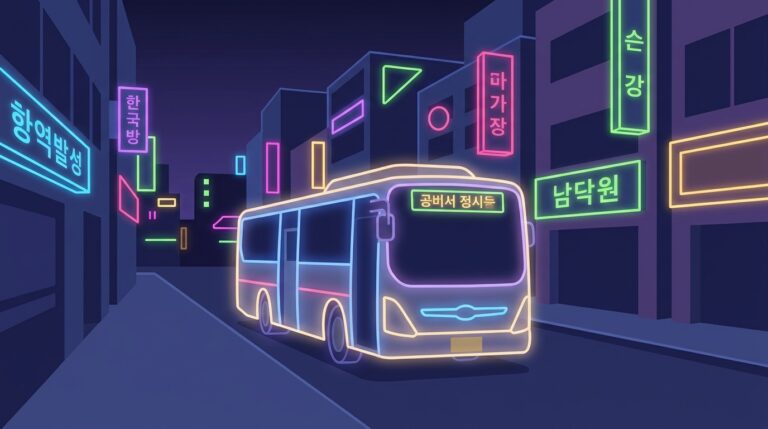
Navigating Seoul’s Midnight Magic: How to Advocate for Late-Night ‘Owl Bus’ Routes Like a True Seoulite
Phase 1: Empathy (스토리 몰입형 오프닝)
안녕하세요! It’s your favorite Korean bestie and Daily Hangul’s Senior Editor here!
Picture this: It’s 1:30 AM in the vibrant district of Hongdae. You’ve just finished a legendary chimaek (chicken and beer) session with your friends, or perhaps you’ve wrapped up a grueling overtime shift at your digital marketing agency in Gangnam. You pull out your phone, open your transit app, and realization hits you like a cold Han River breeze—막차 (makcha – the last bus/subway) has already left. Your only options are a costly taxi ride (good luck catching one during the midnight rush!) or waiting hours in the cold.
This is a classic pain point for anyone living in or visiting Korea’s bustling metropolises. While Seoul boasts one of the world’s finest transit systems, the late-night 올빼미 버스 (Owl Bus – Seoul’s late-night bus network) lines are still heavily congested and don’t reach every corner of the city. As a high-advanced C2-level learner, you aren’t just looking for survival phrases like “Where is the bus stop?” You want to actively engage with your local community, voice your concerns, and maybe even write a formal petition to the local district office (gu-cheong) to demand better service. Let’s master the art of sophisticated civic persuasion in Korean!
Phase 2: 핵심 표현 3선 심층 분석 (Deep Dive into Core Expressions)
1. 노선을 증편하다 / 확충하다 (Noseoneul jeungpyeonhada / hwagchunghada)
- Pronunciation: No-seon-eul jeung-pyeon-ha-da / hwag-chung-ha-da (Sounds like “no-sun-ul jung-pyun-ha-da” / “hwak-choong-ha-da”)
- Meaning: To increase the frequency of a transit route / To expand or scale up a transit route.
- K-Culture Moment: You’ll hear these terms constantly in news broadcasts (KBS, SBS) or local administrative newsletters when discussing urban planning, municipal elections, or public transportation reforms.
- Editor’s Insight: 증편 (jeungpyeon) specifically means adding more physical vehicles to a schedule to reduce waiting times, while 확충 (hwagchung) refers to making the overall system larger and more robust (e.g., adding more stops or new routes). Using these terms shows you have a firm grasp of public policy vocabulary.
- Situation Spectrum: Casual 🚫 | Semi-formal ⚠️ | Formal ✅
- 🤔 Think About It: In many Western cultures, complaining about public services is done through private complaints. In Korea, public transport is seen as a collective civic right, and citizens actively coordinate to request improvements. How does this compare to your home country?
2. 발이 묶이다 (Bal-i muk-gida)
- Pronunciation: Bal-i muk-gi-da (Sounds like “bahl-ee mook-ghee-dah”)
- Meaning: Literal: “To have one’s feet tied.” | Idiomatic: To be stranded or stuck with no way of moving/traveling.
- K-Culture Moment: Often used in K-Dramas when a sudden heavy snowstorm hits, or when characters miss the last train in a rural town and are forced to spend the night at a local jjimjilbang (sauna).
- Editor’s Insight: This is a highly natural, idiomatic expression that instantly bridges the gap between textbook Korean and native-level fluency. It’s perfect for emphasizing the gravity of your situation.
- Situation Spectrum: Casual ✅ | Semi-formal ✅ | Formal ⚠️
- 🤔 Think About It: Why does Korean use physical metaphors like “feet tied” to describe travel delays? It reflects a highly action-oriented linguistic framework.
3. 민원을 제기하다 (Minwoneul jegihada)
- Pronunciation: Min-won-eul je-gi-ha-da (Sounds like “meen-won-ul jay-ghee-ha-da”)
- Meaning: To file a formal civil petition or public complaint.
- K-Culture Moment: You will see this on administrative portals like the Seoul Oasis or the 120 Dasan Call Center website, where citizens voice their daily grievances, from noise complaints to bus route adjustments.
- Editor’s Insight: Do not confuse this with “불평하다” (to complain). 민원 (minwon) is a legitimate civic petition handled by government officials. Filing a minwon is considered a proactive civic duty in Korea.
- Situation Spectrum: Casual 🚫 | Semi-formal ⚠️ | Formal ✅
- 🤔 Think About It: Filing a civil petition is incredibly streamlined in Korea due to high digitalization. Does your culture encourage direct electronic feedback to city hall?
Phase 3: 교과서 한국어 vs 진짜 한국어 (Textbook vs. Real-Life Korean)
Scenario 1: Requesting more buses
- 📖 Textbook Korean: “심야 버스를 더 많이 운행해 주십시오.” (Please run more late-night buses.)
- 🗣️ 진짜 한국어 (C2 Pro): “올빼미 버스 노선 확충 및 배차 간격 단축이 시급합니다.” (An expansion of Owl Bus routes and a reduction in dispatch intervals are urgently needed.)
- 💡 Why the difference? The C2 version uses advanced Sino-Korean nouns (확충 – expansion, 배차 간격 – dispatch interval, 시급 – urgency) to create a professional, authoritative tone suitable for a public forum or official petition.
Scenario 2: Explaining why you can’t get home
- 📖 Textbook Korean: “밤에는 차가 없어서 집에 가기 힘듭니다.” (At night, there are no cars, so it is hard to go home.)
- 🗣️ 진짜 한국어 (C2 Pro): “심야에 막차가 끊기면 사실상 대안이 없어 발이 묶이는 실정입니다.” (When the last transit option cuts off at night, we are practically left stranded with no viable alternatives.)
- 💡 Why the difference? “막차가 끊기다” (the last ride is cut off) and “실정이다” (the current reality/situation is…) paint a vivid, logically structured picture of the systemic issue rather than just a personal complaint.
Phase 4: K-Culture 딥다이브 & 비언어적 매너 (Deep Dive & Non-Verbal Manners)
4-1. 눈치 (Nunchi) & Demanding Public Action
When speaking with local representatives or filing electronic petitions in Korea, your tone of voice and writing style must balance absolute politeness with unwavering assertiveness.
* The “Plea-to-Demand” Spectrum: Start by acknowledging the hard work of municipal employees (“시정 발전을 위해 노고가 많으십니다” – Thank you for your hard work for city development). This is essential Korean Nunchi. Once you’ve established respect, transition smoothly into your logical argument.
* Body Language: If speaking in a town hall setting, always hold the microphone with both hands, bow slightly before speaking, and maintain direct eye contact with the panel without pointing fingers.
4-2. The
Frequently Asked Questions (FAQ)
Q: What does "노선을 증편하다 / 확충하다 (Noseoneul jeungpyeonhada / hwagchunghada)" mean in Korean and how do you pronounce it?
A: In Korean, "노선을 증편하다 / 확충하다 (Noseoneul jeungpyeonhada / hwagchunghada)" is pronounced [No-seon-eul jeung-pyeon-ha-da / hwag-chung-ha-da (Sounds like "no-sun-ul jung-pyun-ha-da" / "hwak-choong-ha-da"] and means: To increase the frequency of a transit route / To expand or scale up a transit route.
Q: What does "발이 묶이다 (Bal-i muk-gida)" mean in Korean and how do you pronounce it?
A: In Korean, "발이 묶이다 (Bal-i muk-gida)" is pronounced [Bal-i muk-gi-da (Sounds like "bahl-ee mook-ghee-dah"] and means: Literal: "To have one's feet tied." | Idiomatic: To be stranded or stuck with no way of moving/traveling.
Q: What does "민원을 제기하다 (Minwoneul jegihada)" mean in Korean and how do you pronounce it?
A: In Korean, "민원을 제기하다 (Minwoneul jegihada)" is pronounced [Min-won-eul je-gi-ha-da (Sounds like "meen-won-ul jay-ghee-ha-da"] and means: To file a formal civil petition or public complaint.






