

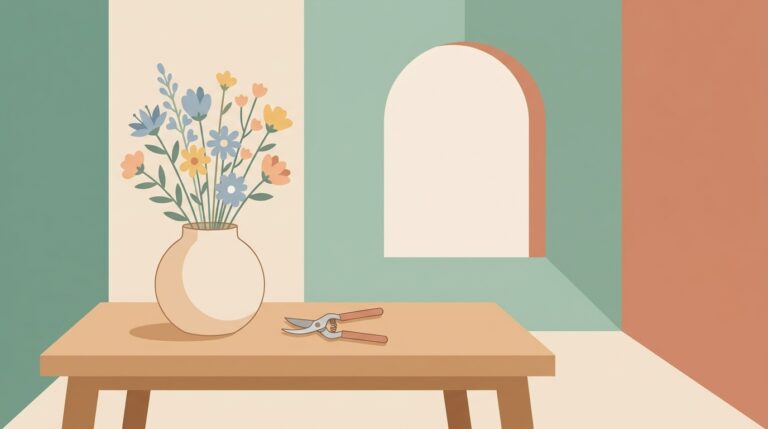
Speak Like a Local Florist in Seoul: Advanced Korean Gardening and Flower Class Phrases
Phase 1: Empathy (An Invitation to the Seoul Flower Atelier)
안녕하세요! Daily Hangul’s Senior Editor here.
Imagine walking into a sun-drenched floral studio in a quiet alley of Yeonnam-dong. The scent of damp soil, fresh eucalyptus, and sweet seasonal blooms fills the air. You’ve booked a highly coveted “One-Day Florist Masterclass” to experience Seoul’s famous minimalist botanical aesthetic.
However, as the instructor begins explaining how to structure the arrangement, you realize that standard textbook Korean didn’t prepare you for professional florist terminology. You hear words like sojae (소재) and yeobaek (여백), and you find yourself nodding along blankly.
If you’ve ever felt intimidated by the language barrier in a highly tactile, creative space, this guide is for you. Based on real classroom feedback from our global learners, we have curated a comprehensive guide to help you express your artistic vision, understand subtle design feedback, and connect deeply with Korean florists. Let’s elevate your botanical Korean to the C1 level!
Phase 2: Three Core Expressions Deep-Dive
1. 소재를 다듬다 (Sojae-reul dadeumda)
- Pronunciation: so-jae-reul da-deum-da (Sounds like “so-jay” + “da-deum-da” with a soft, rolling ‘d’)
- Meaning: Direct translation: “To trim the material.” In floristry, this is the precise equivalent of “conditioning/prepping the botanical elements” (removing thorns, stripping lower leaves, and cutting stems).
- K-Culture Moment: In trendy K-Dramas featuring sophisticated characters who run cozy botanical shops, you’ll often see them quietly snipping leaves at a wooden table. They aren’t just “cutting flowers” (꽃을 자르다); they are 소재를 다듬고 (conditioning the materials) to prepare for a masterpiece.
- Editor’s Insight: While beginners might say kkot-eul junbi-hada (꽃을 준비하다 – to prepare flowers), professional Korean florists refer to all botanical elements—including branches, leaves, and berries—as 소재 (sojae/material). 다듬다 is an incredibly versatile C1-level verb meaning to trim, refine, or groom.
- Situation Spectrum: Casual ✅ | Semi-formal ✅ | Formal ✅
- 🤔 Think About It: Why do you think Korean culture categorizes beautiful flowers, wild branches, and leaves under the single, grounded word 소재 (material)? How does this compare to how you view floral elements in your native language?
2. 여백의 미를 살리다 (Yeobaek-ui mi-reul sallida)
- Pronunciation: yeo-baek-ui mi-reul sal-li-da (Make sure to emphasize the double ‘l’ sound in sallida)
- Meaning: “To bring out the beauty of negative space (empty space).”
- K-Culture Moment: If you visit a modern art gallery in Seoul or attend a traditional flower arrangement (Dongyang Kkotkkoji) exhibition, you will hear this phrase constantly. It reflects the core East Asian aesthetic where empty space is treated as an active, beautiful design element rather than a void to be filled.
- Editor’s Insight: Western arrangements often focus on density and volume. In contrast, Korean floristry heavily emphasizes the natural line of branches and the airiness around each stem. When your teacher says “여백의 미를 살려보세요,” they are gently telling you to stop overcrowding your vase.
- Situation Spectrum: Casual ✅ | Semi-formal ✅ | Formal ✅
- 🤔 Think About It: How does the concept of “the beauty of empty space” challenge the Western instinct to fill every gap in an arrangement?
3. 조화를 이루다 (Johwa-reul iruda)
- Pronunciation: jo-hwa-reul ee-roo-da (Ensure the ‘h’ in johwa is gently breathed, not hard)
- Meaning: “To achieve harmony / to create a balanced ensemble.”
- K-Culture Moment: Frequently heard during evaluations in upscale florist schools in Gangnam, where instructors assess whether the main blooms, foliage, and the vase itself form a cohesive unit.
- Editor’s Insight: While eoullida (어울리다 – to suit/match) is used for simple visual matches (like clothes), 조화를 이루다 is a much more elegant, C1-level formulation that indicates dynamic, organic harmony between diverse elements.
- Situation Spectrum: Casual ⚠️ (Slightly poetic for casual chat) | Semi-formal ✅ | Formal ✅
- 🤔 Think About It: In what areas of your daily life, outside of floral design, do you strive to 조화를 이루다 (achieve harmony)?
Phase 3: Textbook Korean vs. Real-World Korean
Situation 1: Giving direction to branches and stems
- 📖 Textbook Style: “가지를 넓게 펼치세요.” (Gaji-reul neolp-ge pyeol-chi-se-yo.)
- “Spread the branches wide.” (A bit robotic and lacks artistic nuance.)
- 🗣️ Real-World Style: “사방으로 뻗어나가게 꽂아주세요.” (Sa-bang-eu-ro ppeon-deo-na-ga-ge kkoj-a-ju-se-yo.)
- “Insert them so they reach out in all directions/naturally extend outward.”
- 💡 Why the Difference? Real florists describe the movement of the plant. Ppeondeonagada (뻗어나가다 – to reach out/extend) captures the organic life of the branches.
Situation 2: Placing the focal point flower
- 📖 Textbook Style: “가장 예쁜 꽃을 중간에 두세요.” (Gaji-ang yeppeun kkot-eul jung-gan-e du-se-yo.)
- “Put the prettiest flower in the middle.” (Very basic and visually boring.)
- 🗣️ Real-World Style: “메인 꽃으로 시선을 잡아주세요.” (Mein kkot-eu-ro si-seon-eul jab-a-ju-se-yo.)
- “Capture the gaze using the main focal flower.”
- 💡 Why the Difference? C1 florists use design-oriented vocabulary. Si-seon-eul japda (시선을 잡다 – to capture the eyes/gaze) is a sophisticated way to talk about visual weight and focal points.
Phase 4: K-Culture Deep-Dive & Non-Verbal Manners
4-1. Nunchi & Physical Etiquette in the Studio
- The “Salposi” (살포시) Touch: When handling fragile blooms like ranunculus or sweet peas, Korean florists move with a quality called salposi—gently, delicately, almost floatingly. Grabbing stems too roughly signals a lack of refinement.
- Respecting the Tools: Pruning shears (kkot-gawi 꽃가위) are highly personal. Never grab an instructor’s shears without asking. When handing scissors to someone else, always present them with the handle facing the receiver, holding the closed blades gently in your palm.
4-2. Culture Code: “Planterior” (플랜테리어)
South Korea is currently obsessed with Planterior (Plant + Interior). Due to high-density apartment living, young Koreans create green sanctuaries in their homes. Unlike traditional gardening, which requires a backyard, Korean gardening focuses on balcony greening, terrariums, and delicate floral accents. This has birthed a highly sophisticated aesthetic characterized by slender, asymmetrical lines and minimalist containers (화기 – hwagi).
Phase 5: Real-World Roleplay Scenario
Setting: Green Canvas (그린 캔버스), an aesthetic floristry studio in Yeonnam-dong.
Character: Min-ji (민지), a warm, highly-skilled head florist with an eye for minimalist design.
Min-ji: 어서 오세요! 오늘 플로리스트 기초 클래스에 오신 걸 환영합니다. 평소에 꽃꽂이 해보신 적 있으신가요?
(Welcome! Welcome to today's basic florist class. Have you ever tried flower arranging before?)

You: 네, 취미로 조금 해봤지만, 한국어로 본격적으로 배우는 건 처음이라 좀 설레고 떨려요. 잘 부탁드립니다!
(Yes, I've done it a bit as a hobby, but learning it in Korean professionally for the first time makes me excited and a bit nervous. Please guide me well!)

Min-ji: 🎭 (미소를 지으며 꽃가위를 건넨다) 걱정 마세요! 손끝 감각이 좋으실 것 같아요. 먼저 오늘 사용할 소재부터 가볍게 다듬어 볼까요?
(🎭 Smiling as she hands you the shears: Don't worry! I have a feeling you have great manual intuition. Shall we start by lightly prepping the materials we'll use today?)

You: 네! 장미 줄기의 잔가시랑 아래쪽 잎들을 다듬으면 되죠? 줄기가 손상되지 않게 살살 해볼게요.
(Yes! I should trim the small thorns on the rose stems and the lower leaves, right? I'll do it gently so I don't damage the stems.)

Min-ji: 아주 잘하시네요! 이제 화기에 중심을 잡을 건데요, 너무 채우려고 하지 마시고 여백의 미를 살려보세요.
(You're doing great! Now we'll set the center in the vase. Don't try to fill it too much; try to bring out the beauty of negative space.)

You: 🎭 (가지를 조심스럽게 꽃으며) 여백의 미요? 너무 빽빽한 것보다 가지 자체의 곡선과 빈 공간이 어우러지게 하는 거군요!
(🎭 Carefully inserting a branch: The beauty of empty space? Ah! So instead of making it too dense, it's about letting the curves of the branches and the empty space work together!)

Min-ji: 🎭 (박수를 치며 공감한다) 맞아요, 바로 그거예요! 이제 메인 꽃들과 잎 소재가 전체적으로 조화를 이루도록 높낮이에 변화를 주세요.
(🎭 Clapping in agreement: Exactly, that's it! Now, vary the heights so that the main flowers and foliage achieve harmony overall.)

You: 네, 자연스러운 흐름이 생기도록 사방으로 뻗어나가는 느낌을 주면서 조화를 맞춰볼게요. 완성되어가는 모습을 보니 정말 뿌듯해요!
(Yes, I'll match the harmony while giving it a feeling of reaching out in all directions to create a natural flow. Seeing it come together makes me so proud!)
🔀 Interactive Choice Point
After arranging your main roses, you notice a dramatic, crooked branch of spirea (설유화). How do you incorporate it?
- Choice A: Snip it short and tuck it tightly under the main rose to fill the gap.
- Choice B: Keep its long, dramatic curve, strip the bottom leaves, and let it arch gracefully out of the side of the vase.
- Choice C: Place it dead-center, perfectly upright, so it balances the weight of the vase.
🧐 Feedback on your choice:
- Choice A (Bad): Oh no! Cutting this dramatic branch short destroys its natural movement and crowds the arrangement, losing the 여백의 미 (beauty of empty space).
- Choice B (Best): Perfect! By preserving the curve and clearing the base, you showcase the organic line of the branch, allowing it to 조화를 이루다 (achieve harmony) with the focal roses.
- Choice C (Risk): Caution! Placing a crooked branch completely straight makes it look awkward and forced. It disrupts the natural, flowing aesthetic prized in Korean design.
Phase 6: 10-Second Emotion Shadowing Drill
Train your intonation and emotional delivery. Pause briefly at each / mark and embody the designated emotion!
- [😍 Filled with artistic admiration]
“이 라인감이 / 정말 예술이네요! / 소재를 너무 잘 쓰셨어요.”
(This line flow / is truly art! / You used the botanical materials so well.)
Pronunciation: Ee line-gam-i / jeong-mal ye-sul-i-ne-yo! / sojae-reul neo-mu jal sseu-shyeot-eo-yo. -
[🤫 Gentle, encouraging, and instructional]
“줄기가 꺾이지 않게 / 살포시 잡고 / 다듬어 볼까요?”
(Gently hold it / so the stem doesn’t snap / and shall we trim it?)
Pronunciation: Jul-gi-ga kkeok-i-ji an-g-ge / sal-po-shi jap-go / da-deum-eo bol-kka-yo?
Phase 7: K-Culture Mini-Dictionary
- 소재 (Sojae | Materials): Historically meant “raw materials” for manufacturing, but in modern Seoul, it is the primary word for the foliage, branches, and fillers used in floral design.
- 사선 자르기 (Saseon Jareugi | Diagonal Cutting): Cutting stems at a 45-degree angle to maximize water absorption surface area. It is a fundamental technique taught in the first 5 minutes of any Korean flower class.
- 화기 (Hwagi | Vase/Container): A Hanja-derived word (
화= flower,기= vessel). While kkot-byeong (꽃병) is a common word for a glass vase, professional florists use hwagi to refer to ceramic, stone, or clay containers. - 잎 소재 (Ip Sojae | Foliage/Greens): The leafy green materials (like eucalyptus, ruscus, or fern) used to create structure and depth before placing the main flowers.
Phase 8: Traveler’s Survival Kit
Survival Expressions for Flower Class
- “물올림은 어떻게 하나요?” (Mul-ol-lim-eun eo-tteok-hae-yo?)
- Pro Tip: “How do I condition this for water absorption?” (Crucial question for keeping flowers alive longer after class).
- “가시 제거기 좀 빌릴 수 있을까요?” (Gasi je-geo-gi jom bil-ril su is-seul-kka-yo?)
- Pro Tip: “Could I borrow the thorn stripper?” (Saves your fingers from painful rose thorns).
- “사선으로 자르면 되나요?” (Sa-seon-eu-ro ja-reu-myeon doe-na-yo?)
- Pro Tip: “Should I cut this diagonally?” (Shows you already know the basics).
Editor’s Travel Note: Visiting Yangjae Flower Market
If you want to experience the source of all Seoul’s floral beauty, take the subway to Yangjae Citizen’s Forest Station and head to the Yangjae Flower Market (양재꽃시장).
* Digital Tool Tip: Use the Naver Map App to search for “양재꽃시장” as Google Maps is not fully optimized in Korea.
* Survival Tip: The cut flower market is open from 12:00 AM midnight to 1:00 PM afternoon (closed Sundays). Go around 10:00 AM for the best deals, and carry cash or be ready for bank transfers, though many modern stalls now accept major international credit cards.
Phase 9: “One Step Deeper” (Reflective Cultural Essay)
In Western floral design, humans often act as sculptors, shaping nature into symmetrical, geometric, and perfectly manicured forms. Traditional Korean gardening and flower arranging (Dongyang Kkotkkoji), however, operate on the principle of 순리 (Sunri)—following the natural order.
Instead of bending a branch to fit a human ideal, a Korean florist observes the natural curve of that branch and finds the exact spot in the vase where it can continue its natural direction. It is a philosophy of co-existence rather than dominance. By mastering these terms, you aren’t just learning to make pretty centerpieces; you are adopting a serene way of looking at nature and life itself.
💬 Your Turn: How do you approach arranging flowers or plants? Do you prefer perfect, lush symmetry, or do you appreciate asymmetrical, wild lines? Share your thoughts in the comments below!
Phase 10: FAQ & Common Mistakes
Q: Can I use the word “꽃꽂이” (Kkotkkoji) to describe a modern florist class?
A: Yes! While Kkotkkoji (꽃꽂이) is the traditional native Korean word for flower arranging, younger florists also use the loanword Flower Arrangement (플라워 어레인지먼트) or Flower Class (플라워 클래스). Using Kkotkkoji sounds delightfully classic and deeply respectful of the craft.
Q: What is the most polite way to ask the teacher to demonstrate a cutting technique again?
A: You can say: “선생님, 이 부분 커팅하시는 거 다시 한번만 보여주실 수 있나요?” (Seon-saeng-nim, ee bu-bun cutting-ha-si-neun geo da-si han-beon-man bo-yeo-ju-sil su in-na-yo?)
Q: What does it mean when the florist says my design has “라인감이 좋다” (Raingam-i joda)?
A: This is a massive compliment! It means your arrangement has an excellent sense of line, flow, and elegant curves, capturing the true spirit of Korean floral aesthetics.
🚨 Common Mistakes Warning Board
- The Mistake: Saying “꽃을 청소해요” (Kkot-eul cheongso-haeyo) to mean cleaning flowers.
- Correct Action: Use 소재를 다듬다 (Sojae-reul dadeumda). Cheongso is only for cleaning rooms or floors!
- The Mistake: Shoving flowers straight down into the floral foam.
- Correct Action: Cut the stem at a sharp angle (사선 자르기) and insert it smoothly in a single motion so the foam doesn’t crumble.
- The Mistake: Using “중간” (jung-gan) repeatedly for focal points.
- Correct Action: Use 메인 (Mein) or 초점 (Cho-jeom) to sound like a C1 advanced learner.
Phase 11: Action Mission & K-Culture Challenge
Your 3-Step Action Mission
- 🥉 Bronze: Practice saying “여백의 미” out loud 5 times, paying attention to the smooth transition between the vowels.
- 🥈 Silver: Post a photo of a plant or flower on your Instagram and caption it: “오늘의 소재가 주는 아름다움” (The beauty of today’s botanical materials).
- 🥇 Gold: Book a flower class in Seoul and successfully use the phrase “사방으로 뻗어나가게 꽂아볼게요” (I will arrange them so they extend out in all directions) during your session!
🎮 K-Culture Mission
Watch a K-Drama set in a café or traditional home (like Run On or Hometown Cha-Cha-Cha). Pay close attention to the background plants and vases. Count how many times you see asymmetrical arrangements utilizing 여백의 미 (negative space) versus dense, round bouquets!
Phase 12: Interactive Quiz Challenge
Test your florist Korean knowledge! Click the toggles below to reveal the answers.
1. Situation-Based Judgement
Q: Your instructor tells you, “이 꽃은 얼굴이 크니까 시선을 잡는 위치에 배치해 보세요.” Where should you place this flower?
▶ Click to reveal the Answer & Explanation
Answer: Place it at the focal point (usually lower-center or slightly off-center) where it immediately catches the viewer’s eye, acting as the “메인 꽃” (main flower). Do not hide it in the background foliage!
2. Fill-in-the-Blank
Q: 꽃이 잘 보이려면 가지와 꽃 사이에 적절한 ( )의 미가 필요해요.
▶ Click to reveal the Answer & Explanation
Answer: 여백 (Yeobaek)
Explanation: To let the flowers shine, you need the beauty of negative space (여백의 미) between the branches and blooms.
3. True or False
Q: In Korea, “소재” (sojae) only refers to synthetic florist materials like floral foam, wire, and plastic pots. (T/F)
▶ Click to reveal the Answer & Explanation
Answer: False
Explanation: “소재” refers to all organic botanical design elements, including leaves, wild branches, berries, and structural greenery.







