

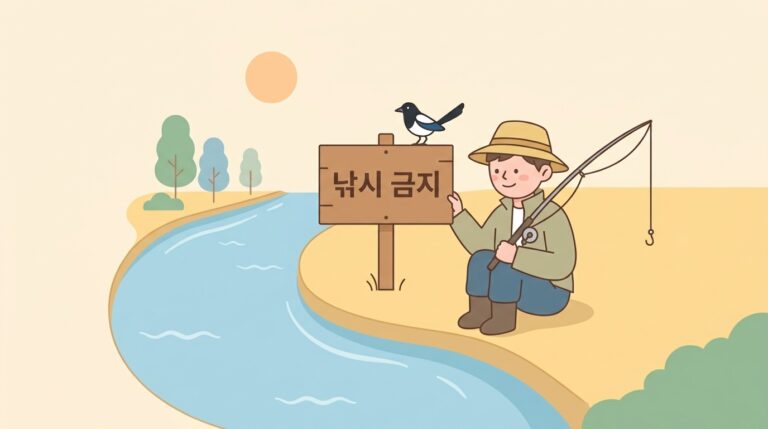
Cast Your Line, Not Your Cash! 🎣 A Friendly Guide to Korea’s No-Fishing Zones and Fines
Phase 1: Empathy (스토리 몰입형 오프닝)
안녕하세요! (Annyeonghaseyo!) It’s your trusty Korean culture navigator from Daily Hangul.
Imagine this: You’ve spent the week watching popular Korean fishing variety shows like The Fishermen and the City (도시어부), and you’re absolutely pumped. You pack your gear, grab some convenience store snacks, and head to a gorgeous spot along the Han River or a serene reservoir in Gangwon Province. The breeze is perfect, the water is sparkling, and you’re just about to cast your line when a local passerby looks at you with a worried expression and says, “여기서 하시면 벌금 물텐데요…” (If you do it here, you might get fined…).
Suddenly, the romantic K-fishing dream turns into a mini panic attack. Where can I fish? What does that sign say? Am I about to get a massive fine?
If you’ve ever felt overwhelmed by the sudden fear of breaking local rules in a foreign country, you are not alone! Many of our intermediate learners have shared how confusing Korea’s local fishing regulations (낚시 규제) can be. Today, we’re going to dive deep into Korea’s No-Fishing Zones (낚시 금지 구역) and the vocabulary you need to avoid heavy fines, blend in with the local fishing community, and experience that legendary son-mat (손맛 – the thrilling ‘hand-taste’ of catching a fish) safely!
Phase 2: 핵심 표현 3선 심층 분석 (Three Key Expressions)
Let’s master the three most critical expressions you’ll need on the Korean waters. These will save your wallet and help you converse like a seasoned local pro.
1. 낚시 금지 구역 (nak-si geum-ji gu-yeok)
- Pronunciation: Nak-see geum-jee goo-yeok (Rhymes with “taxi” + “dream-jee” + “who-yuck”)
- Meaning: No-Fishing Zone / Restricted Fishing Area
- K-Culture Moment: In K-Dramas featuring peaceful countryside escapes, you’ll often see characters sitting near beautiful reservoirs. However, in reality, many of these ecological reserves are strictly designated as 낚시 금지 구역 to protect the local ecosystem.
- Editor’s Insight: 금지 (geum-ji) means “prohibition,” and 구역 (gu-yeok) means “zone” or “area.” If you see these five characters on a red or yellow banner near water, pack up immediately!
- Situation Spectrum:
- Casual: ⚠️ (Used when talking to friends: “여기 낚시 금지 구역이네.”)
- Semi-formal: ✅ (Perfect for asking locals: “여기 혹시 낚시 금지 구역인가요?”)
- Formal: ✅ (Found on official government signs: “본 지역은 낚시 금지 구역입니다.”)
- 🤔 Think About It: How does your home country mark restricted natural zones? Is it as strictly categorized as Korea’s urban rivers?
2. 과태료가 부과되다 (gwa-tae-ryo-ga bu-gwa-doe-da)
- Pronunciation: Gwa-tae-ryo-gah boo-gwa-doe-dah (Think “gwa” as in guava + “tae” as in tae-kwondo + “ryo” as in fee)
- Meaning: To be fined / To have a fine imposed
- K-Culture Moment: This is the administrative term you’ll see on warning signs near public parks or rivers.
- Editor’s Insight: While colloquial Korean uses 벌금 (beol-geum) for any type of fine, legally, 과태료 (gwa-tae-ryo) refers to administrative fines (non-criminal infractions, like illegal parking or illegal fishing), whereas 벌금 is a criminal fine. Knowing the difference shows high B2-level proficiency!
- Situation Spectrum:
- Casual: 🚫 (Too stiff for casual chat; use “벌금 물다” instead)
- Semi-formal: ⚠️ (Used when discussing rules formally with park rangers)
- Formal: ✅ (Used in official notices: “위반 시 과태료가 부과됩니다.”)
- 🤔 Think About It: Why do you think Korean public signs prefer using the passive voice “부과되다” (to be imposed) rather than “우리가 부과합니다” (we impose)? (Hint: It maintains a polite, objective distance!)
3. 손맛을 보다 (son-ma-seul bo-da)
- Pronunciation: Son-mah-seul boh-dah (Literally “to see the taste of the hand”)
- Meaning: To feel the thrilling tug of a fish on the line / To have a good catch
- K-Culture Moment: You will hear this phrase in literally every single episode of Korean fishing shows. When an angler hooks a massive sea bream, they close their eyes and yell, “이게 바로 손맛이지!” (This is the true hand-taste!).
- Editor’s Insight: This is a beautiful idiomatic expression. It describes the physical vibration and tension felt through the fishing rod when a fish bites and fights back. To Koreans, fishing isn’t just about eating the fish; it’s about savoring the 손맛.
- Situation Spectrum:
- Casual: ✅ (Perfect for bonding with local anglers: “오늘 손맛 좀 보셨어요?”)
- Semi-formal: ✅ (Friendly and natural standard Korean)
- Formal: ⚠️ (A bit too idiomatic for a formal presentation, but completely fine in casual business dinners)
- 🤔 Think About It: Does your language have a unique sensory word to describe the physical sensation of catching a fish?
Phase 3: 교과서 한국어 vs 진짜 한국어 (Textbook vs. Real Korean)
Let’s compare the stiff sentences found in basic grammar books with the vibrant, natural phrasing used by real Korean anglers.
Situation 1: Asking if fishing is permitted in a certain spot
- 📖 Textbook Korean: “여기서 낚시를 해도 괜찮습니까?” (Is it okay if I fish here?)
- 🗣️ 진짜 한국어: “여기 낚시 해도 되는 데예요?” (Is this a place where fishing is allowed?)
- 💡 Why the difference? Textbook Korean relies on formal “~해도 괜찮습니까?”. Real Koreans use the highly natural noun-modifying structure “~해도 되는 데” (a place where it’s okay to do…) which sounds much warmer and less robotic.
Situation 2: Warning someone about a potential fine
- 📖 Textbook Korean: “낚시를 하면 벌금을 내야 합니다.” (If you fish, you must pay a fine.)
- 🗣️ 진짜 한국어: “여기서 낚시하면 딱지 끊겨요.” (If you fish here, you’ll get ticketed/fined.)
- 💡 Why the difference? 딱지를 끊다 means to issue a ticket (like a parking ticket or fine). In the passive voice, 딱지 끊기다 is the ultimate colloquial way to say “to get caught and ticketed.” It sounds incredibly natural and local!
Phase 4: K-Culture 딥다이브 & 비언어적 매너 (Culture & Manners)
4-1. The Art of “Nunchi” (눈치) at the Fishing Spot
When you arrive at a Korean fishing spot, don’t just set up your gear immediately. Run a quick check using your nunchi (social intuition):
1. The Trash Rule (쓰레기 되가져가기): Cleanliness is a massive social contract in Korea. Always bring a plastic bag to pack out every single piece of your trash. Leaving bait containers or line scraps behind will get you heavy glares (and potentially reported via local civil apps).
2. Keep Your Distance: If another angler is already positioned, don’t cast too close. Give them at least 5 to 10 meters of breathing room. A polite nod of the head (목인사) when you pass by is the golden standard of K-fishing etiquette.
4-2. The “Urban Fisherman” Phenomenon (도시어부)
Fishing in Korea was once stereotyped as a hobby exclusively for middle-aged fathers. However, with the explosive popularity of the reality show 도시어부 (The Fishermen and the City), it has transformed into a trendy, youthful lifestyle hobby. Younger generations now participate in 짬낚 (quick fishing trips in between busy schedules) and invest in aesthetic, high-end gear. Knowing this trend will instantly help you strike up a conversation with younger locals on the docks!
Phase 5: 실전 롤플레이 시나리오 (Real-Life Roleplay)
Setting: You are at a beautiful riverbank in Gapyeong. You’ve just unpacked your rod. A friendly-looking local middle-aged angler (Uncle Min-woo) approaches you.
Characters:
* Hans (You): An intermediate Korean learner and passionate traveler.
* Min-woo (민우 삼촌): A local fishing veteran with a warm heart but a quick way of speaking.
- 민우: (🎭 approaching with a friendly smile, pointing at your rod) 어라? 외국인 분이 낚시하러 오셨네! 장비가 아주 제대로인데요?
- Eora? Oegugin buni nakshihareo osyeonne! Jangbiga aju jedaeroindeyo?
- (Oh? A foreigner came to fish! Your gear looks like the real deal!)
- Hans: (🎭 bowing politely) 아, 감사합니다! 오늘 날씨가 좋아서 좀 던져보려고요.
- Ah, gamsahabnida! Oneul nalssiga joaseo jom deonjyeoboryeogoyo.
- (Ah, thank you! The weather is so nice today, so I was thinking of casting a few times.)
- 민우: (🎭 looking around, then whispering slightly) 근데… 여기 낚시 금지 구역인 건 아시죠? 저기 현수막 안 보여요?
- Geunde… yeogi nakshi geumji guyeogin geon asijyo? Jeogi hyeonsumak an boyeoyo?
- (But… you do know this is a no-fishing zone, right? Don’t you see that banner over there?)
- Hans: (🎭 startled, looking at the distant red banner) 어, 정말요? 저 빨간 현수막 말씀이세요? 몰랐어요!
- Eo, jeongmaryo? Jeo ppalgan hyeonsumak malsseumiseyo? Mollasseoyo!
- (Oh, really? Do you mean that red banner? I had no idea!)
- 민우: (🎭 nodding) 맞아요. 여기서 하다가 단속 걸리면 바로 과태료 부과돼요. 딱지 끊기면 돈 아깝잖아.
- Majayo. Yeogiseo hadaga dansok geollyeomyeon baro gwataeryo bugwadoeyo. Ttakji kkeunkgimyeon don akkapjana.
- (Yeah. If you get caught by the crackdown here, you’ll be fined immediately. It’s a waste of money to get ticketed.)
- Hans: (🎭 rubbing the back of his neck nervously) 큰일 날 뻔했네요. 가르쳐 주셔서 진짜 감사합니다. 혹시 이 근처에 낚시 해도 되는 데가 있을까요?
- Keunil nal ppeonhaetneyo. Gareuchyeo jusyeoseo jinjha gamsahabnida. Hoksi i geuncheoe nakshi haedo doeneun dega isseulkkayo?
- (That was a close call! Thank you so much for telling me. By any chance, is there a place nearby where fishing is allowed?)
- 민우: (🎭 pointing towards the bridge down the river) 여기서 한 10분만 내려가면 대교 밑 있죠? 거기는 괜찮아요. 거기가 은근히 손맛이 좋아!
- Yeogiseo han sipbunjman naeryogayeon daegyo mit itjyo? Geogineun gwaenchanchayo. Geogiga eungeunhi sonmasi joa!
- (If you go down about 10 minutes from here, see under that big bridge? That spot is fine. You can actually get a pretty good feel for the fish there!)
- Hans: (🎭 smiling brightly with relief) 아, 다행이네요! 대교 밑으로 얼른 이동해야겠어요. 오늘 삼촌 덕분에 살았습니다!
- Ah, dahaengineyo! Daegyo miteuro eolleon idonghaeyagetseyo. Oneul samchon deokbune saratnida!
- (Ah, what a relief! I should move to the bridge right away. You saved my day today, Uncle!)
🔀 Choose Your Next Move!
Scenario: A local authority officer approaches you while you are packing up. How do you respond?
- A) “죄송합니다! 제가 한국 규칙을 잘 몰랐어요. 지금 바로 치울게요.” (I’m sorry! I didn’t know the Korean rules well. I will pack up right now.)
- 🟢 Best: Polite, apologetic, and cooperative. Most officers will let you off with a warning if you show immediate compliance.
- B) “여기 표지판이 잘 안 보였어요. 제 잘못 아니에요!” (The sign wasn’t clearly visible here. It’s not my fault!)
- 🔴 Bad: Defensive. Blaming the signage can make the officer strictly enforce the administrative fine out of spite.
- C) “아, 그냥 가볍게 구경만 하려고 던져본 거예요.” (Ah, I just cast it once just to take a quick look.)
- ⚠️ Risk: Making excuses. In Korea, even “just casting once” in a protected ecological zone counts as fishing. It’s safer to apologize immediately.
Phase 6: 10초 감정 섀도잉 드릴 (Shadowing Drill)
Practice these high-frequency emotional sentences to master native-like rhythm and intonation. Pay close attention to the / pauses and the emotional cues!
- [😰 Worried & Urgent]
- “여기서 / 낚시하다가 / 딱지 끊기면 / 진짜 억울하잖아요!”
- Yeogiseo / nakshihadaga / ttakji kkeunkgimyeon / jinjha eogulhajanayo!
- (If you get ticketed while fishing here, it would be so unfair!)
- [🤩 Excited & Thrilled]
- “우와, / 대교 밑에서 / 드디어 / 제대로 된 / 손맛을 봤네요!“
- Uwa, / daegyo mitesoe / deudieo / jedaero doen / sonmaseul bwatneyo!
- (Wow, I finally got a real taste of the catch under the bridge!)
Phase 7: K-Culture 미니 사전 (Mini Dictionary)
| Word | Pronunciation | English Meaning | Practical Usage Insight |
|---|---|---|---|
| 짬낚 | Jjam-nak | Quick / spare-time fishing | A compound of 짬 (spare time) and 낚시 (fishing). Perfect for a quick 1-2 hour trip after work. |
| 꽝치다 | Kkwang-chi-da | To catch absolutely nothing | Literally “to hit a zero/blank.” If you go home empty-handed, you say: “오늘 결국 꽝쳤어.” |
| 입질 | Ip-jil | A bite / nibble | The movement of bait when a fish tests it. “입질이 오다” means “I’m getting a bite!” |
| 생활낚시 | Saeng-hwal-nak-si | Casual / Lifestyle fishing | Fishing that is easy, close to residential areas, and doesn’t require complex professional gear. |
Phase 8: 여행자를 위한 생존 키트 (Survival Kit for Travelers)
Survival Phrases TOP 3
- “여기 낚시 금지 구역인가요?” (Is this a no-fishing zone?) -> Ask this to any local near the water to stay safe.
- “여기 단속 자주 나와요?” (Do they do crackdowns here often?) -> A sneaky way to ask how strictly the rules are enforced.
- “요즘 뭐가 잘 잡혀요?” (What is biting well these days?) -> The ultimate icebreaker for local anglers.
📝 Editor’s Travel Note
Before heading out, make sure to download the Naver Map App or KakaoMap. These apps show clear boundaries of parks and conservation areas. Also, look up the Korean app “어신” (Eosin / Fisherman’s Compass). It provides real-time marine weather, fishing points, and legal size limits for different fish species in Korean waters!
(Disclaimer: Regulations change periodically; always check local notices on-site.)
Phase 9: “한 발 더 깊이” (Deep Thinking Question)
In Korea, natural spaces like rivers and oceans are treated as shared, collective treasures. This is why public rules regarding waste management and ecological preservation are strictly regulated by the community. While individual freedom is valued, the collective well-being of the nature reserve takes precedence. This is deeply tied to the Korean concept of 공동체 의식 (gong-dong-che ui-sik – community consciousness).
💬 Your Turn: How does your culture balance environmental preservation with personal recreational freedom? Do you have strict zoning laws for hobbies like fishing or camping? Share your thoughts in the comments below!
Phase 10: FAQ & 오해 방지 (FAQ & Common Mistakes)
Q: Can I fish anywhere along the famous Han River in Seoul?
A: Absolutely not! Most parts of the Han River are strictly designated as ecological preservation zones or water supply protection areas where fishing is banned. There are very specific designated areas where fishing is allowed under tight rules (e.g., no multi-hook lines, no motorized boats). Always look for the green “낚시 허용 구역” (Fishing Allowed Zone) signs.
Q: What is the average fine if I get caught in a No-Fishing Zone?
A: Under Korean Fishery Resources Management laws, fines (과태료) can range from 50,000 KRW (approx. $40 USD) up to 3,000,000 KRW ($2,300 USD) depending on the severity, location, and whether it’s a repeat offense.
Q: Is night fishing (밤낚시) allowed in Korea?
A: Yes, night fishing is incredibly popular in Korea! However, the same zoning laws apply. Some areas allow daytime fishing but restrict overnight camping or fires. Always check if “야간 낚시” is permitted at that specific spot.
🚨 Common Mistakes Board (흔한 실수)
- Using live bait where it is banned: Many reservoirs ban live/chemical paste bait (떡밥) to prevent water pollution. Use artificial lures (루어) instead.
- Ignoring fish length regulations: Keeping undersized fish (금지체장) is a crime. For example, catching baby sea bass or trout under a certain limit can result in immediate fines.
- Not having your ID: If local authorities conduct a crackdown (단속), you must show your passport or Alien Registration Card (외국인등록증).
Phase 11: 액션 미션 & 참여 유도 (Action Missions)
- 🥉 Bronze Mission: Write a comment below using the word “낚시 금지 구역” in a sentence.
- 🥈 Silver Mission: Share this post on your social media and tag a friend you want to go 생활낚시 with this weekend!
- 🥇 Gold Mission: Next time you go near a Korean river or lake, take a photo of a warning sign, identify if it says “과태료” or “금지”, and send it to our Daily Hangul community channel for verification!
🎮 K-Culture Bonus Mission: Search YouTube for “도시어부” or “생활낚시 Vlog” and find at least one clip where they scream “손맛”!
Phase 12: 인터랙티브 퀴즈 챌린지 (Quiz Challenge)
Test your knowledge before you hit the waters!
1. What does “딱지 끊기다” mean in colloquial Korean?
- A) To catch a legendary huge fish
- B) To get ticketed or fined
- C) To lose your fishing hook in the rocks
2. Fill in the blank:
“여기서 낚시하시면 과태료가
🔍 Click here for the answers & explanations!
- Answer: B
- Explanation: “딱지 끊기다” is the native passive slang for getting ticketed by police or local officials!
- Answer: 부과됩니다 (bu-gwa-doeb-ni-da)
- Explanation: “과태료가 부과되다” is the official administrative term meaning “a fine will be imposed.”
- Answer: True
- Explanation: Leaving trash behind is a huge taboo in Korea and can easily lead to reports and fines under environmental protection laws. Always pack out your trash!
- Explanation: Leaving trash behind is a huge taboo in Korea and can easily lead to reports and fines under environmental protection laws. Always pack out your trash!







