

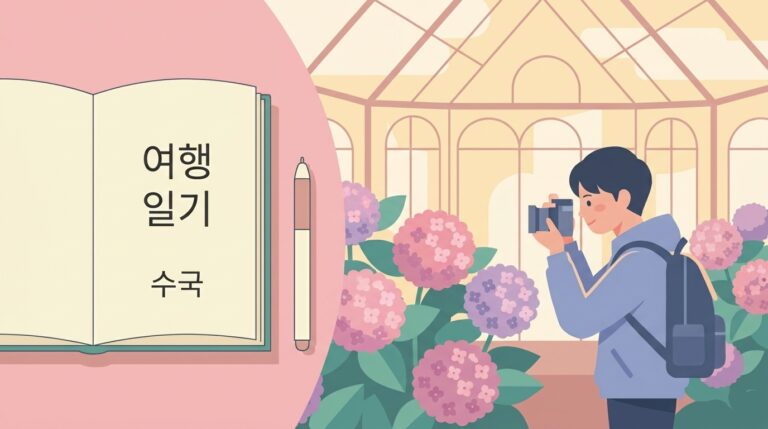
Escape to a Green Oasis: Survival Korean for Your K-Drama Style Botanical Garden Date
안녕하세요! (An-nyeong-ha-se-yo!) Hello! It’s your favorite Korean best friend and Daily Hangul editor.
Have you ever watched a K-drama where the main characters walk through a magical, glowing greenhouse filled with beautiful green leaves and colorful flowers? Places like the Seoul Botanic Park (서울식물원) or the dreamy Garden of Morning Calm (아침고요수목원) are absolute must-visits when you come to Korea. They are the ultimate spots for relaxing, taking gorgeous photos, and experiencing that peaceful “healing” (힐링) culture Koreans love so much.
But as an A1 beginner, stepping into a botanical garden can feel a bit intimidating. What if you want to know the name of a stunning flower? What if you want to ask someone to take a photo of you but don’t know how? Don’t worry! Today, we are going to learn super easy, bite-sized Korean expressions that will make you feel like a confident local walking through a green paradise.
Phase 2: Three Core Expressions for Your Botanical Garden Adventure
Here are three magic phrases you can use immediately. They are short, polite, and perfect for beginners!
1. 이 꽃 이름이 뭐예요? (I kkot i-reum-i mwo-yeo-yo?)
- Pronunciation: Ee kkot ee-reum-ee mwo-yo-yo? (Think of “kkot” sounding like “coat” but with a sharp ‘t’ at the end, and “mwo-yeo-yo” sounding like “mwo-yo-yo” with a soft ‘uh’ in the middle.)
- Meaning: What is the name of this flower?
- K-Culture Moment: Picture yourself pointing at a rare, glowing orchid in a glass greenhouse. A friendly botanist is standing nearby, and you ask this with a bright smile.
- Editor’s Insight: “이” (ee) means “this”, “꽃” (kkot) means “flower”, and “이름” (i-reum) means “name”. If you see a beautiful tree instead, you can simply swap “꽃” with “나무” (na-mu / tree): 이 나무 이름이 뭐예요?
- Situation Spectrum:
- Casual: 이 꽃 이름이 뭐야? (⚠️ Only for close friends)
- Semi-formal: 이 꽃 이름이 뭐예요? (✅ Best for staff/strangers)
- Formal: 이 꽃의 이름은 무엇입니까? (🚫 Too stiff for a garden visit!)
- 🤔 Think About It: In English, we often say “What is this called?” But in Korean, asking for the flower’s “이름” (name) feels more personal and respectful to nature.
2. 여기서 사진 찍어도 돼요? (Yeo-gi-seo sa-jin jjig-eo-do dwae-yo?)
- Pronunciation: Yuh-gi-suh sah-jin jjeek-uh-do dway-yo?
- Meaning: Can I take a photo here?
- K-Culture Moment: You find a breathtaking wall of roses, but there is a small barrier. Before posing, you politely ask a nearby staff member.
- Editor’s Insight: Korea is a photo-friendly country, but some special exhibition zones or research areas restrict photography. Asking this first shows incredible “nunchi” (tact and politeness)!
- Situation Spectrum:
- Casual: 여기서 사진 찍어도 돼? (⚠️)
- Semi-formal: 여기서 사진 찍어도 돼요? (✅ Perfect)
- Formal: 여기서 사진 촬영이 가능합니까? (🚫 Too formal for daily life)
3. 와, 진짜 예뻐요! (Wa, jin-jja ye-ppeo-yo!)
- Pronunciation: Wah, jeen-jja yeh-buh-yo! (Make sure to double the ‘p’ sound in “ye-ppeo-yo” to sound cute and natural!)
- Meaning: Wow, it is really pretty!
- K-Culture Moment: You walk into the main greenhouse dome and the warm air, sweet flower scents, and giant palm trees hit you all at once.
- Editor’s Insight: “진짜” (jin-jja) means “really” or “honestly”. It adds natural emotion to your sentence. Locals say this constantly!
- Situation Spectrum:
- Casual: 와, 진짜 예쁘다! (✅ Great for self-exclamation or with friends)
- Semi-formal: 와, 진짜 예뻐요! (✅ Perfect for sharing your joy politely)
- Formal: 매우 아름답습니다. (🚫 Sounds like a documentary narrator!)
Phase 3: Textbook Korean vs. Real Korean
Let’s look at how textbooks teach you to speak versus how real Koreans actually talk in a beautiful garden.
Situation 1: Identifying a rose
- 📖 Textbook style: “이것은 장미꽃입니다.” (I-geos-eun jang-mi-kkot-im-ni-da. / This is a rose flower.)
- 🗣️ Real conversational style: “이거 장미예요.” (I-geo jang-mi-yeo-yo. / This is a rose.)
- 💡 Why the difference? Textbooks love using “이것은” (-geos-eun) and the formal “-입니다” (-im-ni-da). In real life, we shorten “이것은” to a much softer “이거” (i-geo) and use the friendly “-예요” (-yeo-yo) ending.
Situation 2: Praising the view
- 📖 Textbook style: “풍경이 매우 아름답습니다.” (Pung-gyeong-i mae-u a-reum-dap-sum-ni-da. / The scenery is very beautiful.)
- 🗣️ Real conversational style: “우와, 진짜 예뻐요!” (U-wa, jin-jja ye-ppeo-yo! / Wow, it’s really pretty!)
- 💡 Why the difference? “아름답습니다” is mostly used in writing or formal presentations. For daily life, “예뻐요” (pretty) is the king of adjectives!
Phase 4: K-Culture Deep Dive & Non-verbal Manners
4-1. Greenhouse Etiquette & The “K-Photo” Manners
When visiting a Korean botanical garden, you will see crowds of stylish locals searching for the perfect photo angle. To blend in seamlessly:
1. The “Eye-level” Gesture: If you want someone to take your photo, hold your phone, look at them, and slightly bow your head while saying “저기요…” (Jeo-gi-yo / Excuse me).
2. Look, Don’t Touch: Koreans highly value keeping public spaces pristine. Pointing at a leaf closely is fine, but actually grabbing or bending a branch is a major social no-no.
4-2. The “Healing” (힐링) and “Pool-meong” (풀멍) Trend
You might know “Meong” (멍) as a state of spacing out. Koreans love “Pool-meong” (풀멍), which means quietly “spacing out while looking at green plants.” In a busy city like Seoul, botanical gardens are popular sanctuary zones where people sit silently with a coffee just staring at trees to cure their work stress.
Phase 5: Live Roleplay Scenario
Setting: The beautiful indoor glass dome of the Seoul Botanic Park.
Characters:
* Minjun (민준): A friendly garden staff member wearing an apron.
* Lily (릴리): A curious traveler looking for the perfect photo spot.
민준: 안녕하세요! 도움이 필요하세요?
(An-nyeong-ha-se-yo! Do-um-i pil-yo-ha-se-yo?)
[😊 Greeting warmly] "Hello! Do you need some help?"
릴리: 아, 안녕하세요! 저... 이거 꽃 이름이 뭐예요?
(Ah, an-nyeong-ha-se-yo! Jeo... i-geo kkot i-reum-i mwo-yeo-yo?)
[👉 Pointing gently at a bright blue flower] "Ah, hello! Um... what is the name of this flower?"
민준: 아, 이거요? 이건 '수국'이에요. 여름에 진짜 예쁘게 피어요.
(Ah, i-geo-yo? I-geon 'su-guk'-i-e-yo. Yeo-rum-e jin-jja ye-ppeu-ge pi-eo-yo.)
[smile] "Ah, this one? It's a 'Su-guk' (Hydrangea). It blooms really beautifully in summer."
릴리: 수국... 우와, 진짜 예뻐요!
(Su-guk... u-wa, jin-jja ye-ppeo-yo!)
[🤩 Eyes sparkling with joy] "Su-guk... Wow, it is really pretty!"
민준: 맞아요. 많은 분들이 여기서 사진을 많이 찍으세요.
(Ma-ja-yo. Man-eun bun-deul-i yeo-gi-seo sa-jin-eul man-i jjig-eu-se-yo.)
[📸 Gesturing to a pathway] "That's right. Many people take a lot of photos here."
릴리: 아! 여기서 사진 찍어도 돼요?
(Ah! Yeo-gi-seo sa-jin jjig-eo-do dwae-yo?)
[🥺 Asking politely for permission] "Ah! Can I take a photo here?"
민준: 네, 당연하죠! 제가 한 장 찍어 드릴까요?
(Ne, dang-yeon-ha-jo! Je-ga han jang jjig-eo deu-ril-kka-yo?)
[🙋♂️ Offering friendly help] "Yes, of course! Shall I take a photo for you?"
릴리: 정말요? 감사합니다!
(Jeong-mal-yo? Gam-sa-ham-ni-da!)
[🙌 Giving a polite hand bow] "Really? Thank you so much!"
🔀 Choose Your Path!
Minjun holds your phone and says, “하나, 둘, 셋! (One, two, three!)” and takes the photo. What do you say next?
- Option A: “감사합니다! 진짜 예뻐요!” (Gam-sa-ham-ni-da! Jin-jja ye-ppeo-yo!)
- 💖 Feedback (Best!): You thanked him and complimented his photography skills! Minjun will feel proud and happy.
- Option B: “고마워.” (Go-ma-wo.)
- ⚠️ Feedback (Risk): This is casual Korean. Since Minjun is a stranger and staff member, saying “Go-ma-wo” might sound slightly rude. Stick to “Gam-sa-ham-ni-da!”
- Option C: “안녕히 계세요!” (An-nyeong-hi gye-se-yo!)
- 🚫 Feedback (Bad): While polite, saying “Goodbye” immediately without checking your photo or saying thank you feels a bit cold and abrupt!
Phase 6: 10-Second Emotion Shadowing Drill
Let’s practice speaking with real native emotions! Pause briefly at the slashes (/).
- [😊 Bright & Happy]
- “와, / 진짜 / 예뻐요!”
- (Wah, / jin-jja / ye-ppeo-yo!)
- [🥺 Polite & Wondering]
- “여기서 / 사진 / 찍어도 돼요?”
- (Yeo-gi-seo / sa-jin / jjig-eo-do dwae-yo?)
- [🙋♀️ Extremely Grateful]
- “정말요? / 감사합니다!”
- (Jeong-mal-yo? / Gam-sa-ham-ni-da!)
Phase 7: K-Culture Mini Dictionary
- 식물원 (sing-mul-won) | Botanical Garden / Arboretum
- “식물” means plant, and “원” means garden/park. Combine them to get a botanical oasis!
- 인생샷 (in-saeng-syat) | “Life Shot” (Once-in-a-lifetime photo)
- A slang combining “인생” (life) and “shot” (photo). Korean botanical gardens are famous spots for catching your In-saeng-syat.
- 꽃구경 (kkot-gu-gyeong) | Flower viewing
- Spring in Korea is all about Kkot-gu-gyeong—walking around with family or partners to enjoy cherry blossoms or tulips.
- 힐링 (hil-ling) | Healing / Relaxing
- Used as a noun to describe any activity that refreshes your soul, like drinking tea surrounded by giant ferns.
Phase 8: Traveler’s Survival Kit
Survival Phrases TOP 3
- 입구 어디예요? (Ip-gu eo-di-yeo-yo?)
- Meaning: Where is the entrance?
- Pro Tip: Botanical gardens can be massive. If you get lost in the greenery, use this!
- 화장실 어디예요? (Hwa-jang-sil eo-di-yeo-yo?)
- Meaning: Where is the restroom?
- 여기 지도 있어요? (Yeo-gi ji-do is-seo-yo?)
- Meaning: Is there a map here?
🗺️ Editor’s Travel Note
When traveling to places like the Seoul Botanic Park or Garden of Morning Calm, do not rely solely on Google Maps, as it does not always update walking routes inside parks perfectly. Instead, make sure to download the Naver Map App to search for bus schedules and locate restroom buildings inside the garden complexes easily!
Phase 9: “한 발 더 깊이” (Go One Step Deeper)
In western countries, botanical gardens are often viewed as places of scientific study or quiet academic walks. In Korea, however, nature spaces are deeply tied to the concept of 공동체 (gong-dong-che / community) and emotional sharing. You will rarely see people walking completely alone; instead, you will see families wearing matching outfits, couples taking romantic photos for their social media, and groups of friends laughing together. A Korean garden is not just a collection of plants; it is a shared background scenery for creating happy human memories.
💬 Your Turn: Have you ever experienced a quiet “healing” moment in nature? What is your favorite plant or flower? Let me know in the comments below!
Phase 10: FAQ & Common Mistakes
Q: Can I use “예쁘다” (ye-ppeu-da) to describe a tree?
A: Yes! While textbooks often apply “예쁘다” (pretty) to flowers or people, native speakers use “예뻐요” for trees, leaves, sky, and even a cute flowerpot!
Q: What is the difference between 수목원 (su-mok-won) and 식물원 (sing-mul-won)?
A: “식물원” (Botanic Garden) usually refers to indoor glass domes focusing on a wide variety of exotic plants. “수목원” (Arboretum) focuses more on outdoor trees, forests, and large walking trails.
Q: Can I say “이거 뭐야?” (I-geo mwo-ya?) to a staff member?
A: Please avoid this! “이거 뭐야?” is very casual (banmal). Always add “-요” at the end to make it respectful: “이거 뭐예요?” (I-geo mwo-yeo-yo?).
🚨 Common Mistakes Board
- Mistake 1: Grabbing a flower and asking “이거 얼마예요?” (How much is this?)
- Why: Botanical gardens are not florist shops! Most plants are for exhibition only.
- Correct Action: If you want to buy small plants, look for the designated garden shop near the exit, usually labeled 기념품숍 (Gift Shop) or 화원 (Flower Shop).
- Mistake 2: Saying “사진 찍어!” (Take a picture!) to a stranger.
- Why: This sounds like a harsh command.
- Correct Action: Soften it politely by asking, “사진 한 장 찍어 주실 수 있어요?” (Could you please take a photo for me?).
Phase 11: Action Mission & Engagement
- 🥉 Bronze Mission: Read the Core Expressions out loud 3 times using the Shadowing Drill!
- 🥈 Silver Mission: Write a comment below using the phrase: “와, [insert flower name] 진짜 예뻐요!”
- 🥇 Gold Mission: Next time you see a houseplant or park flower, snap a picture and post it on Instagram with the hashtag #DailyHangul and caption it: “이 꽃 이름이 뭐예요?”
Phase 12: Interactive Quiz Challenge
Let’s test what you learned today!
1. Which phrase means “Can I take a photo here?”
a) 이거 이름이 뭐예요?
b) 여기서 사진 찍어도 돼요?
c) 화장실 어디예요?
Reveal Answer & Explanation
Answer: b
“여기서 (here) 사진 (photo) 찍어도 돼요 (can I take)?” is the correct phrase!
a) means “What is the name of this?”, and c) means “Where is the restroom?”
2. True or False: “이거 장미예요” is a more natural daily conversation style than “이것은 장미꽃입니다.”
Reveal Answer & Explanation
Answer: True
Correct! Natives prefer using the soft, conversational ending “-예요” and shortening “이것은” to “이거” when chatting in person.







