

Phase 1: Empathy (안녕하세요!)
안녕하세요! (An-nyeong-ha-se-yo!) Hello, dear friends! I am the lead editor of Daily Hangul, your cozy Korean guide.
Have you ever watched a K-Drama where the main characters end up washing dishes together after a warm meal? Maybe they play a quick game of 가위바위보 (Ga-wi-ba-wi-bo / Rock-Paper-Scissors) to decide who gets stuck at the sink! Doing the dishes, or 설거지 (Seol-geo-ji), is more than just a chore in Korea—it is a warm, shared moment of daily life.
But for beginner learners, standing in a Korean kitchen can feel a bit intimidating. What do you call the sponge? How do you politely offer to do the dishes at a friend’s house? Don’t worry! Based on real feedback from hundreds of our beginner students, we have put together this simple, stress-free guide. By the end of this post, you’ll be ready to conquer any Korean sink with confidence!
Phase 2: Core Expressions (핵심 표현 3선)
1. 설거지해 주세요 (Seol-geo-ji hae ju-se-yo)
- Pronunciation: Seol-geo-ji (sounds like soul-goh-jee) hae ju-se-yo (heh-joo-seh-yo)
- Meaning: “Please do the dishes.”
- K-Culture Moment: You will hear this constantly in Korean family dramas when a mother gently (or tiredly!) asks her kids to clean up after dinner.
- Editor’s Insight: The word ‘주세요’ (ju-se-yo) adds a polite ‘please’. It is soft yet clear.
- Situation Spectrum: Casual (⚠️ – with close friends, use ‘설거지해 줘’), Semi-formal (✅), Formal (🚫)
- 🤔 Think About It: In your culture, is it common to ask guests to help with the dishes, or is that considered impolite? In Korea, close friends often help naturally!
2. 제가 할게요 (Je-ga hal-ge-yo)
- Pronunciation: Je-ga (jeh-gah) hal-ge-yo (hal-geh-yo)
- Meaning: “I will do it.” (Volunteering)
- K-Culture Moment: The ultimate polite guest move! When visiting a Korean home, saying this while heading to the sink will instantly win you 100 points with your host.
- Editor’s Insight: This uses ‘제가’ (I – polite) and ‘-할게요’ (I will do). It shows initiative and kindness.
- Situation Spectrum: Casual (⚠️ – use ‘내가 할게’ for same-age friends), Semi-formal (✅), Formal (✅)
- 🤔 Think About It: How does it feel when someone offers to do the chores for you? In Korea, offering ‘제가 할게요’ is a huge sign of respect.
3. 물 뿌려 놔 (Mul ppu-ryeo nwa)
- Pronunciation: Mul (mool) ppu-ryeo (pkoo-ryuh) nwa (nwah)
- Meaning: “Soak them in water” (Lit. “Spray water and leave it”)
- K-Culture Moment: If you leave rice bowls dry, the rice grains (밥풀 – bap-pul) become hard like cement! Korean parents always scream this phrase from the living room.
- Editor’s Insight: This is a very casual command (반말 – Banmal) used between family or roommates.
- Situation Spectrum: Casual (✅), Semi-formal (🚫), Formal (🚫)
- 🤔 Think About It: Why does Korean rice stick so hard? Because Korean rice is short-grain and sticky (sticky rice culture!).
Phase 3: Textbook Korean vs. Real Korean (교과서 vs. 진짜 한국어)
Situation 1: Asking someone to clean up
- 📖 Textbook Korean: 식기를 세척하십시오. (Sik-gi-reul se-cheok-ha-sip-si-o.)
- “Please wash the tableware.” (Sounds like a robotic dishwasher manual!)
- 🗣️ 진짜 한국어: 설거지 좀 해 줘. (Seol-geo-ji jom hae jwo.)
- “Do the dishes, please.”
- 💡 Why is it different?: Real Koreans use the cozy word ‘설거지’ and add ‘좀’ (jom – a little/please) to soften the request.
Situation 2: Dealing with dirty rice bowls
- 📖 Textbook Korean: 그릇을 물에 담그세요. (Geu-reut-eul mul-e dam-geu-se-yo.)
- “Immerse the bowl in water.” (Too formal and clinical!)
- 🗣️ 진짜 한국어: 그릇 물에 불려 놔. (Geu-reut mul-e bul-ryeo nwa.)
- “Soak the dishes in water.”
- 💡 Why is it different?: The verb ‘불리다’ (bul-li-da) means to let something swell or soften in water. This is the exact cultural word for soaking dishes!
Phase 4: K-Culture Deep Dive & Non-verbal Manners (눈치와 비언어 매너)
4-1. The Art of “Nunchi” (눈치) at the Sink
In Korea, action speaks louder than words. If you finish eating at a friend’s house, don’t just sit there! Simply standing up, gathering the plates, and bringing them to the sink shows excellent 눈치 (Nunchi – situational quick-wittedness). Even if your host says “아니에요, 괜찮아요!” (No, it’s okay!), offering to help is a warm gesture.
4-2. The Pink Rubber Gloves (고무장갑)
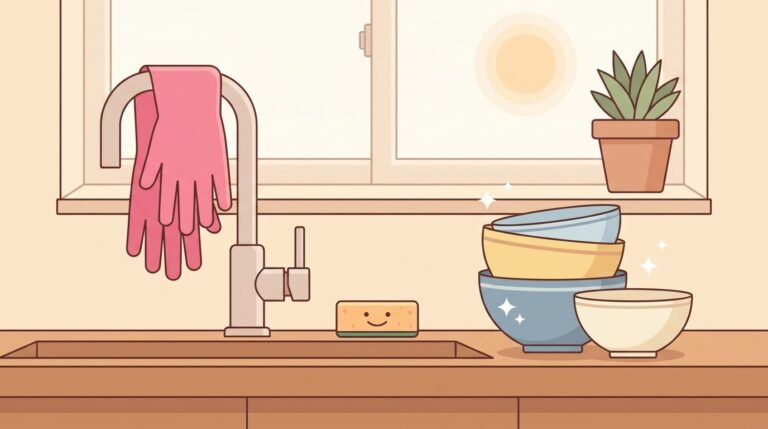
If you enter a Korean kitchen, you will definitely see bright pink/orange rubber gloves (고무장갑 – Go-mu-jang-gap) hanging by the sink. They are iconic! Koreans protect their hands from cold water and strong soap. Wearing these makes you look like a true local!
Phase 5: Real-Life Roleplay (실전 롤플레이)
Setting: You just finished eating delicious, spicy Tteokbokki (떡볶이) with your Korean roommate, Minjun, in your shared kitchen. The plates are covered in red sauce!
Character: Minjun (민준) – Friendly, slightly tired after cooking, but always sweet.
- Minjun: 아, 잘 먹었다! 배불러요. (Ah, jal meog-eot-da! Bae-bul-leo-yo.)
- “Ah, I ate well! I’m full.”
- You: 🎭 (Gently pointing at the sink) 저도요! 떡볶이 진짜 맛있었어요. (Jeo-do-yo! Tteok-bok-ki jin-ja mas-is-eot-seo-yo.)
- “Me too! The Tteokbokki was really delicious.”
- Minjun: 이제 설거지 해야 하는데… 귀찮네요. (I-je seol-geo-ji hae-ya han-deun-de… gwi-chan-ne-yo.)
- “Now we have to do the dishes… what a hassle.”
- You: 🎭 (Smiling warmly) 걱정 마세요. 제가 할게요! (Geok-jeong ma-se-yo. Je-ga hal-ge-yo!)
- “Don’t worry. I’ll do it!”
- Minjun: 진짜요? 고마워요! 그럼 저는 식탁 닦을게요. (Jin-ja-yo? Go-ma-wo-yo! Geu-reom jeo-neun sik-tak dak-eul-ge-yo.)
- “Really? Thank you! Then I will wipe the table.”
- You: 🎭 (Putting on the pink rubber gloves) 네, 좋아요. 주방세제 어디 있어요? (Ne, jo-a-yo. Ju-bang-se-je eo-di is-seo-yo?)
- “Yes, sounds good. Where is the dish soap?”
- Minjun: 싱크대 위에 있어요. 아, 그릇은 물에 조금 불려 놓으세요! (Sing-keu-dae wi-e is-seo-yo. Ah, geu-reut-eun mul-e jo-geum bul-ryeo no-eu-se-yo!)
- “It’s on the sink. Oh, and please let the bowls soak in water for a bit!”
- You: 🎭 (Nodding happily) 네, 물 뿌려 놓을게요! (Ne, mul ppu-ryeo no-eul-ge-yo!)
- “Yes, I’ll soak them in water!”
🔀 Choose Your Next Move!
What will you say to Minjun now?
* A) “오늘 설거지 다 하고 자야 해!” (We must do all dishes before sleeping!)
* B) “고무장갑이 너무 귀여워요!” (These rubber gloves are so cute!)
* C) “나 안 해! 귀찮아!” (I’m not doing it! It’s annoying!)
💡 Feedback on Your Choice:
- Selection A (Risk): Too intense! While clean kitchens are nice, ordering your roommate around right after a meal might feel a bit stiff.
- Selection B (Best!): Perfect! Complimenting the iconic pink gloves breaks the ice and makes the chore fun.
- Selection C (Bad): Oops! This sounds very rude (반말) and might hurt Minjun’s feelings!
Phase 6: 10-Second Emotion Shadowing (10초 감정 섀도잉)
Practice speaking with real Korean emotion! Notice the pauses marked by /.
- [😊 With a warm, eager smile]
- 제가 / 할게요! / 걱정 마세요!
- (Je-ga / hal-ge-yo! / geok-jeong ma-se-yo!)
- “I’ll do it! Don’t worry!”
- [🥺 With a cute, tired whine to your roommate]
- 오늘만… / 설거지 / 해주면 안 돼?
- (O-neul-man… / seol-geo-ji / hae-ju-myeon an dwae?)
- “Just for today… can’t you do the dishes?”
Phase 7: K-Culture Mini Dictionary (미니 사전)
- 수세미 (Su-se-mi) | Sponge / Scrubber
- In Korea, cute, hand-knitted acrylic scrubbers shaped like fruits (like strawberries!) are extremely popular and sold at local markets.
- 주방세제 (Ju-bang-se-je) | Dish soap
- Often called ‘퐁퐁’ (Pong-pong) by locals, which is a famous retro brand name.
- 고무장갑 (Go-mu-jang-gap) | Pink rubber gloves
- The absolute staple of Korean kitchens. They protect hands from spicy pepper oils and cold winter water.
- 행주 (Haeng-ju) | Dishcloth / Kitchen rag
- Used to wipe down tables and counters after cooking.
Phase 8: Travel Survival Kit (여행자를 위한 생존 키트)
Survival Phrases for Airbnb & Guesthouses:
- “퐁퐁 어디 있어요?” (Pong-pong eo-di is-seo-yo?)
- “Where is the dish soap?”
- “이거 써도 돼요?” (I-geo sseo-do dwae-yo?)
- “Can I use this?” (Great for asking before using someone’s sponge or gloves).
- “깨끗해요?” (Kae-kkeut-hae-yo?)
- “Is it clean?”
🗺️ Editor’s Travel Note:
If you are staying in a cozy Airbnb or a traditional Hanok guesthouse in Seoul, you might need to buy your own cleaning supplies. Use Naver Map App to find the nearest 다이소 (Daiso) or neighborhood supermarket. You can buy a pack of cute 수세미 and 고무장갑 for less than 3,000 KRW!
(Note: Store opening times and stock may vary depending on local conditions).
Phase 9: Deepening Thought (한 발 더 깊이)
In many Western cultures, chores are strictly divided by schedules. However, in Korea, there is a strong sense of 우리 (U-ri – “We” or “Us”). If one person cooks a delicious meal, it is culturally expected and polite for the others to jump in and do the dishes without even being asked. It’s a silent, warm contract of mutual care.
💬 Your Turn: How do you divide house chores in your country? Do you use a schedule, or do you play Rock-Paper-Scissors? Let us know in the comments below!
Phase 10: FAQ & Common Mistakes (자주 묻는 질문)
Q: Can I use ‘설거지하다’ (Seol-geo-ji-ha-da) to wash fruits too?
A: No! ‘설거지하다’ is strictly for washing dishes, cups, and cooking pots. For washing fruits or vegetables, use the verb 씻다 (Ssit-da – to wash), as in “과일 씻어 주세요” (Please wash the fruits).
Q: Why do Koreans use pink rubber gloves even in summer?
A: Korean food often contains stubborn red pepper oil (고추기름) and garlic, which can stick to bare hands and cause irritation. The gloves protect your skin and keep your hands soft!
Q: How do I politely tell my host I want to wash my own cup?
A: You can smile and say, “제 컵은 제가 닦을게요!” (Je keop-eun je-ga dak-eul-ge-yo! – I will wash my own cup!).
🚨 Common Mistakes Warning Board:
- Mistake 1: Calling dish soap ‘바디워시’ (Body wash).
- Correct Action: Make sure to ask for 주방세제 (Ju-bang-se-je) or 퐁퐁 (Pong-pong).
- Mistake 2: Using informal ‘너 설거지해’ (You do the dishes) to someone older.
- Correct Action: Always use polite form: “설거지해 주세요” (Seol-geo-ji hae ju-se-yo).
- Mistake 3: Leaving sticky rice bowls dry in the sink.
- Correct Action: Always remember to soak them: “물에 불려 놓으세요” (Soak them in water).
Phase 11: Action Mission (오늘의 미션)
- 🥉 Bronze Mission: Pronounce “제가 할게요!” (I’ll do it!) out loud 3 times in front of your mirror with a bright smile.
- 🥈 Silver Mission: Share this post on your social media with the hashtag
#DailyHanguland tell us what color your kitchen gloves are! - 🥇 Gold Mission: Next time you eat with a Korean friend, stand up first, head to the sink, and proudly say: “설거지는 제가 할게요!”
🎮 K-Culture Search Mission:
Watch your favorite K-drama today and look closely at the kitchen scene. Can you spot the legendary pink rubber gloves? Take a screenshot and tag us!
Phase 12: Interactive Quiz Challenge (퀴즈 챌린지)
1. What is the polite way to volunteer to do the dishes?
- A) 내가 할게
- B) 제가 할게요
- C) 식기 세척
🔍 Click here for the Answer & Explanation
Correct Answer: B) 제가 할게요 (Je-ga hal-ge-yo)
Explanation: ‘제가’ is the polite form of ‘I’, and ‘할게요’ means ‘I will do’. Option A is casual (반말), and Option C sounds like an appliance manual!
2. True or False: You can use ‘설거지하다’ to say you are washing apples.
- True
- False
🔍 Click here for the Answer & Explanation
Correct Answer: False
Explanation: ‘설거지하다’ is only for dishes and cooking utensils. For washing food/fruits, you must use ‘씻다’ (to wash).
3. Fill in the blank: If rice is stuck to the bowl, you should say “물에 ___ 놔” (Soak it in water).
- A) 버려 (Throw away)
- B) 끓여 (Boil)
- C) 불려 (Soak)
🔍 Click here for the Answer & Explanation
Correct Answer: C) 불려 (bul-ryeo)
Explanation: ‘불리다’ means to soak and let soften. ‘불려 놔’ is the perfect local expression for soaking rice bowls!






