

Phase 1: Empathy (Welcome to Seoul’s Fashion Streets!)
안녕하세요! (An-nyeong-ha-se-yo!) Hello! I am your chief editor at Daily Hangul, your personal local culture navigator.
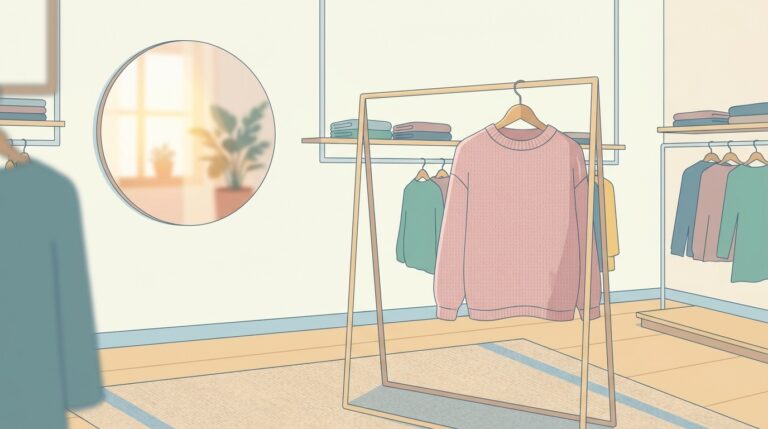
Imagine this: You are walking through the trendy, neon-lit streets of Hongdae in Seoul. Soft K-Pop music plays from a cozy, aesthetic clothing boutique. You step inside, and your eyes land on the absolute perfect pastel-pink oversized sweater. It is exactly what you have seen your favorite K-Drama lead wear!
You pick up the hanger, and the friendly shop assistant looks at you with a warm smile. You want to say, “Oh, this is so pretty!” or “This is so cute!” to share your excitement. But suddenly, your mind goes blank. You freeze, worried you might use the wrong word or sound too robotic.
Don’t worry! This is a very common “pain point” for many of our learners. In this lesson, we are going to learn how to express admiration for beautiful clothes naturally and confidently, using real expressions that actual Koreans use every single day. Let’s make your next shopping trip in Seoul unforgettable!
Phase 2: Deep Dive into 3 Core Expressions
1. 이거 예뻐요 (I-geo ye-ppeo-yo)
- Pronunciation: I-geo yeh-ppuh-yo. (Imagine saying “yep” and then a soft “puh” like the first sound in “pot”, ending with a friendly “yo”.)
- Meaning: “This is pretty.” (이거 = This, 예뻐요 = is pretty)
- K-Culture Moment: You will hear this phrase constantly in fashion vlogs or when K-Drama characters go shopping with friends. When a character steps out of a fitting room, their friend clasps their hands and gasps, “이거 예뻐요!”
- Editor’s Insight: This is the ultimate, safest, and most natural way to say something is pretty in a shop. It is friendly and polite, making it perfect for talking to shop assistants.
- Situation Spectrum: Casual ✅ | Semi-formal ✅ | Formal ⚠️
- 🤔 Think About It: In English, we often say “This is beautiful” or “This is nice.” In Korean, using the verb 예쁘다 (to be pretty) is highly versatile and applies to clothes, accessories, and even food presentations!
2. 이거 귀여워요 (I-geo gwi-yeo-weo-yo)
- Pronunciation: I-geo gwee-yuh-wuh-yo. (Say “gwee” like the start of “queen”, “yuh” like “young”, and “wuh” like “water”.)
- Meaning: “This is cute.”
- K-Culture Moment: If you walk into a character goods shop (like Kakao Friends or LINE Friends Store) in Gangnam, you will hear a chorus of high-pitched “이거 진짜 귀여워요!” (This is really cute!) from shoppers.
- Editor’s Insight: Korean fashion often embraces the “cute” (귀여운) aesthetic, even for adults. Don’t hesitate to use this for adorable socks, oversized hoodies, or quirky hats.
- Situation Spectrum: Casual ✅ | Semi-formal ✅ | Formal ⚠️
- 🤔 Think About It: Is “cute” a compliment you often use for adult fashion in your country? In Korea, calling adult clothes “귀여워요” is a huge compliment!
3. 잘 어울려요 (Jal eo-ul-lyeo-yo)
- Pronunciation: Jal uh-wool-lyuh-yo. (Think of “jal” sounding like “Jal” in “jalapeno”, and “eo-ul-lyeo” flowing together smoothly like “oh-wool-yuh”.)
- Meaning: “It suits you.” or “It looks good on you.”
- K-Culture Moment: When a K-Pop idol tries on a new outfit on a variety show, the other members will immediately clap and shout, “와, 진짜 잘 어울려요!” (Wow, it really suits you!)
- Editor’s Insight: Use this when your shopping partner tries on clothes. It is a wonderful way to build a warm connection!
- Situation Spectrum: Casual ✅ | Semi-formal ✅ | Formal ⚠️
- 🤔 Think About It: Complimenting others is a key part of Korean social harmony (Jeong/정). Saying “잘 어울려요” creates an instant friendly vibe.
Phase 3: Textbook Korean vs. Real Korean
Let’s look at how textbooks sometimes teach you phrases that sound a bit too stiff, and what locals actually say.
Situation 1: Pointing at a beautiful dress
- 📖 Textbook Korean: “이것은 아름답습니다.” (I-geos-eun a-reum-dab-seub-ni-da.)
- Why it’s stiff: This translates to “This object is beautiful.” It sounds like you are reading from a poetry book or describing a painting in a museum!
- 🗣️ 진짜 (Real) Korean: “이거 예쁜데요?” (I-geo ye-ppeun-de-yo?) or “이거 진짜 예쁘다!” (I-geo jin-ja ye-ppeu-da!)
- 💡 Why it’s different: Adding “~ㄴ데요” at the end softens your tone and invites the other person to agree with you. Saying “진짜 예쁘다!” (really pretty!) is the perfect self-talk when you are amazed.
Situation 2: Telling your friend they look great
- 📖 Textbook Korean: “그 옷은 당신에게 맞습니다.” (Geu os-eun dang-sin-e-ge maj-seub-ni-da.)
- Why it’s stiff: This sounds like “Those clothes are correct for you.” It is incredibly formal and clinical.
- 🗣️ 진짜 (Real) Korean: “완전 찰떡이에요!” (Wan-jeon chal-tteok-i-e-yo!)
- 💡 Why it’s different: “찰떡” (chal-tteok) means sticky rice cake. Saying something is “chal-tteok” means it sticks to you perfectly—it is a slang for “perfect match” or “made for you!”
Phase 4: K-Culture Deepdive & Non-verbal Manners
4-1. 눈치 (Nunchi) & Shopping Gestures
When shopping in Korea, Nunchi (the art of reading the room and non-verbal cues) is very important.
* The Soft Touch: When pointing at clothes, avoid pointing aggressively with one finger. Instead, open your hand flat, palm facing slightly up, and gesture towards the item.
* Eye Contact & Nodding: When a shop assistant approaches you and says “어서오세요” (Welcome), simply make brief eye contact, give a small nod, and smile. You do not need to have a long conversation.
4-2. The Seoul Shopping Culture
In modern Korea, shopping is not just about buying clothes; it is about creating an “OOTD” (Outfit Of The Day) culture. Many shops in places like Sinsa-dong or Hannam-dong have beautiful, aesthetic mirrors specifically designed for you to take “mirror selfies” (거울샷 – geoul-syat). If you find something pretty, it is perfectly normal to hold it up to yourself in front of the mirror and take a quick photo!
Phase 5: Real Roleplay Scenario
Setting: A trendy boutique named “Aura” in Sinsa-dong. You are browsing the racks, and the friendly store assistant, Sujin, walks up to help you.
- Sujin: 어서 오세요! 편하게 보세요.
(Eo-seo o-se-yo! Pyeon-ha-ge bo-se-yo.)
(🎭 Smiling warmly, gesturing to the clothes)
“Welcome! Please feel free to look around.” -
You: 네, 감사합니다.
(Ne, gam-sa-ham-ni-da.)
(🎭 Giving a polite nod)
“Yes, thank you.” -
You: (Pointing at a lovely pastel blue cardigan) 와, 이거 예뻐요!
(Wa, i-geo ye-ppeo-yo!)
(🎭 Eyes widening with excitement)
“Wow, this is pretty!” -
Sujin: 맞아요! 요즘 아주 인기 많아요. 한 번 입어보실래요?
(Ma-ja-yo! Yo-jeum a-ju in-gi man-ha-yo. Han beon ib-eo-bo-sil-lae-yo?)
(🎭 Taking the cardigan off the hanger gently)
“That’s right! It is very popular these days. Would you like to try it on?” -
You: 이거 입어봐도 돼요?
(I-geo ib-eo-bwa-do dwae-yo?)
(🎭 Looking at the fitting room)
“Can I try this on?” -
Sujin: 네, 당연하죠! 피팅룸은 이쪽이에요.
(Ne, dang-yeon-ha-ji-yo! Pi-ting-rum-eun i-jjok-i-e-yo.)
(🎭 Pointing to the curtained booths)
“Yes, of course! The fitting room is this way.” -
You: (Steps out wearing the cardigan) 어때요? 잘 어울려요?
(Eo-ttae-yo? Jal eo-ul-lyeo-yo?)
(🎭 Turning around to show her)
“How is it? Does it look good?” -
Sujin: 와! 진짜 찰떡이에요! 너무 예뻐요!
(Wa! Jin-ja chal-tteok-i-e-yo! Neo-mu ye-ppeo-yo!)
(🎭 Clapping her hands gently)
“Wow! It’s a perfect match! It’s so pretty!”
🔀 Choose Your Next Move! (Interactive Branch)
How will you respond to Sujin’s compliment?
- Option A: “이거 주세요!” (I-geo ju-se-yo!)
- Feedback: BEST! This means “I will take this!” It is natural, polite, and shows you are happy with the purchase. Sujin will guide you to the counter with a big smile.
- Option B: “진짜요? 고마워요.” (Jin-ja-yo? Go-ma-wo-yo.)
- Feedback: RISK! While “고마워요” means thank you, it is a bit too casual for a shop assistant. It is better to say “감사합니다” (Gam-sa-ham-ni-da) to keep it polite.
- Option C: “너무 비싸요.” (Neo-mu bi-ssa-yo.)
- Feedback: BAD! Bluntly saying “This is too expensive” right after trying it on can feel a bit rude in Korean shopping etiquette. If it is too expensive, you can say “생각해 볼게요” (Saeng-gak-hae bol-gae-yo – I will think about it) and hand it back politely.
Phase 6: 10-Second Emotion Shadowing Drill
Let’s practice speaking with real Korean emotion! Use the slashes / for natural pauses, and mimic the emotional guides.
- “이거 / 진짜 / 예뻐요!”
- [😊 Bright, excited, and wide-eyed!]
- Pronunciation: I-geo / jin-ja / ye-ppeo-yo!
- “저한테 / 잘 / 어울려요?”
- [🥺 Shy but hopeful, looking for a compliment!]
- Pronunciation: Jeo-han-te / jal / eo-ul-lyeo-yo?
- “우와, / 진짜 / 귀엽다!”
- [🤩 Gasping at something incredibly adorable!]
- Pronunciation: U-wa, / jin-ja / gwi-yeop-da!
Phase 7: K-Culture Mini Dictionary
- 피팅룸 (Pi-ting-rum) | Fitting Room
- How to use: Used in almost all modern clothing stores. (e.g., “피팅룸 어디에 있어요?” = Where is the fitting room?)
- 신상 (Sin-sang) | New Arrivals / New Merchandise
- How to use: Short for 신상품 (new product). Shop owners love to point out “이거 신상이에요!” (This is a new arrival!).
- 세일 (Se-il) | Sale / Discount
- How to use: Look for signs saying “세일” on shop windows to catch the best deals in Dongdaemun.
- 거울 (Geoul) | Mirror
- How to use: Crucial for checking your outfit. (e.g., “거울 어디에 있어요?” = Where is the mirror?)
Phase 8: Traveler’s Survival Kit
Survival Phrases TOP 3
- “얼마예요?” (Eol-ma-yeo-yo?)
- Meaning: How much is it?
- Pro Tip: Use this while pointing at items without price tags in traditional markets.
- “이거 입어봐도 돼요?” (I-geo ib-eo-bwa-do dwae-yo?)
- Meaning: Can I try this on?
- Pro Tip: Always ask this before entering a fitting room. Some white tops or makeup-sensitive items may not be allowed for try-on.
- “이거 주세요.” (I-geo ju-se-yo.)
- Meaning: I’ll take this / Please give me this.
- Pro Tip: The easiest way to purchase your favorite item!
Editor’s Travel Note
When shopping in Seoul, Google Maps might not work well. I highly recommend using the Naver Map App Download for navigating streets like Garosu-gil or Hongdae. Also, while credit cards are accepted almost everywhere, keeping some cash is useful if you want to get discounts in underground shopping centers like Goto Mall!
Phase 9: “One Step Deeper” (Reflection)
In many Western cultures, shopping is highly individualistic. You pick your clothes, try them on, and pay without much interaction. In Korea, however, shopping can be a lively, communal experience. Shop assistants are often very active, offering compliments and suggestions. This comes from the Korean culture of warmth and connection (Jeong). Learning to say “이거 예뻐요” is your bridge to participating in this delightful, friendly exchange!
💬 Your Turn: Have you ever bought clothes in Korea, or do you plan to? What is your favorite K-fashion style? Let us know in the comments below!
Phase 10: FAQ & Common Mistakes
Q: Can I use “예뻐요” (ye-ppeo-yo) for male clothes or men?
A: Yes! While “예뻐요” means pretty, in modern Korea, it is frequently used for stylish men’s clothing as well. However, if you want to say a man looks cool or handsome, you can say “멋있어요” (meos-is-seo-yo).
Q: What is the difference between “이거” (i-geo) and “이것” (i-geot)?
A: They mean the same thing (“this”). However, “이것” is used in formal writing, while “이거” is the natural spoken form used by 99% of Koreans in daily conversations.
Q: How do I call the shop assistant politely?
A: Do not call them “언니” (Unni) unless you are close. Instead, raise your hand slightly and say “저기요” (jeo-gi-yo), which politely means “Excuse me.”
🚨 Common Mistakes Alert!
- Mistake 1: Saying “너 예뻐요” (No ye-ppeo-yo) to a shop assistant.
- Why it’s wrong: “너” (no) means “you” in a highly informal, rude way to strangers.
- Correct Action: Just say “이거 예뻐요” (pointing to the clothes) or “옷이 예뻐요” (The clothes are pretty).
- Mistake 2: Entering the fitting room with shoes on.
- Why it’s wrong: Most Korean fitting rooms have a wooden step. You must take off your shoes before stepping inside.
- Correct Action: Leave your shoes outside the carpeted/wooden fitting room area.
Phase 11: Action Missions
- 🥉 Bronze Mission: Practice saying “이거 예뻐요” out loud 5 times in front of your bedroom mirror today!
- 🥈 Silver Mission: Go to your Instagram or TikTok, find a K-fashion post, and leave a friendly comment: “이거 진짜 예뻐요!”
- 🥇 Gold Mission: Next time you visit a Korean store or restaurant in your area, point to a nice item or side dish and say “이거 예뻐요!” or “이거 맛있어요!”
- 🎮 K-Culture Mission: Listen to your favorite K-pop song today. Can you spot the word “예쁘다” (ye-ppeu-da) or “예뻐” (ye-ppeo)? (Hint: Check out BTS or NewJeans lyrics!)
Phase 12: Interactive Quiz Challenge
Test your knowledge before you hit the Seoul shops!
1. Match the Phrase!
What should you say to a friend when their outfit looks absolutely perfect on them like a custom glove?
* A) 이거 귀여워요
* B) 완전 찰떡이에요
* C) 이것은 아름답습니다
🔍 Check the Answer
Correct Answer: B) 완전 찰떡이에요 (wan-jeon chal-tteok-i-e-yo!)
Explanation: This trendy slang literally means “perfect match like sticky rice cake!” It is the ultimate compliment for an outfit.
2. True or False?
In Korea, it is perfectly fine to walk into any fitting room with your outdoor shoes on.
* A) True
* B) False
🔍 Check the Answer
Correct Answer: B) False
Explanation: You should always take off your shoes before stepping onto the fitting room floor. Keep the space clean!
Keep practicing with Daily Hangul, and make your Korean journey beautiful! 다음에 또 만나요! (See you next time!)






