

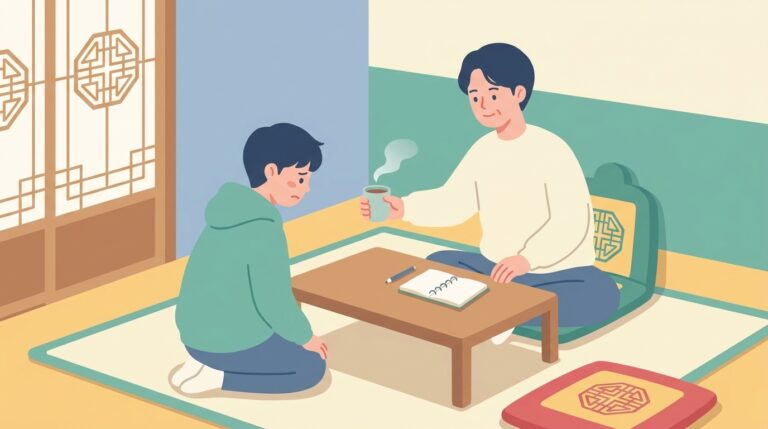
Saving Lives with Words: Advanced C2 Korean Counseling Phrases for Youth Crisis Intervention
안녕하세요! Welcome back to Daily Hangul, your premium space for mastering not just the Korean language, but the profound emotional pulse of Korean society. I’m your senior editor, and today we are addressing a deeply sensitive, high-stakes topic that requires the utmost linguistic precision and cultural empathy: Youth Self-Harm and Suicide Prevention Counseling Intervention (청소년 자해 및 자살 예방을 위한 상담 개입).
If you have watched K-Dramas like Tomorrow (내일) or Daily Dose of Sunshine (정신병동에도 아침이 와요), you know that the pressure on Korean youth is immense, and the way we intervene during a crisis can literally save a life. At a C2 (Advanced) level, counseling isn’t just about translating psychological terms; it’s about navigating the fragile nuances of “Jeong” (정), relieving immense societal guilt, and offering linguistic warmth that cuts through isolation. Let’s explore how to use the power of the Korean language to heal.
Phase 2: Core Expressions Deep Dive
1. 버텨줘서 고마워 (Beo-tyeo-jwo-seo go-ma-wo)
- Pronunciation: buh-tyuh-jwo-suh go-ma-wo (Rhymes with “let her go, so warm”)
- Meaning: “Thank you for holding on.” / “Thank you for enduring this long.”
- K-Culture Moment: In the fantasy K-Drama Tomorrow, when grim reapers save individuals on the brink of suicide, they don’t say “Cheer up.” Instead, they validate the sheer, exhausting effort of just staying alive with this exact phrase.
- Editor’s Insight: Traditional Korean society often views suffering as something to be endured in silence (인내). Telling a struggling teen “버텨줘서 고마워” reframes their survival not as a passive state, but as an active, heroic feat. It removes the pressure of having to “get better” immediately.
- Situation Spectrum: Casual ✅ | Semi-formal ⚠️ | Formal 🚫 (Best used in intimate, deeply trust-built therapeutic bonds)
- 🤔 Think About It: How does thanking someone for “enduring” differ from simply saying “I’m sorry you are sad” in your native culture?
2. 네 잘못이 아니야 (Ne jal-mo-si a-ni-ya)
- Pronunciation: neh jal-mo-shee ah-nee-yah (Rhymes with “get the ball, see ya”)
- Meaning: “It is not your fault.”
- K-Culture Moment: Reminiscent of the iconic emotional breakthrough scenes in healing K-Dramas, where a mentor tears down a youth’s internalized guilt caused by academic or family failure.
- Editor’s Insight: Korean youth often internalize collective shame (family expectations, school rankings). Saying “네 잘못이 아니야” directly targets this systemic guilt, severing the link between external failures (like the Suneung exam) and personal worth.
- Situation Spectrum: Casual ✅ | Semi-formal ⚠️ | Formal 🚫
- 🤔 Think About It: Why is addressing internalized guilt so crucial in highly collectivistic societies?
3. 네 마음의 무게를 내가 다 헤아릴 수는 없겠지만, 함께 나누고 싶어 (Ne ma-eu-mui mu-ge-leul nae-ga da he-a-ril su-neun eop-get-ji-man, ham-kke na-nu-go si-peo)
- Pronunciation: neh mah-eum-ui mu-geh-reul neh-gah dah heh-ah-ril soo-neun up-get-jee-mahn, hahm-kkeh nah-noo-go shee-puh
- Meaning: “I might not be able to fully fathom the weight of your heart, but I want to share it with you.”
- K-Culture Moment: A classic phrase utilized by professional youth counselors in high-end psychiatric clinics in Seoul, establishing a collaborative therapeutic alliance.
- Editor’s Insight: C2 proficiency requires poetic humility. Claiming you “perfectly understand” a suicidal teen’s pain often feels invalidating. This phrase respects their unique pain (헤아리다 – to fathom/measure deeply) while offering active solidarity (나누다 – to share).
- Situation Spectrum: Casual ⚠️ | Semi-formal ✅ | Formal ✅
- 🤔 Think About It: What makes acknowledging the limits of our empathy actually build more trust?
Phase 3: Textbook Korean vs. Real-World Empathetic Korean
At a C2 level, you must avoid clinical or dismissive textbook phrases that can trigger defensiveness.
Scenario A: Encouraging a crisis-ridden teen to live
- 📖 Textbook Korean: “자살하지 마세요. 생명은 소중합니다.” (Do not commit suicide. Life is precious.)
- 🗣️ Real-World Counseling: “네가 없으면 세상의 소중한 한 부분이 사라지는 거야. 나는 네가 꼭 살아갔으면 좋겠어.” (If you are not here, a precious part of the world disappears. I truly want you to live.)
- 💡 Why the shift? Textbook warnings feel like a legalistic, impersonal lecture. The real-world alternative focuses on personal connection, emphasizing their intrinsic value to the speaker.
Scenario B: Responding to a teen’s confession of self-harm
- 📖 Textbook Korean: “자해를 중단하고 긍정적으로 생각하세요.” (Stop self-harming and think positively.)
- 🗣️ Real-World Counseling: “얼마나 아프고 답답했으면 네 몸에 상처를 내면서까지 버텨야 했을까… 감히 상상조차 안 되네.” (How painful and suffocating must it have been for you to have to endure even by hurting your own body… I can’t even dare to imagine.)
- 💡 Why the shift? Telling a self-harming youth to “stop and think positive” is invalidating. The C2 counselor validates the deep psychic pain behind the physical action first before attempting behavior modification.
Phase 4: K-Culture Deep Dive & Non-verbal Manners
4-1. Nunchi (눈치) & Silent Presence in Crisis
In Korean counseling, non-verbal cues carry 80% of the emotional weight. When dealing with a youth in crisis:
* Lowered Gaze & Body Language: Do not maintain sharp, interrogative eye contact. Sit at an angle, slightly lower your head, and open your palms.
* The Art of “Gong-gam-jeok Chimmuk” (공감적 침묵 – Empathetic Silence): Korean teenagers are highly sensitive to adult pressure. Do not rush to fill silences. A soft nodding of the head combined with the sigh of shared grief (“하아…”) often speaks louder than words.
4-2. The Pressure Cooker: Korean Youth Culture
To counsel Korean teens, you must understand the academic hell known as “Ip-si Ji-ok” (입시지옥 – Entrance Exam Hell). The relentless pressure to fit into the standard mold of success (prestigious university -> conglomerate job -> marriage) often makes any detour feel like the end of life. When you speak to a Korean teen, you are speaking to someone who feels they have let down their entire lineage. Your language must act as an oasis that disconnects their human value from their grade point average (내신).
Phase 5: Live Roleplay Scenario
Setting: A quiet counseling room at a Youth Welfare Center in Mapo, Seoul.
Characters:
* Counselor (You): An empathetic, culturally astute professional.
* Min-ji (민지): A 17-year-old high school student who has been secretly self-harming, overwhelmed by school stress and parental neglect.
Dialogue
- 민지: (고개를 푹 숙이고 손가락을 만지작거리며) “선생님, 그냥… 제가 없어지는 게 모두에게 더 나을 것 같아요. 아무리 노력해도 안 돼요.”
(Min-ji: [Keeping her head low, fidgeting with her fingers] Counselor, just… I think it would be better for everyone if I just disappeared. No matter how hard I try, it doesn’t work.) - Counselor: (민지의 손을 따뜻하게 바라보며) “민지야, 고개 들어서 내 눈을 꼭 안 봐도 괜찮아. 그렇게까지 지치고 힘들 때까지 혼자서 얼마나 외로웠을까…”
(Counselor: [Looking warmly at Min-ji’s hands] Min-ji, you don’t have to raise your head or look me in the eyes if it’s hard. How lonely must you have been to get this exhausted and hurt all by yourself…) - 민지: (울컥하며) “엄마는 맨날 공부 안 한다고 소리만 지르고… 학교에서도 제가 왜 이렇게 살아야 하는지 모르겠어요. 매일 밤 제 손목을 보면서… 그냥 끝내고 싶어요.”
(Min-ji: [Choking up] Mom is always screaming that I don’t study… and at school, I don’t even know why I have to live like this. Every night looking at my wrists… I just want to end it.) - Counselor: (깊은 한숨과 함께 마음을 담아) “매일 밤 그 좁은 방에서 혼자 그 두려움을 견뎌냈던 거구나. 민지야, 그 아픈 순간들을 버텨줘서 정말 고마워.”
(Counselor: [With a deep sigh, with all their heart] So you endured that fear all alone in that small room every single night. Min-ji, thank you so much for enduring through those painful moments.) - 민지: (눈물을 흘리며) “진짜… 진짜 너무 힘들었어요. 근데 다들 절 한심하게만 보니까…”
(Min-ji: [Crying] Truly… it was really so hard. But everyone just looks at me like I’m pathetic…) - Counselor: “사람들 눈에 비친 네 모습은 전혀 중요하지 않아. 지금 내 앞바닥에 흘러내리는 네 눈물이 너의 진짜 아픔이잖아. 네 잘못이 아니야, 민지야. 절대로.”
(Counselor: “How you look in other people’s eyes doesn’t matter at all. The tears falling to the floor right now are your real pain. It’s not your fault, Min-ji. Absolutely not.”) - 민지: (고개를 약간 들며) “정말… 제가 다시 시작할 수 있을까요?”
(Min-ji: [Slightly raising her head] Really… can I start over again?) - Counselor: “급하게 시작 안 해도 돼. 우리는 그냥 오늘 하루를 같이 살아내는 것부터 시작할 거야. 내가 네 편에서 같이 걸을게.”
(Counselor: “You don’t have to start in a hurry. We will start by just surviving today together. I will walk right by your side on your team.”)
🔀 Interactive Choice Point
Min-ji is silent again, looking at her self-harm scars. How do you respond?
- [Choice A – Best]: “민지야, 그 흉터들은 네가 약해서 생긴 게 아니라, 살고 싶어서 몸부림친 치열한 흔적이야. 그 마음을 내가 소중히 다루고 싶어.”
- Feedback: Exceptional validation. It reframes self-harm from a “shameful failure” to a survival mechanism that deserves professional, gentle care.
- [Choice B – Risk]: “흉터가 깊네. 자해는 언제부터 시작했니? 구체적인 도구는 뭐였어?”
- Feedback: Too clinical and interrogative. Asking for direct self-harm methods without establishing deep emotional safety can cause the youth to shut down immediately.
- [Choice C – Bad]: “공부 때문에 그렇게까지 하다니, 부모님이 아시면 얼마나 가슴이 찢어지겠니? 부모님 생각해서 참자.”
- Feedback: Disastrous. Guilt-tripping a suicidal Korean teenager using family duty (효도) is a primary trigger for further self-harm and immediate emotional withdrawal.
Phase 6: 10-Second Shadowing Drill
To speak to a vulnerable youth, your prosody (intonation, pauses, and emotional coloring) must be flawless. Practice shadowing with these marked pauses (/) and emotional milestones.
“네가 / 얼마나 힘든 시간을 / 견뎌왔을지 / 감히 다 상상할 수는 없지만… 내가 네 옆에 있을게.”
* Emotional Blueprint:[🥺 Deeply empathetic, slightly whispered, slow tempo]
* Pronunciation: Ne-ga / ol-ma-na him-deun si-gan-eul / gyon-dyo-wat-eul-ji / gam-hi da sang-sang-hal su-neun eop-get-ji-man… nae-ga ne yeop-e it-eul-ge.“네 잘못이 아니야. / 그 무거운 짐을 / 혼자 지지 않아도 괜찮아.”
* Emotional Blueprint:[🫂 Firm, reassuring, protective tone]
* Pronunciation: Ne jal-mot-i a-ni-ya. / Geu mu-gop-eun jim-eul / hon-ja ji-ji a-na-do gwen-cha-na.
Phase 7: K-Culture Mini Dictionary
- 심리적 심폐소생술 (Sim-li-jeok Sim-pye-so-saeng-sul) | Psychological CPR
- Essential crisis intervention technique of focusing strictly on immediate survival and emotional validation rather than long-term behavioral correction.
- 지적/정서적 지지 체계 (Ji-ji Chae-gye) | Support System
- The social and psychological safety net around a youth (friends, teachers, online communities, specialized centers).
- 골든타임 (Gol-deun-ta-im) | Golden Time (Critical Window)
- The precious minutes or hours immediately after a youth signals suicidal ideation or self-harm behavior before irreversible actions are taken.
- 위클래스 (Wee Class) | Wee Class (School Counseling Center)
- The official counseling system installed in Korean middle and high schools to identify and assist high-risk students.
Phase 8: Survivor’s Crisis Kit
If you are counseling a Korean youth or suspect a friend is in danger, utilize these exact survival resources:
Survival Phrases TOP 3
- “지금 너무 힘들면, 잠시만 숨을 깊이 쉬어볼까?” (If it’s too hard right now, shall we take a deep breath for a second?)
- “도움을 요청하는 것은 부끄러운 일이 아니야. 아주 용감한 거야.” (Asking for help is not a shameful thing. It is very courageous.)
- “내가 네 연락을 기다리고 있을게. 언제든 연락해.” (I will be waiting for your message. Reach out anytime.)
Editor’s Travel & Crisis Note
In Korea, professional help is highly accessible. If you need to refer a youth, guide them to download the official mobile counseling app designed specifically for youths: 다들어줄개 (Listen to All Your Stories) App which allows anonymous texting. In an acute emergency, dial 1393 (Suicide Prevention Hotline) or 1388 (Youth Crisis Hotline), both available 24/7 with professional Korean operators.
Phase 9: “한 발 더 깊이” (One Step Deeper)
In traditional Korea, mental health was often swept under the rug as a “weakness of character” or “lack of willpower.” However, the modern Korean linguistic landscape has shifted dramatically. The emergence of “정서적 웰빙” (emotional well-being) in public discourse highlights a growing realization: Korean collective pressure requires a collective healing response. When you step into a crisis situation as a speaker of Korean, your empathy acts as a direct counter-agent to the social isolation that fuels suicide rates in East Asia. By refusing to judge, and instead offering verbal shelter, you are performing a revolutionary act of compassion.
💬 Your Turn: Have you ever seen a Korean drama or movie handle the topic of youth mental health? What verbal or non-verbal reactions stood out to you? Let us know in the comments below!
Phase 10: FAQ & Common Mistakes
Q: What if the youth refuses to speak and remains completely silent?
A: Do not force them. Instead, use reassurance through presence: “말하고 싶지 않아도 괜찮아. 그냥 내가 네 옆에 같이 앉아 있을게. 그것만으로도 충분해.” (It’s okay if you don’t want to talk. I will just sit next to you. That is more than enough.)
Q: Is it culturally appropriate to contact their parents immediately if they mention self-harm?
A: In Korea, parental dynamic is often the source of the pain. Unless there is an imminent life-threatening emergency, breaking confidentiality immediately to parents can make the youth completely disconnect. Always consult a specialized supervisor or use anonymous channels like the 1388 youth hotline first to strategize safe intervention.
Q: Can I use religious phrases to comfort them? (e.g., “Everything is in God’s hands”)
A: Avoid religious or highly spiritual platitudes. Focus exclusively on secular, deeply grounded, human-to-human validation. Highly stressed Korean teens may feel alienated by spiritual lessons when dealing with immediate pain.
🚨 Common Mistakes Warning Board
- Mistake: Saying “힘내!” (Cheer up!) or “네 부모님을 생각해봐” (Think of your parents).
- Correct Action: Acknowledge their suffering directly: “지금껏 버텨온 것만으로도 너는 정말 최선을 다한 거야.” (Just by enduring until now, you have truly done your best.)
- Mistake: Asking why they did it in an accusatory tone: “왜 그런 바보 같은 짓을 했어?” (Why did you do such a foolish thing?).
- Correct Action: Reframe gently: “얼마나 견디기 힘들었으면 그런 선택을 해야 했을지 내 가슴이 아프다.” (It breaks my heart thinking how hard it must have been for you to have to make that choice.)
- Mistake: Overpromising: “내가 모든 걸 해결해 줄게.” (I will fix everything for you).
- Correct Action: Set realistic boundaries of shared presence: “모든 걸 한 번에 바꿀 수는 없지만, 한 걸음씩 같이 가보자.” (We can’t change everything at once, but let’s take it one step at a time together.)
Phase 11: Action Mission
- Bronze Mission 🥉: Memorize the phrase “버텨줘서 고마워” and practice saying it with a warm, low voice, utilizing the proper emotional pause.
- Silver Mission 🥈: Share your thoughts on how we can make social media a safer space for struggling youth in Korean on Instagram/X, tagging
#DailyHangul#MentalHealthKorea. - Gold Mission 🥇: Translate a comforting quote from your own native language into advanced-level empathetic Korean and leave it in our comments to support other language learners!
- 🎮 K-Culture Mission: Watch Episode 6 of the K-Drama Tomorrow or Episode 5 of Daily Dose of Sunshine. Note down three distinct emotional reactions the characters display during crisis moments.
Phase 12: Interactive Quiz Challenge
1. Advanced Scenario Quiz
Which of the following responses is the most appropriate C2-level intervention for a student who says they feel they are a useless burden (“저는 그냥 짐만 되는 존재예요”)?
* A) “아니야, 너는 아직 젊고 할 수 있는 일이 많아. 포기하지 마!”
* B) “네가 어떤 아픔 속에서 스스로를 그렇게 바라보고 있는지 더 듣고 싶어. 네 존재 자체가 나한테는 짐이 아니야.”
* C) “그런 약한 생각 하면 부모님이 속상해하셔. 강해져야지.”
👉 Click to Reveal Answer & Explanation
- Correct Answer: B
- Explanation: Option B practices the high-level art of counseling inquiry and validation. It shows willingness to sit in the darkness with them without rushing to offer generic motivational advice (Option A) or toxic guilt-tripping (Option C).
2. Fill in the Blank
Complete this powerful counseling phrase:
“네 마음의 _______(을/를) 내가 다 헤아릴 수는 없겠지만, 끝까지 네 편이 되어 줄게.”
* Hint: “weight / burden”
👉 Click to Reveal Answer
- Correct Answer: 무게 (Muge – Weight)
- Full Sentence: “네 마음의 무게를 내가 다 헤아릴 수는 없겠지만, 끝까지 네 편이 되어 줄게.” (I may not be able to fully fathom the weight of your heart, but I will be on your side until the end.)
3. True or False
In Korea, “1388” is the specialized hot-line strictly reserved for the elderly suffering from depression.
👉 Click to Reveal Answer & Explanation
- Correct Answer: False
- Explanation: 1388 is the national youth welfare and crisis counseling hotline (청소년전화 1388), heavily utilized for youth self-harm, runaways, and school violence prevention. For general suicide prevention across all ages, 1393 is the primary number.







