

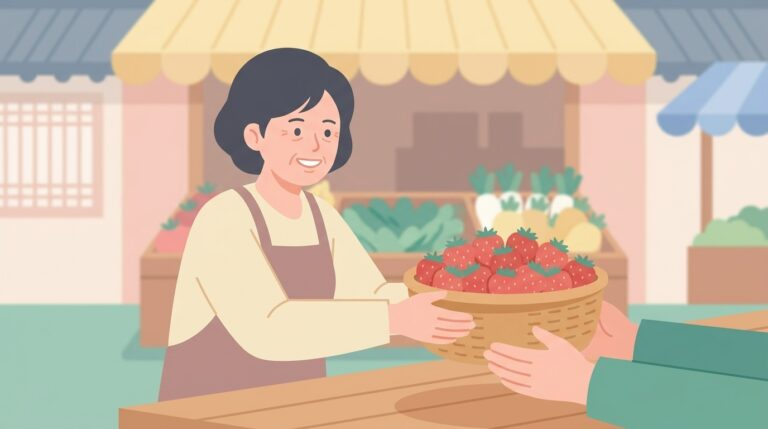
How to Haggle in Korean Traditional Markets Like a Born Local
안녕하세요! Welcome back to another edition of Daily Hangul. I’m your resident editor and cultural navigator, bringing you the warmest, most practical secrets to mastering the Korean language and lifestyle.
Have you ever walked through the vibrant, sensory-rich alleys of a Korean traditional market (전통 시장 – Jeontong Sijang)? The aroma of freshly fried hotteok (sweet pancakes), the mountain-like displays of shiny red apples, and the energetic shouts of vendors calling you sajangnim (boss) or haksaeng (student). It’s sensory overload in the best way possible!
But then, a pang of anxiety hits. You see something you absolutely love—maybe a vintage hanbok vest, a beautifully crafted wooden souvenir, or a giant basket of fresh strawberries. You want to haggle, but you freeze. “What if I sound rude? What if I use the wrong word and offend them?”
Don’t worry! In Korea, haggling is not a hostile battle of wits. It’s a dance of connection, warmth, and 정 (Jeong)—the Korean concept of deep, affectionate attachment. Today, we are going to unlock the exact expressions, tones, and cultural hacks that will turn you from an anxious tourist into an endearing, bargain-winning local.
Phase 2: Deep Dive into the Top 3 Bargaining Expressions
To haggle successfully in Korea, you only need three powerful phrases. Let’s analyze their hidden nuances and cultural weight.
1. 좀 깎아 주세요 (Jom kkakka juseyo)
- Pronunciation: Jom kka-kka ju-se-yo (Sounds like “Jom kah-kah joo-seh-yo”)
- Meaning: Please give me a little discount. (Literally: “Please cut [the price] a bit.”)
- K-Culture Moment: You will hear this in almost every Korean family drama set in a neighborhood market, like Reply 1988. The mother usually says this while playfully nudging the seller’s shoulder.
- Editor’s Insight: The magic word here is 좀 (jom), meaning “a little.” In Korean culture, softening your request makes it sound polite rather than demanding. It shows you respect their business but are hoping for a tiny favor.
- Situation Spectrum: Casual (✅ with close vendors) | Semi-formal (✅ standard) | Formal (🚫 not for high-end department stores)
- 🤔 Think About It: In your culture, is it acceptable to ask for a price cut directly, or do you find it awkward? Why do you think Koreans use the verb “to cut” (깎다) for prices?
2. 많이 사니까 서비스 좀 주세요 (Mani sanikka seobiseu jom juseyo)
- Pronunciation: Ma-ni sa-ni-kka seo-bi-seu jom ju-se-yo
- Meaning: Since I’m buying a lot, please give me a freebie!
- K-Culture Moment: Think of variety shows like Running Man, where cast members try to charm local market grandmas into giving them extra food for free.
- Editor’s Insight: In Korea, 서비스 (seobiseu) doesn’t mean customer service. It refers to free goods given as a gesture of goodwill. Asking for a seobiseu is often much more successful (and culturally pleasing) than asking for money off, as it allows the vendor to show their generosity (Jeong) without losing face on the price tag.
- Situation Spectrum: Casual (✅) | Semi-formal (✅) | Formal (⚠️ use with caution)
- 🤔 Think About It: Giving away extra items is a core way of building customer loyalty in Korea. How does this compare to the promotional strategies in your country?
3. 남는 게 없어요 (Namneun ge eopseoyo)
- Pronunciation: Nam-neun ge eop-seo-yo
- Meaning: “There’s no profit margin left for me.” (Literally: “Nothing is left over.”)
- K-Culture Moment: This is the ultimate, good-natured defense phrase used by sellers in K-dramas when customers haggle too aggressively.
- Editor’s Insight: This is the vendor’s polite way of saying, “I’ve already given you the best price.” If a seller says this with a sigh and a smile, it’s your cue to stop haggling, buy the item at the current price, and maintain a good relationship. Pushing past this point crosses the line from friendly banter to rudeness.
- Situation Spectrum: Casual (✅) | Semi-formal (✅) | Formal (🚫)
- 🤔 Think About It: Recognizing when to stop is a vital part of Nunchi (social sensing). How do you signal boundaries in negotiations in your home country?
Phase 3: Textbook Korean vs. Real-Life Korean
Let’s compare the stiff expressions found in standard textbooks with what actually gets you a discount in real life.
Scenario 1: Asking for a discount
- 📖 Textbook Korean: “할인해 주시겠습니까?” (Ha-rin-hae ju-si-get-seup-ni-ka? – “Would you be willing to offer a discount?”)
- 🗣️ Real-Life Korean: “이모, 조금만 해 주세요~” (I-mo, jo-geum-man hae ju-se-yo~ – “Auntie, just a little bit [off] for me please~”)
- 💡 Why the difference? Traditional markets run on relationships. Calling a female vendor “Imo” (Auntie) instantly breaks the ice, and using “해 주세요” (please do it for me) with a soft, elongated ending tone makes you sound incredibly friendly and endearing.
Scenario 2: Expressing that the price is high
- 📖 Textbook Korean: “이것은 너무 비쌉니다.” (I-geot-eun neo-mu bip-sap-ni-da. – “This is too expensive.”)
- 🗣️ Real-Life Korean: “아이고, 사장님! 생각보다 조금 비싸네요~” (Ai-go, sa-jang-nim! Saeng-gak-bo-da jo-geum bi-ssa-ne-yo~ – “Oh my, Boss! It’s a bit more expensive than I thought!”)
- 💡 Why the difference? Directness can sound confrontational in Korean. By starting with “Aigo!” and adding “thought” (생각보다), you shift the blame away from the seller and onto your own expectations, keeping the vibe playful.
Phase 4: K-Culture Deep Dive & Non-Verbal Manners
4-1. The Art of Eye Contact and Hand Gestures
When haggling, your body language is just as important as your words.
* The Tilt and Smile: Tilt your head slightly to the side when asking for a discount. It signals humility.
* The Two-Handed Hand-off: When paying, always hand your cash or card to the vendor with both hands. This is a non-negotiable sign of respect in Korea. Doing this while asking for a discount shows you are polite, making them much more likely to say yes.
4-2. The “Imo” and “Sajangnim” Magic
In Western markets, you might address someone as “Sir” or “Ma’am.” In Korea, family terms rule the market:
* 이모 (Imo – Maternal Aunt): Use this for middle-aged or older female vendors. It creates an instant, warm familial bond.
* 사장님 (Sajangnim – President/Boss): Use this for male vendors or younger female vendors. It inflates their ego in a fun, respectful way!
Phase 5: Real-Life Roleplay Scenario
Join Minjun (a foreign student) as he tries to buy delicious strawberries from Yumi Imo (the fruit stall owner) at Mangwon Market.
- Character: Yumi Imo (Friendly, talkative, but business-minded stall owner)
- Character: Minjun (Polite, using his B1 Korean skills)
[The Scene: A colorful fruit stall laden with fresh berries]
- Minjun: 사장님, 이 딸기 얼마예요?
(Sajangnim, i ttal-gi eol-ma-yeo?)
“Boss, how much are these strawberries?” -
Yumi Imo: 🎭 (Smiling warmly, pointing to a large basket)
한 바구니에 만 원이에요. 오늘 아침에 들어와서 아주 달고 맛있어!
(Han ba-gu-ni-e man won-i-e-yo. O-neul a-chim-e deu-reo-wa-seo a-ju dal-go ma-sit-eo!)
“Ten thousand won for one basket. They came in this morning, so they are super sweet and delicious!” -
Minjun: 🎭 (Slightly hesitating, checking his budget)
아, 생각보다 조금 비싸네요. 이모, 두 바구니 사면 좀 깎아 주실 수 있어요?
(A, saeng-gak-bo-da jo-geum bi-ssa-ne-yo. I-mo, du ba-gu-ni sa-myeon jom kkak-ka ju-sil su it-eo-yo?)
“Ah, it’s a bit more expensive than I thought. Auntie, if I buy two baskets, could you cut the price a bit?” -
Yumi Imo: 🎭 (Shaking her head playfully)
아이고, 총각! 원래 진짜 저렴하게 파는 거야. 남는 게 없어~
(Ai-go, chong-gak! Won-rae jin-jja jeo-ryeom-ha-ge pa-neun geo-ya. Nam-neun ge eop-seo~)
“Oh my, young man! I’m already selling them so cheap. There’s no profit margin left for me!” -
Minjun: 🎭 (Putting his hands together politely with a cute smile)
제가 한국 딸기 진짜 좋아하거든요. 다음에도 또 올게요! 조금만 해 주세요~
(Je-ga han-guk ttal-gi jin-jja jo-a-ha-geo-deun-yo. Dae-eum-e-do tto ol-ge-yo! Jo-geum-man hae ju-se-yo~)
“I really love Korean strawberries. I’ll definitely come back next time too! Just a little discount, please~” -
Yumi Imo: 🎭 (Laughing at his sweet persuasion)
에구, 한국말을 어쩜 이렇게 예쁘게 해? 좋아, 그럼 두 바구니에 만 팔천 원에 줄게!
(E-gu, han-guk-mal-eul eo-jjeom i-reo-ge ye-ppeu-ge hae? Jo-a, geu-reom du ba-gu-ni-e man pal-cheon won-e jul-ge!)
“Oh my, how can you speak Korean so beautifully? Alright, then I’ll give you two baskets for 18,000 won!” -
Minjun: 🎭 (Handing over the money with both hands)
와! 감사합니다, 이모! 진짜 최고예요!
(Wa! Gam-sa-hap-ni-da, i-mo! Jin-jja choe-go-ye-yo!)
“Wow! Thank you, Auntie! You are truly the best!” -
Yumi Imo: 🎭 (Bagging the strawberries and throwing in a few extra cherry tomatoes)
맛있게 먹고 다음에 또 와요, 총각!
(Ma-sit-ge meok-go da-eum-e tto wa-yo, chong-gak!)
“Enjoy them, and come back again, young man!”
🔀 Choose Your Next Move!
What should Minjun do next to secure an even warmer relationship?
* A) Accept the 2,000 won discount, say thank you with a bow, and pay with both hands.
* B) Push further and ask: “Can you make it 15,000 won instead?”
* C) Insist on paying by credit card even though it’s a small stall and he just got a cash discount.
💡 Feedback on Your Choice:
- If you chose A [BEST]: Perfect! You showed incredible Nunchi. You accepted her generous offer, expressed deep gratitude, and paid respectfully. You are now officially a beloved regular customer!
- If you chose B [BAD]: Oh no! This crosses the line into greed. The vendor already gave you a discount and said she had “no margin left.” Pushing further will ruin the friendly atmosphere.
- If you chose C [RISK]: Be careful! Small traditional market stalls operate on very tight margins. If they discount the price for you, paying in cash is a highly appreciated courtesy. Cards incur merchant fees for them.
Phase 6: 10-Second Shadowing Drill
Practice saying these lines with the perfect flow, pauses (/), and emotional tones to sound natural.
- [🥺 Cute and pleading]
사장님, / 조금만 / 깎아 주세요~
(Sa-jang-nim, / jo-geum-man / kkak-ka ju-se-yo~) -
[😊 Warm and promising]
맛있으면 / 다음에 / 또 올게요!
(Ma-sit-eu-myeon / da-eum-e / tto ol-ge-yo!) -
[🥳 Excited and grateful]
와, / 서비스 진짜 많이 주셨네요! / 감사합니다!
(Wa, / seo-bi-seu jin-jja ma-ni ju-syeot-ne-yo! / Gam-sa-hap-ni-da!)
Phase 7: K-Culture Mini-Dictionary
| Word | Pronunciation | Meaning & Cultural Context |
|---|---|---|
| 에누리 | E-nu-ri | Haggling / Discounting. An old Korean word representing the warm, flexible nature of traditional trading before fixed-price supermarkets became the norm. |
| 덤 | Deom | The “extra pile.” The small, extra portion of grains, vegetables, or fruits that vendors toss into your bag without charging you. It is the physical manifestation of Jeong. |
| 현금 | Hyeon-geum | Cash. While most of Korea is completely cashless, carrying paper money to traditional markets is still highly appreciated and often unlocks deeper discounts. |
| 단골 | Dan-gol | A regular customer. Becoming a dangol at a market stall means you get the best quality items, the biggest discounts, and the warmest greetings. |
Phase 8: Survival Kit for Travelers
Top 3 Survival Phrases
- 이것 좀 보여주세요. (I-geot jom bo-yeo-ju-se-yo.)
👉 “Could you please show me this?” (Use this to inspect items closely). - 카드로 해도 돼요? (Ka-deu-ro hae-do dwae-yo?)
👉 “Can I pay by card?” (Ask politely before pulling out plastic). - 계좌이체 가능해요? (Gye-jwa-i-che ga-neung-hae-yo?)
👉 “Is bank transfer possible?” (A very popular alternative to cash in Korea today!).
📝 Editor’s Travel Note
Before heading out to famous spots like Mangwon Market or Gwangjang Market, make sure you download the Naver Map app. It is far more accurate than Google Maps in Korea for finding hidden market alleys! Note: Market operating hours and cash discount policies are subject to change over time.
Phase 9: “One Step Deeper” (Cultural Reflection)
In many Western societies, negotiations are strictly transactional. It is about saving money. But in a Korean traditional market, haggling is actually an exchange of human warmth.
When you ask for a discount politely, and the vendor smiles and gives you a 덤 (extra freebie), you aren’t just saving 1,000 won. You are acknowledging their hard work, and they are acknowledging your appreciation of their goods. It’s a beautiful, uniquely Korean way of saying, “I see you, and I appreciate you.”
💬 Your Turn
Have you ever haggled in your own country, or does the idea make you nervous? How do you think you would feel trying it in Korea? Let me know in the comments below!
Phase 10: FAQ & Avoiding Misunderstandings
Q: Is it okay to haggle at franchise stores or supermarkets?
A: Absolutely not! Haggling is strictly reserved for traditional open-air markets (전통 시장) and small street stalls. Doing this in chain stores, convenience stores, or department stores will cause extreme confusion and awkwardness.
Q: What is the maximum discount I should ask for?
A: Keep it reasonable. Asking for 10% to 15% off, or asking for a small “service” (freebie) is perfect. Asking for a 50% discount is considered highly disrespectful and implies the vendor’s goods are worthless.
Q: How do I know if the vendor is genuinely annoyed or just playfully protesting?
A: Watch their facial expressions and tone. If they smile, laugh, use dramatic gestures, or call you chong-gak (young man) or agassi (young lady), they are enjoying the interaction. If they turn away, stop smiling, or give short, flat answers, it’s time to pay the full price gracefully.
🚨 Common Mistakes Alert!
- Mistake 1: Demanding a discount loudly without buying anything else.
Correct Action: Ask for a discount after you have committed to buying at least one or two items. - Mistake 2: Complaining that the competitor’s stall is cheaper.
Correct Action: Never compare vendors directly. It hurts their pride. Instead, focus on your own limited budget or sweet-talk them. - Mistake 3: Not having cash ready when asking for a “cash discount.”
Correct Action: Only ask for a discount if you have physical banknotes ready to hand over.
Phase 11: Action Mission
- 🥉 Bronze Mission: Practice the 10-Second Shadowing Drill out loud 5 times until the transition between jom and kkakka feels completely natural.
- 🥈 Silver Mission: Share this guide on your social media with your favorite Korean fruit or snack name, tagging your favorite travel buddy!
- 🥇 Gold Mission: The next time you visit a traditional market in Korea, use the phrase “많이 사니까 서비스 좀 주세요!” with a warm smile and tell us what freebie you received!
Phase 12: Interactive Quiz Challenge
Test your knowledge before you hit the markets!
1. Which term is the most appropriate and endearing to call a middle-aged female vendor at a market?
- A) 아주머니 (Ajumoni)
- B) 이모 (Imo)
- C) 할머니 (Halmeoni)
👉 Click to reveal the Answer & Explanation
Correct Answer: B) 이모 (Imo)
While Ajumoni is polite, it can sound a bit distant. Imo (Auntie) instantly warms up the relationship and makes the vendor feel like family, which is the secret key to getting discounts! (Be careful with Halmeoni unless the vendor is visibly very elderly, as some ladies might feel sensitive about their age!)
2. What does “서비스” (seobiseu) mean in the context of Korean shopping?
- A) The polite behavior of the shop staff.
- B) A free item or bonus product thrown in for free.
- C) Fast delivery options.
👉 Click to reveal the Answer & Explanation
Correct Answer: B) A free item or bonus product thrown in for free.
In Korea, “service” refers to freebies! Vendors love giving a little extra instead of cutting the actual cash price, making it a win-win for both parties.
3. True or False: It is polite to negotiate prices at a high-end department store in Seoul if you buy multiple designer bags.
- A) True
- B) False
👉 Click to reveal the Answer & Explanation
Correct Answer: B) False
Department stores, chain outlets, and supermarkets have strictly fixed pricing systems. Haggling there is highly inappropriate and will make the staff feel very uncomfortable.







