

Master the Art of Korean Pet Treats: Essential Intermediate Vocabulary for Pet Lovers
안녕하세요! Welcome back to another edition of Daily Hangul, your ultimate guide to living and speaking like a true Seoulite. I’m your chief editor and resident cultural navigator, bringing you over 10 years of experience in decoding the hidden nuances of Korean culture.
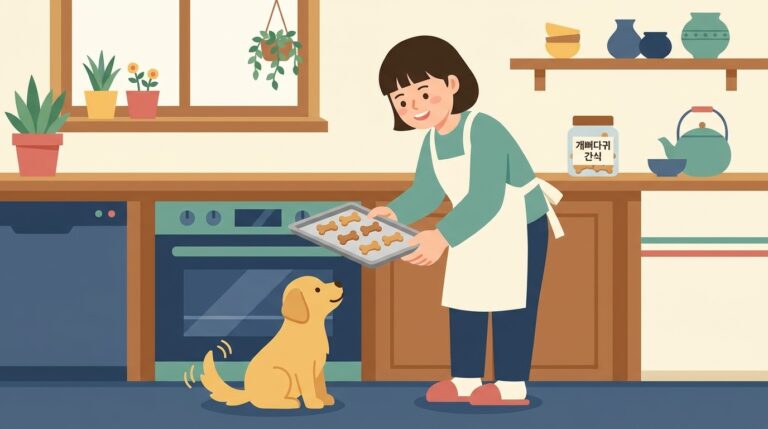
Lately, if you walk through the trendy neighborhoods of Mapo or Seongsu, you’ll notice something adorable: Koreans are absolutely obsessed with their furry companions. We call ourselves the “Pet-fam족” (Pet + Family tribe). Along with this trend, a massive boom in cooking handmade treats, or 수제 간식 (su-je gan-sik), has taken over social media.
Have you ever tried to follow a Korean pet recipe on YouTube, only to get lost when the chef says to add ingredients “눈대중으로” or mentions the dog’s “기호성”? Don’t worry! Today, we are going to dive deep into the heart of Korean pet food culture. You’ll learn how to talk about making nutritious pet snacks like an absolute pro, upgrading your vocabulary to a solid B2 level.
Phase 2: Three Core Expressions Deep-Dive
1. 기호성 (gi-ho-seong)
- Pronunciation: gi-ho-seong (Sounds like “key-ho-sung”)
- Meaning: Palatability / Food preference (Literally: “preference property”).
- K-Culture Moment: In Korean pet vlogs, creators almost always perform a 기호성 테스트 (palatability test) before introducing a new homemade recipe. They line up different treats to see which one the pet runs to first.
- Editor’s Insight: While “taste” (맛) is used for humans, Koreans specifically use 기호성 for pets to describe how appealing or enticing a food is to them. If a dog goes crazy for a snack, we say “기호성이 좋다” (It has great palatability).
- Situation Spectrum: Casual ✅ / Semi-formal ✅ / Formal ✅
- 🤔 Think About It: In English, we simply say “my dog loves it.” Why do you think Korean pet parents prefer using a slightly scientific-sounding word like “기호성” in their daily lives? It highlights how deeply pet care is researched and treated with professional-level respect in modern Korea.
2. 수제 간식 (su-je gan-sik)
- Pronunciation: su-je gan-sik (Sounds like “soo-jeh gahn-seek”)
- Meaning: Homemade / Artisanal pet treats.
- K-Culture Moment: Go to any trendy K-pet bakery, and you’ll find treats that look identical to human pastries—like pupcakes, doggoccinos, and even pet-friendly gimbap! These are all proudly labeled as 수제 간식.
- Editor’s Insight: “수제” (handmade) combined with “간식” (snack) implies high-quality, preservative-free ingredients. Making these at home is seen as the ultimate sign of parental love for a pet.
- Situation Spectrum: Casual ✅ / Semi-formal ✅ / Formal ✅
- 🤔 Think About It: How does the culture of preparing “수제” food for pets connect to the traditional Korean concept of 정 (jeong)—the deep warmth and affection shared through giving food?
3. 눈대중으로 (nun-dae-jung-eu-ro)
- Pronunciation: nun-dae-jung-eu-ro (Sounds like “noon-dae-joong-oo-ro”)
- Meaning: Eyeballing it / Measuring by eye.
- K-Culture Moment: If you watch a Korean grandmother or a local pet-chef bake, they rarely use scales. They will throw in chopped carrots and sweet potatoes 눈대중으로 (by eye estimate).
- Editor’s Insight: This stems from the traditional Korean cooking concept of 손맛 (son-mat)—the intuitive “taste of one’s hands.” It’s highly valued as a sign of experienced, natural cooking.
- Situation Spectrum: Casual ✅ / Semi-formal ✅ / Formal ⚠️
- 🤔 Think About It: Western recipes are highly precise, relying heavily on grams and ounces. How comfortable are you with ditching the measuring cups and cooking 눈대중으로?
Phase 3: Textbook Korean vs. Real Korean
Situation 1: Feeding your pet
- 📖 Textbook Korean: “강아지에게 밥을 주다.” (I give food to the dog.)
- 🗣️ Real Korean: “강아지 밥 챙겨주다” (I’m taking care of my dog’s meal) or “우리 댕댕이 맘마 주다” (Giving my puppy their ‘mamma’ / baby food).
- 💡 Why the difference? To Koreans, pets are family. Instead of the simple transaction of “giving food” (밥을 주다), we use 챙겨주다 (to care for and provide) or the cute baby-talk 맘마 (mamma) to show deep familial affection.
Situation 2: When your pet absolutely loves the food
- 📖 Textbook Korean: “강아지가 음식을 아주 맛있게 먹습니다.” (The dog eats the food very deliciously.)
- 🗣️ Real Korean: “우리 애가 아주 순삭했어!” (My baby literally instantly deleted it!)
- 💡 Why the difference? 순삭 (sun-sak) is a compound slang word combining 순간 (instant) and 삭제 (deletion). Using “우리 애” (my kid/baby) instead of “강아지” (dog) is the gold standard of modern Korean pet-parent speak.
Phase 4: K-Culture Deep-Dive & Non-verbal Manners
4-1. Hands-On Pet Etiquette: The Flat Palm
When you meet a Korean dog at a pet café or while visiting a friend, and you want to offer them a homemade snack (수제 간식), never feed them with your fingertips.
- The Gesture: Keep your hand completely flat (손바닥을 펴서), resting the treat in the middle of your palm. This prevents the dog from accidentally nipping your fingers and signals to the owner that you are a polite, experienced pet handler.
- The Greeting: Always ask the owner first: “간식 줘도 돼요?” (Can I give a treat?) to ensure the pet doesn’t have allergies.
4-2. The Rise of “Pet-fam” Culture
Korea’s birthrate trends have led to a fascinating sociological shift: more young couples are choosing to raise pets instead of having children. This has birthed the premium pet market. From specialized dehydration machines for making 고구마 말랭이 (chewy sweet potatoes) to dog-friendly beer (made of barley and vitamin water), the attention to nutritional detail is staggering. Making pet snacks isn’t just a hobby; it’s an industry.
Phase 5: Real-Life Roleplay Scenario
Setting: A cozy pet cooking studio in Mapo, Seoul. You (Alex) are attending a weekend workshop to learn how to make pet-friendly chicken breast terrines.
Characters:
* 유나 (Yuna): The friendly workshop instructor.
* 알렉스 (Alex): A passionate expat pet parent (You).
유나: 안녕하세요, 알렉스 씨! 오늘 만들 닭가슴살 테린은 강아지들이 정말 좋아해요.
      (Hello, Alex! Dogs absolutely love the chicken breast terrine we are making today.)

알렉스: 🎭 (Excitedly smiles) 네, 진짜 기대돼요! 우리 강아지가 요즘 입맛이 까다로워서요.
        (Yes, I'm really looking forward to it! My dog has been a picky eater lately.)

유나: 걱정 마세요. 이건 기호성이 아주 좋아서 다들 잘 먹거든요.
      (Don't worry. This has great palatability, so they all eat it well.)

알렉스: 다행이네요. 재료 계량은 정확히 해야 하나요?
        (That's a relief. Do we need to measure the ingredients exactly?)

유나: 🎭 (Waving hand warmly) 아뇨, 당근이랑 브로콜리는 눈대중으로 대충 넣으셔도 돼요!
      (No, you can just eyeball the carrots and broccoli and toss them in!)

알렉스: 🎭 (Nodding in relief) 아, 눈대중으로요? 한국 요리는 그게 매력인 것 같아요.
        (Ah, by eyeballing it? I think that's the charm of Korean cooking.)

유나: 맞아요! 다 찌고 나서 식힌 다음 먹기 좋은 크기로 썰어주면 끝이에요.
      (Exactly! Once steamed, cool it down, slice it into bite-sized pieces, and you're done.)

알렉스: 집에 가서 주면 순삭하겠네요. 벌써 신나요!
        (My dog will probably finish it in a flash when I go home. I'm already excited!)
🔀 Choose Your Next Move!
- Option A: “이거 저도 같이 먹어도 돼요?” (Can I eat this together with my pet?)
- Option B: “기호성 검사 어떻게 해요?” (How do I do a palatability test?)
- Option C: “강아지한테 매일 줘도 괜찮아요?” (Is it okay to give this to my dog every day?)
Feedback on your choices:
- Option A (Best): 🌟 Highly realistic and funny! Since pet terrines contain human-grade chicken and veggies with no seasoning, they are technically edible for humans. Yuna will laugh and say, “맛은 없겠지만 드셔도 돼요!” (It won’t taste like much, but sure!)
- Option B (Bad): ⚠️ Note the vocabulary error. Instead of “기호성 검사” (which sounds like an official scientific audit), you should say 기호성 테스트 (palatability test).
- Option C (Risk): ⚠️ A bit too serious for a casual cooking class. It’s safe, but doesn’t build a fun rapport with the instructor.
Phase 6: 10-Second Emotion Shadowing Drill
Let’s practice speaking with natural Korean rhythm, pauses (/), and emotional tones!
- [😊 Proud and bragging to friends]
우리 / 댕댕이가 / 이거 엄청 / 잘 먹어요!
U-ri / daeng-daeng-i-ga / i-geo eom-cheong / jal meog-eo-yo!
(My puppy eats this so well!) - [😎 Confident and breezy]
레시피 없어도 / 눈대중으로 / 대충 / 만들 수 있어요.
Re-si-pi eop-seo-do / nun-dae-jung-eu-ro / dae-chung / man-deul su is-seo-yo.
(Even without a recipe, I can easily make it by eye.)
Phase 7: K-Culture Mini Dictionary
- 댕댕이 (Daeng-daeng-i) | Noun | Cute slang for puppy/dog. Originates from internet slang where the visual shape of the letters “멍멍이” (meong-meong-i) looks similar to “댕댕이”.
- 수제 간식 (Su-je gan-sik) | Noun | Premium, handmade pet treats made without commercial chemicals.
- 순삭 (Sun-sak) | Slang | Short for “순간삭제” (instant deletion). Used to describe eating something incredibly fast because it’s delicious.
- 코박죽 (Ko-bak-juk) | Slang (Slightly playful) | Literally “burying one’s nose to eat.” Used to describe a pet eating intensely without looking up once.
Phase 8: Traveler’s Pet Survival Kit
Survival Expressions for Pet Lovers
- Expression 1: “반려동물 동반 가능한가요?” (ban-ryeo-dong-mul dong-ban-gan-eung-han-ga-yo?)
- Pro Tip: Use this when checking if a cafe or restaurant allows dogs inside.
- Expression 2: “이거 강아지 수제 간식이에요?” (i-geo gang-a-ji su-je gan-sik-i-e-yo?)
- Pro Tip: Use this at local premium markets to confirm if the treats are handmade.
- Expression 3: “알레르기 유발 성분이 있나요?” (al-le-reu-gi yu-bal seong-bun-i it-na-yo?)
- Pro Tip: Essential if your pet has a sensitive stomach.
Editor’s Travel Note 🗺️
If you are traveling in Korea with your pet, you must download the Naver Map App. Simply search “반려동물 동반” (Pet-friendly) in the search bar, and it will instantly filter all nearby restaurants, cafes, and parks that welcome pets. (Note: Pet entry policies are subject to change, so calling ahead is recommended!)
Phase 9: “한 발 더 깊이” (Going Deeper)
In English, a dog is a “pet” and a owner is a “master” or “owner.” In Korea, however, the terminology has undergone a massive shift. The old word 애완견 (ae-wan-gyeon), which meant “toy dog,” has been completely replaced by 반려견 (ban-ryeo-gyeon), meaning “companion dog” (partner in life).
Furthermore, pet parents rarely refer to themselves as “주인” (owner). Instead, they call themselves 엄마 (mom), 아빠 (dad), or 누나/형 (older sister/brother). This linguistic shift proves that dogs are no longer seen as possessions, but as actual members of the family hierarchy.
💬 Your Turn: Does your native language have different terms for “pet owner”? How do you refer to yourself when talking to your pet? Let us know in the comments below!
Phase 10: FAQ & Avoiding Misunderstandings
Q: Can I use the term “기호성” when talking about human food?
A: No! “기호성” is strictly reserved for animals and pets. If you say “이 음식은 내 기호성에 맞아,” it will sound incredibly robotic and strange. For humans, simply use “입맛에 맞다” (suits my taste) or “취향 저격” (hits my preference).
Q: How do I tell a Korean pet owner their dog is cute without sounding rude?
A: Instead of calling the dog “귀여운 동물” (cute animal), use friendly terms like “댕댕이가 너무 미남/미녀네요” (Your puppy is such a handsome boy / beautiful girl) or “너무 인형 같아요” (It looks just like a doll).
🚨 Common Mistakes Warning Board
| Incorrect Usage | What it sounds like | Correct Action |
|---|---|---|
| “강아지 맛있다” | “The dog tastes delicious.” 😱 | Say “강아지가 잘 먹어요” (The dog eats well). |
| “이거 개 밥이에요?” | “Is this dog food?” (Sounds harsh/derogatory) | Say “이거 반려견 사료/간식인가요?” (Is this companion dog food/treat?). |
| “우리 개 주인이에요” | “I am the dog’s master.” (Very cold and distant) | Say “우리 아이 보호자예요” (I am my child’s guardian) or “강아지 엄마예요”. |
Phase 11: Action Mission & Engagement
Ready to put your learning into practice? Complete these challenges:
- Bronze Medal 🥉: Look at your pet (or a friend’s pet) eating, and say out loud: “와, 우리 애가 순삭했네!” (Wow, my baby devoured it instantly!)
- Silver Medal 🥈: Go on Instagram, find a Korean pet baking account, and leave a friendly comment: “기호성이 정말 좋아 보여요! 👍”
- Gold Medal 🥇: Create a simple 5-second video of your pet enjoying a treat. Post it on social media with the hashtag
#매일한글and write: “눈대중으로 만들었는데 순삭 완료!”
Phase 12: Interactive Quiz Challenge
Test your knowledge of Korean pet culture and intermediate vocabulary!
Q1. Which word refers to “making pet treats by eye/without measuring tools”?
- A) 기호성
- B) 수제 간식
- C) 눈대중으로
💡 Click here to see the answer!
Correct Answer: C) 눈대중으로
Explanation: “눈대중으로” means eyeballing it. “기호성” is palatability, and “수제 간식” means handmade treats.
Q2. True or False: It is completely natural to tell a Korean colleague, “이 삼겹살은 제 기호성에 아주 좋습니다.”
- A) True
- B) False
💡 Click here to see the answer!
Correct Answer: B) False
Explanation: “기호성” is only used for pets. For humans, say “이 삼겹살 제 입맛에 딱 맞아요!” (This pork belly is perfect for my taste!).







