

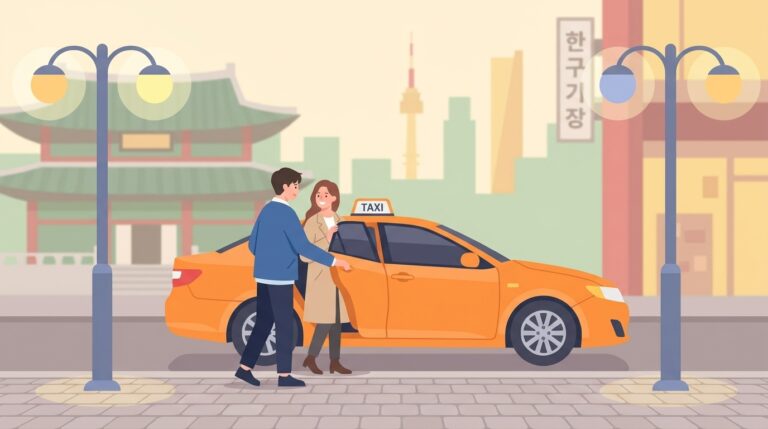
Survival Guide: How to Hail a Taxi for Your Korean Boss Like a Pro
Phase 1: Empathy (Welcome to the Real K-Work Culture!)
안녕하세요! (An-nyeong-ha-se-yo!) Your trusted Korean bestie and Daily Hangul senior editor is here!
Imagine this: You’ve just finished a wonderful, laugh-filled Hoesik (회식 – company dinner). Everyone is a bit tipsy, the night is wrapping up, and your team manager (부장님 – Bujangnim) is standing on the sidewalk, looking slightly tired. You want to make a great impression and show that you care about their safety. This is the ultimate “make-or-break” moment in Korean office life!
Hailing a taxi for your superior—known as 택시 잡아드리기 (taeksi jaba-deurilkkayo)—is a legendary social skill in Korea. Many of our actual learners have told us, “I wanted to help my boss get home, but I was so scared of saying the wrong thing or looking awkward!” Don’t worry. Today, we’ll turn this nerve-wracking moment into your absolute shining hour. Let’s dive in!
Phase 2: Deep Dive into Core Expressions
1. 택시 잡아드릴까요? (Taeksi jaba-deurilkkayo?)
- Pronunciation: Tek-see ja-ba-deu-ril-kka-yo? (Sounds like “Taxi” + “Java” + “Dream” but with an ‘l’ sound at the end + “Kka-yo”)
- Meaning: “Shall I catch a taxi for you?” (Literally: “Shall I grab a taxi for you?”)
- K-Culture Moment: You often see this in K-dramas when a polite junior employee steps out of a restaurant ahead of the group to secure a cab on a busy night.
- Editor’s Insight: The word 잡아주다 (jaba-juda) means “to catch/hold for someone.” By changing it to the honorific 잡아드리다 (jaba-deurida), you show immense respect and proactive care.
- Situation Spectrum: Casual 🚫 | Semi-formal ⚠️ | Formal ✅
- 🤔 Think About It: In your culture, is it common to help a manager get home after a night out, or do people usually go their separate ways immediately?
2. 조심히 들어가세요. (Josimhi deureogaseyo.)
- Pronunciation: Jo-seem-hee deu-reo-ga-seh-yo.
- Meaning: “Please get home safely.” (Literally: “Go inside carefully.”)
- K-Culture Moment: The universal parting phrase used in Korea at the end of every work day, family gathering, or casual hangout.
- Editor’s Insight: “들어가다” (deureogada) means “to enter” (referring to entering one’s home). It is much warmer than just saying “Goodbye!”
- Situation Spectrum: Casual ⚠️ | Semi-formal ✅ | Formal ✅
3. 도착하시면 연락해 주세요. (Deochak-hasimyeon yeollak-hae juseyo.)
- Pronunciation: Doh-chak-ha-see-myeon yeol-lak-hae joo-seh-yo.
- Meaning: “Please text/call me when you arrive.”
- K-Culture Moment: A warm gesture of care often exchanged between close colleagues, friends, or family members late at night.
- Editor’s Insight: Asking a superior to text you might sound bold, but in this context, it shows you genuinely care about their safety. It builds a beautiful human connection (Jeong / 정).
- Situation Spectrum: Casual ✅ | Semi-formal ✅ | Formal ⚠️
Phase 3: Textbook Korean vs. Real-Life Korean
Let’s compare what textbooks teach versus what Koreans actually say on the streets of Seoul!
Situation 1: Offering to book a ride
- 📖 Textbook: “택시를 부르겠습니다.” (Taeksireul bureugetseumnida. – “I will call a taxi.”)
- 🗣️ Real Life: “택시 잡아드릴게요!” (Taeksi jaba-deurilgeyo! – “Let me grab a taxi for you!”)
- 💡 Why the difference? The textbook version sounds like a robotic announcement. The real-life version is warm, proactive, and natural.
Situation 2: Wishing them a safe ride
- 📖 Textbook: “안녕히 가십시오.” (Annyeonghi gasipsio. – “Go in peace.”)
- 🗣️ Real Life: “조심히 들어가세요!” (Josimhi deureogaseyo! – “Get home safely!”)
- 💡 Why the difference? While “안녕히 가십시오” is technically correct, it can feel overly stiff and distant on a casual sidewalk after a fun dinner.
Phase 4: K-Culture Deep Dive & Non-Verbal Manners
4-1. The Art of Nunchi (눈치) & Body Language
- The Double-Hand Gesture: When holding the taxi door open for your boss, use both hands or place one hand gently over your chest while bowing slightly (about 15 to 30 degrees).
- The Door Etiquette: If the taxi arrives, open the door for them. Once they are safely inside, wait until the taxi drives off before you turn away!
4-2. Safety & Plate Numbers
In K-dramas, you might see characters memorizing or taking a photo of the taxi’s license plate. This is a real-life practice! Sharing the taxi plate number with your colleague or boss via KakaoTalk is considered the ultimate act of consideration.
Phase 5: Real-Life Roleplay Scenario
Setting: Outside a cozy Korean BBQ restaurant in Gangnam at 11:30 PM. It is cold, and the streets are busy.
Characters:
* Manager Kim (김 부장님): Friendly but tired.
* You (The Star Employee): Polite and alert.
- Manager Kim: 아, 오늘 회식 아주 재미있었어! (Ah, oneul hoesik aju jaemi-isseosseo!)
- 🎭 [Manager Kim smiles, rubbing his neck tiredly]
- You: 네, 부장님! 정말 즐거웠습니다. (Ne, Bujangnim! Jeongmal jeulgeoweotseumnida.)
- 🎭 [You nod enthusiastically with a warm smile]
- Manager Kim: 그런데 슬슬 집에 어떻게 가나… (Geureonde seul-seul jibe eotteohge gana…)
- 🎭 [He looks around the busy street for a taxi]
- You: 부장님, 제가 택시 잡아드릴까요? (Bujangnim, jega taeksi jaba-deurilkkayo?)
- 🎭 [You pull out your phone to open Kakao T]
- Manager Kim: 오, 그래줄 수 있어? 고마워! (Oh, geuraejul su isseo? Gomawo!)
- 🎭 [He looks relieved]
- You: 네, 불렀습니다! 저기 오네요. (Ne, bulleotseumnida! Jeogi oneyo.)
- 🎭 [You point to the arriving taxi, open the door for him, and bow]
- Manager Kim: 고생했어. 먼저 갈게! (Gosaenghaesseo. Meonjeo galge!)
- 🎭 [He steps inside the taxi]
- You: 조심히 들어가세요, 부장님! 도착하시면 연락해 주세요! (Josimhi deureogaseyo, Bujangnim! Deochak-hasimyeon yeollak-hae juseyo!)
- 🎭 [You wave politely with both hands as the taxi drives away]
🔀 Interactive Choice Point
Your boss gets in the taxi, but he realizes he forgot his wallet! What do you do?
* A) Say: “어떡해요?!” (Eotteokhaeyo?! – “What to do?!”) and panic.
* B) Say: “부장님, 제가 카드로 먼저 결제할게요!” (Bujangnim, jega kadeuro meonjeo gyeoljehalgeyo! – “Manager, let me pay with my card first!”) and use the Kakao T app auto-pay.
* C) Say: “내리세요!” (Naeriseyo! – “Get out!”) and pull him out.
Feedback:
- Best Choice (B): Superb! Booking via an app like Kakao T allows automatic payment. You just saved the day!
- Risk (A): Panic doesn’t help. It makes your boss feel anxious and awkward.
- Bad Choice (C): Yikes! Pulling your boss out of a taxi is a major cultural faux pas!
Phase 6: 10-Second Emotion Shadowing Drill
Practice these with natural rhythm and emotional cues!
- “부장님, / 제가 / 택시 잡아드릴까요?”
- [😊 Helpful, eager, with a polite smile]
- “조심히 / 들어가세요, / 부장님!”
- [👋 Warm, caring, shouting slightly over the street noise]
- “도착하시면 / 연락해 주세요!”
- [🥺 Soft, concerned for their safety]
Phase 7: K-Culture Mini Dictionary
- 회식 (Hoesik): Company dinner/gathering. A staple of Korean office culture.
- 막차 (Makcha): The last train/bus of the night. Missing this is why people scramble for taxis!
- 대리운전 (Daeri-unjeon): Designated driver service. If your boss drove to the dinner but drank, you call this service instead of a taxi.
- 눈치 (Nunchi): The art of reading the room and sensing others’ needs. Essential for survival!
Phase 8: Traveler’s Survival Kit
Top 3 Survival Phrases
- “카카오 T로 불렀어요.” (Kakao T-ro bulleotseumnida.) – “I called it using the Kakao T app.”
- “주소 말씀해 주세요.” (Juso malsseumhae juseyo.) – “Please tell me the address.”
- “기사님, 여기 세워주세요.” (Gisanim, yeogi seoweojuseyo.) – “Driver, please stop here.”
🗺️ Editor’s Travel Note
When traveling or working in Korea, do not try to hail taxis randomly on busy nights by waving your hand. Download the Kakao T App beforehand. It allows you to enter destinations, see fares upfront, and pay automatically with foreign credit cards!
Phase 9:
Frequently Asked Questions (FAQ)
Q: What does "택시 잡아드릴까요? (Taeksi jaba-deurilkkayo?)" mean in Korean and how do you pronounce it?
A: In Korean, "택시 잡아드릴까요? (Taeksi jaba-deurilkkayo?)" is pronounced [Tek-see ja-ba-deu-ril-kka-yo? (Sounds like "Taxi" + "Java" + "Dream" but with an 'l' sound at the end + "Kka-yo"] and means: "Shall I catch a taxi for you?" (Literally: "Shall I grab a taxi for you?")
Q: What does "조심히 들어가세요. (Josimhi deureogaseyo.)" mean in Korean and how do you pronounce it?
A: In Korean, "조심히 들어가세요. (Josimhi deureogaseyo.)" is pronounced [Jo-seem-hee deu-reo-ga-seh-yo.] and means: "Please get home safely." (Literally: "Go inside carefully.")
Q: What does "도착하시면 연락해 주세요. (Deochak-hasimyeon yeollak-hae juseyo.)" mean in Korean and how do you pronounce it?
A: In Korean, "도착하시면 연락해 주세요. (Deochak-hasimyeon yeollak-hae juseyo.)" is pronounced [Doh-chak-ha-see-myeon yeol-lak-hae joo-seh-yo.] and means: "Please text/call me when you arrive."







