

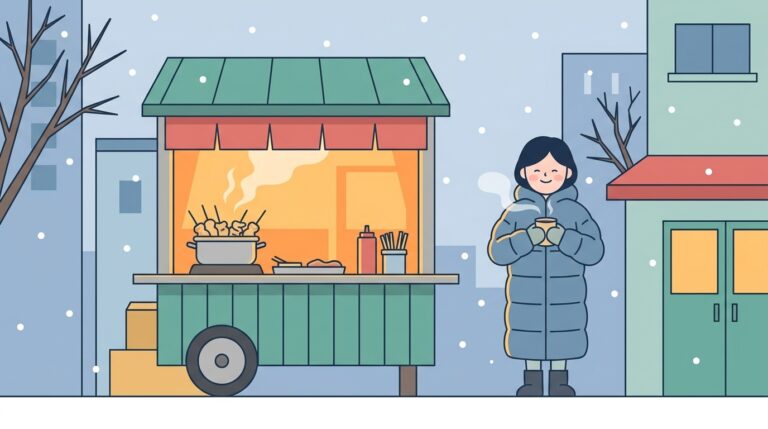
Stay Warm! How to Say “It’s Cold” in Korean Like a True Local
Phase 1: Empathy (Your Shivering K-Drama Moment)
안녕하세요! (An-nyeong-ha-se-yo!) Your Daily Hangul editor here, your personal Korean bestie!
Picture this: You step out of a warm café in Seoul into the crisp, chilly winter air. The wind hits your face, and you want to tell your friend, “Whoa, it’s freezing!” But you freeze up because you only know the stiff textbook phrases.
If you’ve ever struggled to express how chilly you are without sounding like a robot, you are not alone! Many of our A1 learners tell us they feel self-conscious saying basic things. In this guide, we’re going to give you the exact warm, cozy, and natural phrases that real Koreans use every single day. By the end of this post, you’ll be complaining about the cold just like your favorite K-drama leads!
Phase 2: Core Expressions – Deep Dive
1. 추워요 (chu-wo-yo)
- Pronunciation: “Chu-wo-yo” (Imagine sneezing a cute “chu!”, then saying “wo” like in “water,” and ending with “yo” like the toy yo-yo!)
- Meaning: It’s cold. (Standard & Polite)
- K-Culture Moment: This is the ultimate safe phrase! You’ll hear this in almost every winter K-drama scene when characters walk outside together, rubbing their hands.
- Editor’s Insight: The ending “-요 (-yo)” makes this polite and friendly. You can use this with store clerks, new friends, or coworkers.
- Situation Spectrum: Casual (⚠️ without ‘-yo’ it becomes ‘추워’, only for close friends), Semi-formal (✅), Formal (⚠️).
- 🤔 Think About It: In your language, do you have a polite way to say simple things like “It’s cold”? In Korean, showing respect is woven into the simplest daily observations!
2. 추워 죽겠어요 (chu-wo juk-gess-eo-yo)
- Pronunciation: “Chu-wo jook-get-suh-yo” (Think of “jook” as in warm soup, and “get-suh-yo” as “get-saw-yo”!)
- Meaning: “I’m freezing to death!” (Literally: Cold so I could die)
- K-Culture Moment: When a character in a drama runs into a convenience store after waiting in the snow, shivering dramatically.
- Editor’s Insight: Don’t worry, you aren’t actually dying! Koreans love using the word “죽겠다 (juk-gess-da – to die)” to exaggerate everyday feelings (like being hungry, tired, or cold). It sounds very natural and expressive.
- Situation Spectrum: Casual (✅ as ‘추워 죽겠네’), Semi-formal (✅), Formal (🚫 too dramatic!).
- 🤔 Think About It: Why do you think Koreans use dramatic exaggerations for feelings? It’s a fun way to share immediate empathy!
3. 춥다 (chup-da)
- Pronunciation: “Chup-dah” (Sounds like “chup” from chocolate chips, and “dah” like “ta-da!”)
- Meaning: “Cold!” (Exclamatory / Self-talk)
- K-Culture Moment: Walking out the door, immediately hugging your arms, and saying this to yourself.
- Editor’s Insight: This is the base form of the verb. When said out loud to yourself, it works as a quick exclamation. No polite ending is needed because you’re just talking to the wind!
- Situation Spectrum: Casual (✅ to yourself), Semi-formal (🚫), Formal (🚫).
- 🤔 Think About It: Do you talk to yourself in your native language when the weather changes? Try whispering “춥다…” next time you open the freezer!
Phase 3: Textbook Korean vs. Real Korean
Let’s see the difference between what’s in old books and how real people talk:
- Scenario 1: Talking to a friend outside
- 📖 Textbook: 날씨가 춥습니다. (nal-ssi-ga chup-seum-ni-da. – The weather is cold.)
- 🗣️ Real Korean: 아, 진짜 추워요! (ah, jin-jja chu-wo-yo! – Ah, it’s really cold!)
- 💡 Why? Nobody speaks formally to their friends like a news anchor. Dropping the formal subject particles makes you sound like a human, not a translator!
- Scenario 2: Reacting to sudden wind
- 📖 Textbook: 매우 춥습니다. (mae-u chup-seum-ni-da. – It is very cold.)
- 🗣️ Real Korean: 으, 추워! (eu, chu-wo! – Ugh, cold!)
- 💡 Why? “매우 (mae-u)” is mostly written in newspapers. In real life, “진짜 (jin-jja – really)” or “너무 (neo-mu – too/very)” are the king and queen of conversational emphasis!
Phase 4: K-Culture Deep Dive & Body Language
4-1. The “Nunchi” Shiver & Gestures
When saying “추워요,” don’t just use your voice! In Korea, expressing the cold is an active physical language:
* The Shiver Shrug: Shrug your shoulders high up to your ears, tuck your chin down, and lightly shake.
* The Hand Blow: Cup your hands together, bring them to your mouth, and blow warm air (hooo~) while saying “아, 추워!”
* The Pocket Hug: Keep your hands deep in your coat pockets while keeping your elbows glued to your ribs.
4-2. The Korean Winter Culture
In Korea, winter is not just cold; it’s delicious and cozy!
* 롱패딩 (Rong-pae-ding): The famous black floor-length padded coats. When winter hits, Seoul streets look like a parade of cute penguins!
* 붕어빵 (Bung-eo-ppang): Cute, fish-shaped pastries filled with sweet red bean or custard. Buying these warm snacks from a street stall is the ultimate Korean winter romance.
Phase 5: Live Roleplay – Cold Winter Night
Let’s practice! You are walking to a subway station with Minjun, your friendly Korean classmate.
- Minjun: 오늘 진짜 춥죠? (o-neul jin-jja chup-jyo? / Today is really cold, right?)
- You: 🎭 [hugging yourself] 네, 너무 추워요! (ne, neo-mu chu-wo-yo! / Yes, it’s so cold!)
- Minjun: 손이 꽁꽁 얼었네요! (son-i kkong-kkong eol-eot-ne-yo! / Your hands are frozen stiff!)
- You: 🎭 [showing your hands] 맞아요. 장갑이 없어요. (ma-ja-yo. jang-gap-i eop-seo-yo. / That’s right. I don’t have gloves.)
- Minjun: 우리 따뜻한 어묵 먹고 갈래요? (u-ri tta-tteut-han eo-muk meok-go gal-rae-yo? / Shall we eat some warm fishcakes before we go?)
- You: 🎭 [eyes lighting up] 와, 좋아요! 국물도 마시고 싶어요. (wa, jo-a-yo! guk-mul-do ma-si-go sip-eo-yo. / Wow, great! I want to drink the soup too.)
- Minjun: 저기 포장마차로 빨리 가요! (jeo-gi po-jang-ma-cha-ro ppal-li ga-yo! / Let’s run to that street stall over there!)
- You: 🎭 [shivering and running] 네, 추워 죽겠어요! 빨리 가요! (ne, chu-wo juk-gess-eo-yo! ppal-li ga-yo! / Yes, I’m freezing to death! Let’s go fast!)
🔀 Your Interactive Choice!
Minjun hands you a hot paper cup of fishcake soup. What do you say?
- A) 춥다! (chup-da!)
- B) 와, 진짜 따뜻해요! 고마워요! (wa, jin-jja tta-tteut-hae-yo! go-ma-wo-yo!)
- C) 싫어요. (sil-heo-yo.)
Feedback:
- If you chose A (Chup-da): Risk! Saying “Cold!” while receiving a warm cup sounds a bit disconnected and self-centered.
- If you chose B (Best Choice): Best! You expressed warmth (“진짜 따뜻해요” – It’s really warm) and thanked your friend. Perfect manners!
- If you chose C (Sil-heo-yo): Bad! This means “I hate it” or “No.” It sounds very cold and rude to say to someone offering you warm food!
Phase 6: 10-Second Emotion Shadowing Drill
Feel the cold in your chest! Try speaking these out loud with emotional cues:
아, / 진짜 / 추워요! [🥺 Shivering and rubbing hands together]오늘 / 너무 / 춥다! [🥶 Saying quickly as soon as you step outside]추워 / 죽겠어요! [😩 Complaining playfully to a close classmate]
Phase 7: K-Culture Mini Dictionary
- 롱패딩 (rong-pae-ding): Long padded coats (winter uniform in Korea).
- 붕어빵 (bung-eo-ppang): Fish-shaped winter street pastries.
- 어묵 (eo-muk): Warm, delicious fishcakes served on skewers.
- 핫팩 (hat-paek): Disposable pocket hand warmers sold at every convenience store.
Phase 8: Traveler’s Winter Survival Kit
Survival Expressions TOP 3:
- 따뜻한 거 주세요. (tta-tteut-han geo ju-se-yo.) | “Warm drink/thing, please.” (Perfect for cafes!)
- 핫팩 있어요? (hat-paek iss-eo-yo?) | “Do you have hand warmers?” (Ask this at any convenience store!)
- 안으로 들어가요. (an-eu-ro deul-eo-ga-yo.) | “Let’s go inside.” (To save yourself from the cold wind!)
📌 Editor’s Travel Note:
To find the closest indoor shopping malls or cozy cafes to hide from the wind, always download the Naver Map App or Kakao Map App. Google Maps doesn’t work well for walking directions in Korea! Note: App store details may vary depending on your region.
Phase 9: “One Step Deeper” – The Warmth of “Jeong (정)”
In Korea, winter is when you truly feel “Jeong (정)”—the unique Korean feeling of warm affection and community. Sharing a single hot pack, huddling together under a bus stop heater, or ordering fishcakes and getting free warm soup refills are all quiet ways Koreans show love. When you say “추워요,” you aren’t just complaining about the weather; you’re inviting the other person to share a moment of cozy connection with you.
💬 Your Turn: What is your favorite winter street food in your country? Let me know in the comments below!
Phase 10: FAQ & Common Mistakes
Q: Can I say “춥다” to my Korean teacher or boss?
A: No! “춥다” is casual self-talk. Always use “추워요” (chu-wo-yo) or “오늘 날씨가 정말 춥네요” (o-neul nal-ssi-ga jeong-mal chup-ne-yo) to show polite respect.
Q: What is a “핫팩” (hat-paek) and where do I get one?
A: It is a hot pack! You can shake them to activate the heat. You can buy them at any CU, GS25, or 7-Eleven convenience store.
Q: Is “추워 죽겠어요” rude?
A: Not at all! It is a bit dramatic, but completely natural to use with classmates, friends, or friendly colleagues. Just avoid using it in highly formal business meetings.
🚨 Common Mistakes Warning Board:
- Mistake 1: Saying “나는 추워요” (na-neun chu-wo-yo).
- Why: Koreans almost never say “나는 (I)” when talking about their own feelings. It sounds like a Google Translation.
- Correct Action: Just say “추워요!”—the subject is already understood!
Phase 11: Action Missions
- 🥉 Bronze Mission: Whisper “춥다…” to yourself next time you open your freezer.
- 🥈 Silver Mission: Write a comment below using “너무 추워요!” (It’s too cold!) or share this post with your study buddy.
- 🥇 Gold Mission: Next time you talk to a Korean friend online, start with: “오늘 한국은 추워요?” (Is it cold in Korea today?)
Phase 12: Interactive Quiz Challenge
1. Which expression means “I’m freezing to death!”?
- A) 날씨가 좋습니다
- B) 추워 죽겠어요
- C) 따뜻해요
👀 Click to see the answer!
Correct Answer: B
“추워 죽겠어요” means “cold to death.” A means “The weather is good” and C means “It’s warm.”
2. True or False: You should say “춥다” directly to your boss to sound natural.
👀 Click to see the answer!
Correct Answer: False!
“춥다” is casual. With your boss, you should always say “추워요” or “춥네요” to be polite!
Keep cozy, keep practicing, and see you next time on Daily Hangul!







