

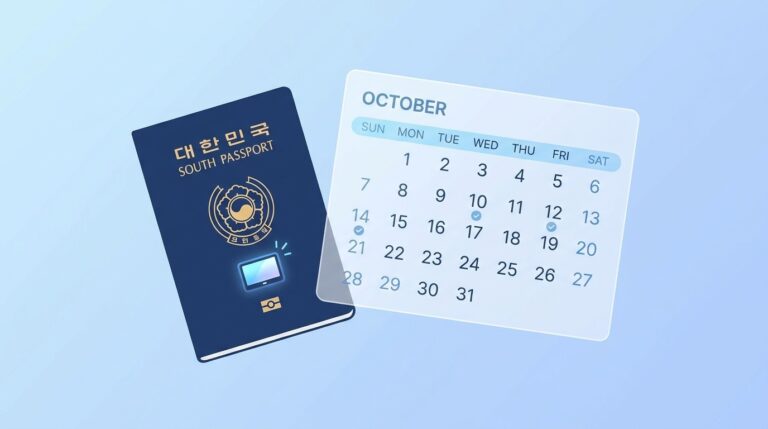
Navigating Passport Renewal in Korea: Mastering Administrative Nuances Like a Local
Phase 1: Empathy (Anxious Waits & Golden Tickets)
안녕하세요! Welcome back to Daily Hangul, your trusted cultural companion.
Imagine this scenario: You have finally locked in your dream itinerary—a multi-city tour through Seoul’s historical alleys and Jeju’s volcanic coastlines. Your bags are half-packed, and your excitement is peak. But then, you open your drawer, check your passport, and freeze. It expires in less than four months.
In the world of international travel, few things trigger adrenaline like realizing your passport validity is ticking away. You find yourself at a Korean local district office (Gu-cheong / 구청), or dealing with the Korean consular portal, trying to figure out exactly how long the “next-generation electronic passport” (차세대 전자여권) will take to reach your hands.
If you are a C2-level learner, simply asking “How many days?” won’t cut it. You need to navigate the sophisticated administrative landscape, understand the bureaucratic flow, and discuss potential bottlenecks with nuance and confidence. Today, we will master the high-level vocabulary and cultural context of 여권 갱신 발급 소요 기간 (passport renewal processing times) so you can communicate like a native diplomat.
Phase 2: Key Expressions Deep-Dive
1. 소요 기간을 넉넉히 잡다 (So-yo gi-gan-eul neon-neok-hi jap-da)
- Pronunciation: [So-yo gee-gan-eul nuck-nuck-hee jap-dah] (Think of “neon-neok” as a deep, satisfying sigh of having more than enough of something, like an extra scoop of rice.)
- Meaning: To allow/estimate a generous buffer of processing time.
- K-Culture Moment: You will hear this frequently in lifestyle vlogs or podcasts when Korean travel influencers discuss planning peak-season trips to Europe or Japan.
- Editor’s Insight: While “소요 시간” refers to hours/minutes of travel, “소요 기간” specifically references blocks of days, weeks, or months required for a process. The verb “잡다” (literally, to grab) is used here metaphorically to mean “to set aside” or “to estimate.”
- Situation Spectrum: Casual (✅) | Semi-formal (✅) | Formal (✅)
- 🤔 Think About It: In your native language, do you “grab” time, or do you “leave” or “save” it? How does the physical action of “grabbing a buffer” change your perception of time management?
2. 발급 신청이 폭주하다 (Bal-geup sin-cheong-i pok-ju-ha-da)
- Pronunciation: [Bal-geup seen-chung-ee poke-joo-hah-dah] (The “pok” should feel explosive, similar to “poke” but with a short, sharp burst of air.)
- Meaning: A massive surge/flooding of issuance applications.
- K-Culture Moment: Often seen in breaking news headlines (뉴스 속보) right before summer vacation season or when visa-free entries to popular destinations are newly announced.
- Editor’s Insight: “폭주” (暴走) originally means running wildly out of control, but in modern Korean administrative contexts, it implies a system overload due to demand. It carries a heavy nuance of unexpected delays.
- Situation Spectrum: Casual (⚠️ – sounds a bit dramatic for daily chat) | Semi-formal (✅) | Formal (✅)
- 🤔 Think About It: Why does Korean administration favor highly visual, dynamic hanja (Chinese character) terms like “폭주” (exploding run) over simple words like “많다” (many)?
3. 차세대 전자여권으로 교체하다 (Cha-sae-dae jeon-ja-yeog-won-eu-ro gyo-che-ha-da)
- Pronunciation: [Cha-sae-dae jun-jah-yuh-gwon-eu-ro gyo-cheh-hah-dah]
- Meaning: To upgrade/replace with the next-generation electronic passport (the sleek blue design introduced in Korea in late 2021).
- K-Culture Moment: This is a proud talking point on Korean tech and design forums. The transition from the old green passport (구권) to the new navy blue (신권) was a major aesthetic and security upgrade.
- Editor’s Insight: “차세대” means “next-generation,” representing cutting-edge technology. In Korea, even administrative paper documents are treated as high-tech consumer goods.
- Situation Spectrum: Casual (✅) | Semi-formal (✅) | Formal (✅)
- 🤔 Think About It: How does the physical color change of a national passport reflect a country’s evolving global brand identity?
Phase 3: Textbook Korean vs. Real-World Korean
Situation A: Inquiring about processing delays
- 📖 Textbook Korean: 여권 발급이 지연되면 제 일정에 차질이 생깁니다. (If passport issuance is delayed, my schedule will experience a setback.)
- 🗣️ Real-World Korean: 여권 발급이 계속 밀려버리면 이번 여행 일정 자체가 완전히 꼬이게 생겼어요. (If the passport issuance keeps getting backed up, my entire travel itinerary is going to be completely tangled up.)
- 💡 Why the difference? The textbook version is grammatically flawless but sounds like a formal written complaint. Real Koreans use kinetic, physical verbs like “밀리다” (to be pushed/backed up) and “꼬이다” (to get tangled/screwed up) to express genuine anxiety and urgency.
Situation B: Discussing the application rush
- 📖 Textbook Korean: 많은 사람들이 신청하여 대기 시간이 깁니다. (Many people have applied, so the waiting time is long.)
- 🗣️ Real-World Korean: 지금 신청자가 대거 몰리는 바람에 발급되기까지 세월아 네월아 걸릴지도 몰라요. (Since applicants are flooding in all at once right now, it might take ages for it to finally come out.)
- 💡 Why the difference? C2-level fluency shines when utilizing idiomatic expressions. “세월아 네월아” (literally, saying “Oh, years! Oh, months!”) perfectly captures the frustratingly slow passage of time during bureaucratic processing.
Phase 4: K-Culture Deep-Dive & Non-Verbal Manners
4-1. The Art of Administrative “Nunchi” (눈치)
When you visit a local district office (Gu-cheong / 구청) in Korea, you are stepping into a high-speed, hyper-efficient ecosystem.
* The Gesture: Do not hover over the officer’s desk or tap your fingers loudly. Instead, maintain a respectful, slightly leaned-in posture. Keep your documents neatly arranged.
* The Eye Contact: If there is a delay, do not show overt anger. A gentle, sighing nod of sympathy (“아, 요즘 신청이 많이 밀렸나 보네요…” – Ah, I guess there are a lot of backlogged applications lately…) will get the officer on your side faster than demanding a manager.
4-2. The “Pali-Pali” (빨리빨리) Administrative Paradox
Korea is famous for its hyper-fast processing. Normally, a passport is ready in 3 to 4 business days. However, because Koreans are accustomed to this extreme speed, any delay beyond 5 days is viewed as an absolute national crisis. This intense societal expectation keeps public servants under constant pressure, which in turn fuels the continuous optimization of online systems like the government portal.
Phase 5: Real-World Roleplay Scenario
Setting: The bustling Passport Section of the Gangnam-gu Office (강남구청 여권과).
Characters:
* Officer Kim (주무관 김민수): Efficient, polite, but visibly exhausted from the summer vacation rush.
* Jiwon (지원 – You): An advanced Korean speaker who needs to renew their passport before a critical international flight.
주무관 김민수: (번호표를 확인하며) 안녕하십니까, 245번 고객님. 어떤 업무 도와드릴까요?

지원: 안녕하세요. 제가 이번에 차세대 전자여권으로 갱신 신청을 하려고 하는데요. 혹시 발급까지 소요 기간이 얼마나 걸릴지 여쭤볼 수 있을까요?

주무관 김민수: (조회를 해보며) 아, 요즘 여름 휴가철을 앞두고 신청이 워낙 폭주해서요. 평소보다 지체되고 있습니다. 지금 접수하시면 영업일 기준 최소 일주일은 잡으셔야 합니다.

지원: (걱정스러운 표정으로) 아... 일주일이나요? 제가 열흘 뒤에 당장 출국해야 하는 상황이라서 일정이 너무 촉박하네요. 조금이라도 더 빨리 수령할 수 있는 방법은 없을까요?

주무관 김민수: 정 급하시면 우편 개별배송 서비스를 신청하시는 방법이 있습니다. 조폐공사에서 주소지로 직접 배송해 드리는 건데, 구청에 직접 방문하시는 것보다 하루 이틀 정도 단축될 수 있어요.

지원: 그렇군요! 그럼 배송 중에 분실될 위험은 없는 건가요?

주무관 김민수: 본인 본인확인 후 직접 대면 수령이 원칙이라 분실 걱정은 안 하셔도 됩니다. 수수료가 추가되는데 신청하시겠습니까?

지원: 네, 하루가 급한 상황이니 우편 개별배송으로 바로 진행해 주세요. 여기 신청서랑 기존 여권 있습니다.
🔀 Interactive Choice Point
What is your next move to ensure everything goes smoothly?
- Option A: “최대한 빨리 부탁드립니다!” (Pushing the officer for speed)
- Feedback (Bad): Asking an administrative officer to hurry doesn’t bypass system queues; it only makes you look impatient.
- Option B: “우편 배송 진행 상황은 카카오톡 알림으로 실시간 조회가 가능한가요?” (Asking for digital tracking)
- Feedback (Best): Perfect! It shows you understand Korea’s highly digitized notification system and allows you to track your delivery step-by-step.
- Option C: “그냥 일반 발급으로 하고 매일 구청에 전화해서 확인해 볼게요.” (Calling daily)
- Feedback (Risk): This will clog the office’s lines and won’t speed up the physical printing process at the security printing corporation.
Phase 6: 10-Second Emotional Shadowing Drill
Practice these high-level sentences with realistic emotional inflections. / indicates a micro-pause for natural rhythm.
1. [🥺 Expressing extreme anxiety about travel plans]
“여권 갱신이 / 제때 안 되면 / 진짜 비행기 표부터 / 숙소까지 / 전부 위약금 물고 / 취소해야 할 판이에요.”
(If my passport renewal isn’t done in time, I’m literally in a position where I have to pay cancellation fees and cancel everything from plane tickets to accommodations.)
2. [😊 Relieved and grateful to an officer]
“우편 개별배송으로 하면 / 훨씬 단축된다니 / 정말 다행이네요. / 신경 써주셔서 / 대단히 감사합니다!”
(I’m so glad to hear that using the individual postal delivery will shorten the time significantly. Thank you so much for your attention to this!)
Phase 7: K-Culture Mini Dictionary
- 영업일 기준 (Yeong-eop-il gi-jun) | Business Days
- Crucial in Korean administration. Weekends and national holidays are strictly excluded from the
Frequently Asked Questions (FAQ)
Q: What does "소요 기간을 넉넉히 잡다 (So-yo gi-gan-eul neon-neok-hi jap-da)" mean in Korean and how do you pronounce it?
A: In Korean, "소요 기간을 넉넉히 잡다 (So-yo gi-gan-eul neon-neok-hi jap-da)" is pronounced [So-yo gee-gan-eul nuck-nuck-hee jap-dah] and means: To allow/estimate a generous buffer of processing time.
Q: What does "발급 신청이 폭주하다 (Bal-geup sin-cheong-i pok-ju-ha-da)" mean in Korean and how do you pronounce it?
A: In Korean, "발급 신청이 폭주하다 (Bal-geup sin-cheong-i pok-ju-ha-da)" is pronounced [Bal-geup seen-chung-ee poke-joo-hah-dah] and means: A massive surge/flooding of issuance applications.
Q: What does "차세대 전자여권으로 교체하다 (Cha-sae-dae jeon-ja-yeog-won-eu-ro gyo-che-ha-da)" mean in Korean and how do you pronounce it?
A: In Korean, "차세대 전자여권으로 교체하다 (Cha-sae-dae jeon-ja-yeog-won-eu-ro gyo-che-ha-da)" is pronounced [Cha-sae-dae jun-jah-yuh-gwon-eu-ro gyo-cheh-hah-dah] and means: To upgrade/replace with the next-generation electronic passport (the sleek blue design introduced in Korea in late 2021).







