

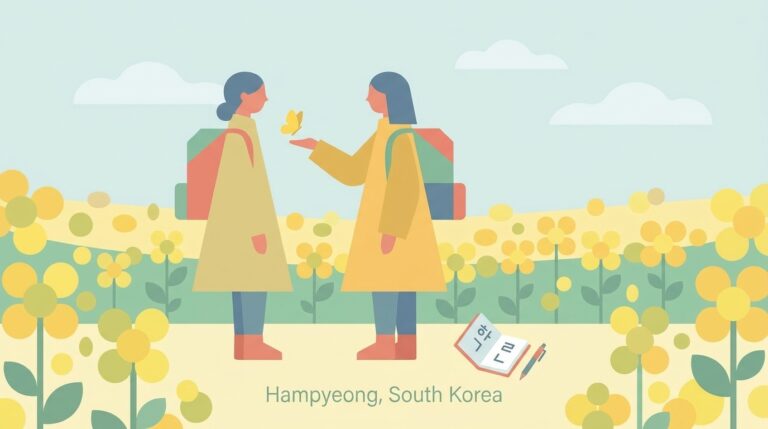
Master Intermediate Korean at the Hampyeong Butterfly Festival: Your Ecological Adventure Guide
Phase 1: Empathy & Storytelling (공감)
안녕하세요! Hello, fellow Korean learners! It’s your favorite senior editor from Daily Hangul, your trusty cultural navigator.
Have you ever dreamt of escaping the towering skyscrapers of Seoul to experience the serene, green side of Korea? Imagine stepping into a vast meadow of yellow canola flowers, surrounded by thousands of fluttering butterflies. Welcome to the Hampyeong Butterfly Festival (함평나비대축제), one of Korea’s most successful regional ecological festivals!
However, traveling outside major cities to regional festivals often triggers a major pain point for intermediate (B2) learners. Suddenly, standard classroom textbook expressions like “이것은 나비입니다” (This is a butterfly) feel incredibly stiff, and you might struggle to express your excitement or navigate hands-on ecological experiences. Based on real-life feedback from our global community, we’ve designed this guide to help you transition from sounding like a tourist reading from a pamphlet to a natural, culturally-aware traveler enjoying Korea’s greenest festival.
Phase 2: Deep Dive into 3 Key Expressions (핵심 표현 3선)
1. 체험 프로그램은 어떻게 신청해요? (How do I sign up for the experience program?)
- Pronunciation: Che-heom peu-ro-geu-raem-eun eo-tteo-ke sin-cheong-hae-yo? (Sounds like: “chay-um pro-gram-un uh-tuh-kay seen-chung-hay-yo?”)
- Meaning: “How do I register for the hands-on programs?”
- K-Culture Moment: You will hear this constantly on Korean healing travel shows like 1 Night 2 Days or House on Wheels whenever the cast arrives at a rural village and wants to try local crafts or harvesting.
- Editor’s Insight: While “예약하다” (ye-yak-ha-da) means to book in advance (like a hotel), “신청하다” (sin-cheong-ha-da) is used for applying or signing up for activities on-site or via forms.
- Situation Spectrum: Casual (⚠️ – too polite for close friends, use ‘신청해?’), Semi-formal (✅), Formal (✅).
- 🤔 Think About It: In Korean culture, active participation (체험) is highly valued over passive sightseeing. Why do you think hands-on learning is so central to Korean leisure activities?
2. 동심으로 돌아간 것 같아요. (I feel like I’ve returned to my childhood.)
- Pronunciation: Dong-sim-eu-ro dol-a-gan geot gat-a-yo. (Sounds like: “dong-seem-eu-ro dol-ah-gahn gut gaht-ah-yo.”)
- Meaning: “It feels like I have returned to a child’s innocent mind.”
- K-Culture Moment: In K-Dramas, when the main leads play with bubbles or release butterflies in a flower field, they often look at each other and say this with a nostalgic smile.
- Editor’s Insight: “동심” (dong-sim) literally means “child’s mind/innocence.” Using this expression shows high B2 proficiency because it carries a deeply emotional, poetic vibe that native speakers adore.
- Situation Spectrum: Casual (✅ – 동심으로 돌아간 것 같아), Semi-formal (✅), Formal (✅).
- 🤔 Think About It: English speakers often say “I feel like a kid again.” How does “returning to a child’s mind (동심)” highlight the soft, emotional nature of the Korean language?
3. 눈이 정화되는 기분이에요. (It feels like my eyes are being purified.)
- Pronunciation: Nun-i jeong-hwa-doe-neun gi-bun-i-e-yo. (Sounds like: “noon-ee jung-hwa-day-noon gee-boon-ee-ay-yo.”)
- Meaning: “I feel like my eyes/mind are being cleansed by this beautiful scenery.”
- K-Culture Moment: Commonly used by vloggers when they pan their cameras over lush green fields, mountains, or sparkling rivers away from city pollution.
- Editor’s Insight: “정화” (jeong-hwa) means purification. This is the ultimate compliment for scenic, eco-friendly travel destinations in Korea.
- Situation Spectrum: Casual (✅ – 눈이 정화되는 기분이야), Semi-formal (✅), Formal (✅).
- 🤔 Think About It: Why does modern Korean society place such a high linguistic emphasis on visual purification (눈 정화) and mental healing?
Phase 3: Textbook Korean vs Real Korean (교과서 vs 진짜 한국어)
Situation 1: Expressing awe at the beautiful natural landscape.
- 📖 Textbook: “경치가 아주 아름답습니다.” (The scenery is very beautiful.)
- 🗣️ Real Korean: “와, 대박! 풍경이 완전 예술이네요!” (Wow, amazing! The scenery is a total work of art!)
- 💡 Why the difference? While the textbook phrase is grammatically perfect, native speakers use “예술이다” (to be art/masterpiece) to describe stunning landscapes or delicious food dynamically. “완전” (completely/totally) acts as a natural B2 intensifier.
Situation 2: Inquiring about the butterfly dome.
- 📖 Textbook: “나비 사육장 안으로 들어가도 됩니까?” (May I enter the butterfly breeding ground?)
- 🗣️ Real Korean: “나비 관람실에 지금 들어가도 돼요?” (Can I go into the butterfly viewing room now?)
- 💡 Why the difference? “사육장” sounds overly academic/scientific. For public festivals, “관람실” (viewing room) or “체험장” (experience center) is much more natural and friendly.
Phase 4: K-Culture Deep Dive & Non-verbal Etiquette (문화 딥다이브)
4-1. Nunchi & Gentle Gestures
When interacting with living creatures at the Hampyeong Butterfly Festival, showing “눈치” (nunchi – situational awareness) is crucial. Instead of pointing aggressively with a single index finger to show someone a butterfly, Koreans gently gesture with an open palm. If a butterfly lands on you, remain still and smile quietly for photos—making loud noises or sudden gestures is seen as inconsiderate to both the creatures and nearby visitors.
4-2. The “Healing” (힐링) Trend in Regional Korea
Hampyeong, a quiet agricultural county in South Jeolla Province, completely transformed itself by launching this ecological festival in 1999. In Korea, this represents the ultimate “힐링” (healing) culture. Amid intense city life, traveling to Hampyeong is a mental reset. It’s a prime example of how regional areas use ecology to foster community pride and sustainable tourism.
Phase 5: Practical Roleplay Scenario (실전 롤플레이)
Setting: The butterfly release zone inside the Hampyeong Eco-Park.
Characters:
* 민우 (Minwoo): A friendly local festival volunteer guide.
* Sarah: An intermediate Korean learner seeking a local experience.
- 민우: 안녕하세요! 함평 나비 축제에 오신 것을 환영합니다!
(An-nyeong-ha-se-yo! Hampyeong na-bi chuk-je-e o-sin geos-eul hwan-yeong-ham-ni-da!)
“Hello! Welcome to the Hampyeong Butterfly Festival!” -
Sarah: (Excitedly waving) 안녕하세요! 서울에서 왔는데 축제 규모가 정말 크네요!
(An-nyeong-ha-se-yo! Seo-ul-e-seo wat-neun-de chuk-je gyu-mo-ga jeong-mal keu-ne-yo!)
“Hello! I came from Seoul, and the scale of the festival is really huge!” -
민우: 마침 지금 야외 광장에서 나비 날리기 체험을 하려고 하는데, 참여해 보실래요?
(Ma-chim ji-geum ya-oe gwang-jang-e-seo na-bi nal-li-gi che-heom-eul ha-ryeo-go han-un-de, cham-yeo-hae bo-sil-rae-yo?)
“We are actually about to do a butterfly releasing experience in the outdoor plaza right now. Would you like to participate?” -
Sarah: 와, 진짜요? 체험 프로그램은 어떻게 신청해요?
(Wa, jin-jja-yo? Che-heom peu-ro-geu-raem-eun eo-tteo-ke sin-cheong-hae-yo?)
“Wow, really? How do I sign up for the experience program?” -
민우: (Pointing to a wooden booth) 저기 안내 데스크에서 성함만 적으시면 바로 참여 가능해요!
(Jeo-gi an-nae de-seu-keu-e-seo seong-ham-man jeog-eu-si-myeon ba-ro cham-yeo ga-neung-hae-yo!)
“If you just write your name down at the information desk over there, you can join right away!” -
Sarah: (After signing up, carefully holding a small eco-friendly box) 우와, 나비가 제 손등에 앉았어요!
(U-wa, na-bi-ga je son-deung-e an-jas-eo-yo!)
“Wow, a butterfly landed on the back of my hand!” -
민우: (Smiling) 정말 멋지네요! 사진 한 장 찍어 드릴까요?
(Jeong-mal meot-ji-ne-yo! Sa-jin han jang jjig-eo deu-ril-kka-yo?)
“That’s wonderful! Shall I take a photo for you?” -
Sarah: 네, 감사합니다! 노란 꽃밭이랑 나비를 보니까 정말 동심으로 돌아간 것 같아요.
(Ne, gam-sa-ham-ni-da! No-ran kkot-bat-i-rang na-bi-reul bo-ni-kka jeong-mal dong-sim-eu-ro dol-a-gan geot gat-a-yo.)
“Yes, thank you! Looking at the yellow flower fields and the butterflies, I feel like I’ve returned to my childhood.” -
민우: 맞아요. 푸른 자연 속에 있으면 스트레스가 다 풀리죠.
(Maj-a-yo. Pu-reun ja-yeon sog-e is-seu-myeon seu-teu-re-seu-ga da pul-ri-jyo.)
“Exactly. Being in green nature washes away all your stress.” -
Sarah: 네, 정말로 눈이 정화되는 기분이에요. 오기를 정말 잘했어요!
(Ne, jeong-mal-lo nun-i jeong-hwa-doe-neun gi-bun-i-e-yo. O-gi-reul jeong-mal jal-haess-eo-yo!)
“Yes, truly, it feels like my eyes are being purified. I’m so glad I came!”
🔀 Choose Your Adventure!
What should Sarah say next to ask about local food in Hampyeong?
- Option A: “함평에서 가장 맛없는 음식이 뭐예요?”
- Option B: “여기 근처에 맛있는 로컬 음식을 먹을 수 있는 곳이 있나요?”
- Option C: “밥 줘요.”
💡 Feedback on Your Choice:
- Option A (Bad): Oh no! “맛없는” means “tasteless/bad.” You asked for the worst food in Hampyeong!
- Option B (Best): Perfect! You politely asked, “Is there a place nearby where I can eat delicious local food?”
- Option C (Risk): Too blunt! “밥 줘요” translates directly to “Give me food.” It sounds demanding and impolite.
Phase 6: 10-Second Emotion Shadowing Drill (감정 섀도잉)
Practice these sentences out loud, paying attention to the breath pauses (/) and emotional tone indicators ([...]).
[😊 Excitedly and with wonder]
와! / 진짜 / 동심으로 돌아간 / 것 같아요!
(Wa! / jin-jja / dong-sim-eu-ro dol-a-gan / geot gat-a-yo!)-
[😌 Sigh of absolute relief and peace]
푸른 들판을 보니까 / 눈이 정화되는 / 기분이에요.
(Pu-reun deul-pan-eul bo-ni-kka / nun-i jeong-hwa-doe-neun / gi-bun-i-e-yo.)
Phase 7: K-Culture Mini Dictionary (미니 사전)
- 생태 체험 (Saeng-tae che-heom): Ecological experience. Hands-on learning programs related to nature and ecosystems.
- 축제 먹거리 (Chuk-je meok-geo-ri): Festival food. Local culinary delights sold at booths during regional festivals (e.g., Hampyeong Hanwoo Beef dishes!).
- 인생샷 (In-saeng-syat): “Life-shot.” A slang term meaning the best photo of your life, typically taken against scenic backdrops.
- 힐링 (Hil-ring): Healing. The mental wellness trend in Korea focusing on relaxation and escaping urban stress.
Phase 8: Travel Survival Kit (여행자 생존 키트)
Survival Expressions TOP 3
- “셔틀버스는 어디서 타요?” (Syeo-teul-beo-seu-neun eo-di-seo ta-yo?)
- Pro Tip: Use this to find the regional festival shuttle buses running between the Hampyeong Station and the festival grounds.
- “입장료는 얼마예요?” (Ip-jang-ryo-neun eol-ma-ye-yo?)
- Pro Tip: Ask this at the ticket booth. (Note: Foreign residents or students sometimes get discounts!)
- “여기 사진 촬영 되나요?” (Yeo-gi sa-jin chwal-yeong doe-na-yo?)
- Pro Tip: Always ask before filming or taking flash photography near sensitive insect enclosures.
Editor’s Travel Note:
To reach Hampyeong seamlessly, download the 네이버 지도 앱 다운로드 (Naver Map App) instead of relying on global maps which lack local bus routes. You can take an KTX train from Yongsan Station in Seoul to Hampyeong Station, then take a quick local shuttle. Note: Festival operational dates vary annually, so always double-check official local government portals before booking.
Phase 9: “Go Deeper” (생각 질문)
Korean regional festivals are not just tourist attractions; they are the lifeblood of rural revitalization. In Korea, there is a strong sense of “정” (Jeong)—the warm, collective feeling of sharing and community. Regional seniors put months of effort into planting canola flowers and breeding butterflies to welcome visitors. When you visit these festivals and speak natural Korean, you aren’t just a tourist; you are actively participating in the preservation of local Korean culture.
💬 Your Turn: Have you ever visited a local festival outside of Seoul? What was your favorite memory? Leave a comment below!
Phase 10: FAQ & Avoiding Misunderstandings (자주 묻는 질문)
Q: Can I catch the butterflies at the Hampyeong Butterfly Festival?
A: No, capturing or injuring the butterflies is strictly prohibited to protect the local ecosystem. You can gently interact with them during designated release programs under staff supervision.
Q: What is the best season to visit Hampyeong?
A: The main Butterfly Festival takes place in late spring (usually late April to early May). However, Hampyeong also hosts beautiful autumn flower exhibitions!
Q: Is it easy for foreigners who don’t speak fluent Korean to navigate Hampyeong?
A: While English signs are available at major stations, speaking intermediate Korean using the phrases in this guide will make your experience infinitely smoother and earn you warm smiles from the local volunteers.
🚨 Common Mistakes Alert!
- Mistake 1: Calling all outdoor areas “공원” (Gong-won – standard park).
- Correct Action: Use “생태 공원” (Saeng-tae gong-won – eco-park) or “체험장” (Che-heom-jang – experience venue) for accuracy.
- Mistake 2: Confusing “신청하다” (to apply) with “예약하다” (to reserve).
- Correct Action: Use “예약” for hotels/trains, and “신청” for on-the-spot festival programs.
Phase 11: Action Mission (액션 미션)
- 🥉 Bronze Mission: Read the 3 key expressions out loud three times each.
- 🥈 Silver Mission: Write down a comment below using the expression “눈이 정화되는 기분이에요” to describe your favorite natural park in your country.
- 🥇 Gold Mission: Next time you watch a travel-related K-Drama or Variety show, spot at least one native speaker saying “예술이다” or “동심” and write down the context!
Phase 12: Interactive Quiz Challenge (퀴즈 챌린지)
1. Which of the following is the most natural way to express that a scenic view is exceptionally beautiful and artistic?
- A) 아주 아주 예쁩니다.
- B) 풍경이 완전 예술이네요!
- C) 이곳의 자연은 참 신비해요.
2. Fill in the blank:
“어렸을 때가 생각나서 정말 ( )으로 돌아간 것 같아요!”
* A) 동심
* B) 마음
* C) 학생
🔍 Click here to reveal the Answers & Explanations!
1. Correct Answer: B
Explanation: While A and C are grammatically correct, “풍경이 완전 예술이네요!” is the ultimate B2 conversational phrase used by native speakers to express intense visual admiration.
2. Correct Answer: A (동심)
Explanation: “동심으로 돌아가다” (to return to a child’s mind/innocence) is a set idiomatic expression used to describe nostalgia and pure joy in natural surroundings.







