

Declutter Like a Local: Master Korea’s Secondhand Trading Slang and Manners
Phase 1: Empathy (안녕하세요! Welcome to the Cozy World of Korean Decluttering)
안녕하세요! (An-nyeong-ha-se-yo!) Your favorite K-culture bestie and Daily Hangul senior editor is back!
Have you ever looked around your cozy Korean studio apartment (원룸 – won-rum) and realized you have way too many things? Maybe you bought a massive air fryer during your first week in Seoul, only to realize your kitchen counter is the size of a cutting board. Or perhaps you accumulated too many K-pop albums and books that you need to clear out before your visa ends.
You want to practice minimalism (미니멀리즘) and make a little extra cash, but the thought of navigating Korea’s massive secondhand market sounds terrifying. “What if I say something rude? How do locals actually talk on these apps?”
Don’t worry! Today, we are unlocking the secret language of Korean secondhand trading (중고 거래 – jung-go geo-rae). Based on years of helping expats safely buy and sell items, this guide will transform you from a hesitant outsider into a savvy local trader who can secure a “cool trade” (쿨거래) in seconds! Let’s dive in!
Phase 2: Deep Dive into 3 Core Expressions
To master the art of decluttering in Korea, you must understand these three fundamental words. They are the backbone of any secondhand conversation.
1. 비우다 (bi-u-da)
- Pronunciation: [Bee-oo-da] (Think of saying “Be u” with a quick “da” at the end)
- Meaning: Literally “to empty,” but dynamically used for “decluttering” or “clearing out items.”
- K-Culture Moment: You will often see lifestyle vloggers on YouTube title their clean-out videos: “미니멀리즘을 위해 집 비우기” (Emptying my house for minimalism).
- Editor’s Insight: While English speakers say “I’m selling my stuff,” Koreans poetically describe it as “emptying my space” (공간을 비우다). It shows a mindful, intentional approach to possessions.
- Situation Spectrum: Casual (✅) / Semi-formal (✅) / Formal (⚠️ – feels a bit too personal for strict corporate contexts)
- 🤔 Think About It: How does viewing decluttering as “emptying” change your emotional connection to your belongings compared to just “throwing away”?
2. 처분하다 (cheo-bun-ha-da)
- Pronunciation: [Chuh-boon-ha-da] (Sounds like “chuh” as in “church” + “boon” as in “boon” + “ha-da”)
- Meaning: To get rid of, dispose of, or sell off quickly (often at a low price).
- K-Culture Moment: In dramas, characters moving abroad or breaking up will suddenly say, “물건 다 처분했어” (I disposed of all my things).
- Editor’s Insight: 처분하다 implies urgency. If you use this word, buyers know you are motivated to sell fast, meaning they might ask for a slight discount.
- Situation Spectrum: Casual (✅) / Semi-formal (✅) / Formal (✅)
- 🤔 Think About It: Is there an equivalent word in your language that blends “selling” with “urgently letting go”?
3. 나눔하다 (na-num-ha-da)
- Pronunciation: [Nah-noom-ha-da] (Rhymes with “ah-loom-ha-da”)
- Meaning: To share for free / give away without charging money.
- K-Culture Moment: On Karrot Market (당근마켓), “무료 나눔” (free sharing) listings get claimed within literally three seconds. It’s a beloved neighborhood culture.
- Editor’s Insight: Instead of the cold, transactional “공짜” (freebie), Koreans prefer 나눔 (sharing). It sounds incredibly warm, polite, and community-oriented.
- Situation Spectrum: Casual (✅) / Semi-formal (✅) / Formal (🚫 – too informal for corporate contracts)
- 🤔 Think About It: Why do you think Korean culture prefers the word “sharing” (나눔) over “giving away free stuff” (무료 기부)?
Phase 3: Textbook Korean vs. Real-Life Korean
Let’s bridge the gap between classroom Korean and the actual language used on the streets and apps of Seoul.
Scenario 1: Letting people know you are selling an item
- 📖 Textbook style: “이 물건을 중고로 판매하고 싶습니다.” (I would like to sell this item as secondhand.)
- Why it’s awkward: It sounds like a formal corporate announcement on an auction site.
- 🗣️ Real-Life Local style: “이거 당근에 올려요.” (I’m uploading this to Karrot Market.)
- 💡 Why it’s different: “당근” (Carrot) has become a verb! Instead of saying “sell online,” locals just say “put it on Karrot.”
Scenario 2: Asking for a discount politely
- 📖 Textbook style: “가격을 조금만 깎아주실 수 있습니까?” (Could you reduce the price a little bit?)
- Why it’s awkward: It is too textbook-stiff and sounds like you’re haggling aggressively at a traditional market.
- 🗣️ Real-Life Local style: “혹시 네고 가능할까요?” (Is negotiation/discount possible?)
- 💡 Why it’s different: “네고” (from the English “negotiation”) is the standard, polite slang used by everyone online to ask for a slight discount without sounding pushy.
Phase 4: K-Culture Deep Dive & Non-verbal Manners
4-1. The Art of “Nunchi” (눈치) and Secondhand Etiquette
When trading in Korea, your actions speak as loudly as your words. Here are the golden non-verbal rules:
1. The “No-Show” is the Ultimate Sin: Koreans value time immensely. If you are going to be even 5 minutes late to a face-to-face meet (직거래), message them immediately.
2. The Double-Hand Hand-off: When exchanging the item and the money/drink, always use both hands (or place your left hand under your right forearm) to show respect.
3. The “Sugar Boost” Gesture: It is incredibly common to bring a small sweet treat—like a pouch of warm soy milk, a Bacchus energy drink, or a tiny chocolate bar—especially if you are receiving a free item (나눔). It shows incredible jeong (정 – warm affection).
4-2. The “당근이세요?” (Are you Carrot?) Phenomenon
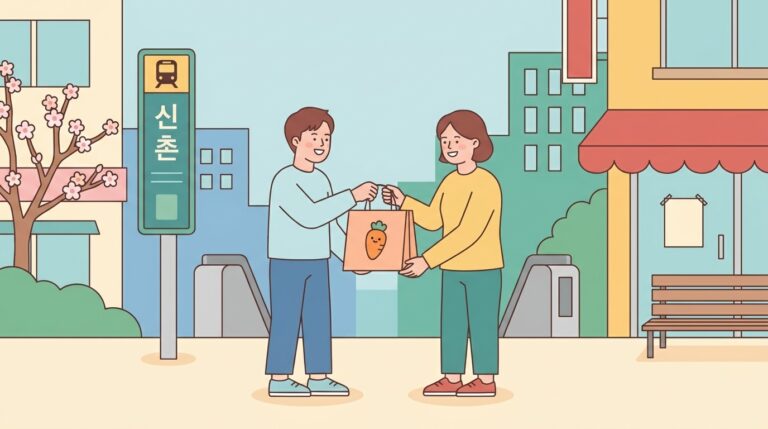
In Korea, the Karrot Market app is localized by neighborhood (within a 2-10km radius). Because of this, you don’t ship items; you walk down to the local subway exit. This has birthed a hilarious national sight: people awkwardly standing near Subway Exit 3 holding a shopping bag, looking around suspiciously until someone makes eye contact and whispers, “혹시… 당근이세요?” (Are you… Carrot?). If you hear this, smile, nod, and begin your trade!
Phase 5: Real-Life Roleplay Scenario
Meet Alex (an expat trying to clear out a humidifier before moving) and Ji-yeong (a friendly local buyer looking for a winter humidifier).
- Setting: Outside Sinchon Station, Exit 2. It’s chilly, and both are holding shopping bags.
Ji-yeong: (Approaches cautiously, looking at Alex’s bag)
🎭 저기... 혹시 당근이세요?
(Jeo-gi... hok-si dang-geun-i-se-yo? / Excuse me... are you Carrot?)

Alex: (Brightly smiles and nods)
🎭 네, 맞아요! 가습기 구매하시는 분이죠?
(Ne, maj-a-yo! Ga-seup-gi gu-mae-ha-si-neun bun-i-jyo? / Yes, that's right! You're the one buying the humidifier, right?)

Ji-yeong: 🎭 네! 안 그래도 건조해서 급하게 찾고 있었는데, 싸게 처분해 주셔서 감사해요.
(Ne! An geu-rae-do geon-jo-hae-seo geup-ha-ge chat-go is-seot-neun-de, ssa-ge cheo-bun-hae ju-syeo-seo gam-sa-hae-yo. / Yes! It was dry so I was urgently looking for one, thank you for selling it off so cheaply.)

Alex: 🎭 아닙니다! 방이 좁아서 빨리 비워야 했거든요. 상태는 정말 깨끗해요.
(An-ip-ni-da! Bang-i job-a-seo ppal-li bi-u-ya haet-geon-deun-yo. Sang-tae-neun jeong-mal kkae-kkeut-hae-yo. / No problem! My room is small so I had to empty it quickly. The condition is very clean.)

Ji-yeong: (Hands over a cute paper bag with cash and a canned coffee)
🎭 여기 돈이랑, 오시느라 추우셨을 텐데 따뜻한 커피예요!
(Yeo-gi don-i-rang, o-si-neu-ra chu-u-syeos-seul ten-de tta-tteut-han keo-pi-yeo! / Here is the money, and a warm coffee since it must have been cold coming here!)

Alex: (Using two hands to accept the bag)
🎭 와, 정말 감동이에요! 감사합니다. 잘 쓰세요!
(Wa, jeong-mal gam-dong-i-e-yo! Gam-sa-hap-ni-da. Jal sseu-se-yo! / Wow, I'm so touched! Thank you. Please use it well!)

Ji-yeong: 🎭 네, 좋은 하루 보내세요! 쿨거래 감사합니다.
(Ne, jo-eun ha-ru bo-nae-se-yo! Kul-geo-rae gam-sa-hap-ni-da. / Yes, have a great day! Thanks for the cool trade.)

Alex: 🎭 조심히 들어가세요!
(Jo-sim-hi deul-eo-ga-se-yo! / Get home safely!)
🔀 Choose Your Adventure!
If the buyer asked for a last-minute 5,000 KRW discount on the spot, how would you respond?
- A) “죄송하지만 이미 저렴하게 올려서 더 이상의 네고는 어렵습니다.”
- Feedback (Best): Extremely polite and clear. It maintains firm boundaries without being rude.
- B) “싫어요. 그냥 거래 취소할게요.”
- Feedback (Bad): Too blunt and aggressive. It might lead to a bad rating on your profile.
- C) “아… 네… 어쩔 수 없죠… 그냥 가져가세요.”
- Feedback (Risk): You lose money unnecessarily. Last-minute haggling at the meeting spot is actually considered bad manners in Korea; you don’t have to agree to it!
Phase 6: 10-Second Emotion Shadowing Drill
Practice saying these high-frequency transaction sentences with natural rhythm and emotional context!
[😊 Excited & Friendly]
“방을 / 빨리 비워야 해서 / 무료 나눔해요!”
(Bang-eul / ppal-li bi-u-ya hae-seo / mu-ryo na-num-hae-yo!)
Pause breakdown: My room / because I need to empty it fast / I’m giving it away for free!-
[🥺 Polite & Cautious]
“혹시 / 약간의 네고가 / 가능할까요?”
(Hok-si / yak-an-ui ne-go-ga / ga-neung-hal-kka-yo?)
Pause breakdown: By any chance / a tiny bit of negotiation / would it be possible? -
[😎 Cool & Satisfied]
“매너가 좋으셔서 / 쿨거래하고 싶어요!”
(Mae-neo-ga jo-eu-syeo-seo / kul-geo-rae-ha-go sip-eo-yo!)
Pause breakdown: Because your manners are great / I want to do a cool trade!
Phase 7: K-Culture Mini Dictionary
- 당근하다 (dang-geun-ha-da)
- Definition: Verb meaning “to buy or sell on Karrot Market.”
- Example: “주말에 집 정리하면서 싹 다 당근하려고요.” (I plan to ‘Karrot’ everything while cleaning my house this weekend.)
- 쿨거래 (kul-geo-rae)
- Definition: A “cool trade.” A transaction that happens swiftly without excessive questioning, bargaining, or delays.
- Example: “쿨거래 하시면 천 원 깎아드릴게요!” (If we do a cool trade, I’ll give you a 1,000 KRW discount!)
- 문고리 거래 (mun-go-ri geo-rae)
- Definition: “Door-handle transaction.” A contactless trade where the seller hangs the bag on their door handle, and the buyer picks it up and sends money via bank transfer.
- Example: “비대면으로 문고리 거래 가능할까요?” (Can we do a contactless door-handle trade?)
- 택포 (taek-po)
- Definition: Short for “택배비 포함” (shipping fee included in the price).
- Example: “이 가격 택포인가요?” (Is shipping included in this price?)
Phase 8: Traveler’s & Expats’ Survival Kit
Top 3 Survival Phrases
- “제가 그쪽으로 갈게요.” (Je-ga geu-jjok-eu-ro gal-gae-yo.)
- Pro Tip: “I’ll go to your location.” Offering to go to the buyer’s preferred station dramatically increases your chance of selling quickly.
- “사용감 전혀 없어요.” (Sa-yong-gam jeon-hyeo eop-seo-yo.)
- Pro Tip: “There is absolutely no sign of use.” Use this phrase to describe items that are basically brand new.
- “입금했습니다. 확인해 주세요!” (Ip-geum-haet-seup-ni-da. Hwa-gin-hae ju-se-yo!)
- Pro Tip: “I transferred the money. Please check!” Send this immediately after doing a mobile bank transfer.
🗺️ Editor’s Travel & Life Note
To get started with secondhand trading, download the official Karrot Market iOS App or check the Karrot Market Android Version. Remember, to verify your neighborhood location on the app, you must physically be in that specific area! If you are trading high-value items, always meet in a public, well-lit place like a subway station exit or inside a convenience store.
Phase 9: “One Step Deeper” (The Trust Economy of Korea)
Have you ever heard of a country where people leave their expensive MacBooks on cafe tables while they go to the restroom for 20 minutes? That extreme level of social trust extends directly to Korean secondhand trading through “문고리 거래” (door-handle transactions).
Sellers regularly leave valuable electronics, luxury items, or clothes on their apartment door handles before they head out to work. Buyers walk up to the seller’s apartment floor, grab the item, and transfer the money afterward. There are rarely any security guards or cameras in the hallways, yet theft is practically nonexistent. This practice reflects Korea’s strong collective community trust (신뢰 사회), where respecting another person’s property is an unwritten, iron-clad rule.
💬 Your Turn: Would you feel comfortable doing a “door-handle transaction” in your home country? What do you think makes this possible in Korea? Let’s talk in the comments below!
Phase 10: FAQ & Avoiding Misunderstandings
Q: Can foreigners use Karrot Market without a Korean phone number?
A: Unfortunately, no. To register and complete neighborhood verification, you must have a valid Korean phone number (associated with your ARC/Alien Registration Card) to receive the SMS verification code.
Q: What is a polite way to reject a low-ball offer?
A: You don’t have to feel pressured! Simply reply: “죄송합니다만 에누리(네고)는 정중히 사양합니다.” (I apologize, but I politely decline any discount/haggling.)
Q: Can I pay with cash during a face-to-face meet?
A: Yes, cash is perfectly fine, but mobile bank transfers (계좌이체 – gye-jwa-i-che) using apps like KakaoPay or Toss are much more common and preferred by younger locals.
🚨 The Expat’s Mistake Scoreboard
| Common Mistake | Why it’s bad | Correct Action |
|---|---|---|
| Demanding extreme discounts (e.g., asking for 50% off). | Considered highly rude and will get you blocked. | Ask for small discounts (usually 1,000 to 5,000 KRW). |
| Cancelling the trade right before the meeting. | Ruins your profile’s “Manner Temperature” (매너온도). | Give at least 2 hours’ notice if you really must cancel. |
| Not checking the item size or voltage before buying. | Most Korean electronics use 220V. No refunds are allowed. | Always check the product specifications beforehand! |
Phase 11: Action Mission & Engagement
Challenge: Your 3-Step Decluttering Mission
- 🥉 Bronze Mission: Find one item in your room you don’t use. Take a picture and draft a Korean description using the phrase “방 정리하면서 처분합니다” (Disposing of this while organizing my room).
- 🥈 Silver Mission: Share this post on your social media with the hashtag
#DailyHanguland tell us: What is the first item you want to “당근” (sell on Karrot)? - 🥇 Gold Mission: Actually complete a “무료 나눔” (free giveaway) or a sale with a local resident and exchange a sweet canned coffee as a warm gesture!
🎮 K-Culture Mission: Next time you watch a modern K-Drama (like Our Blues or Crash Course in Romance), listen closely to see if characters mention “당근” or “중고 나라” (Joonggonara)! Keep an ear out!
Phase 12: Interactive Quiz Challenge
Let’s test what you’ve learned today! Can you get a perfect score?
1. What does “무료 나눔” (muryo nanum) mean?
- A) Urgent paid sale
- B) Free delivery
- C) Free giveaway / sharing for free
2. Fill in the blank:
“This transaction went so smoothly and fast without any complaints! It was a total ( ) !”
* A) 네고 (nego)
* B) 쿨거래 (kul-geo-rae)
* C) 직거래 (jik-geo-rae)
3. True or False:
In Korea, it is considered perfectly normal and polite to aggressively haggle for half the price during a face-to-face meeting.
* A) True
* B) False
👀 Click here to reveal the answers & explanations!
- Correct Answer: C
- Explanation: “무료 나눔” literally translates to “free sharing.” It is the warm way of giving things away for free.
- Correct Answer: B
- Explanation: “쿨거래” (Cool trade) refers to a fast, pleasant, hassle-free transaction.
- Correct Answer: B (False)
- Explanation: Haggling aggressively at the meeting spot is a major breach of etiquette. All price negotiations must be agreed upon before meeting up!







