

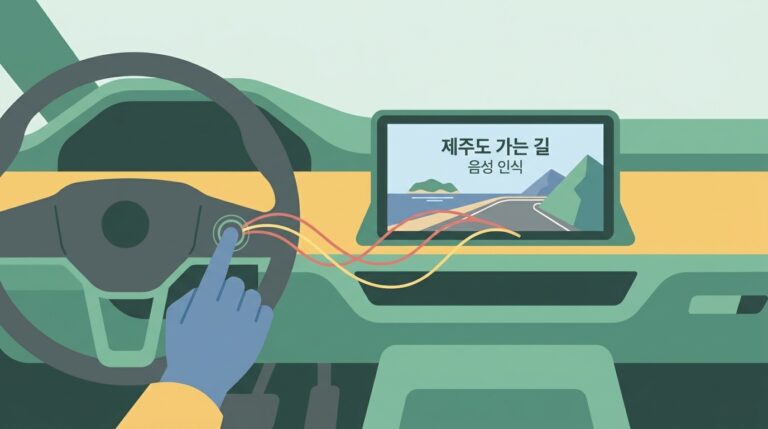
Master In-Vehicle Voice Commands Like a Local: Navigating Korea by Car
안녕하세요! (An-nyeong-ha-se-yo!) Welcome back to Daily Hangul. I’m your chief editor and local culture navigator.
Imagine this: You’ve just landed in beautiful Jeju Island, rented a sleek new Hyundai Ioniq, and you’re ready to hit the coastal roads. You want to find a hidden local restaurant, but typing Korean characters into the navigation screen while trying to keep your eyes on the road feels like a hazardous chore. You confidently press the voice assistant button on your steering wheel and say, “Show me a restaurant.” The car’s AI assistant, powered by Kakao i, pauses and politely says, “다시 말씀해 주세요 (Please say that again).”
Speaking to an AI assistant in a foreign language requires more than just correct grammar; it requires understanding the system’s acoustic parser, local idiomatic phrasing, and conversational flow. Today, we’re leveling up your C1 Korean skills specifically for in-car voice command systems (차량용 음성 명령 시스템) so you can drive, navigate, and control your environment like a true native.
Phase 2: Deep Dive into 3 Core In-Car Expressions
Let’s dissect the top three expressions you will use behind the wheel. These are polished, natural, and highly effective for modern Korean automotive AI.
1. 경로를 재탐색해 줘 (gyyeong-ro-reul jae-tam-saek-hae jwo)
- Pronunciation: [gyung-ro-reul jey-tahm-sek-hey jwo]
- Meaning: Re-route me / Find an alternative route.
- K-Culture Moment: You’ll hear this constantly in modern lifestyle K-dramas when the main characters are trying to escape Seoul’s notorious Friday afternoon gridlock to head to a pension in Gangwon Province.
- Editor’s Insight: While textbook Korean teaches the formal “경로를 재탐색해 주십시오,” real drivers use the active and concise ~해 줘 (do it for me) form. Car AIs in Korea are deeply optimized to understand this semi-informal imperative.
- Situation Spectrum: Casual ✅ | Semi-formal ✅ | Formal ⚠️
- 🤔 Think About It: Why does Korean rely on Sino-Korean nouns like 경로 (Route) and 재탐색 (Re-search/Re-route) for voice tech, rather than pure Korean words like 길 (way/path)? How does this compare to your native language’s technical jargon?
2. 주변에 조용한 카페로 안내해 봐 (ju-byeon-e jo-yong-han ka-pe-ro an-nae-hae bwa)
- Pronunciation: [joo-byun-eh jo-yong-hahn kah-peh-ro ahn-neh-hey bwah]
- Meaning: Guide me to a quiet cafe nearby.
- K-Culture Moment: Finding a cozy “Instagrammable” spot off the beaten path in Gyeongju or Jeju.
- Editor’s Insight: Adding “~해 봐” (try doing) to the end of your command softens the tone. It treats the AI almost like an assistant who is searching on your behalf, which helps the system process natural language queries rather than rigid keywords.
- Situation Spectrum: Casual ✅ | Semi-formal ⚠️ | Formal 🚫
- 🤔 Think About It: Does personifying your car’s AI make you feel more comfortable speaking to it, or does it feel unusual?
3. 에어컨 온도를 22도로 맞춰 줘 (e-eo-keon on-do-reul i-sip-i-do-ro mat-chwo jwo)
- Pronunciation: [eh-uh-kun ohn-do-reul ee-ship-ee-do-ro maht-chwo jwo]
- Meaning: Set the air conditioning to 22 degrees.
- K-Culture Moment: Surving the notorious Korean summer heat (affectionately nicknamed “Daefrica” for Daegu + Africa).
- Editor’s Insight: Always use Sino-Korean numbers (이십이 – i-sip-i) for temperatures, channels, and speeds. Native Korean numbers will confuse the AI system.
- Situation Spectrum: Casual ✅ | Semi-formal ✅ | Formal ⚠️
- 🤔 Think About It: How does the structure of Korean commands (Noun + Object Particle + Verb) affect the way you prioritize information when driving?
Phase 3: Textbook Korean vs. Real-World Korean
Let’s compare the rigid phrases found in manual books with what native drivers actually say to their dashboards.
Situation 1: Changing your destination
- 📖 Textbook: “목적지를 변경해 주십시오.” (Please change the destination.)
- 🗣️ Real Korean: “목적지 다른 데로 바꿀래.” (I want to change the destination to somewhere else.)
- 💡 Why it’s different: Modern Korean car AI is conversational. Using strict honorifics can actually sound stiff and unnatural to acoustic parsers optimized for casual speech flows.
Situation 2: Adjusting the radio volume
- 📖 Textbook: “음량을 조절해 주세요.” (Please adjust the volume.)
- 🗣️ Real Korean: “소리 좀 키워/줄여 줘.” (Turn the volume up/down a bit.)
- 💡 Why it’s different: Driving requires split-second reactions. Sensory verbs like 키우다 (to grow/increase) and 줄이다 (to decrease) are prioritized over technical nouns like 음량 (volume) or 조절 (adjustment).
Phase 4: K-Culture Deep Dive & Non-Verbal Driving Etiquette
4-1. Eyes on the Road, Pitch on the Mic
When using Korean voice recognition, do not look directly at the center fascia screen—it’s both dangerous and unnecessary. Instead, keep your posture straight and elevate the pitch at the end of each command phrase (e.g., 맞춰 / 줘!). Korean AI models are trained on continuous speech patterns, and a slight rise in pitch helps the microphone distinguish your active command from casual conversation with passengers.
4-2. The “My Car” Phenomenon (붕붕이)
Koreans love personalizing their vehicles. It’s common to give cars cute nicknames, such as 붕붕이 (Bung-bung-i / Vroom-vroom). When setting up advanced car profiles, drivers often set their AI assistant’s speech mode to casual banmal (반말), making the interaction feel like chatting with a close friend during a long road trip.
Phase 5: Interactive Roleplay Scenario
Setting: You are driving a rental car along the beautiful coast of Jeju Island with your friend, Sohee. The car’s voice assistant is activated.
- Minwoo (Driver / You)
- Ari (AI Assistant)
- Sohee (Passenger)
- Ari: 무엇을 도와드릴까요? (What can I help you with?)
- Minwoo:
🎭 [Presses the steering wheel button confidently]아리야, 주변에 유명한 고기국수 맛집 찾아줘. (Ari, find a famous pork noodle restaurant nearby.) - Ari: 제주시 근처 고기국수 맛집 세 곳을 찾았습니다. 첫 번째 장소로 안내할까요? (Found three pork noodle restaurants near Jeju City. Shall I guide you to the first one?)
- Sohee:
🎭 [Looking at her phone]어! 거기 대기 줄 길대. 민우야, 그냥 함덕 해수욕장 근처로 가자. (Oh! I heard the wait line there is long. Minwoo, let’s just go near Hamdeok Beach.) - Minwoo: 아리야, 목적지 함덕 해수욕장으로 변경해 줘. (Ari, change the destination to Hamdeok Beach.)
- Ari: 함덕 해수욕장으로 경로를 재탐색합니다. (Re-routing to Hamdeok Beach.)
- Sohee: 아, 다행이다. 근데 차 안이 좀 후끈거리지 않아? (Ah, thank goodness. But isn’t it a bit hot inside the car?)
- Minwoo: 좀 덥네. 아리야, 에어컨 온도 좀 더 낮춰 줄래? (A bit hot. Ari, could you lower the AC temperature a bit more?)
- Ari: 실내 온도를 21도로 설정합니다. 안전 운전하세요. (Setting cabin temperature to 21 degrees. Drive safely.)
🔀 Your Turn: Interactive Decision Point!
Suddenly, a detour sign appears due to construction. You need to find a fast, alternative route immediately. What do you say to Ari?
- Option A: “아리야, 지금 도로가 막히니까 다른 길로 가자.” (Ari, the road is blocked right now, let’s go another way.)
- Option B: “아리야, 경로 재탐색.” (Ari, route re-search.)
- Option C: “야! 네비게이션 똑바로 일 안 해? 다른 길 찾아!” (Hey! Is the navigation not working right? Find another road!)
💡 Feedback:
- Best (Option A): Excellent! Conversational AI easily processes contextual commands like “다른 길로 가자” (Let’s go another way).
- Bad (Option B): Too robotic. While the AI will understand, it lacks the natural flow and might not register if spoken too abruptly.
- Risk (Option C): Using slang, angry tones, or highly informal scolding will likely crash the parser, leading to the dreaded “다시 말씀해 주세요.”
Phase 6: 10-Second Emotional Shadowing Drill
Practice these three lines with real emotional nuance to train your pronunciation rhythm!
여기서 / 제일 가까운 / 맛집 / 찾아줘!- [gyeo-gi-seo / je-il ga-kka-un / mat-jip / cha-ja-jwo!]
- Emotion: [😊 Excited & Hungry]
에어컨 좀 / 세게 / 틀어줄래? / 더워 죽겠어!- [e-eo-keon jom / se-ge / teu-reo-jul-rae? / deo-wo juk-ges-seo!]
- Emotion: [🥵 Exhausted & Sweaty]
라디오 / 음악 소리 / 조금만 / 줄여 줘.- [ra-di-o / eu-mak so-ri / jo-geum-man / ju-ryeo jwo]
- Emotion: [😌 Calm & Gentle]
Phase 7: K-Culture Mini Dictionary
- 맛집 (Mat-jip): Literally “taste house.” A highly popular, verified delicious restaurant.
- 길치 (Gil-chi): A person with a terrible sense of direction (directionally challenged).
- 티맵 (T-map): Korea’s representative, undisputed king of real-time mobile GPS navigation apps.
- 붕붕이 (Bung-bung-i): An affectionate baby-talk name for a car, used by adults and kids alike.
Phase 8: Survivor Kit for Travelers
내비 켜 줘(nae-bi kyeo jwo) | Turn on the navigation. (Pro Tip: Shortening 네비게이션 to 내비 is crucial!)가장 빠른 길로 가자(ga-jang bpa-reun gil-ro ga-ja) | Let’s go via the fastest route.라디오 꺼 줘(ra-di-o kkeo jwo) | Turn off the radio.
🗺️ Editor’s Travel Note:
Google Maps does not provide driving navigation in South Korea due to national security map export laws. Before you rent your car, make sure to perform a Naver Map App Download or KakaoMap search. Set your language settings to Korean or English before starting your engine! (Disclaimer: App interface changes may occur over time.)
Phase 9: A Step Deeper — Linguistic Reflections
Speaking politely to machines? In Korea, because honorifics (존댓말) and informal registers (반말) are deeply baked into the social fabric, people often debate whether to use polite language with AI. Many older Koreans feel deeply uncomfortable talking to an AI in flat banmal, while younger generations enjoy treating the AI like an equal friend. It shows how language hierarchies affect even our interactions with technology.
💬 Your Turn: How do you speak to AI in your native language? Do you say “please” and “thank you” to Siri or Alexa? Share your thoughts in the comments below!
Phase 10: FAQ & Avoiding Common Mistakes
Q: Can the car system recognize English addresses?
A: Generally, no. While high-end rental systems have basic English search functions, voice recognition performs much better when destination names are spoken in native Korean (e.g., “함덕 해수욕장” instead of “Hamdeok Beach”).
Q: Why does the system keep failing to recognize my numbers?
A: You might be mixing Native Korean numbers (하나, 둘, 셋) with Sino-Korean numbers (일, 이, 삼). For temperatures and channels, always use Sino-Korean numbers!
Q: How do I cancel a navigation route quickly via voice?
A: Simply press the voice button and say “안내 종료” (an-nae jong-ryo), which means “Terminate guidance.”
🚨 Common Mistakes Alert!
- Mistake 1: Speaking too slowly with long pauses (e.g., “에어컨… 온도를…”).
- Correct Action: Speak in a single, smooth, continuous breath.
- Mistake 2: Relying on English pronunciations for loanwords (e.g., saying “Map” with a deep English “æ” sound).
- Correct Action: Koreanize the pronunciation slightly (e.g., 맵 – maep / 내비 – nae-bi).
- Mistake 3: Overusing grammatical particles (e.g., “에어컨을 온도를 맞춰 주세요”).
- Correct Action: Omit particles while driving to keep commands crisp (e.g., “에어컨 온도 낮춰 줘”).
Phase 11: Action Mission
- 🥉 Bronze: Read the three emotional shadowing drills in Phase 6 out loud three times.
- 🥈 Silver: Open your phone’s voice assistant, set the language to Korean, and try saying “오늘 날씨 어때?” (How’s the weather today?).
- 🥇 Gold: Next time you rent a car or take a taxi in Korea, ask the driver or car system: “가장 빠른 경로로 재탐색해 주세요.”
Phase 12: Interactive Quiz Challenge
Try this quiz to test your driving Korean skills!
- Which phrase is the most natural way to tell the AI to re-route due to sudden traffic?
- A) 경로를 다시 가십시오.
- B) 다른 길로 가자.
- C) 길을 바꾸어 봐라.
- True or False: You should use native Korean numbers (하나, 둘) when setting the car AC temperature.
- True / False
🔍 Reveal Answers & Explanations
- Correct Answer: B (다른 길로 가자 is the most natural, conversational way to request an alternative route that contemporary AI systems easily understand.)
- Correct Answer: False (You must use Sino-Korean numbers like 이십일, 이십이 for temperatures! Native Korean numbers will confuse the system.)
“,







