

Saving Lives in Korean: How to Guide and Perform CPR (심폐소생술) in an Emergency
Phase 1: Empathy (An Emergency Scene straight out of a K-Drama)
안녕하세요! Welcome back to Daily Hangul. I’m your chief editor and native Korean bestie.
Have you ever watched medical K-Dramas like Hospital Playlist (슬기로운 의사생활) or Dr. Romantic (낭만닥터 김사부)? There is always that heart-stopping moment when someone collapses in public, and a hero steps up to perform CPR, counting out loud while crowds watch anxiously.
While we hope you never have to face a real-life medical emergency in Korea, being prepared is a superpower. If someone collapses in a busy Seoul subway station, would you know how to direct bystanders, call for an AED, or guide someone through CPR in Korean?
Many intermediate Korean learners feel confident chatting about food or K-Pop, but freeze completely when high-stakes, urgent communication is needed. Today, we are going to bridge that gap. Based on real-life feedback from expats and travelers, we’ve put together a practical guide to instructing and performing CPR (심폐소생술) in Korean. Let’s learn these lifesaving skills together!
Phase 2: Core Expressions Deep Dive
Here are the three most critical expressions you need to memorize. In an emergency, clear and authoritative language is key.
1. 의식이 있는지 확인해 주세요 (Please check if they are conscious)
- Pronunciation: ui-sig-i it-neun-ji hwa-gin-hae ju-se-yo (Wee-shig-ee een-neun-jee hwa-gheen-hae joo-seh-yo)
- Meaning: Please check if the person is conscious.
- K-Culture Moment: This is the absolute first step taught in Korean safety centers (안전체험관). You will hear paramedics or dramatic leads shout this while tapping the victim’s shoulders.
- Editor’s Insight: The word 의식 (uisik) means “consciousness.” By adding ~는지 확인해 주세요 (~neun-ji hwagin-hae juseyo – “please check if…”), you are giving a polite yet urgent and clear instruction to anyone nearby.
- Situation Spectrum:
- Casual: 의식 있는지 확인해 봐! (⚠️ Only use with close friends)
- Semi-formal: 의식이 있는지 확인해 주세요. (✅ Best for public emergencies)
- Formal: 환자의 의식 여부를 확인하십시오. (🚫 Too clinical; sounds like a textbook)
- 🤔 Think About It: In your native language, how do you verify if someone is awake in an emergency? In Korea, asking for “consciousness” (의식) is preferred over simply asking “Are they okay?” (괜찮아요?).
2. 가슴 압박을 실시해 주세요 (Please perform chest compressions)
- Pronunciation: ga-seum ap-bag-eul sil-si-hae ju-se-yo (Gah-seum ap-bahg-eul sheel-shee-hae joo-seh-yo)
- Meaning: Please perform chest compressions / start CPR.
- K-Culture Moment: You will see characters in military or medical dramas shouting this to rhythmically pump the heart.
- Editor’s Insight: 가슴 (gaseum) means “chest,” 압박 (apbak) means “pressure/compression,” and 실시하다 (silsihada) means “to carry out/execute.” Combined, this is the standard, precise instruction for chest compressions.
- Situation Spectrum:
- Casual: 가슴 눌러! (⚠️ Too informal for coordinating with strangers)
- Semi-formal: 가슴 압박을 실시해 주세요. (✅ Clear, standard, and highly effective)
- Formal: 가슴 압박을 실시하십시오. (🚫 Used in pre-recorded safety broadcast announcements)
3. 119에 신고하고 자동심장충격기를 가져다주세요 (Please call 119 and bring an AED)
- Pronunciation: il-il-gu-e sin-go-ha-go ja-dong-sim-jang-chung-gyeok-gi-reul ga-jeo-da-ju-se-yo (Eel-eel-goo-eh sheen-go-hah-go jah-dong-sheem-jahng-choong-gyeok-ghee-reul gah-juh-dah-joo-seh-yo)
- Meaning: Please call 119 and bring an Automated External Defibrillator (AED).
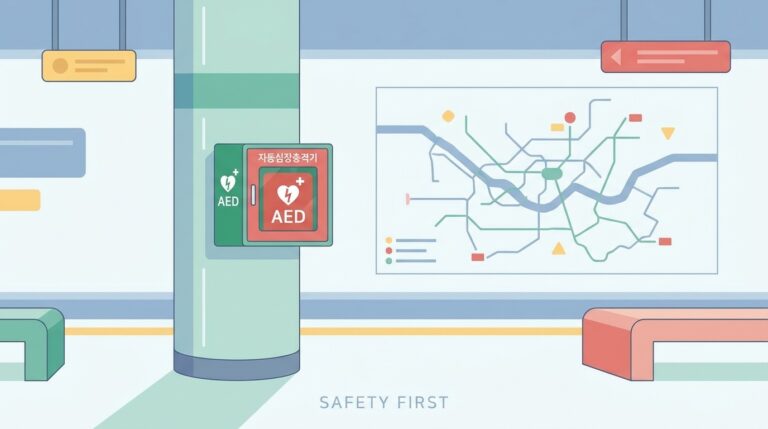
- K-Culture Moment: Every Korean subway station and public office is equipped with an AED, clearly marked as 자동심장충격기 (sometimes colloquially called AED).
- Editor’s Insight: In Korea, the emergency number is 119 (not 911). It is vital to couple the call with a request for the AED (ja-dong-sim-jang-chung-gyeok-gi), which literally translates to “automatic heart shocker.”
- Situation Spectrum:
- Casual: 119 부르고 기계 가져와! (🚫 Sounds disorganized and rude even in crises)
- Semi-formal: 119에 신고해 주시고 자동심장충격기 좀 가져다주세요. (✅ Perfect for mobilizing helpers)
- Formal: 119 신고 및 자동제세동기를 지참하십시오. (🚫 Obsolete medical terminology)
Phase 3: Textbook Korean vs. Real-World Korean
When things go wrong, textbook phrases can sound incredibly robotic and confusing. Let’s look at how Koreans actually speak during a medical emergency.
Situation 1: Declaring someone has passed out
- 📖 Textbook Korean: “환자가 기절 상태에 빠졌습니다.” (The patient has fallen into a state of syncope.)
- 🗣️ Real-World Korean: “사람이 쓰러졌어요!” (Someone collapsed!)
- 💡 Why the difference? In a split second, nobody uses administrative or medical jargon. Shouting “사람이 쓰러졌어요!” (sa-ram-i sseul-eo-jeot-eo-yo!) instantly grabs everyone’s attention and signals extreme urgency.
Situation 2: Directing someone to perform chest compressions
- 📖 Textbook Korean: “흉부 압박을 30회 지속적으로 수행하십시오.” (Perform thoracic compressions continuously 30 times.)
- 🗣️ Real-World Korean: “세게, 빠르게 계속 누르세요!” (Press hard and fast continuously!)
- 💡 Why the difference? During high-stress CPR, simple, monosyllabic commands like “세게” (hard) and “빠르게” (fast) are much easier to process and execute than technical medical counts.
Phase 4: K-Culture Deep Dive & Non-Verbal Manners
4-1. The Art of Direct Pointing (지목하기)
In Korea, pointing directly at someone is usually considered bad manners. However, during an emergency, it is a legal and practical necessity.
If you shout “Somebody help!” (누가 좀 도와주세요!), the “bystander effect” (방관자 효과) kicks in, and everyone assumes someone else will help. To prevent this, you must point directly at a specific person and describe their clothes:
* “거기 빨간색 티셔츠 입으신 분, 119에 신고해 주세요!” (You, the person in the red t-shirt, please call 119!)
* “거기 안경 쓰신 분, 자동심장충격기 좀 찾아와 주세요!” (You, the person wearing glasses, please go find the AED!)
Make direct eye contact, point with a firm hand gesture, and speak loudly.
4-2. The “Golden Time” (골든타임) Culture in Korea
Korea is obsessed with efficiency, and this extends to emergency medical services. Paramedics aim for a 4-minute Golden Time (골든타임) for cardiac arrests. Because of Seoul’s heavy traffic, citizens are legally protected under the “Good Samaritan Law” (선한 사마리아인 법 – Article 5-2 of the Emergency Medical Service Act), meaning you are legally exempt from civil or criminal liability if you perform CPR in good faith to save a life. Do not hesitate to step in!
Phase 5: Real-Life Roleplay Scenario
Setting: Gangnam Subway Station (강남역) during rush hour. An elderly man suddenly collapses near the turnstiles. Sarah, a brave expat who completed CPR training, immediately runs over to help, coordinating with Minho, a worried bystander.
Characters:
- Sarah (사라): Certified in CPR, calm and commanding.
- Minho (민호): A panicked commuter who wants to help but doesn’t know how.
사라: (환자의 어깨를 두드리며 크게) 괜찮으세요? 제 말 들려요?
      (Gwen-chan-eu-se-yo? Je mal deul-ryeo-yo?)
      "Are you okay? Can you hear me?"

민호: (당황하며) 어떡해요! 쓰러지셨어요! 숨을 안 쉬는 것 같아요!
      (Eo-tteok-hae-yo! Sseul-eo-ji-syeot-eo-yo! Sum-eul an swi-neun geot gat-ah-yo!)
      "Oh no, what do we do! He collapsed! I don't think he's breathing!"

사라: (민호를 똑바로 가리키며) 거기 파란색 셔츠 입으신 분! 정신 차리세요. 빨리 119에 신고해 주세요!
      (Geo-gi pa-ran-saek syeo-tsu ip-eu-sin bun! Jeong-sin cha-ri-se-yo. Ppal-li il-il-gu-e sin-go-hae ju-se-yo!)
      "You, the person in the blue shirt! Stay focused. Please call 119 quickly!"

민호: (전화를 걸며) 네, 네! 119에 신고할게요!
      (Ne, ne! Il-il-gu-e sin-go-hal-ge-yo!)
      "Yes, yes! I will call 119!"

사라: 그리고 역무실에 가서 자동심장충격기 좀 가져다주세요! 빨리요!
      (Geu-ri-go yeong-mu-sil-e ga-seo ja-dong-sim-jang-chung-gyeok-gi jom ga-jeo-da-ju-se-yo! Ppal-li-yo!)
      "And please go to the station office and bring the AED! Hurry!"

민호: 네! 바로 다녀오겠습니다!
      (Ne! Ba-ro da-nyeo-o-get-seum-ni-da!)
      "Yes! I will go right away!"

사라: (가슴 압박 위치를 잡고 깍지를 끼며) 제가 가슴 압박을 실시하겠습니다. 하나, 둘, 셋, 넷...
      (Je-ga ga-seum ap-bag-eul sil-si-ha-get-seum-ni-da. Ha-na, dul, set, net...)
      "I will begin chest compressions. One, two, three, four..."

민호: (기계를 들고 숨을 헐떡이며 복귀) 기계 가져왔습니다! 어떻게 쓰는 거죠?
      (Gi-gye ga-jeo-wat-seum-ni-da! Eo-tteok-he sseu-neun geo-jyo?)
      "I brought the machine! How do we use it?"

사라: (단호하게) 전원을 켜고, 안내 음성에 따르세요. 제가 계속 누를 테니 패드를 붙여 주세요!
      (Jeon-won-eul kyeo-go, an-nae eum-seong-e tta-reu-se-yo. Je-ga gye-sok nu-reul te-ni pae-deu-reul but-yeo ju-se-yo!)
      "Turn on the power and follow the voice prompts. I will keep pressing, so please attach the pads!"
🔀 Interactive Choice Point
The patient is still unconscious, and the AED voice guide says “분석 중…” (Analyzing…). What should Sarah and Minho do next?
- Choice A: Keep performing chest compressions while the AED analyzes the heart rhythm.
- Choice B: Step back, touch nobody, and shout “물러서세요!” (Step back!).
- Choice C: Stop chest compressions and try to give artificial respiration (mouth-to-mouth).
Feedback:
- Choice A (Risk): ❌ Incorrect! If you touch the patient while the AED is analyzing, it may misread your own pulse instead of the patient’s.
- Choice B (Best): Excellent! When the machine analyzes or delivers a shock, you must step back. Shouting “모두 물러서세요!” (mo-du mul-reo-seo-se-yo! – Everyone step back!) is the perfect protocol.
- Choice C (Bad): ❌ Incorrect! Modern CPR guidelines prioritize continuous chest compressions over mouth-to-mouth, and you should never interrupt the AED analysis.
Phase 6: 10-Second Emotional Shadowing Drill
In emergency situations, your voice cannot shake. Practice shouting these commands with rhythm and authority. / marks a pause for breath.
- Drill 1: Command to Bystander
- “거기 / 노란 티셔츠 / 입으신 분! / 빨리 / 119에 / 신고해 주세요!”
- [🚨 Urgent, loud, and pointing directly]
- Drill 2: Calming the Scene
- “괜찮습니다! / 제가 / 심폐소생술을 / 할 수 있습니다! / 물러서 주세요!”
- [💪 Confident, firm, and assuring]
- Drill 3: Operating AED
- “기계 / 전원 켜세요! / 환자 몸에서 / 모두 / 물러서세요!”
- [🚨 Sharp, commanding tone for safety]
Phase 7: K-Culture Mini Dictionary
| Korean (Romanization) | English Meaning | Practical Context in Korea |
|---|---|---|
| 심폐소생술 (sim-pye-so-saeng-sul) | CPR | Acronym of 심장 (Heart), 폐 (Lung), 소생 (Resuscitation). |
| 자동심장충격기 (ja-dong-sim-jang-chung-gyeok-gi) | AED | Installed in every public space; easily recognized by its red/green casing. |
| 구급차 (gu-geup-cha) | Ambulance | If you hear sirens, motorists pull over to let the 구급차 pass. |
| 골든타임 (gol-deun-ta-im) | Golden Time | Widely used in news and medicine to refer to the first 4 crucial minutes. |
Phase 8: Traveler’s Survival Kit
If you find yourself in a crisis, keep these three survival phrases ready:
- 도와주세요! 사람이 쓰러졌어요! (Do-wa-ju-se-yo! Sa-ram-i sseul-eo-jeot-eo-yo!)
- “Help! Someone collapsed!”
- 여기 근처에 자동심장충격기 어디 있어요? (Yeo-gi geun-cheo-e ja-dong-sim-jang-chung-gyeok-gi eo-di it-eo-yo?)
- “Where is the AED nearby here?”
- 119에 신고해 주시고 심폐소생술 하실 줄 아는 분 찾아요! (Il-il-gu-e sin-go-hae ju-si-go sim-pye-so-saeng-sul ha-sil jul a-neun bun cha-ja-yo!)
- “Please call 119 and find someone who knows how to do CPR!”
Editor’s Travel Note:
To find emergency medical facilities instantly, we highly recommend downloading the “응급의료정보제공” (E-Gen) app before traveling. It shows live maps of nearby open hospitals, pharmacies, and AED locations. Also, if you call 119, they have a translation service system—just say “English, please” to be connected to a translator.
Phase 9: “One Step Deeper” (Reflecting on Korean Collective Culture)
In Korea, there is a strong cultural concept called 정 (Jeong)—a deep-seated sense of affection, community, and collective responsibility. When an emergency happens on a Korean street, you will rarely see people just walking past. Complete strangers will run over, start directing traffic, and help carry patients. It is a beautiful aspect of Korean society where the “우리” (We/Us) mindset shines brightest. By learning these Korean expressions, you are not just acquiring language skills; you are becoming an active, caring member of this community who can step up when “우리” needs you most.
💬 Your Turn: Have you ever witnessed or helped in an emergency situation in another country? How does the response culture differ from Korea’s “Jeong” culture? Share your thoughts in the comments below!
Phase 10: FAQ & Common Mistakes
Q: What is the official emergency number in Korea? Is it the same for police and fire?
A: No, they are separate. Call 119 for fire, medical emergencies, and rescue services. Call 112 for the police. For general medical consultation in English, you can also dial 1339.
Q: Can foreigners legally use an AED or perform CPR on a Korean citizen?
A: Absolutely. Korea’s Emergency Medical Service Act protects anyone who provides emergency care in good faith. You will not be held legally responsible for injuries (like rib fractures) that commonly occur during properly executed CPR.
Q: Do Korean AEDs provide English audio instructions?
A: Most modern AEDs installed in tourist districts, airports, and subway stations have a language selection button (usually green or labeled “Language/언어”). Pressing it will switch the audio prompts to English.
🚨 Common Mistakes Alert!
- Mistake: Calling 911 out of habit.
- Correct Action: Dial 119 immediately. (Some international phones redirect 911 to 112, but calling 119 is faster for medical help).
- Mistake: Saying “누가 좀 도와주세요!” (Somebody help!) in a crowd.
- Correct Action: Point at someone directly and say “거기 [옷 색상] 입으신 분, 도와주세요!” (You, wearing [color], please help!).
- Mistake: Giving up CPR before paramedics arrive.
- Correct Action: Keep performing chest compressions continuously until the ambulance team physically takes over.
Phase 11: Action Mission & Engagement
- 🥉 Bronze Mission: Practice saying “119에 신고해 주세요!” out loud 3 times in front of your mirror with a strong, pointing gesture.
- 🥈 Silver Mission: Locate an AED (자동심장충격기) next time you visit a Korean subway station or public building, take a mental picture of its location, and write down its name in your study notebook.
- 🥇 Gold Mission: Write a mock emergency scenario in the comments below using at least two of the Korean medical terms we learned today. I’ll personally review your grammar!
🎮 K-Culture Mission: Watch a medical K-Drama (like Dr. Romantic or Doctor John) and try to spot the moment they shout “심폐소생술” or “가슴 압박!” Write down the episode number and share it with us!
Phase 12: Interactive Quiz Challenge
Test your knowledge to see if you’re ready for an emergency in Korea!
- What does 자동심장충격기 mean?
- A) Emergency Ambulance
- B) Chest Compression
- C) Automated External Defibrillator (AED)
- D) First Aid Kit
- Fill in the blank: If you want to ask someone to call 119, you point and shout: “빨리 119에 ________!”
- A) 전화해 (Jeon-hwa-hae)
- B) 신고해 주세요 (Sin-go-hae ju-se-yo)
- C) 오세요 (O-se-yo)
- D) 압박해 주세요 (Ap-bak-hae ju-se-yo)
- True or False: Under Korea’s Good Samaritan Law, you can be sued for saving someone’s life with CPR if they break a rib.
- A) True
- B) False
🔍 Reveal Answers & Explanations
- Answer: C. 자동심장충격기 is the official Korean name for an AED. (심장 = heart, 충격 = shock).
- Answer: B. “신고해 주세요” (sin-go-hae ju-se-yo) is the formal, correct expression for reporting an emergency to the authorities like 119 or 112.
- Answer: B (False). Korea’s Good Samaritan Law protects bystanders who perform CPR in good faith from civil or criminal liability. Don’t worry, save lives!







