

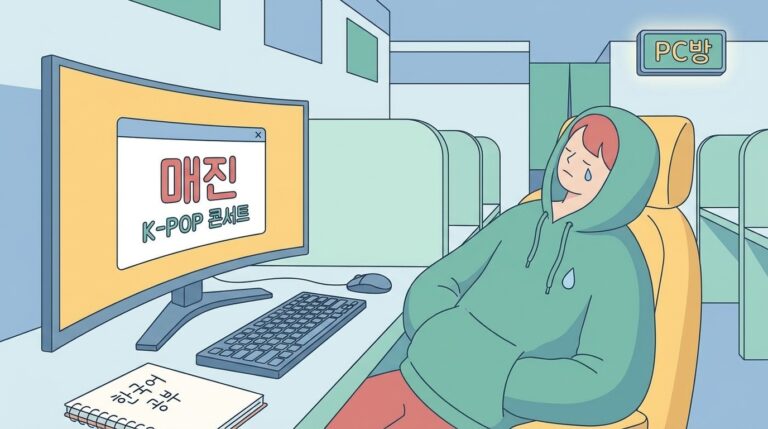
How to Express Your K-Pop Ticketing Grief Like a Real Korean
Phase 1: Empathy (Welcome to the Battleground!)
안녕하세요! (An-nyeong-ha-se-yo!) Welcome back to Daily Hangul, your trusty cultural navigator.
We have all been there. You have three laptops open, the world clock synchronized to the millisecond, your heart rate hovering around 150 BPM, and… click. The page freezes. By the time it loads, the dreaded pop-up appears: ALL SEATS SOLD OUT.
Yes, we are talking about the soul-crushing tragedy of K-Pop concert ticketing.
Whether you were trying to grab tickets for BTS, Stray Kids, SEVENTEEN, or BLACKPINK, failing at ticketing is a universal rite of passage for K-Pop fans. But instead of crying silently in English, why not express your frustration in natural, native Korean? Sharing your pain with other fans is the best therapy.
Today, you will learn the exact terms, slangs, and cultural nuances Koreans use when their ticketing dreams go down the drain. This isn’t textbook Korean—this is the real, raw language of survival in the fandom trenches!
Phase 2: The Core 3 Expressions Deep-Dive
1. 피켓팅 (Pi-keting)
- Pronunciation: [Pi-keting] (Sounds like “blood” + “ticketing”)
- Meaning: Blood-bath ticketing (피 Pi means blood + 티켓팅 Tiketing)
- K-Culture Moment: You’ll see this word on Twitter (X) and Weverse trending worldwide the second tickets go on sale. It perfectly describes the savage, dog-eat-dog nature of buying concert tickets in Korea.
- Editor’s Insight: This isn’t just a “difficult” ticketing. It implies you fought with your blood, sweat, and tears, and probably ended up wounded.
- Situation Spectrum: Casual: ✅ | Semi-formal: ⚠️ (Used in light articles) | Formal: 🚫
- 🤔 Think About It: How does your culture describe highly competitive situations? Is it as vivid as using “blood”?
2. 광탈하다 (Gwang-tal-hada)
- Pronunciation: [Gwang-tal-hada] (Think of “Gwang” like a flash of light, and “tal” like a swift exit)
- Meaning: To be eliminated at lightning speed (광 Gwang = light + 탈락 Tallak = drop/eliminate)
- K-Culture Moment: Used when your queue number is 87,000 and the venue only holds 10,000 people. You were eliminated before you even saw the seating chart.
- Editor’s Insight: It’s a combination of speed and absolute failure. It feels much more dramatic than just saying “I failed.”
- Situation Spectrum: Casual: ✅ | Semi-formal: ⚠️ | Formal: 🚫
- 🤔 Think About It: Koreans love speed (빨리빨리 – Ppalli-ppalli). Even our failures must happen at light speed!
3. 내 자리는 없었다 (Nae ja-ri-neun eop-seot-da)
- Pronunciation: [Nae ja-ri-neun eop-seot-da] (Pronounced like “Nay jah-ree-noon up-sut-dah”)
- Meaning: There was no seat for me (Lit: “My seat did not exist”)
- K-Culture Moment: The final stage of grief. When you accept the reality that out of 50,000 seats, not a single purple bubble was yours.
- Editor’s Insight: It’s poetic, dramatic, and deeply relatable. It shifts the blame from your slow fingers to the universe.
- Situation Spectrum: Casual: ✅ | Semi-formal: ✅ | Formal: 🚫
- 🤔 Think About It: Why does saying “there was no seat for me” feel more comforting than “I failed to click the button fast enough”?
Phase 3: Textbook Korean vs. Real Korean
Let’s look at how textbooks teach this situation versus how K-fans actually talk in real life.
Situation 1: Telling your friend you failed the ticketing
- 📖 Textbook: “콘서트 표를 사지 못해서 너무 슬픕니다.”
(I am very sad because I could not buy the concert ticket.) - 🗣️ Real Korean: “나 이번 티켓팅 완전히 폭망했어…”
(I completely, disastrously ruined this ticketing…) - 💡 Why the difference? Pok-mang (폭망) is a slang merger of “explosion” (폭발) and “ruin” (망하다). It captures the dramatic explosion of your plans much better than the polite textbook phrase.
Situation 2: Describing the empty seating chart
- 📖 Textbook: “남은 좌석이 하나도 없습니다.”
(There are no seats left.) - 🗣️ Real Korean: “포도알 구경도 못 해봤어.”
(I couldn’t even catch a glimpse of a purple grape.) - 💡 Why the difference? On popular ticketing sites like Interpark, available seats are shown as purple circles. K-fans affectionately call them “grapes” (포도알 – Podoral). Saying you couldn’t even see a grape means you didn’t even get past the queue screen!
Phase 4: K-Culture Deep-Dive & Non-Verbal Manners
4-1. The “Otl” Gestures of Ticketing Grief
When a Korean fan fails ticketing, they don’t just sigh. They display a full theatrical range of non-verbal grief:
* The “Otl” Pose: This classic internet emoticon represents a person kneeling on the floor in despair. In real life, fans will literally drop their heads onto the PC bang (internet cafe) keyboard.
* The Silent Gasp: Holding both cheeks (like The Scream painting) while staring blankly at the screen. Speaking is forbidden; only silence can process the grief.
4-2. The PC Bang (PC방) Ritual
Why do Koreans go to PC Bangs for ticketing? Korea has some of the fastest internet in the world, but PC Bangs have custom high-speed lines and optimized graphics cards. Going to a PC Bang at 7:50 PM is a holy ritual. If you see five people in a row staring at a digital clock showing “7:59:58,” you are witnessing the sacred silence before the storm.
Phase 5: Real-Life Roleplay Scenario
Setting: A cozy cafe near Hongdae. Alex (the B1 learner) is sitting with Yuna (their Korean friend) staring blankly at a phone screen.
- Yuna (유나): 야, 얼굴색이 왜 그래? 무슨 일 있어?
(Ya, eol-gul-saek-i wae geu-rae? Mu-sun il is-seo?)
(🎭 Looking worriedly at Alex’s pale face) -
Alex (알렉스): 유나야… 나 오늘 8시에 최애 콘서트 티켓팅 있었잖아…
(Yuna-ya… na o-neul yeo-deol-si-e choe-ae kon-seo-teu ti-ket-ting is-seot-ja-na…)
(🎭 Speaking in a trembling, weak voice) -
Yuna (유나): 아, 맞다! 오늘이었지! 어떻게 됐어? 포도알 잡았어?
(A, mat-da! O-neul-i-eot-ji! Eo-tteo-ke dwaes-seo? Po-do-al jab-as-seo?)
(🎭 Leaning in with anticipation) -
Alex (알렉스): 잡기는 무슨… 대기 번호 오만 번 뜨고 바로 광탈했어.
(Jab-gi-neun mu-seun… dae-gi beon-ho o-man beon tteu-go ba-ro gwang-tal-haes-seo.)
(🎭 Slaying their head onto the table) -
Yuna (유나): 어휴, 오만 번? 진짜 피켓팅이었네. 완전 피 눈물 난다.
(Eo-hyu, o-man beon? Jin-cha pi-ket-ting-i-eot-ne. Wan-jeon pi num-mul nan-da.)
(🎭 Patting Alex’s back comfortingly) -
Alex (알렉스): 피켓팅이 아니라 이건 그냥 전쟁이야. 내 자리는 세상 어디에도 없더라.
(Pi-ket-ting-i a-ni-ra i-geon geu-nyang jeon-jaeng-i-ya. Nae ja-ri-neun se-sang eo-di-e-do eop-deora.)
(🎭 Sighing deeply) -
Yuna (유나): 너무 낙담하지 마! 아직 취켓팅이 남았잖아! 새벽 두 시 알람 맞춰놔.
(Neo-mu nak-dam-ha-ji ma! A-jik chwi-ket-ting-i nam-at-ja-na! Sae-byeok du si al-lam mat-chwo-nwa.)
(🎭 Winking and trying to cheer Alex up) -
Alex (알렉스): 그래, 오늘 잠은 다 잤다. 새벽 두 시에 무조건 부활한다!
(Geu-rae, o-neul jam-eun da jat-da. Sae-byeok du si-e mu-jo-geon bu-hwal-han-da!)
(🎭 Clenching fists with renewed determination)
🔀 Choose Your Response! What should Alex do next?
- A) “포기하고 그냥 트위터에서 양도표 찾을래.” (I’ll just give up and look for a transferred ticket on Twitter.)
- ⚠️ Risk! Twitter ticket transfers are prone to scamming. Be careful!
- B) “오늘 새벽에 취켓팅 불태운다!” (I’ll burn the midnight oil for canceled tickets tonight!)
- 🏆 Best! Safe, free of extra charge, and a true Korean fan strategy.
- C) “콘서트 포기하고 그냥 집에서 유튜브 볼래.” (I’ll give up the concert and just watch YouTube at home.)
- 😢 Bad! Don’t lose hope yet; the fan life requires grit!
Phase 6: 10-Second Emotion Shadowing Drill
Let’s practice saying these like you are actually crying inside a PC bang. Pause at the slashes / and mimic the emotion markers!
- “아… / 진짜 / 피켓팅이었어…”
- [🥺 Deeply disappointed, almost whispering]
- [Ah… / jin-ja / pi-ket-ting-i-eot-seo…]
- “포도알 / 딱 하나만 / 주라…”
- [😭 Desperate, begging the computer monitor]
- [Po-do-al / ttak ha-na-man / ju-ra…]
- “대기 번호 / 실화냐?”
- [🤯 Shocked, angry laugh, staring in disbelief]
- [Dae-gi beon-ho / sil-hwa-nya?] (Is this queue number for real?)
Phase 7: K-Culture Mini Dictionary
- 이선좌 (I-seon-jwa)
- Short for 이미 선택된 좌석입니다 (This seat is already selected). The ultimate jump-scare pop-up when you click a grape but someone else was 0.01 seconds faster.
- 취켓팅 (Chwi-keting)
- 취소 (Cancellation) + 티켓팅 (Ticketing). Unpaid tickets are released back into the system, usually around 2:00 AM to 4:00 AM. This is when dead dreams come back to life.
- 새고 (Sae-go)
- Short for 새로고침 (Refresh / F5). The act of spamming F5 waiting for the ticketing page to open.
- 티케팅 용병 (Ticketing Yong-byeong)
- “Ticketing Mercenaries.” Friends who don’t even like K-pop but join the ticketing battle just to help you secure a seat.
Phase 8: The Traveler’s Survival Kit
Survival Phrases for Ticketing Day
- “네이버 시계 켜놨어?” (Nei-beo si-gye kyeo-nwas-seo?)
- Meaning: Did you turn on the Naver server clock? (Crucial for clicking refresh at the exact microsecond).
- “서버 터졌어.” (Seo-beo teo-jeos-seo.)
- Meaning: The server crashed/exploded.
- “피씨방 어디가 좋아?” (Pi-ssi-bang eo-di-ga jo-ah?)
- Meaning: Which PC bang has the fastest internet?
🗺️ Editor’s Travel Note
If you are doing ticketing while traveling in Seoul, do not try it on your hotel Wi-Fi! Head to the nearest subway station and look for a sign saying PC방 (PC bang). Download the Naver Map App to find the highest-rated PC bang nearby. Pro tip: Type “프리미엄 PC방” (Premium PC Bang) for gaming-grade computers with hyper-fast speeds. Bring a credit card that supports 3D Secure authentication, or you’ll get stuck at the payment screen!
Phase 9:
Frequently Asked Questions (FAQ)
Q: What does "피켓팅 (Pi-keting)" mean in Korean and how do you pronounce it?
A: In Korean, "피켓팅 (Pi-keting)" is pronounced [Pi-keting] and means: Blood-bath ticketing (피 Pi means blood + 티켓팅 Tiketing)
Q: What does "광탈하다 (Gwang-tal-hada)" mean in Korean and how do you pronounce it?
A: In Korean, "광탈하다 (Gwang-tal-hada)" is pronounced [Gwang-tal-hada] and means: To be eliminated at lightning speed (광 Gwang = light + 탈락 Tallak = drop/eliminate)
Q: What does "내 자리는 없었다 (Nae ja-ri-neun eop-seot-da)" mean in Korean and how do you pronounce it?
A: In Korean, "내 자리는 없었다 (Nae ja-ri-neun eop-seot-da)" is pronounced [Nae ja-ri-neun eop-seot-da] and means: There was no seat for me (Lit: "My seat did not exist")







