

Phase 1: Empathy (Inspirational Story-driven Opening)
안녕하세요! (Annyeonghaseyo!) Hello there, my dear Daily Hangul family! It’s your favorite Seoul-based language navigator and editor here.
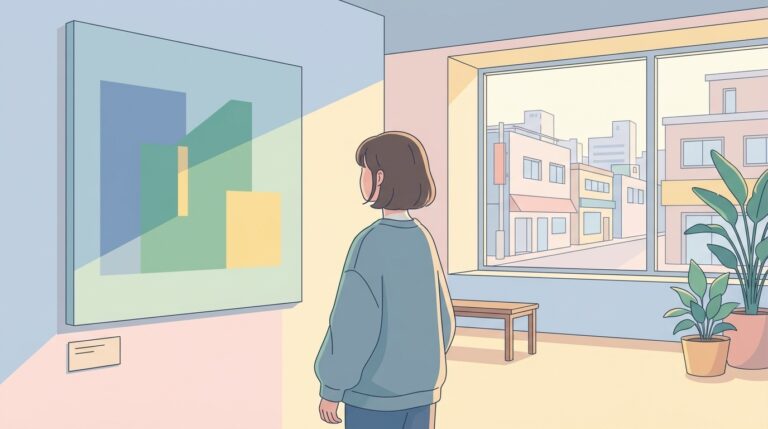
Picture this: You are walking through the beautiful, quiet halls of the National Museum of Modern and Contemporary Art (MMCA) in Seoul. Outside, the autumn leaves are falling over the traditional Hanok rooftops of Samcheong-dong. Inside, you spot a breathtaking, minimalist painting. You walk up to it, eager to understand its story, but as you look at the little description card (설명판 – seolmyeong-pan) on the wall, your eyes glaze over. It is filled with Korean characters, and suddenly, you feel like an outsider looking in.
Don’t worry! This is a classic “cultural barrier” moment that almost every Korean learner goes through. In fact, one of our regular students, Sarah from Chicago, told us: “I loved looking at the paintings, but I felt so disconnected because I couldn’t read the descriptions. I felt like I was missing the real Korean soul behind the art.”
That conversation inspired this exact guide. Reading artwork descriptions in Korean isn’t about memorizing ancient, academic vocabulary. It’s about recognizing 3 magical, recurring patterns that open up the artist’s mind to you. By the end of this post, you’ll be able to confidently decode Korean gallery cards and impress your friends with real cultural insight!
Phase 2: Deep Dive into 3 Core Expressions
Let’s break down the three most common sentence patterns you will find on any Korean artwork label.
1. 이 작품은 [대상]을 나타냅니다 (I jakpumeun [daesang]eul nata-naemnida)
- Pronunciation: Ee jahk-poom-eun [Object]-eul nah-tah-neh-mnee-dah. (Pro tip: Think of “nata-nae” as sounding like “not-a-day” spoken quickly without the ‘d’ sound!)
- Meaning: This artwork represents [object] / This work portrays [object].
- K-Culture Moment: You will hear this phrase in almost every romantic K-Drama museum scene, like when the main characters stand side-by-side staring at a modern canvas.
- Editor’s Insight: The verb 나타내다 (nata-naeda) literally means “to make appear” or “to reveal.” In art, it is the standard, polite way to explain what a physical painting or sculpture is depicting.
- Situation Spectrum:
- Casual: 이 작품은 자연을 나타내요. (⚠️ Use with close friends)
- Semi-formal: 이 작품은 자연을 나타냅니다. (✅ Standard for exhibitions)
- Formal: 이 작품은 자연을 나타내고 있습니다. (✅ High-end curator style)
- 🤔 Think About It: How does your native language describe representation in art? Do you say “This painting is a tree,” or “This painting shows a tree”? Korean loves using active verbs like “making it appear” (나타내다).
2. [대상]에 영감을 받았습니다 ([Dae-sang]e yeong-gameul badasseumnida)
- Pronunciation: [Source]-eh young-gahm-eul bah-dah-sseum-nee-dah. (Pronounce “yeong-gam” like “young-gum” with a soft ‘g’.)
- Meaning: Inspired by [object/source].
- K-Culture Moment: Famous K-Pop artists, like BTS’s RM (who is a massive art lover!), often use this phrase in interviews when discussing their favorite painters.
- Editor’s Insight: 영감 (yeong-gam) means “inspiration.” When combined with 받다 (badda – to receive), it literally means “to receive inspiration from.” It’s a beautiful way of acknowledging one’s creative muses.
- Situation Spectrum:
- Casual: 이거 보고 영감 받았어. (⚠️ Casual, speaking to a friend)
- Semi-formal: 한국 역사에 영감을 받았습니다. (✅ Perfect for writing or polite conversation)
- Formal: 한국 전통 미학에서 영감을 받았습니다. (✅ Official artist’s statement)
- 🤔 Think About It: Why do you think Korean uses the passive-like form “received inspiration” rather than the active “it inspired me”? It shows a deep cultural humility, pointing the honor back to the source of inspiration.
3. 작가의 의도는 [명사/동사]입니다 (Jakgaui uidoneun [Noun/Verb]imnida)
- Pronunciation: Jahk-gah-wee wee-doh-neun [Noun]-eem-nee-dah.
- Meaning: The artist’s intention is [noun/verb].
- K-Culture Moment: You’ll see this in art history textbooks or hear it during audio tours in major museums like the National Museum of Korea.
- Editor’s Insight: 작가 (jak-ga) means “writer” or “artist/creator,” and 의도 (ui-do) means “intention.” Understanding the “artist’s intention” is the key to unlocking abstract art!
- Situation Spectrum:
- Casual: 작가 의도가 뭐야? (⚠️ Sounds abrupt; use only as a quick question to yourself or a very close friend)
- Semi-formal: 작가의 의도는 평화입니다. (✅ Clean and clear)
- Formal: 본 작가의 의도는 현대 사회를 비판하는 데 있습니다. (✅ Advanced academic level)
- 🤔 Think About It: In English, we often ask “What does the painting mean?” but in Korean culture, we focus on the human behind it: “What was the artist’s intention?”
Phase 3: Textbook Korean vs. Real-life Korean
Let’s compare how textbooks teach you to speak in a museum versus how real Koreans actually chat about art!
Situation 1: Describing a painting’s beauty
- 📖 Textbook Korean: 이 그림은 아름답습니다. (I geurimeun areumdapseumnida. / “This painting is beautiful.”)
- 🗣️ 진짜 Korean: 와, 이 그림 색감이 대박이네요! (Wa, i geurim saekgami daebagineyo! / “Wow, the color palette of this painting is incredible!”)
- 💡 Why the difference? While “아름답습니다” is grammatically perfect, native Koreans love to point out specific artistic features like 색감 (saek-gam – color vibe/palette) and use casual exclamation markers like 대박 (daebak – awesome/amazing) to express genuine awe.
Situation 2: Asking someone to look at the placard
- 📖 Textbook Korean: 설명을 읽어 보십시오. (Seolmyeongeul ilgeo bosipsio. / “Please read the description.”)
- 🗣️ 진짜 Korean: 우리 작품 설명 한번 같이 읽어볼까요? (Uri jakpum seolmyeong hanbeon gachi ilgeobolkkayo? / “Shall we read the artwork description together?”)
- 💡 Why the difference? “~십시오” can sound like a cold command from an old textbook. Real Koreans prefer the friendly, soft suggestion form ~ㄹ까요? (Shall we?) to make the experience shared and warm.
Phase 4: K-Culture Deep Dive & Non-verbal Manners
4-1. “Nunchi” & Gallery Etiquette in Korea
Korean art spaces value 눈치 (Nunchi – the art of reading the room) immensely.
1. The Whispering Posture: When discussing art in Korea, tilt your head slightly toward your partner and keep your voice at a gentle whisper. Speaking too loudly in a gallery is considered highly disruptive (민폐 – minpye).
2. The Polite Distance: Do not lean in too close to the artwork description cards. If you need to read the small letters, wait until the person ahead of you has stepped back, giving them a polite nod.
4-2. RM of BTS: The Art-World Icon
In Korea, art exhibitions have exploded in popularity among Gen Z, largely thanks to RM (Kim Nam-joon) of BTS. He is famous for “art-touring” (미술관 투어) around Korea. When he visits a gallery, fans flock to take photos in the exact same spot, creating a trend called “RM Tour.” This has made learning art-related Korean terms incredibly trendy!
Phase 5: Real-Life Roleplay Scenario
Setting: You are visiting the stunning Leeum Museum of Art in Hannam-dong, Seoul. You meet Minho, a friendly Korean college student volunteering as a museum docent.
Minho: 안녕하세요! 오늘 전시회는 어떠세요?
       (Annyeonghaseyo! Oneul jeonsihoeneun eotteoseyo?)
       🎭 [Smiling warmly, pointing gently to a painting]
       "Hello! How are you enjoying today's exhibition?"

You: 정말 멋져요. 그런데 이 그림은 무엇을 나타내나요?
     (Jeongmal meotjyeoyo. Geureonde i geurimeun mueoseul natanaenayo?)
     🎭 [Leaning in slightly with a curious expression]
     "It's really wonderful. By the way, what does this painting represent?"

Minho: 아, 이 작품은 서울의 밤하늘을 나타냅니다.
       (Ah, i jakpumeun Seourui bamhaneureul nata-naemnida.)
       🎭 [Nodding softly, looking at the canvas]
       "Ah, this artwork represents Seoul's night sky."

You: 아, 그렇군요! 작가가 어디에서 영감을 받았나요?
     (Ah, geureokgunyo! Jakgaga eodieseo yeonggameul badannayo?)
     🎭 [Tilting your head in interest]
     "Ah, I see! Where did the artist get their inspiration?"

Minho: 전통 한지(traditional paper)와 별빛에서 영감을 받았다고 해요.
       (Jeontong hanji-wa byeolbicheoseo yeonggameul badatdago haeyo.)
       🎭 [Trimming your gaze toward the description card]
       "They say they were inspired by traditional Hanji paper and starlight."

You: 설명을 읽으니까 작품이 더 이해가 잘 돼요.
     (Seolmyeongeul ilgeunikka jakpumi deo ihaega jal dwoeyo.)
     🎭 [Smiling with relief]
     "Reading the description makes it much easier to understand the piece."

Minho: 맞아요. 작가의 의도를 알면 미술이 더 재미있어지죠!
       (Majayo. Jakgaui uidoreul almyeon misuri deo jaemi-isseojijo!)
       🎭 [Giving a soft, encouraging thumbs up]
       "That's right. Knowing the artist's intention makes art so much more fun!"

You: 오늘 설명해 주셔서 정말 감사합니다!
     (Oneul seolmyeonghae jusyeoseo jeongmal gamsahamnida!)
     🎭 [Bowing your head politely at a 15-degree angle]
     "Thank you so much for explaining it to me today!"
🔀 Interactive Choice Point
Minho asks you: “어떤 스타일의 예술을 가장 좋아하세요? (What style of art do you like the most?)”
- Choice A: “현대 미술을 좋아해요.” (Hyeondae misureul joahae-yo. – “I like modern art.”)
- Feedback (Best!): Minho’s face lights up! He will likely recommend the second-floor gallery showcasing contemporary abstract works.
- Choice B: “그냥 다 좋아해요.” (Geunyang da joahae-yo. – “I just like everything.”)
- Feedback (Bad): Too vague. It closes the conversational flow. Try naming at least one element!
- Choice C: “미술은 너무 어려워요.” (Misureun neomu eoryeowo-yo. – “Art is too difficult.”)
- Feedback (Risk): Honest and cute, but can make the mood awkward if you say it too bluntly. Try adding “그래도 보는 건 재미있어요” (But it’s still fun to watch!) to keep the vibe positive.
Phase 6: 10-Second Emotion Shadowing Drill
Practice these natural pacing patterns with emotional color! Pay attention to the pause markers (/).
[😊 Excited & Curious]- 이 작품은 / 어떤 의미가 / 있나요?
- Ee jakpumeun / eotteon uimiga / innayo?
- “What kind of / meaning / does this work have?”
[😲 Amazed & Whimsical]- 우와, / 자연에서 / 영감을 받았네요!
- Uwa, / jayeoneseo / yeonggameul badanneyo!
- “Wow, / they got inspiration / from nature!”
[🥺 Thoughtful & Reflective]- 작가의 의도가 / 참 / 따뜻한 것 같아요.
- Jakgaui uidoga / cham / ttatteut-han geot gatayo.
- “I think the artist’s intention is / truly / warm.”
Phase 7: K-Culture Mini Dictionary
- 미술관 (Misulgwan) | Art Gallery / Fine Arts Museum
- Usage: Going to see paintings and visual arts. Do not confuse with regular “박물관” (history museums).
- 도슨트 (Doseunt) | Docent / Gallery Guide
- Usage: Curators or volunteers who explain the artwork to visitors in Korean galleries.
- 설명판 (Seolmyeong-pan) | Artwork Description Placard / Label
- Usage: The small card next to paintings containing the title, artist name, and description.
- 색감 (Saek-gam) | Color Palette / Color Tone
- Usage: Extremely popular slang-adjacent aesthetic term used to describe the beautiful color harmony of a picture, photo, or K-pop MV.
Phase 8: Survivor’s Kit for Travelers
Survival Phrases TOP 3
- 한국어 설명판은 어디에 있나요?
- Han-gugeo seolmyeong-paneun eodie innayo?
- “Where is the Korean description board?”
- 사진 촬영 가능한가요?
- Sajin chwaryeong ganeung-hangayo?
- “Is photo-taking allowed here?” (Very important in Seoul museums!)
- 오디오 가이드 대여하고 싶어요.
- Audio gaideu daeyeohago sipeoyo.
- “I would like to rent an audio guide.”
🗺️ Editor’s Travel Note
When visiting major museums like the National Museum of Korea or MMCA, do not pay for expensive rental guides! Instead, search for the official [National Museum of Korea Mobile App] on the Google Play Store or Apple App Store. It provides high-quality, free audio guides in English and Korean directly on your smartphone. Just make sure to bring your own earphones!
Phase 9: One Step Deeper (Thoughtful Reflection)
In traditional Korean art, there is a core aesthetic concept called 여백의 미 (Yeobaekui mi), which translates to “the beauty of empty space.” Unlike Western art history, which historically favored filling every inch of canvas with detail, traditional Korean painting values what is left out.
This reflects a deeper Korean cultural philosophy: leaving space for the viewer’s mind to rest and breathe. When you read Korean artwork descriptions, you will often find terms emphasizing silence, emptiness, and natural flow. It’s not just art—it’s a spiritual pause.
💬 Your Turn: What do you think about “the beauty of empty space”? Do you prefer paintings filled with lots of details, or minimalist art that leaves space for your imagination? Share your thoughts in the comments below!
Phase 10: FAQ & Avoiding Common Mistakes
Q: Can I use “그림” (geurim) for every artwork?
A: Not quite! 그림 strictly means







