

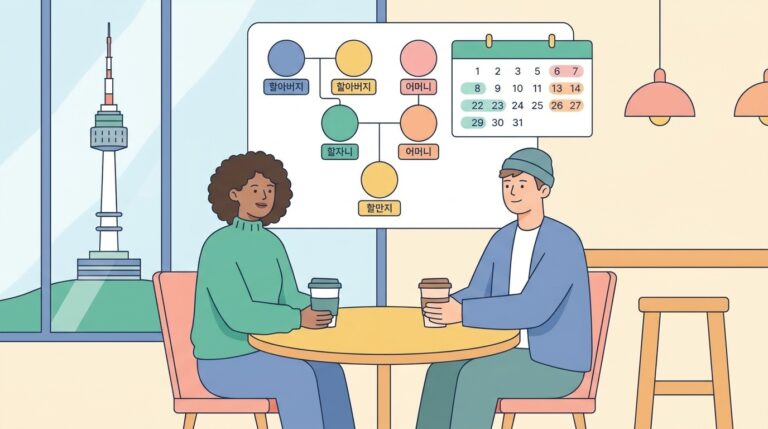
Navigating the Korean Age Puzzle: How to Handle the “Early-Born” (빠른 년생) Hierarchy Maze Without Ruining Friendships
Phase 1: Empathy (Story-driven Opening)
안녕하세요! (Annyeonghaseyo!) Your friendly Korean culture navigator and Daily Hangul editor is back.
Imagine this: You are at a trendy cafe in Hongdae with two new Korean friends, Ji-won and Min-woo. Both were born in 1994, so you naturally assume they are “friends” of equal standing (친구, chingu). But suddenly, Ji-won calls Min-woo “Oppa” (older brother) and speaks to him in formal Korean (존댓말, jondetmal), while Min-woo replies in casual Korean (반말, banmal). You rub your eyes. Did you miss a secret portal? How can people born in the same year have a hierarchy?
Welcome to the mind-bending world of “빠른 년생” (ppar-eun nyeon-saeng) — the “early-born” age puzzle.
For many of our intermediate (B1) learners, mastering when to drop honorifics is already a challenge. But when “early-born” dynamics get thrown into the mix, it feels like the social hierarchy family tree (“족보”, jokbo) gets completely tangled up! Don’t panic. Today, we are going to untangle this cultural knot together so you can confidently navigate social boundaries just like a local. Let’s dive in!
Phase 2: Deep Dive into 3 Core Expressions
Let’s break down the three most crucial expressions you need to survive and navigate this social maze.
1. 빠른 년생이에요. (한글)
- Pronunciation: [Ppar-eun nyeon-saeng-i-e-yo] (Sounds like “Par-oon neon-saeng-ee-ae-yo”)
- Meaning: “I am an early-born.” (Born in January or February)
- K-Culture Moment: You will often hear this in university dramas when freshmen are sorting out who gets to speak casually to whom. One character will defensively say, “Wait, I’m an early-born!” to claim seniority.
- Editor’s Insight: Historically, Korea’s school year started in March. Children born in January or February of the following year entered school with children born between March and December of the previous year. Even though this system officially changed in 2009, anyone born before then still carries this “early-born” identity, which can create social shifts!
- Situation Spectrum: Casual (✅) / Semi-formal (✅) / Formal (⚠️)
- 🤔 Think About It: How does your culture define social groups? Is it strictly based on birth year, or does the school cohort system play a bigger role in how close you feel to someone?
2. 말 놓으셔도 돼요. (한글)
- Pronunciation: [Mal no-eu-syeo-do dwae-yo] (Sounds like “Mal noh-oo-syuh-do dweh-yo”)
- Meaning: “You can lower/drop your words.” (Feel free to speak casually with me)
- K-Culture Moment: In K-Dramas, when a budding couple or two close colleagues finally decide to drop the formal “Yo” (-요) endings, one of them will shyly say this phrase to signal, “We are close now.”
- Editor’s Insight: In Korea, speaking casually (반말, banmal) without permission can sound incredibly rude. Even if someone is younger, wait until they give you the green light by saying this phrase, or ask for their permission first.
- Situation Spectrum: Casual (✅) / Semi-formal (✅) / Formal (🚫)
- 🤔 Think About It: In your native language, is there a specific phrase or moment when you shift from formal to informal speech with someone?
3. 족보가 꼬였어요. (한글)
- Pronunciation: [Jok-bo-ga kko-yeot-eo-yo] (Sounds like “Jok-bo-gah kko-yut-uh-yo”)
- Meaning: “The family tree (genealogy) is tangled up.” (Our age hierarchy is messy)
- K-Culture Moment: On popular variety shows like Running Man, cast members of similar ages often laugh and use this phrase when they realize their mutual friends have different age dynamics, making it hard to decide who is the “older” one.
- Editor’s Insight: While “족보” literally means a traditional family genealogy book, Koreans use this metaphorically to describe any social circle where age-based rules of address become complicated due to “early-borns.”
- Situation Spectrum: Casual (✅) / Semi-formal (✅) / Formal (⚠️)
- 🤔 Think About It: Why do you think maintaining a clear social order is so deeply embedded in the Korean language?
Phase 3: Textbook Korean vs. Real Korean
Let’s see how textbook grammar compares to what native Koreans actually say in real life.
Situation 1: Suggesting to speak casually
- 📖 Textbook Korean: “우리 이제 반말할까요?” (Shall we speak casually now?)
- 🗣️ Real Korean: “우리 편하게 말 놓을까요?” (Shall we comfortably drop our words?)
- 💡 Why is it different? The textbook version can feel a bit too direct or clinical. The real-life version uses the word “편하게” (comfortably), which sounds much softer, warmer, and more polite.
Situation 2: Resolving a messy age hierarchy
- 📖 Textbook Korean: “나이 관계가 복잡합니다.” (The age relationship is complex.)
- 🗣️ Real Korean: “에이, 우리 그냥 친구 해요!” (Aw, let’s just be friends!)
- 💡 Why is it different? Instead of dwelling on the complicated rules, young Koreans will often wave their hand and suggest being “same-age friends” (친구) to bypass the awkwardness. It instantly breaks the ice!
Phase 4: K-Culture Deep Dive & Non-Verbal Manners
4-1. Nunchi (눈치) & Non-Verbal Gestures
When discussing age and deciding whether to use banmal or jondetmal, your body language is just as important as your words.
* The Head Tilt: When suggesting to drop honorifics, slightly tilt your head and smile. This shows you are making a friendly suggestion, not demanding informal speech.
* Hand Placement: If you are younger but the older person suggests speaking casually, gently place one hand over your chest, bow slightly, and say “감사합니다” (Thank you) or “그럼 편하게 할게요” (Then I’ll speak comfortably) to show respect.
4-2. Culture Code: The Dramatic Power of the “Banmal Shift”
In K-Dramas, the moment characters switch from Jondetmal to Banmal is a major plot device. It signifies that the invisible wall of formality has crumbled. However, doing this prematurely in real life is a social faux pas. In the context of the “early-born” system, Koreans use intense “Nunchi” (social sensing) to make sure they do not offend someone who went to school a year earlier, as they technically share the same academic social rank.
Phase 5: Real-Life Roleplay Scenario
Setting: A casual chicken-and-beer (치맥) gathering in Sinchon.
Characters:
* Min-woo (민우): Born in Feb 1995 (Early-born, went to school with 1994-borns).
* Sarah (세라 – You): Born in 1994 (Your B1 level character).
- Min-woo: 🎭 Smiling warmly while raising a glass
세라 씨, 우리 나이가 비슷해 보이는데 몇 년생이세요?
(Sarah, we seem to be a similar age. What year were you born?) - Sarah: 🎭 Smiling back and clinking glasses
저는 94년생이에요. 민우 씨는요?
(I was born in ’94. What about you, Min-woo?) - Min-woo: 🎭 Scratching his head with a sheepish grin
아, 저는 95년 2월생이라 빠른 95예요. 학교는 94년생들이랑 같이 다녔어요.
(Ah, I was born in February ’95, so I’m an “early 95.” I went to school with the ’94-borns.) - Sarah: 🎭 Widening eyes in realization
아! 그럼 저랑 친구네요!
(Ah! Then we are same-age friends!) - Min-woo: 🎭 Nodding happily
맞아요. 학번이 같으니까 편하게 친구 하면 될 것 같아요.
(Right. Since we are in the same school cohort, I think we can comfortably be friends.) - Sarah: 🎭 Tasting the chicken
좋아요! 그럼… 우리 이제 말 놓을까요?
(Great! Then… shall we drop our words now?) - Min-woo: 🎭 Laughing cheerfully
네, 말 놓자! 편하게 대답해줘.
(Yeah, let’s speak casually! Answer me comfortably.) - Sarah: 🎭 Giggling and clinking glasses again
그래, 반가워 민우야! 우리 족보 안 꼬여서 다행이다.
(Yeah, nice to meet you Min-woo! Glad our family tree didn’t get tangled.)
🔀 Interactive Choice Points
If Min-woo told you he was an “early-born” but you didn’t want to switch to casual speech immediately, how would you respond?
* Option A: “아, 그렇군요. 그래도 전 아직 존댓말이 더 편해요.” (Ah, I see. Still, I’m more comfortable with formal language.)
* Feedback (Best): Extremely polite and honest! It respects your own boundaries while being clear.
* Option B: “아, 진짜요? 그럼 그냥 반말 써!” (Oh, really? Then just use casual talk!)
* Feedback (Bad): Too abrupt. Even if they are an early-born, dropping honorifics without mutual agreement can feel jarring.
* Option C: “족보가 꼬였네요. 그냥 제가 누나 할게요!” (Our hierarchy is tangled. I’ll just be your older sister!)
* Feedback (Risk): Playful but risky. If you aren’t very close yet, claiming seniority (“Nuna”) might make the atmosphere slightly awkward.
Phase 6: 10-Second Emotion Shadowing Drill
Let’s practice speaking with real Korean emotions! Pay attention to the pauses (/) and the emotional cues.
- [🥺 Sheepish & apologetic]
“제가 / 빠른 년생이라 / 족보가 / 좀 꼬였네요.”
(Je-ga / ppar-eun nyeon-saeng-i-ra / jok-bo-ga / jom kko-yeot-ne-yo.)
(“Since I am an early-born… our social hierarchy got a bit tangled up.”) -
[😊 Warm & welcoming]
“편하게 / 말씀 낮추세요! / 우리 친구 해요.”
(Pyeon-ha-ge / mal-sseum nat-chu-se-yo! / U-ri chin-gu hae-yo.)
(“Please speak casually to me comfortably! Let’s be friends.”)
Phase 7: K-Culture Mini Dictionary
- 빠른 년생 (Ppar-eun nyeon-saeng): An “early-born” individual (born in Jan/Feb before 2009) who entered school early.
- 야자타임 (Ya-ja-ta-im): A popular social game where age hierarchy is temporarily reversed or flattened, allowing everyone to speak casually to one another.
- 족보 (Jok-bo): Literally a family genealogy book, but colloquially used to describe the age-based social hierarchy of a friend group.
- 말을 놓다 (Mal-eul no-ta): Literally “to lower one’s words.” It means to transition from formal Korean (Jondetmal) to casual Korean (Banmal).
Phase 8: Traveler’s Survival Kit
Survival Expressions TOP 3
- 몇 년생이세요? [Myeot nyeon-saeng-i-se-yo?] – “What year were you born?” (The polite way to ask for age without sounding too intrusive).
- 말 편하게 해주세요. [Mal pyeon-ha-ge hae-ju-se-yo.] – “Please speak comfortably to me.”
- 우리 동갑이네요! [U-ri dong-gap-i-ne-yo!] – “We are the exact same age!”
💡 Editor’s Travel Note:
When meeting new Korean friends at a guesthouse or cafe, use the 네이버 지도 앱 다운로드 (Naver Map App) to find cozy spots in Hongdae or Itaewon to hang out and practice these expressions. Note: App interface and features may vary by region.
Phase 9: “One Step Deeper” (Thought Question)
In many Western cultures, a one-year age gap is virtually meaningless in casual friendships. However, in Korea, age hierarchy acts as a social map that dictates verbal endings, pronouns, and even sitting arrangements. While this can feel restrictive to outsiders, it also fosters a deep sense of mutual responsibility and care—older friends often take care of younger ones, while younger ones show respect.
💬 Your Turn: Do you prefer having clear, structured social rules like Korea’s age system, or do you prefer the flatter, less-defined social structures of your own culture? Let me know in the comments below!
Phase 10: FAQ & Common Mistakes
Q: Why did Korea change the “early-born” school system in 2009?
A: The government abolished it because it created too much confusion and social friction in universities and workplaces when people tried to figure out who was older or younger.
Q: Can I just start speaking Banmal if someone is clearly younger than me?
A: No, it is highly recommended to use Jondetmal first, even if they look younger. Always wait until you both agree to “말을 놓다” (drop honorifics).
Q: What if an early-born person is older than me by school year but has the same birth year?
A: Usually, Koreans respect the school year (학번) hierarchy. If they went to school earlier, they are considered your social senior (선배, seonbae), so you should use honorifics unless they ask you to speak comfortably.
🚨 Common Mistakes Alert
- Calling a male friend “Oppa” or “Hyung” immediately after learning they are older.
- Correct Action: Keep using their name + “씨” (e.g., Min-woo-ssi) until you are closer and they agree to the title.
- Using “너” (you) to someone who is an early-born of the same birth year without asking.
- Correct Action: Use their name instead of “너” until you both agree to be “same-age friends.”
- Assuming the age rules don’t apply to foreigners.
- Correct Action: While Koreans are forgiving with foreigners, showing that you understand the “early-born” nuance will earn you immense respect!
Phase 11: Action Mission & Engagement
- Bronze Mission: Say “몇 년생이세요?” out loud three times to practice the natural intonation.
- Silver Mission: Share this post on your SNS and tag a friend who loves K-Dramas with the caption: “Did you know about 빠른 년생?”
- Gold Mission: Next time you talk to a Korean language partner, ask them if they have ever experienced a “족보 꼬임” (tangled family tree) situation!
🎮 K-Culture Mission
Watch your favorite K-Drama this week and try to spot the exact moment two characters agree to drop honorifics. Listen for the magic words: “말 놓으세요”!
Phase 12: Interactive Quiz Challenge
1. What does the term “빠른 년생” (ppar-eun nyeon-saeng) refer to?
* A) Someone who runs fast.
* B) Someone born in January or February who entered school early.
* C) A sibling who is older than you.
2. Fill in the blank: “족보가 _______.” (Our social hierarchy is tangled up.)
* A) 편해요 (pyeon-hae-yo)
* B) 꼬였어요 (kko-yeot-eo-yo)
* C) 똑같아요 (ttok-gat-ah-yo)
3. True or False: If someone is the same age as you but was born in February, they might expect you to use formal language if they entered school a year earlier.
* A) True
* B) False
🔍 Click here to reveal the Answers & Explanations!
- Answer: B – “Early-born” refers to those born in Jan/Feb who entered school with the previous year’s cohort.
- Answer: B – “족보가 꼬였어요” means the social hierarchy/family tree is tangled up.
- Answer: A (True) – Yes! Because of the school cohort system, they may consider themselves senior in social standing.







