

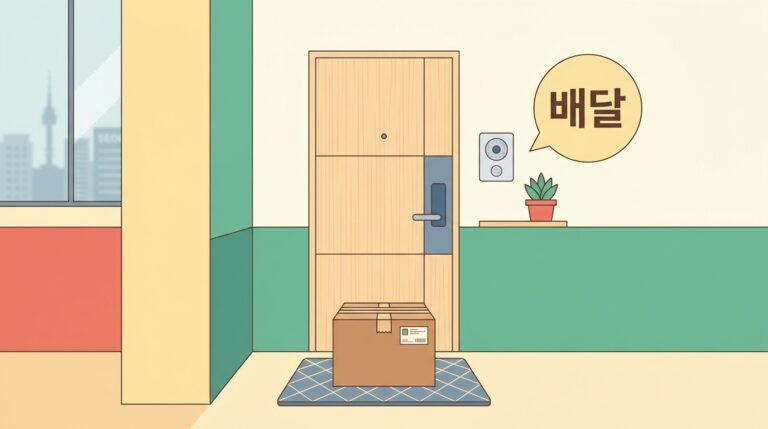
Handling Delivery Mishaps in Korea: How to Resolve Issues Like a Local (B2)
안녕하세요! Welcome back to another edition of Daily Hangul, your ultimate guide to living and speaking like a true Seoulite. I’m your host and chief editor, your Korean best friend who is always here to make sure you never feel lost in translation!
We all know that South Korea’s delivery culture (배달 문화 – baedal munhwa) is legendary. You can order anything—from sizzling hot Korean fried chicken (치킨) to premium Hanwoo beef—right to your picnic mat at the Han River park! But what happens when the delivery goes wrong?
Imagine this: you’ve had a long, exhausting day. You order a spicy pork dish to cure your fatigue. The app says “delivered,” but your doorstep is completely empty. Or worse, you open the plastic bag and find… cold noodles instead of your hot soup. Panic mode on!
Our learners often tell us that resolving these minor delivery disasters is one of the scariest moments of living in Korea. Today, we are going to change that. By the end of this guide, you will have the linguistic tools and cultural “nunchi” to fix any delivery mishap with absolute confidence. Let’s dive in!
Phase 2: 3 Key Expressions Deep Dive
1. 음식이 잘못 배달되었어요. (eumsigi jalmot baedal-doe-eosseoyo)
- Pronunciation: oom-shee-gee jal-mot bae-dal-dwe-uh-suh-yo (Think of the “doe” as the “dwe” in “dwell”)
- Meaning: “My food was delivered incorrectly” (The wrong items arrived).
- K-Culture Moment: You’ll often see this in K-Dramas when the protagonist receives a premium luxury meal meant for the rich neighbor, leading to a hilarious rom-com encounter.
- Editor’s Insight: The word 잘못 (jalmot) means “mistakenly” or “wrongly.” This expression is polite, objective, and doesn’t sound overly aggressive, making it perfect for initiating a claim.
- Situation Spectrum: Casual (🚫), Semi-formal (✅), Formal (✅)
- 🤔 Think About It: In your home country, do you call the restaurant directly, or do you always resolve delivery issues through an app? Korean apps make direct communication with the shop incredibly easy.
2. 주문한 음식이 하나 빠졌어요. (jumunhan eumsigi hana ppajyeosseoyo)
- Pronunciation: joo-moon-han oom-shee-gee ha-na ppa-jyeot-suh-yo (The “ppa” sounds like the sharp ‘p’ in “spit”)
- Meaning: “One of the items I ordered is missing.”
- K-Culture Moment: The ultimate tragedy: your fried chicken arrives, but the essential pickled radish (치킨무) or the ice-cold cola is missing!
- Editor’s Insight: 빠지다 (ppajida) means “to be omitted” or “to fall out.” Instead of accusatory phrases like “You didn’t send my food,” saying “It got left out” softens the statement while clearly pointing out the mistake.
- Situation Spectrum: Casual (⚠️ – use “하나 안 왔어” for close friends), Semi-formal (✅), Formal (✅)
3. 배달 완료라고 뜨는데 아직 못 받았어요. (baedal wallyorago tteuneunde ajik mot bada-eosseoyo)
- Pronunciation: bae-dal wal-lyo-ra-go ttheu-neun-de ah-jik mot ba-da-suh-yo (Focus on the double “tt” in “tteu”, which sounds like “t” in “stop”)
- Meaning: “It says ‘delivery complete’ on the app, but I haven’t received it yet.”
- K-Culture Moment: You look at your phone, see the “Delivered!” notification, open your door, and… meet the cold, empty draft of the hallway.
- Editor’s Insight: The verb 뜨다 (tteuda) literally means “to float” or “to rise” (like the sun), but in modern digital life, it means “to pop up / show up on a screen.” It’s highly idiomatic and used constantly by native speakers!
- Situation Spectrum: Casual (⚠️), Semi-formal (✅), Formal (✅)
Phase 3: Textbook Korean vs. Real-Life Korean
Let’s compare the sterile phrases you find in classroom textbooks with the lively, natural language Koreans actually use.
Situation 1: Pointing out a missing item
- 📖 Textbook: “제 주문에 누락된 품목이 있습니다.” (je jumune nurakdoen pummogi isseudnida. / “There is an omitted item in my order.”)
- 🗣️ Real Life: “사장님, 치킨무가 안 왔는데 다시 보내주실 수 있나요?” (sajangnim, chikinmuga an wanneunde dasi bonaejusil su innayo? / “Boss, the pickled radish didn’t come. Could you send it again?”)
- 💡 Why the difference? Textbooks use formal, bureaucratic words like 누락 (omission) and 품목 (item). In reality, calling the shop owner 사장님 (sajangnim) instantly builds a friendly rapport, and using a simple “안 왔는데” (didn’t come) sounds much more natural.
Situation 2: Incorrect delivery address
- 📖 Textbook: “배달원이 다른 장소에 배달을 하였습니다.” (baedalwoni dareun jangsoe baedaleul hayeosseunida. / “The delivery person performed delivery to another location.”)
- 🗣️ Real Life: “옆집으로 잘못 간 것 같아요. 한번 확인해 주시겠어요?” (yeopjibeuro jalmot gan geot gatayo. hanbeon hwaginhae jusigesseoyo? / “I think it went to the next door by mistake. Could you please check?”)
- 💡 Why the difference? Instead of blaming the courier directly, Koreans soften the delivery mistake by using “~것 같아요” (it seems like/I think) to avoid sounding rude or confrontational.
Phase 4: K-Culture Deep Dive & Non-Verbal Manners
4-1. The Art of “Nunchi” (눈치) during a Dispute
When dealing with a delivery mistake, how you say it matters just as much as what you say.
* Tone of Voice: Even if you are starving and angry, keep your tone polite and slightly apologetic. Start with “죄송하지만…” (I’m sorry, but…) or “실례지만…” (Excuse me, but…).
* Why? In Korean culture, starting with a polite buffer phrase indicates that you are not looking for a fight, but rather a quick collaborative solution. This activates the restaurant owner’s desire to help you immediately!
4-2. The Digital Infrastructure: Proof Photos
Korea’s delivery apps like Baemin (배달의민족) and Coupang Eats (쿠팡이츠) rely heavily on “문 앞 배달” (delivery in front of the door). Riders will almost always take a photo of the bag sitting at your doorstep.
* If your food is missing, check the app’s photo proof first! Often, you’ll realize it was delivered to the floor below yours or to your neighbor’s door.
Phase 5: Real-Life Roleplay Scenario
Scenario: Jun (B2 learner) has ordered crispy chicken from a local shop, but notices that the essential side menu—the pickled radish and dipping sauce—is missing. He calls the restaurant.
Characters:
* 준 (Jun): Hungry, polite, but firm student.
* 사장님 (Sajangnim): The busy but well-meaning restaurant owner.
준: (Clearing throat politely) 여보세요? 방금 배달 주문한 사람인데요...
(yeoboseyo? banggeum baedal jumunhan saramingdeyo...)
"Hello? I'm the person who just ordered delivery..."

사장님: (With a busy, high-energy voice) 네, 안녕하세요! 어떤 것 때문에 그러시죠?
(ne, annyeonghaseyo! eotteon geot ttaemune geureosijo?)
"Yes, hello! How can I help you?"

준: (Checking the receipt) 다름이 아니라, 프라이드치킨은 잘 왔는데 세트에 포함된 양념 소스랑 치킨무가 빠졌어요.
(dareumi anira, peuraideuchikineun jal wanneunde setteue pohamdoen yangnyeom soseurang chikinmuga ppajyeosseoyo.)
"Actually, the fried chicken arrived safely, but the sweet and spicy sauce and the pickled radish included in the set were left out."

사장님: (Gasps, apologetic) 아이구, 정말 죄송합니다! 오늘 주말이라 저희가 정신이 없어서 빼먹었나 봐요.
(aigu, jeongmal joesonghamnida! oneul jumalira jeohiga jeongsini eopseoseo ppaemeogeonna bwayo.)
"Oh dear, I am so sorry! It's the weekend, and we were so hectic that we must have missed it."

준: (Smiling, understanding tone) 아, 바쁘시면 그럴 수 있죠. 혹시 지금 소스랑 무만 다시 보내주실 수 있나요?
(a, bappeusimyyeon geureol su itjyo. hoksi jigeum soseurang muman dasi bonaejusil su innayo?)
"Ah, that can happen when you're busy. Is it possible to send just the sauce and radish again now?"

사장님: (Checking rider status) 지금 배달 대행이 밀려서 다시 보내드리면 40분 넘게 걸릴 것 같아요. 혹시 그 부분만 바로 환불해 드려도 괜찮을까요?
(jigeum baedal daehaengi millyeoseo dasi bonaedreimyeon sasipbun neomge geollil geot gatayo. hoksi geu bubunman baro hwanbulhae deuryeodo gwaenchanheulkkayo?)
"The delivery agencies are backed up right now, so if we resend them, it might take over 40 minutes. Would it be okay if we just refund you for that portion right away?"

준: (Nodding over the phone) 아, 네! 그럼 그렇게 해주세요. 계좌번호를 문자로 보내드릴까요?
(a, ne! geureom geureoke haejuseyo. gyejwabeonhoreul munjaro bonaedreilkkayo?)
"Oh, yes! Please do that then. Shall I text you my bank account number?"

사장님: (Relieved) 네! 계좌번호 남겨주시면 바로 입금해 드릴게요. 정말 죄송합니다!
(ne! gyejwabeonho namgyeojusimyyeon baro ipgeumhae deurilgeyo. jeongmal joesonghamnida!)
"Yes! If you leave your bank account number, I'll transfer it right away. We are truly sorry!"
🔀 Choose Your Adventure!
How should Jun respond if he absolutely must have that dipping sauce?
* Option A: Insist that they send it immediately because dry chicken is unbearable. (Risk: Your chicken gets ice cold while waiting 40 minutes for the sauce.)
* Option B: Agree to the cash refund and use whatever sauce you have in your fridge. (Best: Fastest, stress-free, and keeps a great relationship with the shop.)
* Option C: Get angry and demand a whole new hot chicken set for free. (Bad: Completely destroys your “nunchi” points and might brand you as a black consumer!)
Phase 6: 10-Second Emotion Shadowing Drill
Practice matching your tone to the emotion. Pay attention to the / pauses!
- [🥺 Frustrated and Confused]
- “배달 완료라고 뜨는데 / 아직 못 받았어요.”
- (bae-dal wal-lyo-ra-go ttheu-neun-de / ah-jik mot ba-da-suh-yo.)
- [😊 Polite, Patient, yet Assertive]
- “바쁘시면 그럴 수 있죠. / 혹시 다시 보내주실 수 있나요?”
- (ah, ba-ppeu-shi-myeon geu-reol soo it-jyo. / hok-shi da-shi bo-nae-joo-shil soo in-na-yo?)
Phase 7: K-Culture Mini-Dictionary
- 오배송 (obaesong) | Misdelivery (Delivery sent to the wrong address).
- 문 앞 (mun ap) | In front of the door (The default contactless drop-off spot in Korea).
- 계좌이체 (gyejwa-iche) | Bank transfer (The standard way Korean shop owners quickly refund minor missing items directly to you).
- 배달 대행 (baedal daehaeng) | Third-party delivery agency (Independent riders who deliver for multiple restaurants).
Phase 8: The Traveler’s Survival Kit
Survival Phrases TOP 3
- “옆 동에 잘못 가신 것 같아요.” (yeop dong-e jalmot gasin geot gatayo.)
- Pro Tip: If you live in a multi-building apartment complex (아파트 단지), riders often mix up building numbers (e.g., Building 101 vs. 102).
- “사진이랑 저희 집 문 앞이랑 달라요.” (sajin-irang jeohye jib mun ap-irang dallayo.)
- Pro Tip: Use this when the proof photo shows a door color or decoration that is clearly not yours!
- “그냥 문 앞에 두고 가세요.” (geunyang mun ape dugo gaseyo.)
- Pro Tip: Use this when you want contactless delivery to avoid face-to-face interaction.
🗺️ Editor’s Travel Note
When navigating Korea, make sure you download the Naver Map App for exact address coordinates and use the Baedalui Minjok App for real-time tracking. Always double-check your floor and unit number (e.g., 502호) in your profile to prevent 오배송 before ordering!
(Note: App interfaces and delivery fees are subject to change based on company policies.)
Phase 9:
Frequently Asked Questions (FAQ)
Q: What does "음식이 잘못 배달되었어요. (eumsigi jalmot baedal-doe-eosseoyo)" mean in Korean and how do you pronounce it?
A: In Korean, "음식이 잘못 배달되었어요. (eumsigi jalmot baedal-doe-eosseoyo)" is pronounced [oom-shee-gee jal-mot bae-dal-dwe-uh-suh-yo (Think of the "doe" as the "dwe" in "dwell"] and means: "My food was delivered incorrectly" (The wrong items arrived).
Q: What does "주문한 음식이 하나 빠졌어요. (jumunhan eumsigi hana ppajyeosseoyo)" mean in Korean and how do you pronounce it?
A: In Korean, "주문한 음식이 하나 빠졌어요. (jumunhan eumsigi hana ppajyeosseoyo)" is pronounced [joo-moon-han oom-shee-gee ha-na ppa-jyeot-suh-yo (The "ppa" sounds like the sharp 'p' in "spit"] and means: "One of the items I ordered is missing."
Q: What does "배달 완료라고 뜨는데 아직 못 받았어요. (baedal wallyorago tteuneunde ajik mot bada-eosseoyo)" mean in Korean and how do you pronounce it?
A: In Korean, "배달 완료라고 뜨는데 아직 못 받았어요. (baedal wallyorago tteuneunde ajik mot bada-eosseoyo)" is pronounced [bae-dal wal-lyo-ra-go ttheu-neun-de ah-jik mot ba-da-suh-yo (Focus on the double "tt" in "tteu", which sounds like "t" in "stop"] and means: "It says 'delivery complete' on the app, but I haven't received it yet."







