

Talk About Your Self-Esteem and Confidence in Korean Like a Local (자존감 vs 자신감)
Phase 1: Empathy (스토리 몰입형 오프닝)
안녕하세요! Your favorite Korean learning buddy and Senior Editor at Daily Hangul is back!
Have you ever been watching a slice-of-life K-Drama like Our Beloved Summer or My Liberation Notes and noticed how characters talk about their inner struggles? In Korea, especially with the massive explosion of MBTI (MBTI 열풍) culture, conversations about mental health, self-esteem, and personal vibes are no longer taboo. They are the ultimate bonding topics over a cup of iced americano.
But here is the catch: when many intermediate (B2) learners try to express their feelings, they get stuck. You might want to say “I’m feeling a bit insecure today” or “I want to build my confidence,” but translating these directly from English often sounds clinical, awkward, or way too dramatic.
Today, we are diving deep into how Koreans actually talk about self-esteem and confidence. This guide is built on real case studies of our learners who wanted to move past robotic textbook sentences and connect with Korean friends on a truly soul-deep level. By the end of this post, you’ll be able to express your emotional highs and lows with nuance and genuine Korean warmth.
Phase 2: 3 Core Expressions (핵심 표현 3선 심층 분석)
Let’s unpack the three absolute must-know expressions. In Korean, “confidence” and “self-esteem” are split into two very distinct words: 자신감 (confidence in skills/actions) and 자존감 (internal self-esteem). Let’s master them!
1. 자존감이 높다 / 낮다 (Self-esteem is high/low)
- Pronunciation: [Jajon-gami nopda / natda] (Sounds like: “jah-jon-gah-mee nop-dah” / “naht-dah”)
- Meaning: High self-esteem / Low self-esteem
- K-Culture Moment: You will hear this constantly in healing K-Dramas when a character realizes they’ve been dating someone toxic because their “자존감” was low, or when an idol talks during a live broadcast about how their fans help raise their 자존감.
- Editor’s Insight: Do not confuse this with 자존심 (jajonsim), which means “pride” or “ego.” If someone has “high 자존심,” they might be stubborn and refuse to apologize. But someone with “high 자존감” has a healthy, loving relationship with themselves.
- Situation Spectrum: Casual ✅ | Semi-formal ✅ | Formal ✅
- 🤔 Think About It: In your culture, is it common to openly discuss whether your self-esteem is high or low with friends? In Korea, identifying yourself as “자존감이 낮은 편” (on the lower self-esteem side) is seen as a sign of vulnerability and honesty, not weakness.
2. 자신감이 넘치다 (To overflow with confidence)
- Pronunciation: [Jasin-gami neomchida] (Sounds like: “jah-shin-gah-mee neom-chee-dah”)
- Meaning: To be bursting/overflowing with confidence
- K-Culture Moment: Think of a K-Pop group’s main dancer stepping onto the stage, or a job applicant nailing an interview. It’s that magnetic, visible energy.
- Editor’s Insight: While “자신감이 있다” (to have confidence) is standard, using “넘치다” (to overflow) elevates your Korean to a highly natural, descriptive level. It carries a very positive, vibrant nuance.
- Situation Spectrum: Casual ✅ | Semi-formal ✅ | Formal ⚠️ (Use ‘자신감이 넘칩니다’ in formal settings to describe others, but be careful using it for yourself as it might sound slightly boastful.)
- 🤔 Think About It: How does your native language describe someone who is extremely confident without sounding arrogant?
3. 기죽지 마 (Don’t lose your spirit / Keep your chin up)
- Pronunciation: [Gi-juk-ji ma] (Sounds like: “ghee-jook-jee mah”)
- Meaning: Don’t get discouraged / Don’t let your spirit die
- K-Culture Moment: A classic line spoken by a loyal friend or a supportive parent when the protagonist fails an exam, gets rejected, or feels intimidated by wealthy rivals.
- Editor’s Insight: “기” (Gi) refers to life energy or spirit, and “죽다” means to die. Literally, it means “don’t let your energy die.” It is one of the most comforting, powerful things you can say to someone whose confidence has taken a hit.
- Situation Spectrum: Casual ✅ | Semi-formal ⚠️ (Use ‘기죽지 마세요’) | Formal 🚫
- 🤔 Think About It: “Don’t get discouraged” feels quite formal in English, but “기죽지 마” is highly affectionate and intimate. It shows you are actively protecting your friend’s energy.
Phase 3: Textbook Korean vs Real Korean (교과서 vs 진짜 한국어)
Let’s compare the sterile sentences from old textbooks with what you will actually hear on the streets of Mapo or Seongsu-dong.
Scenario A: Encouraging a friend before a big challenge
- 📖 Textbook Korean: “자신감을 가지세요! 당신은 할 수 있습니다.”
(Have confidence! You can do it.) - 🗣️ 진짜 한국어: “야, 기죽지 마! 네가 최고야. 어깨 펴!”
(Hey, don’t lose your spirit! You are the best. Shoulders back!) - 💡 왜 다를까? The textbook version sounds like a corporate motivational poster. Real friends use visceral physical cues like “어깨 펴” (spread your shoulders/chin up) to break the tension and show immediate, warm solidarity.
Scenario B: Describing your own quiet personality
- 📖 Textbook Korean: “저는 성격이 소심합니다.”
(I have a timid personality.) - 🗣️ 진짜 한국어: “제가 은근히 낯을 좀 가리고, 자존감도 기복이 있는 편이에요.”
(I actually get a bit shy around strangers, and my self-esteem tends to have its ups and downs.) - 💡 왜 다를까? Calling yourself “소심하다” (timid/narrow-minded) in modern Korean has a slightly clinical or negative connotation. Instead, saying you “낯을 가리다” (shy around strangers) combined with “자존감 기복이 있다” (self-esteem has fluctuations) sounds incredibly self-aware, modern, and socially smooth.
Phase 4: K-Culture Deep Dive & Non-verbal Manners
4-1. 눈치 (Nunchi) & Body Language
When discussing confidence in Korea, 겸손 (humility) is still a gold-standard social value.
* The Waving Hand Gesture: If someone praises your confidence (“자신감이 대단해요!”), do not just say “Thank you.” Instead, smile, tilt your head slightly, and wave your hand in front of your face as if brushing away the compliment, saying “아니에요, 아직 부족해요” (No, I’m still lacking). This demonstrates high Nunchi—balancing confidence with social grace.
* Eye Contact: While talking about deep personal struggles like low self-esteem (자존감), it is natural to look down at your coffee cup occasionally rather than maintaining intense eye contact. It signals sincerity and vulnerability.
4-2. The MBTI & Counseling Cafe Phenomenon
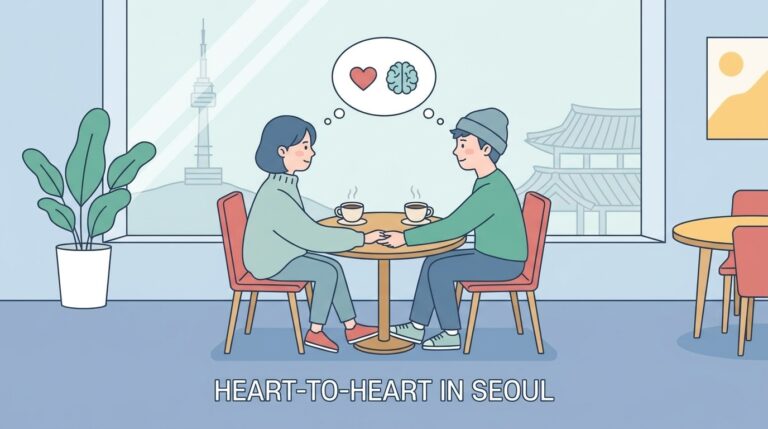
In Korea, MBTI isn’t just a trend; it’s a social tool. If you visit a 심리 카페 (Psychology & Counseling Cafe) in Hongdae or Gangnam, you will see couples and friends analyzing their MBTI charts to discuss their 자존감. Knowing whether you are an ‘I’ (Introvert) or ‘E’ (Extravert) helps Koreans frame conversations about mental health in a fun, non-threatening way. “I’m an INFP, so my 자존감 naturally dips when I’m alone too long” is a perfectly normal sentence in Seoul today!
Phase 5: Practical Roleplay Scenario (실전 롤플레이)
Setting: A cozy, warm-lit cafe in Hongdae. You are sitting with Minho (민호), your supportive ENFJ Korean friend. You recently messed up a presentation at work/school and are feeling down.
- 민호: (따뜻하게 웃으며 커피를 건넨다) / “무슨 일 있어? 아까부터 얼굴이 어두워 보여.”
(Is something wrong? Your face has looked dark/gloomy for a while.) - You (B2): “어제 발표를 망쳤거든. 나 진짜 자신감을 다 잃었어.”
(I ruined my presentation yesterday. I’ve really lost all my confidence.) - 민호: “아, 진짜? 열심히 준비했잖아. 많이 속상하겠다.”
(Oh, really? You prepared so hard. You must be so upset.) - You (B2): “응, 다른 사람들 앞에서 버벅거리니까 내가 너무 바보 같았어. 갑자기 자존감도 낮아지는 것 같아.”
(Yeah, stammering in front of others made me feel like such a fool. Suddenly I feel like my self-esteem is dropping too.) - 민호: “(진지한 눈빛으로 손을 잡아주며) 야, 기죽지 마! 한 번 실수한 것뿐이잖아.”
(Hey, don’t lose your spirit! It was just a one-time mistake.) - You (B2): “그래도 다음 발표 때 또 실수할까 봐 걱정돼.”
(Even so, I’m worried I’ll make another mistake during the next presentation.) - 민호: “걱정 마. 넌 원래 자신감 넘치는 사람이잖아. 네 실력을 믿어봐!”
(Don’t worry. You’re originally an overflowing-with-confidence person. Believe in your skills!) - You (B2): “(고개를 끄덕이며) 고마워, 민호야. 네 덕분에 힘이 난다. 어깨 좀 펴야겠어!”
(Thank you, Minho. Thanks to you, I get strength. I should spread my shoulders/chin up!)
🔀 Interactive Choice Points (선택 분기점)
How would you reply to Minho’s encouragement? Choose your path!
- Option A: “고마워. 나 이제 기 안 죽을게! 덤벼라 세상아!”
- (Thanks. I won’t lose my spirit now! Bring it on, world!)
- Feedback: Best! 🌟 This is incredibly natural, witty, and shows a great sense of humor. “덤벼라 세상아” is a famous meme-like phrase used when you jokingly puff up your chest to face the world.
- Option B: “아닙니다. 저는 더 겸손해야 합니다.”
- (No. I must be more humble.)
- Feedback: Bad! 🚫 This is too rigid and formal for a cafe chat with a close friend. It sounds like an historical drama character.
- Option C: “응, 내 자존심은 절대 무너지지 않아!”
- (Yeah, my pride will never collapse!)
- Feedback: Risk! ⚠️ Be careful! Using 자존심 (ego/pride) here makes you sound defensive or stubborn, as if you are angry about the mistake rather than building up your healthy self-esteem (자존감).
Phase 6: 10-Second Emotional Shadowing Drill (섀도잉 드릴)
Practice saying these lines with the exact emotional pauses (/) and inflections to sound 100% natural.
- [🥺 Softly, opening up about your feelings]
“요즘 / 자존감이 좀 / 떨어졌는데… / 네 얘기 들으니까 / 위로가 된다.”
(Yo-jeum / ja-jon-ga-mi jom / tteo-reo-jyeot-neun-de… / ne yae-gi deu-ri-kka / wi-ro-ga doen-da.) -
[🔥 Energetically, cheering up a close friend]
“야! / 기죽지 마! / 네가 / 최고야. / 어깨 펴자!”
(Ya! / Gi-juk-ji ma! / Ne-ga / choi-go-ya. / Eo-kkae pyeo-ja!)
Phase 7: K-Culture Mini Dictionary
- 자존심 (Jajonsim) | Pride / Ego
- Unlike 자존감, this is your defensive ego. “자존심 상해” (My pride is hurt) is used when you hate losing to someone.
- 멘탈 (Mental) | Mental Strength / Grit
- Adapted from English “mental,” but used as a noun. “멘탈이 나갔다” means “My mental state is shattered” or “I’m totally spaced out.”
- 뼈 때리다 (Ppyeo ttaerida) | To hit the bone (To hit too close to home)
- Used when a friend gives you harsh but 100% true advice about your lack of confidence. “방금 민호 말이 내 뼈를 때렸어” (What Minho just said really hit home).
- 우쭈쭈 (Ujujoo) | Babying/Comforting sound
- An onomatopoeia used playfully to comfort someone who is feeling down or pouting. “우리 애기, 우쭈쭈 기죽지 마~”
Phase 8: Survival Kit for Travelers
Survival Expressions TOP 3
- “할 수 있어!” [Hal su isseo!]
- Pro Tip: Chant this to yourself or your friends. It’s the ultimate Korean “You can do it!”
- “토닥토닥” [To-dak-to-dak]
- Pro Tip: This is the sound of patting someone’s back. You can text this to a sad friend to show you are virtually hugging them.
- “파이팅!” [Pai-ting!]
- Pro Tip: The classic, indispensable cheer. Always say it with a clenched fist!
📌 Editor’s Travel Note:
If you are feeling emotionally exhausted during your trip to Seoul, look up a “심리 상담 카페” (Psychological Counseling Cafe) on the NAVER Map App. They offer light personality tests and warm tea in a comforting space. Please check opening hours beforehand, as schedules may vary.
Phase 9: “한 발 더 깊이” (Deepening Thought)
Korean culture places a heavy emphasis on community and how others perceive you, which historically tied one’s self-esteem directly to societal milestones (university, marriage, corporate jobs). However, the younger generation (MZ세대) is actively shifting the narrative. By adopting terms like 자존감 and using MBTI as a shield to explain their unique traits, young Koreans are creating a new culture of self-acceptance. It’s no longer about being perfect; it’s about being “나다운 것” (authentically myself).
💬 Your Turn: How do you define the difference between confidence and self-esteem in your own life? Leave a comment below—let’s chat in Korean!
Phase 10: FAQ & Common Mistakes
Q: What is the exact difference between 자신감 and 자존감?
A: Think of 자신감 (confidence) as your belief in your external skills and actions (e.g., “I am confident in speaking Korean”). Think of 자존감 (self-esteem) as your internal value of yourself, regardless of your skills or failures (e.g., “Even if I make mistakes, I still love myself”).
Q: Can I say “자존심이 높다” to mean I have high self-esteem?
A: No! “자존심이 높다” (or 세다) means you have a very strong pride or ego, which can sometimes make you look stubborn or arrogant. Always use “자존감이 높다” for healthy self-esteem.
Q: When should I use “기죽지 마” instead of “걱정하지 마”?
A: Use “걱정하지 마” (Don’t worry) when someone is anxious about a future event. Use “기죽지 마” (Don’t lose heart) specifically when someone has already suffered a setback, is feeling intimidated by someone else, or is feeling small.
🚨 Common Mistakes Alert!
- Mistake 1: Saying “나 자존심 낮아” (My pride is low) when you mean you feel insecure.
- Correct Action: Say “나 요즘 자존감이 낮아진 것 같아.”
- Mistake 2: Using “기죽지 마” to your boss or teacher.
- Correct Action: This is too casual! If an older person is down, use a softer phrase like “힘내세요, 항상 응원합니다” (Cheer up, I am always rooting for you).
Phase 11: Action Mission & Engagement
- Bronze Level 🥉: Write down the sentence “나는 내가 좋아” (I like myself) on a sticky note and stick it on your mirror!
- Silver Level 🥈: Share your MBTI on Instagram or Threads and write: “나는 [MBTI], 은근히 낯을 가려요!” (I am [MBTI], I get a bit shy around strangers!).
- Gold Level 🥇: The next time a friend tells you they failed at something, send them a message: “기죽지 마! 넌 충분히 잘하고 있어. 토닥토닥.“
Phase 12: Interactive Quiz Challenge
Test your emotional B2 Korean skills!
1. Which word fits best in the blank?
“실수를 많이 해서 그런지 요즘 부쩍 ( )이/가 떨어졌어. 내 자신을 사랑하기가 힘드네.”
* A) 자존심
* B) 자신감
* C) 자존감
2. True or False?
“기죽지 마” can be naturally said to your boss at a company dinner when they look stressed.
* True
* False
🔍 Click here to reveal Answers & Explanations!
- Correct Answer: C) 자존감
- Explanation: The sentence talks about struggling to “love myself” (내 자신을 사랑하기가 힘드네), which relates to internal self-esteem (자존감), not external confidence (자신감) or pride (자존심).
- Correct Answer: False
- Explanation: “기죽지 마” is highly casual (반말) and intimate. Saying this to your boss would be considered extremely impolite! Instead, use “부장님, 힘내세요!” (Cheer up, Director!).
- Explanation: “기죽지 마” is highly casual (반말) and intimate. Saying this to your boss would be considered extremely impolite! Instead, use “부장님, 힘내세요!” (Cheer up, Director!).







