

Master the Golden Rule of Korean Noraebang: Never Cut Off Someone’s Song!
Phase 1: Empathy (Dive into the Story)
안녕하세요! (Annyeonghaseyo!) I’m your lead editor and culture navigator at Daily Hangul.
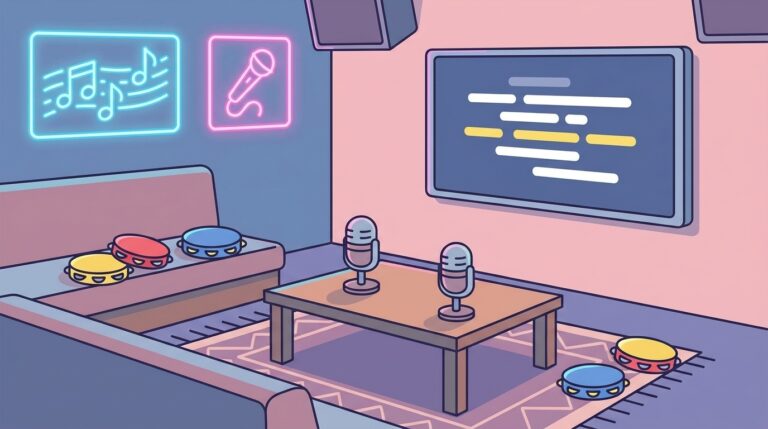
Picture this: You are at a neon-lit Noraebang (노래방 – Korean karaoke room) in Hongdae with your new Korean friends. The energy is amazing, tambourines are shaking, and everyone is laughing. Then, a slow ballad starts playing. You don’t know the song, and it feels a bit long. You spot the giant remote control, find the big red “취소” (Cancel) button, and press it to queue your favorite upbeat K-pop track.
Suddenly, the room goes dead silent. The tambourine stops. Your Korean friends stare at you with wide, shocked eyes.
What just happened? You accidentally broke the ultimate, unwritten golden rule of Korean social life: Never cut off someone else’s song!
In Korea, Noraebang isn’t just about showing off your singing skills; it’s a sacred bonding ritual built on mutual respect and shared energy. Today, we will explore the essential phrases and manners you need to survive a night out at a Korean karaoke room without losing your cool points!
Phase 2: Deep Dive into 3 Core Expressions
1. 노래 끊지 마세요 (Norae kkeun-chi ma-se-yo)
- Pronunciation: No-rae kkeun-chee mah-say-yo (Think of “kkuen” as a short “k-uhn” sound, snapping shut at the end).
- Meaning: Please don’t cut off / stop the song.
- K-Culture Moment: You will hear this dramatic plea in Korean sitcoms when an emotional singer gets brutally skipped by an impatient friend holding the remote.
- Editor’s Insight: The verb “끊다” (kkeun-ta) means to cut, disconnect, or interrupt. Using “~지 마세요” (ji ma-se-yo) makes this a polite yet firm request to protect your musical masterpiece.
- Situation Spectrum: Casual: ✅ (노래 끊지 마!) | Semi-formal: ✅ (노래 끊지 마세요) | Formal: ⚠️ (노래 중단하지 마십시오 – too rigid for Noraebang!)
- 🤔 Think About It: How does this rule reflect the collective mindset of Korean culture? Why is let-everyone-finish-their-turn so important in social gatherings?
2. 끝까지 부를게요 (Kkeut-kka-ji bu-reul-ge-yo)
- Pronunciation: Kkeut-kah-jee boo-reul-gay-yo (Make the “kk” sounds double-tense and crisp!).
- Meaning: I will sing it until the end.
- K-Culture Moment: Use this when you queue up a legendary 6-minute K-ballad and want to jokingly warn your friends that you have no intention of skipping a single verse.
- Editor’s Insight: “끝까지” means “until the end,” and “~을게요” (eul-ge-yo) expresses your active promise or intention. It sounds friendly, playful, and determined.
- Situation Spectrum: Casual: ✅ (끝까지 부를게) | Semi-formal: ✅ (끝까지 부를게요) | Formal: 🚫 (Not suited for formal business meetings!)
- 🤔 Think About It: In your home country, is it normal to skip songs halfway through during karaoke, or do people always sing until the very last note?
3. 중간에 취소하면 안 돼요 (Jung-gan-e chwi-so-ha-myeon an dwae-yo)
- Pronunciation: Joong-gahn-ay chwee-so-hah-myeon ahn dway-yo (The “chwi” sounds like a quick “ch-wee”).
- Meaning: You shouldn’t cancel it in the middle.
- K-Culture Moment: When a beginner guest holds the remote control too tightly, a protective veteran friend will quickly remind them of this cardinal rule.
- Editor’s Insight: “중간에” means “in the middle,” and “취소하면 안 돼요” uses the “~면 안 돼요” grammar pattern which means “you must not / it is not allowed.” It is the perfect phrase for teaching Noraebang etiquette.
- Situation Spectrum: Casual: ✅ (중간에 취소하면 안 돼) | Semi-formal: ✅ (중간에 취소하면 안 돼요) | Formal: ⚠️
- 🤔 Think About It: Notice how “안 돼요” is gentle yet clear. How does this compare to the direct “Don’t do that” commands in your native language?
Phase 3: Textbook Korean vs. Real Korean
Situation 1: Warning a friend not to skip your song
- 📖 Textbook Korean: “제 노래를 취소하지 말아 주십시오.” (Please do not cancel my song.)
- 🗣️ Real Korean: “앗, 내 애창곡인데 끊지 마요~!” (Ah, this is my favorite song, don’t cut it off!)
- 💡 Why the difference?: Textbook Korean is too stiff for a fun social room. Adding “~마요” (soft prohibition) and calling it your “애창곡” (ae-chang-gok – favorite go-to song) makes the complaint cute, natural, and friendly.
Situation 2: Asking if it’s okay to skip a song when the singer is resting
- 📖 Textbook Korean: “이 노래를 생략해도 괜찮겠습니까?” (Would it be acceptable to omit this song?)
- 🗣️ Real Korean: “이거 그냥 넘길까요?” (Shall we just skip/pass this one?)
- 💡 Why the difference?: Real Koreans use the conversational verb “넘기다” (to turn over / pass) rather than dry academic terms like “생략하다” (to omit).
Phase 4: K-Culture Deep-Dive & Non-verbal Manners
4-1. The Art of Nunchi (눈치) & The Remote Control
In Korea, the person holding the remote control (“리모컨”) holds the ultimate responsibility. Having “Nunchi” (social wit) means observing the room’s energy. Even if someone is struggling with a high note, you never touch that remote to cancel. Instead, grab the 템버린 (tambourine) and shake it with extra passion! This non-verbal gesture shows: “I’ve got your back, keep going!”
4-2. The “Heung” (흥) Culture
Korean Noraebang is centered around “흥” (Heung)—a collective feeling of joy, excitement, and release. If you cut off a song, you break the flow of “Heung.” The only time skipping is acceptable is if the singer themselves sighs and says: “아, 이거 못 부르겠다. 취소해 줘!” (Ah, I can’t sing this. Cancel it for me!).
Phase 5: Practical Roleplay Scenario
- Background: Min-jun (a cheerful Korean guy) and Sarah (an intermediate expat) are enjoying themselves at a cozy Noraebang in Mapo-gu. Sarah is holding the remote controller.
-
Min-jun: 🎭 (Shaking the tambourine energetically) “와, 이 노래 진짜 오랜만이다! 완전 내 애창곡이에요!”
(Wow, it’s been so long since I heard this song! It is totally my favorite song!) - Sarah: 🎭 (Peeking at the next song on the screen) “민준 씨, 근데 다음 노래 제 건데 이거 취소할까요?”
(Min-jun, but the next song is mine, should I cancel this one?) - Min-jun: 🎭 (Feigning dramatic shock, wide-eyed) “허걱! 설마… 내 노래를 중간에 취소하려고 했어요?!”
(Oh my! No way… were you trying to cancel my song in the middle?!) - Sarah: 🎭 (Blushing, waving hands) “앗, 미안해요! 전 그냥 다음 곡 빨리 하려고…”
(Ah, sorry! I just wanted to do the next song quickly…) - Min-jun: 🎭 (Laughing warmly) “하하, 장난이에요! 근데 노래방에서 남의 노래 끊으면 안 돼요~ 그건 유죄예요!”
(Haha, just kidding! But in a Noraebang, you shouldn’t cut off other people’s songs~ That is a crime!) - Sarah: 🎭 (Nodding and smiling) “아, 진짜요? 한국 노래방 매너군요. 몰랐어요!”
(Oh, really? That’s Korean Noraebang manners. I didn’t know!) - Min-jun: 🎭 (Handing her the second microphone) “맞아요! 대신 이 노래 같이 불러요. 듀엣 고고!”
(Exactly! Instead, let’s sing this together. Duet go go!) - Sarah: 🎭 (Taking the mic confidently) “좋아요! 끝까지 열심히 부를게요!”
(Great! I will sing passionately until the end!)
🔀 Interactive Branching Point
Your friend queued up a long, slow ballad, but then left the room to grab drinks. What do you do?
* Option A: Press “취소” immediately to save time. (Bad) -> Feedback: A major Noraebang sin! They might come back right at the chorus and feel hurt.
* Option B: Sing their song for them while they are gone. (Risk) -> Feedback: Cute if you know the song, but if you ruin their pitch, they might feel awkward.
* Option C: Leave the song playing, grab the tambourine, and wait. Or ask over KakaoTalk: “노래 넘길까?” (Best) -> Feedback: Pure gold! This shows top-tier Korean Nunchi and deep respect.
Phase 6: 10-Second Emotion Shadowing Drill
Read these out loud, pausing at the / marks, and match the emotional cues!
- [😊 Playfully teasing]
“노래방에서 / 남의 노래 / 끊으면 / 안 돼요!”
(No-rae-bang-e-seo / nam-ui no-rae / kkeun-heu-myeon / an dwae-yo!) -
[🥺 Regretful & cute]
“이거 / 제 최애곡인데 / 끊지 마요~”
(I-geo / je chwoe-ae-gok-in-de / kkeun-chi ma-yo~) -
[🔥 Energetic & passionate]
“우리 / 이 노래 / 끝까지 / 불러요!”
(U-ri / i no-rae / kkeut-kka-ji / bu-rreo-yo!)
Phase 7: K-Culture Mini Dictionary
- 애창곡 (Ae-chang-gok) | Favorite Song | The specific song you always practice and sing best when you go to Noraebang.
- 취소 (Chwi-so) | Cancel / Cancel Button | The forbidden red button on the remote that should only be pressed with consensus.
- 예약 (Ye-yak) | Reservation / Queue | The act of typing in a song number to put it in the upcoming queue.
- 템버린 (Tem-beo-rin) | Tambourine | The ultimate social tool in Korea to show enthusiasm and cheer on your friends.
Phase 8: Traveler’s Survival Kit
Top 3 Noraebang Survival Expressions
- “서비스 주세요!” (Seo-bi-seu ju-se-yo!)
- Meaning: “Please give us some service (free extra time)!”
- Pro Tip: Say this to the counter staff when your remaining time is dropping. They will often add 20-30 free minutes!
- “템버린 어디 있어요?” (Tem-beo-rin eo-di is-seo-yo?)
- Meaning: “Where is the tambourine?”
- Pro Tip: Keep the energy high even if you don’t know the lyrics.
- “먼저 부르세요!” (Meon-jeo bu-reu-se-yo!)
- Meaning: “Please go ahead and sing first!”
- Pro Tip: A polite way to show respect to your hosts or elders before jumping in.
Editor’s Travel Note
To find the coolest spots near you, search for “코인노래방” (Coin Noraebang – budget-friendly booths) using the Naver Map App on App Store or Google Play. Note: Coin Noraebang prices generally range from 500 to 1,000 KRW per 2-3 songs, and card payments are widely accepted, though carrying cash is always handy.
Phase 9: “One Step Deeper” (Reflection)
Why is skipping a song such an issue in Korea? It links back to 공동체 문화 (Gong-dong-che Mun-hwa – community culture). In Western karaoke, the singer is often performing on a elevated stage for an audience. In Korea, everyone sits inside a small, cozy room together. The microphone passes around equally. Skipping someone’s song is viewed as dismissing their emotional space and prioritizing yourself over the group’s harmony.
💬 Your Turn: Have you ever experienced a similar unspoken rule when hanging out with friends from other countries? Let us know in the comments below!
Phase 10: FAQ & Avoiding Misunderstandings (FAQ Schema)
Q: Is it ever okay to cancel a song?
A: Yes, but only if the person who reserved the song explicitly says so. For example, if they realize the key is too high and say, “아, 이거 키가 너무 높아. 취소해 줘!” (Ah, the key is too high. Please cancel it!).
Q: What does ‘Service’ (서비스) mean in a Korean Noraebang?
A: In Korea, “service” refers to free items or perks. In Noraebangs, owners will often add extra minutes to your room timer for free, especially if you order drinks or behave politely!
Q: How many songs should I reserve at one time?
A: To maintain good manners, only reserve 1 or 2 songs at a time. Booking 5 songs in a row is considered very rude (“예약 독점” – reservation monopoly).
🚨 Common Mistakes Warning Board
- Pressing the ‘Start’ (시작) button while another song is ending: Let the score screen fully finish. Interrupting the final score is considered a minor buzzkill!
- Singing loudly over someone else’s solo: Unless they invite you to sing along with “같이 불러요!” (Let’s sing together!), keep your voice down and use the tambourine.
- Holding the microphone too close to your mouth: This creates a loud popping noise. Keep it about 3 centimeters away for clean sound quality.
Phase 11: Action Mission & Participation
- Bronze Mission: Say “노래 끊지 마세요!” out loud 5 times with natural, playful intonation in front of your mirror.
- Silver Mission: Share this post on your social media, tag @DailyHangul, and name the one K-pop song you would sing “끝까지” (until the end) at a Noraebang.
- Gold Mission: Next time you watch a K-Drama with a Noraebang scene (like Reply 1988 or Hospital Playlist), watch the characters’ remote control behavior and comment here if they followed the rule!
Phase 12: Interactive Quiz Challenge
1. What is the most polite action when a friend’s song is too long or unfamiliar?
- A) Silently hit the red “취소” button.
- B) Clap and shake the tambourine to match their energy.
- C) Order more food so you have an excuse to look away.
Click here for the Answer & Explanation
Correct Answer: B
Explanation: Keeping the “Heung” (excitement) alive by shaking the tambourine is the gold standard of Korean Noraebang manners. Never skip without permission!
2. Fill in the blank: “노래방에서 남의 노래 _____ 안 돼요.”
- A) 부르면 (If you sing)
- B) 끊으면 (If you cut off)
- C) 예약하면 (If you reserve)
Click here for the Answer & Explanation
Correct Answer: B
Explanation: “끊으면” (kkeun-heu-myeon) means “if you cut off.” The sentence translates to: “You shouldn’t cut off other people’s songs in a Noraebang.”
3. True or False: It is completely fine to queue 5 of your favorite songs back-to-back as soon as you enter the room.
- True
- False
Click here for the Answer & Explanation
Correct Answer: False
Explanation: It is polite to take turns. Reserving too many songs at once is called a reservation monopoly and breaks the collective social spirit!







