

Spilling the Tea on K-Beauty: How to Chat About ‘Petit’ Procedures Like a Local
안녕하세요! Hello! Your favorite Korean bestie and Daily Hangul Editor is back!
Have you ever walked down the glowing streets of Gangnam or Myeongdong and noticed the endless, beautiful signs for dermatology clinics (피부과)? If you’ve spent any time watching K-Dramas or lifestyle vlogs, you know that talking about skincare, glow-ups, and subtle cosmetic touch-ups isn’t taboo in Korea—it’s practically a national hobby!
Many of our intermediate (B2) learners tell me: “I want to ask my Korean friends about their skincare secrets or share my own laser treatment experience, but textbook terms like ‘성형수술 (plastic surgery)’ feel way too intense and awkward!”
That is a massive pain point. In Korea, there is a world of difference between undergoing major surgery and getting a quick, subtle beauty treatment. Today, we are going to bridge that gap. By the end of this guide, you will be able to talk about K-Beauty procedures smoothly, naturally, and with the perfect cultural nuance. Let’s dive in!
Phase 2: Core Expressions for Your K-Beauty Arsenal
To talk about beauty treatments naturally, you need to master these three foundational terms. These aren’t your typical rigid dictionary words—they are the heartbeat of daily beauty talk in Seoul.
1. 시술받다 (si-sul-bat-da)
- Pronunciation: She-sool-bat-da (Sounds like “she” + “rule” with a soft ‘s’ + “baht-dah”)
- Meaning: To receive a cosmetic/micro-procedure (non-invasive treatments like lasers, fillers, or botox) vs. 수술받다 (to undergo invasive surgery).
- K-Culture Moment: In K-Dramas, when a character suddenly looks incredibly refreshed and glowing, their friends might suspiciously ask, “너 혹시 요즘 시술 받았어?” (Did you get a procedure done lately?)
- Editor’s Insight: Never confuse 시술 (procedure/treatment) with 수술 (surgery)! Saying 수술 makes it sound like you were hospitalized for major reconstructive surgery. For quick touch-ups, “쁘띠 성형” (petit cosmetic procedure) or simply “시술” is your go-to!
- Situation Spectrum: Casual ✅ / Semi-formal ✅ / Formal ✅
- 🤔 Think About It: In your home country, is there a sharp verbal distinction between a “spa procedure” and “cosmetic surgery”? How does this affect how openly people talk about it?
2. 자연스럽게 잘 됐다 (ja-yeon-seu-reop-ge jal dwaet-da)
- Pronunciation: Jah-yuhn-seu-rup-gae jahl dwaet-dah (Like “natural-ly well done”)
- Meaning: “It turned out so naturally!” / “It looks so natural!”
- K-Culture Moment: You see your friend after they got a subtle double-eyelid pinch or lip filler. Instead of focusing on the change itself, you compliment how seamless it is.
- Editor’s Insight: In Korea, the absolute highest praise for any beauty procedure is that it looks natural. Saying a treatment looks “티가 안 나다” (doesn’t show/obvious) or “자연스럽다” is the ultimate green light. Avoid saying “Your face looks different!”—aim for “It looks so natural!”
- Situation Spectrum: Casual ✅ / Semi-formal ✅ / Formal 🚫
- 🤔 Think About It: Why do you think looking “effortless” (꾸안꾸 – styled yet unstyled) is valued so highly in modern Korean beauty standards?
3. 효과를 보다 (hyo-gwa-reul bo-da)
- Pronunciation: Hyo-gwa-ruhl bo-dah (Think of “Hyo” + “gwan” without the n + “rule” + “bo-dah”)
- Meaning: To see/experience the results or effects of a treatment.
- K-Culture Moment: Discussing the legendary Korean skin booster ‘Rejuran Healer’ or laser toning with your friend and sharing when the glow actually kicked in.
- Editor’s Insight: While in English we “get results,” in Korean, you “see” (보다) the effect. It emphasizes visual, tangible transformation.
- Situation Spectrum: Casual ✅ / Semi-formal ✅ / Formal ✅
- 🤔 Think About It: What verb do you naturally associate with “effects” in your native language? “To get,” “to feel,” or “to see”?
Phase 3: Textbook Korean vs. Real-Life Korean
Let’s level up your intermediate fluency! See how textbooks teach these situations versus how real Seoulites actually speak.
Situation 1: Explaining that you got a quick skin treatment
- 📖 Textbook Korean: “저는 피부과에서 미용 치료를 받았습니다.” (I received aesthetic treatment at the dermatology clinic.) – Too clinical and stiff! This sounds like you went to treat a medical disease.
- 🗣️ 진짜 한국어: “나 이번에 피부과에서 관리 좀 받았어.” (I got some skin management/care done at the derm clinic this time.)
- 💡 Why? “관리받다” (to receive management/care) is the everyday term Koreans use for everything from basic facials to advanced laser procedures. It sounds routine, casual, and elegant.
Situation 2: Commenting on a friend’s glowing appearance
- 📖 Textbook Korean: “얼굴 모양이 변하셨군요.” (Your face shape has changed.) – Ouch! This can sound incredibly rude or accusatory!
- 🗣️ 진짜 한국어: “뭐 했어? 얼굴이 확 살았네!” (Did you do something? Your face totally popped/brightened up!)
- 💡 Why? “얼굴이 살다” literally means “the face lives/revives.” It’s a highly complimentary, natural way to notice a glow-up without awkwardly pointing out a specific medical procedure.
Phase 4: K-Culture Deep Dive & Non-verbal Manners
4-1. The Art of “Nunchi” & Subtle Gestures
When talking about cosmetic procedures in Korea, pay attention to these unspoken rules:
* The Confidential Whisper Hand: If a friend asks where you got your filler or Botox, it’s common to lean in slightly and use the “hand-covering-mouth” gesture. It creates an instant bond of sharing a premium beauty secret!
* The V-Line Gesture: When discussing jawline treatments (like Shurink or Ulthera lifting), Koreans often frame their chin with their thumb and index finger to form a “V” (브이라인). It’s a playful way to show the desired result.
4-2. The “Self-Management” (자기관리) Mindset
In Korea, investing in your skin and appearance isn’t viewed as vanity; it is widely respected as 자기관리 (self-management). Just like going to the gym, visiting the 피부과 (skin clinic) once a month for a routine “시술” is seen as a sign of a disciplined, healthy lifestyle. This is why conversations about Botox, lasers, and skin boosters are so open and normalized among friends of all genders!
Phase 5: Real-World Roleplay Scenario
Meet your practice partners: 지민 (Jimin), a local beauty enthusiast who knows every top clinic in Gangnam, and 민아 (Min-ah), an intermediate learner who recently tried a Korean skin booster treatment.
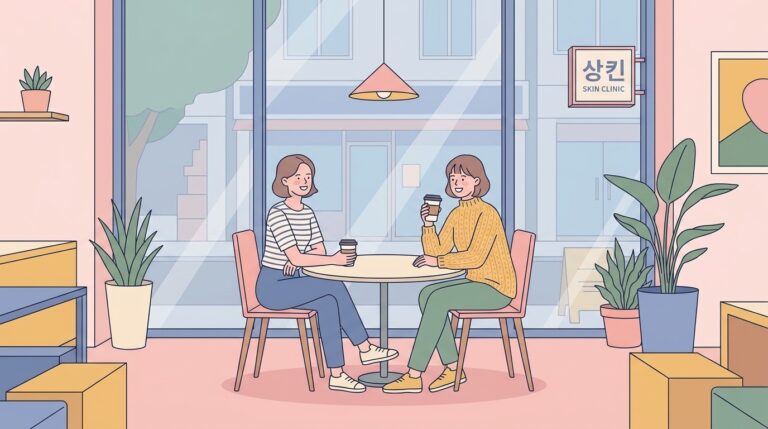
(Setting: A chic cafe in Sinsa-dong, sipping iced Americanos)
- 지민: 민아 장난 아니다! 🎭 (눈을 크게 뜨며) 너 오늘 피부에서 아주 광이 나는데? 요즘 좋은 화장품 써?
(Min-ah, no joke! (Eyes widening) Your skin is absolutely glowing today! Are you using some good skincare lately?) - 민아: 🎭 (쑥스럽게 웃으며) 아, 정말? 티 나? 사실 지난주에 압구정 피부과에서 스킨부스터 시술 받았거든.
(Oh, really? Does it show? Actually, I got a skin booster procedure at an Apgujeong clinic last week.) - 지민: 어쩐지! 전혀 인위적이지 않고 자연스럽게 잘 됐다. 무슨 시술이야?
(I knew it! It looks so natural and not artificial at all. What kind of treatment is it?) - 민아: ‘리쥬란’이랑 물광 주사 같이 하는 건데, 처음에는 좀 부어올라서 걱정했어.
(It’s a mix of Rejuran and Aqua Injection. At first, it swelled up a bit so I was worried.) - 지민: 원래 엠보 현상 좀 있어! 일주일 지나니까 효과를 제대로 본 것 같네.
(Embossing is totally normal at first! Now that a week passed, it looks like you’re really seeing the results.) - 민아: 응! 원장님이 꼼꼼하게 시술해 주셔서 그런지 대만족이야. 화장도 진짜 잘 먹어.
(Yeah! The doctor performed the procedure so thoroughly, I’m super satisfied. My makeup goes on so well.) - 지민: 대박, 나도 거기 정보 좀 공유해 줘! 나 요즘 탄력이 떨어져서 고민이거든.
(Awesome, share the clinic info with me! I’ve been worried about losing skin elasticity lately.) - 민아: 🎭 (핸드폰을 켜며) 당연하지! 예약 어플 링크 보내줄게. 여기 평점 엄청 좋아.
(Of course! (Turning on phone) I’ll send you the booking app link. The ratings here are amazing.)
🔀 Choose Your Response! (Interactive Branching)
Imagine Jimin asks you: “너도 보톡스 한번 맞아볼래? 요새 엄청 저렴해.” (Do you want to try getting Botox too? It’s really cheap lately.)
- Option A: “아니요, 저는 성형수술을 무서워해요.” (No, I’m scared of plastic surgery.)
- Option B: “저는 인위적인 건 싫은데, 자연스럽게 되는 거면 한번 고민해 볼게요!” (I don’t like artificial looks, but if it turns out naturally, I might consider it!)
- Option C: “보톡스는 치료가 아니라 시술이라서 효과가 금방 없어져요.” (Botox is a procedure, not a treatment, so the effect disappears quickly.)
💡 Feedback on Your Choice:
- Best Choice – Option B: Perfect! It uses the B2 nuance of “자연스럽다” (natural) and shows you understand the aesthetic value Koreans appreciate. It keeps the conversation warm and natural.
- Risk Choice – Option A: A bit too dramatic! Remember, Botox is a minor “시술 (procedure),” not a “성형수술 (major surgery).” Using “성형수술” here might make your friend feel self-conscious for suggesting it.
- Bad Choice – Option C: While factually true that botox wears off, the tone is a bit too clinical, academic, and dry for a casual coffee chat.
Phase 6: 10-Second Emotion Shadowing Drill
Let’s master the emotional flow! Practice saying these out loud. The / marks indicate short pauses to build natural rhythm.
[😊 Excited & Satisfied]
“나 / 이번에 / 필러 맞았는데 / 자연스럽게 잘 됐지?”
(Na / ibon-e / filler maj-at-neun-de / ja-yeon-seu-reop-ge jal dwaet-ji?)
“I got fillers this time, and it turned out so naturally, right?”-
[🥺 Slightly worried but hopeful]
“이 레이저 시술 / 진짜로 / 효과를 볼 수 있을까?”
(I laser si-sul / jin-jja-ro / hyo-gwa-reul bol su is-seul-kka?)
“Can I really see results from this laser treatment?”
Phase 7: K-Culture Mini Dictionary
- 쁘띠 성형 (Petit Seonghyeong): “Petit plastic surgery.” Refers to non-surgical micro-procedures with short recovery times (e.g., botox, fillers, threads).
- 피부과 (Pibugwa): Dermatology clinic. In Korea, it’s visited as frequently as a beauty salon for routine skin maintenance.
- 홈케어 (Hom-ke-eo): Home care. Post-procedure skincare routines done at home (using sheet masks, modeling packs, or beauty devices).
- 시카 (Cica): Centella Asiatica. The absolute holy grail ingredient in Korean soothing creams used to heal skin rapidly after laser treatments.
Phase 8: Traveler’s Survival Kit
If you plan to visit a skin clinic during your trip to Korea, keep these survival phrases close at hand!
TOP 3 Clinic Expressions
- “예약하고 왔어요.” (I came after making a reservation.)
- Pronunciation: Ye-yak-ha-go wat-seo-yo.
- “마취 크림 좀 더 많이 발라주세요.” (Please apply a bit more numbing cream.) [Pro-tip for painful lasers like Rejuran!]
- Pronunciation: Ma-chwi cream jom deo ma-ni bal-la-ju-se-yo.
- “부작용이나 주의사항이 있나요?” (Are there any side effects or precautions?)
- Pronunciation: Bu-jak-yong-i-na ju-ui-sa-hang-i in-na-yo?
🗺️ Editor’s Travel Note:
To research clinics, check out local review apps like Gangnam Unni Google Play Store or Babitalk Official Website. They offer verified patient reviews, price transparency, and before-and-after photos. Make sure to download them before your trip to find the most trusted aesthetic spots in Seoul! (Please note: App availability and language support may vary over time).
Phase 9: “One Step Deeper” (Reflection)
In many Western cultures, there can still be a subtle stigma attached to cosmetic enhancements, often framed under “keeping it completely natural.” In contrast, Korean society views 자기관리 (self-management) as an active form of self-love and professional preparation. Enhancing one’s appearance is often seen as a practical investment in one’s confidence. However, some argue that this creates a high societal pressure to conform to uniform beauty standards.
💬 Your Turn: What is the general attitude toward petit cosmetic procedures in your country? Is it openly shared like in Korea, or kept as a secret? Let me know in the comments below!
Phase 10: FAQ & Avoiding Misunderstandings
Q: Can I use “성형” (Seonghyeong) to describe any beauty clinic visit?
A: No! “성형” (short for 성형수술) implies major surgical restructuring (like a rhinoplasty or jaw shaving). For skin treatments, lasers, or botox, always use 피부과 관리 (dermatology care) or 시술 (procedure) to avoid sounding overly dramatic.
Q: What is the best way to ask a Korean friend if they got a skin treatment without being rude?
A: Instead of directly asking “Did you get work done?”, use a soft compliment: “요즘 피부가 왜 이렇게 좋아? 비결이 뭐야?” (Why is your skin so good lately? What’s your secret?). If they got a procedure, they will naturally share it with you!
Q: Is “쁘띠” (Petit) a native Korean word?
A: It actually comes from the French word “petit” (small). In Korea, it is combined with “성형” to elegantly describe low-risk, fast-recovery micro-procedures that don’t involve scalpel cuts.
🚨 Common Mistakes Warning Board
- Mistake 1: Saying “너 성형 수술 했어?” (Did you get plastic surgery?) when a friend got simple fillers.
- Correct Action: Say “너 혹시 시술 받았어?” (Did you get a procedure?). It’s much softer and socially acceptable.
- Mistake 2: Complimenting someone with “너 얼굴 많이 변했다!” (Your face changed a lot!).
- Correct Action: Use “훨씬 자연스럽고 예쁘다!” (It looks so much more natural and beautiful!).
- Mistake 3: Confusing “치료” (medical treatment for disease) with “시술” (cosmetic procedure).
- Correct Action: Keep “치료” for when you are sick or injured, and “시술” or “관리” for beauty.
Phase 11: Action Missions
- 🥉 Bronze Mission: Practice saying the 3 Core Expressions from Phase 2 out loud three times. Focus on the distinction between 시술 (si-sul) and 수술 (su-sul).
- 🥈 Silver Mission: Write a comment below in Korean using the expression “자연스럽게 잘 됐다” to compliment a hypothetical friend’s glow-up!
- 🥇 Gold Mission: Next time you watch a K-Beauty YouTube vlog, listen carefully for the words 효과 (hyogwa) and 관리 (gwan-ri), and note how the creator uses them in context.
Phase 12: Interactive Quiz Challenge
Test your K-Beauty Korean skills!
1. Situation Quiz
Your Korean friend Min-ji got subtle chin fillers and asked: “나 턱 필러 맞았는데 어때?” Which is the best response?
* A) “진짜 수술이 잘 됐네요!”
* B) “티도 안 나고 자연스럽게 잘 됐다!”
* C) “얼굴이 완전히 다른 사람이 되었어요.”
View Answer & Explanation
Correct Answer: B
Explanation: Complimenting that it looks “natural and doesn’t show” (티도 안 나고 자연스럽게 잘 됐다) is the ultimate compliment in Korea. ‘A’ uses ‘수술’ (major surgery) which is inappropriate for fillers, and ‘C’ implies their face looks totally different, which can be taken negatively.
2. Fill in the Blank
“이 화장품은 한 달 동안 꾸준히 쓰면 눈에 띄는 ( )을/를 볼 수 있어요.”
(If you use this cosmetic steadily for a month, you can see noticeable results/effects.)
* A) 시술 (si-sul)
* B) 효과 (hyo-gwa)
* C) 피부과 (pi-bu-gwa)
View Answer & Explanation
Correct Answer: B (효과 – effect/result)
Explanation: The phrase “효과를 보다” means “to see results/effects.” Therefore, “효과를 볼 수 있어요” is the grammatically and contextually correct choice.
3. True or False
In Korea, visiting a 피부과 (dermatology clinic) for regular skin scaling or lasers is heavily stigmatized and kept strictly secret.
* True / False
View Answer & Explanation
Correct Answer: False
Explanation: Visiting dermatology clinics for skincare treatments is highly normalized and widely respected as a healthy form of ‘자기관리’ (self-management) in modern Korea.
Now you are fully equipped to chat about K-Beauty procedures like a true Seoul insider! Keep practicing, stay glowing, and see you in the next lesson! 다음에 또 만나요! 💖







