

Don’t Get Locked Out! How to Ask for Bank Hours in Korea like a Local
Phase 1: Oh No, the Shutters are Down! (Empathy)
안녕하세요! (Annyeonghaseyo!) Welcome back to Daily Hangul, your cozy corner for learning real, living Korean. I’m your Korean bestie and editor.
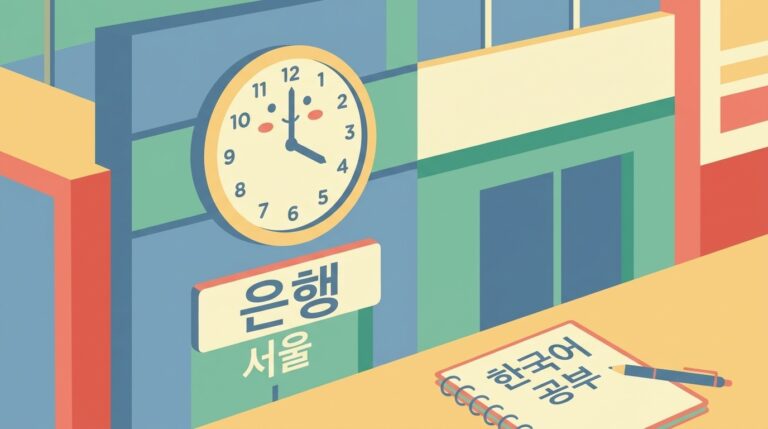
Imagine this: You’re walking down the vibrant streets of Myeongdong. You need to exchange some cash for that perfect street food run. You see a bank, check your phone—it’s 3:55 PM. “I have plenty of time,” you think. But as you approach, the security guard gently pulls down the metal shutters.
What?! It’s not even 4:00 PM yet!
Yes, welcome to one of the biggest culture shocks for expats in Korea: Korean banks close their doors at 4:00 PM sharp.
If you don’t know how to ask about business hours, you might find yourself stranded without cash right before a big weekend trip. Today, we’re going to master the exact phrases you need so you never get locked out again. Best of all, these aren’t stiff textbook sentences—they are the exact, polite words real Koreans use daily.
Phase 2: The Big Three: Core Expressions for Asking Bank Hours
Let’s look at the three most important phrases you’ll need. We’ll break them down step-by-step for A2 learners!
1. 몇 시에 문 닫아요? (Myeot sie mun dad-ayo?)
- Pronunciation: [Myeot she-eh moon dad-ah-yo?] (Rhymes with meet she-eh moon)
- Meaning: What time do you close? (Literally: “At what hour do you close the door?”)
- K-Culture Moment: You’ll hear this in almost every K-Drama when a character rushes into a convenience store, pharmacy, or bank right before closing.
- Editor’s Insight: This is highly practical. “문” means door, and “닫다” means to close. It’s polite enough for shop staff but friendly enough for daily life.
- Situation Spectrum: Casual: 🚫 | Semi-formal: ✅ | Formal: ⚠️
- 🤔 Think About It: In English, we just say “close,” but in Korean, we literally say “close the door” (문 닫다). It paints a clear visual image, doesn’t it?
2. 은행 영업 시간이 어떻게 돼요? (Eun-haeng yeong-eop si-gan-i eo-tteo-ke dwae-yo?)
- Pronunciation: [Eun-haeng young-up she-gan-ee uh-ttuh-keh dway-yo?]
- Meaning: What are the bank’s operating hours?
- K-Culture Moment: This is the perfect phrase when calling customer service or asking the security guard at a high-end bank in Yeouido (Korea’s Wall Street).
- Editor’s Insight: “영업 시간” means business/operating hours. “어떻게 돼요?” is a magical Korean phrase that politely asks “What is…?” (literally, “How does it become?”).
- Situation Spectrum: Casual: 🚫 | Semi-formal: ✅ | Formal: ✅
- 🤔 Think About It: Why do Koreans ask “how does it become” instead of “what is”? It’s a cultural habit of avoiding direct questions to sound softer and more polite!
3. 주말에도 영업해요? (Ju-mal-e-do yeong-eop-hae-yo?)
- Pronunciation: [Joo-mal-eh-do young-up-hae-yo?]
- Meaning: Are you open on weekends too?
- K-Culture Moment: Essential when you are planning a Saturday trip and realize you need to visit a physical bank branch.
- Editor’s Insight: The particle “-도” (-do) means “also” or “too.” “영업하다” means to do business.
- Situation Spectrum: Casual: 🚫 | Semi-formal: ✅ | Formal: ⚠️
- 🤔 Think About It: Korea has a famous “Pali-Pali” (hurry-hurry) culture, but bank hours are strictly weekday-only in most residential areas. However, some special tourist zones might surprise you!
Phase 3: Textbook Korean vs. Real-Life Korean
Let’s compare what dusty grammar books teach you versus what you will actually hear on the streets of Seoul.
Scenario A: Asking about closing time
- 📖 Textbook Korean: 은행이 몇 시에 폐점합니까? (Eun-haeng-i myeot si-e pye-jeom-ham-ni-ka?)
- Why it’s stiff: “폐점” (pye-jeom) is an extremely formal, written business term. If you say this out loud, people might think you are a news reporter!
- 🗣️ Real Korean: 은행 몇 시에 닫아요? (Eun-haeng myeot si-e dad-ayo?)
- Why it’s better: Simple, natural, and instantly understood by any local.
Scenario B: Asking when they open
- 📖 Textbook Korean: 영업을 시작하는 시간은 언제입니까? (Yeong-eop-eul si-jak-ha-neun si-gan-eun eon-je-im-ni-ka?)
- Why it’s stiff: Too long and grammatically dense for a simple question.
- 🗣️ Real Korean: 몇 시에 열어요? (Myeot si-e yeol-eo-yo?)
- Why it’s better: “열다” (yeol-da) means to open. It is short, sweet, and perfectly polite with the “요” ending.
Phase 4: K-Culture Deep Dive & Non-Verbal Manners
4-1. The Art of
Frequently Asked Questions (FAQ)
Q: What does "몇 시에 문 닫아요? (Myeot sie mun dad-ayo?)" mean in Korean and how do you pronounce it?
A: In Korean, "몇 시에 문 닫아요? (Myeot sie mun dad-ayo?)" is pronounced [Myeot she-eh moon dad-ah-yo?] and means: What time do you close? (Literally: "At what hour do you close the door?")
Q: What does "은행 영업 시간이 어떻게 돼요? (Eun-haeng yeong-eop si-gan-i eo-tteo-ke dwae-yo?)" mean in Korean and how do you pronounce it?
A: In Korean, "은행 영업 시간이 어떻게 돼요? (Eun-haeng yeong-eop si-gan-i eo-tteo-ke dwae-yo?)" is pronounced [Eun-haeng young-up she-gan-ee uh-ttuh-keh dway-yo?] and means: What are the bank's operating hours?
Q: What does "주말에도 영업해요? (Ju-mal-e-do yeong-eop-hae-yo?)" mean in Korean and how do you pronounce it?
A: In Korean, "주말에도 영업해요? (Ju-mal-e-do yeong-eop-hae-yo?)" is pronounced [Joo-mal-eh-do young-up-hae-yo?] and means: Are you open on weekends too?







