

No More Awkward Dinners: How to Respectfully Drink with Korean Elders
Phase 1: Empathy (Your Korean Best Friend is Here!)
안녕하세요! (Annyeonghaseyo!) It’s your favorite Korean bestie and Daily Hangul’s senior editor here!
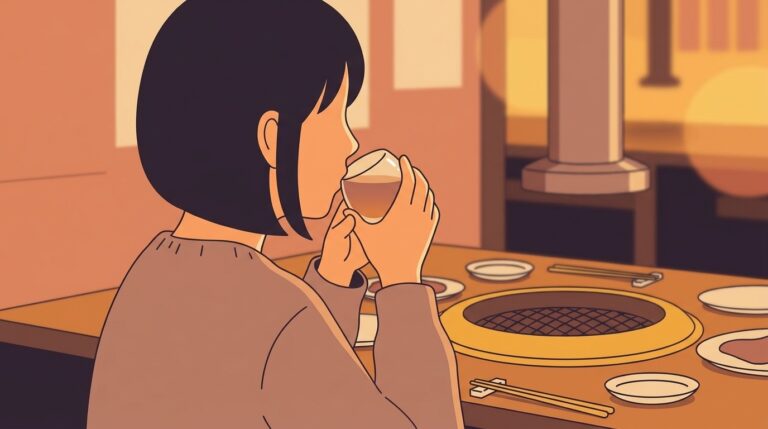
Picture this: You are sitting in a cozy, lively K-BBQ restaurant. The samgyeopsal is sizzling on the grill, and your Korean boss or your partner’s parents are sitting right across from you. A green bottle of Soju appears, and they kindly pour a shot for you. You raise your glass, clink with them, and… wait! A sudden wave of panic hits you. Do you drink it straight? Do you look them in the eye?
If you have watched K-dramas, you might have noticed people dramatically turning their heads to the side while drinking. This is one of Korea’s most important social etiquettes: 어른 앞에서는 고개 돌리고 술 마시기 (Turning your head away when drinking in front of elders).
Don’t worry! This guide is built from real-life embarrassing stories shared by our global learners. By the end of this post, you will not only understand the “why” but will also feel 100% confident at any Korean dinner table. Let’s dive in!
Phase 2: Core Expressions Deep Dive
Here are the top three expressions you absolutely need to know to survive and thrive at a Korean drinking table!
1. 제가 한잔 올리겠습니다. (Je-ga han-jan ol-li-get-seum-ni-da)
- Pronunciation Analogy: “Jay-gah han-jan ol-lee-get-soom-nee-dah” (Think of “ol-lee” like lifting something up high with respect).
- Meaning: Let me pour you a drink (Literally: “I will offer you a glass”).
- K-Culture Moment: You will see this in office K-dramas (like Misaeng) when a rookie employee politely offers a drink to their manager to show respect.
- Editor’s Insight: The verb 올리다 (ol-li-da) means “to raise” or “to offer upward.” Using this instead of 주다 (ju-da / to give) instantly makes you sound highly polite and culturally aware!
- Situation Spectrum: Casual: 🚫 | Semi-formal: ⚠️ | Formal: ✅
- 🤔 Think About It: In your culture, is offering a drink seen as a gesture of serving someone, or simply being friendly?
2. 편하게 드세요. (Pyeon-ha-ge deu-se-yo)
- Pronunciation Analogy: “Pyun-hah-gae deu-say-yo” (Think of “pyeon” like a comfortable “pen”).
- Meaning: Please drink/eat comfortably.
- K-Culture Moment: A kind older colleague or a friend’s father says this when they notice you are sitting too stiffly or looking nervous.
- Editor’s Insight: This comes from 들다 (deul-da), the polite version of “to eat/drink.” When an elder says this, they are giving you permission to relax a little bit, though you should still maintain basic manners!
- Situation Spectrum: Casual: ⚠️ | Semi-formal: ✅ | Formal: ✅ (Used by elders to younger people, or peer-to-peer in polite settings).
- 🤔 Think About It: Why do you think Korean elders make an effort to tell younger people to “relax”? It shows that Korean hierarchy is also about mutual care, not just strict rules.
3. 감사합니다! (Gam-sa-ham-ni-da)
- Pronunciation Analogy: “Gahm-sah-hahm-nee-dah”.
- Meaning: Thank you!
- K-Culture Moment: Said with a slight bow of the head right after an elder pours a drink into your glass.
- Editor’s Insight: While simple, saying this while holding your cup with two hands is the ultimate sign of respect. Never receive a drink with one hand from an elder!
- Situation Spectrum: Casual: ✅ | Semi-formal: ✅ | Formal: ✅
- 🤔 Think About It: How does physical posture (using two hands) change the way “Thank you” feels compared to just saying the words?
Phase 3: Textbook Korean vs. Real-Life Korean
Let’s compare what you learn in static textbooks versus what Koreans actually say in the heat of a K-BBQ dinner!
Situation A: Offering to pour a drink
- 📖 Textbook Korean: “술을 더 마시겠습니까?” (Su-reul deo ma-si-get-seum-ni-kka? / Would you like to drink more alcohol?)
- Why it feels awkward: It sounds like an official survey or an interrogation!
- 🗣️ Real-Life Korean: “한잔 더 하시겠습니까?” (Han-jan deo ha-si-get-seum-ni-kka? / Would you like another glass?) or “제가 한잔 더 올려도 될까요?” (Je-ga han-jan deo ol-ryeo-do doel-kka-yo? / May I offer you another glass?)
- 💡 Why it’s better: It uses the warm, rhythmic concept of “한잔” (one glass) which sounds much more inviting and polite.
Situation B: Proposing a toast
- 📖 Textbook Korean: “건배합시다.” (Geon-bae-hap-si-da. / Let’s toast.)
- Why it feels awkward: It is grammatically correct but feels slightly demanding and robotic when said to elders.
- 🗣️ Real-Life Korean: “건배하겠습니다!” (Geon-bae-ha-get-seum-ni-da! / I will make a toast!) or “건강을 위하여!” (Geon-gang-eul wi-ha-yeo! / For your health!)
- 💡 Why it’s better: It shows initiative and high respect. Wishing for an elder’s health (건강) is always a safe and highly appreciated toast.
Phase 4: K-Culture Deep Dive & Non-Verbal Manners
4-1. The Art of the Turn (비언어적 매너)
Drinking with elders in Korea is like a beautifully choreographed dance. Here are the exact physical movements you need to master:
1. The Double Hand Rule: When receiving a drink, hold your glass with both hands (right hand holding the glass, left hand gently supporting your right wrist or under the glass).
2. The Turn: When it is time to drink, turn your head and torso slightly away from the most senior person at the table (usually to the left or right, depending on where they are sitting).
3. The Shield: Cup your left hand around your glass so the elder cannot see you gulping the drink down.
4. The Angle: Keep your head turned until you have swallowed, then turn back with a gentle smile.
4-2. The Drama Connection
In the hit drama Itaewon Class, the main character, Park Saeroyi, is taught how to drink by his father. His father tells him: “How you learn to drink first shapes your drinking habits for life.” When Saeroyi turns his head to drink, it symbolizes his deep respect and love for his father. In Korea, drinking is not just about getting drunk; it is a sacred tool for building trust (정 – Jeong).
Phase 5: Real-Life Roleplay Scenario
- Setting: A high-end Hanwoo (Korean beef) restaurant.
- Characters:
- Sophia (You): A B1 level learner attending a dinner with her Korean company’s Director.
- Director Kim (NPC): An old-school but warm-hearted Director.
The Dialogue
- Director Kim: “소피아 씨, 오늘 고생 많았어요. 한잔 받아요.” (Sophia, you worked hard today. Have a drink.)
- Sophia: “(Holding the cup with both hands) 🎭 Gently bowing 감사합니다, 부장님!” (Thank you, Director!)
- Director Kim: “(Pours the drink) 자, 다 같이 건배합시다! 건강을 위하여!” (Now, let’s toast together! To health!)
- Sophia: “건강을 위하여!” (To health!)
- Director Kim: “자, 시원하게 마셔요!” (Go ahead, drink up!)
- Sophia: “🎭 Turns her body and head 45 degrees to the left, cups her glass with her left hand, and takes a sip.“
- Director Kim: “(Nodding approvingly) 오, 소피아 씨 술버릇이 아주 바르네! 편하게 마셔요.” (Oh, Sophia, your drinking manners are excellent! Drink comfortably.)
- Sophia: “🎭 Turns back with a polite smile 부장님 덕분에 많이 배우고 있습니다.” (I am learning a lot thanks to you, Director.)
🔀 Interactive Choice Point
After Director Kim pours your drink, he asks: “소피아 씨, 술 잘 마셔요?” (Sophia, can you drink well?) What do you say?
* Option A: “네! 저 술 진짜 잘 마셔요! 소주 세 병 마셔요!” (Yes! I drink really well! I can drink three bottles of soju!)
* Option B: “잘 못 마시지만, 오늘 한잔 배우겠습니다!” (I am not great at it, but I will gladly learn a glass today!)
* Option C: “술 안 좋아합니다. 콜라 주세요.” (I don’t like alcohol. Give me Coke.)
💡 Feedback on Your Choice
- Best Choice (Option B): 🌟 Perfect! This shows humility while displaying a warm, open attitude toward Korean dining culture. Elders love this response!
- Risk Choice (Option A): ⚠️ Careful! While honesty is fine, boasting about drinking too much can sometimes look a bit unrefined in formal corporate settings.
- Bad Choice (Option C): 🚫 Oops! If you cannot drink, it is perfectly okay to refuse, but saying “Give me Coke” too bluntly can kill the atmosphere. Try saying: “제가 술을 잘 못해서 물로 대신 채워도 될까요?” (Since I cannot drink well, may I fill my glass with water instead?)
Phase 6: 10-Second Shadowing Drill
Let’s practice speaking with real Korean emotion! Read these aloud, mimicking the speed and breaks marked by the slashes /.
- “제가 / 한잔 / 올리겠습니다!”
- [😊 With a respectful, bright smile]
- Je-ga / han-jan / ol-li-get-seum-ni-da!
- “부장님 / 덕분에 / 아주 즐겁습니다!”
- [☺️ With a warm, appreciative tone]
- Bu-jang-nim / deok-bun-e / a-ju jeul-geop-seum-ni-da!
Phase 7: K-Culture Mini Dictionary
- 꼰대 (Kkondae): | Noun | An old-school, stubborn person (similar to “boomer”) who forces rules on younger people. Knowing drinking etiquette helps you avoid being nagged by a kkondae!
- 회식 (Hoesik): | Noun | Company dinner. This is the ultimate battleground where you will put these drinking manners to the test.
- 밑잔 (Mit-jan): | Noun | Leftover alcohol at the bottom of the glass. Drinking all of it is considered polite before receiving a refill.
- 원샷 (Won-syat): | Noun/Verb | Bottoms up! (Literally “One shot”). Usually chanted during lively rounds.
Phase 8: Survival Kit for Travelers
Top 3 Survival Phrases
- “술을 잘 못 마십니다.” (Su-reul jal mot ma-sim-ni-da) / I cannot drink alcohol very well. (Use this if you don’t drink alcohol at all).
- “물로 대신해도 될까요?” (Mul-lo dae-sin-hae-do doel-kka-yo?) / May I replace it with water? (Perfect for keeping the glass full to participate in toasts).
- “정말 감사합니다!” (Jeong-mal gam-sa-ham-ni-da) / Thank you so much!
📌 Editor’s Travel Note:
If you ever have too much to drink at a Hoesik, do not try to drive or walk home alone in the dark. Use the Kakao T App on Google Play to call a safe designated driver (대리기사 – Daeri-gisa) or a taxi. It is safe, fast, and highly reliable!
Phase 9: “한 발 더 깊이” (A Deeper Step)
Why does Korea have such a detailed rule for drinking? To Western minds, turning your head away might look like you are hiding something. However, in Korean culture, looking an elder directly in the eye while consuming food or drink was historically seen as aggressive or animalistic.
By turning your head, you are creating a private boundary, showing that you do not dare to consume something comfortably right in front of someone of higher status. It is a beautiful paradox: turning away is actually a way of drawing closer in respect.
💬 Your Turn: How do people show respect to elders at dining tables in your home country? Let us know in the comments below!
Phase 10: FAQ & Common Mistakes
Q: What if I don’t drink alcohol? Will I offend them?
A: Not at all! Koreans respect personal or religious choices. The key is to participate in the mood. Simply receive a glass of water or soda with two hands, and join the toast!
Q: Do I have to turn my head if the elder is only one year older than me?
A: Generally, no. This rule applies to people with significant age gaps (like parents, uncles, bosses) or high professional ranks. With friends only a few years older, a simple polite nod is enough.
Q: Can I pour my own drink?
A: Try to avoid this! In Korea, pouring your own drink (자작 – Jajak) is jokingly said to bring bad luck (like not finding a partner for 3 years!). Always let someone else pour for you, and offer to pour for them in return.
🚨 Common Mistakes Alert
- Mistake: Pouring with one hand.
- Correct Action: Always hold the bottle with both hands (right hand pouring, left hand supporting the elbow or wrist).
- Mistake: Emptying your glass when someone else’s is empty.
- Correct Action: In Korea, you should pour a drink for others first before waiting for them to refill yours.
- Mistake: Keeping your head turned for too long.
- Correct Action: Just turn your head for the quick sip, swallow, and then turn back to face the table.
Phase 11: Action Mission!
- 🥉 Bronze Level: The next time you drink water or juice at home, practice holding the cup with both hands and turning your head 45 degrees. Feel the posture!
- 🥈 Silver Level: Share this post on your Instagram Story and tag @DailyHangul with your favorite Korean drinking tip!
- 🥇 Gold Level: Watch a K-drama tonight and spot at least one scene where characters turn their heads to drink. Write down the title of the drama in our comments!
Phase 12: Interactive Quiz Challenge
Test your B1 Korean culture skills below!
1. What should you do when an elder pours you a drink?
Reveal Answer & Explanation
Answer: Hold the glass with both hands and bow slightly while saying







