

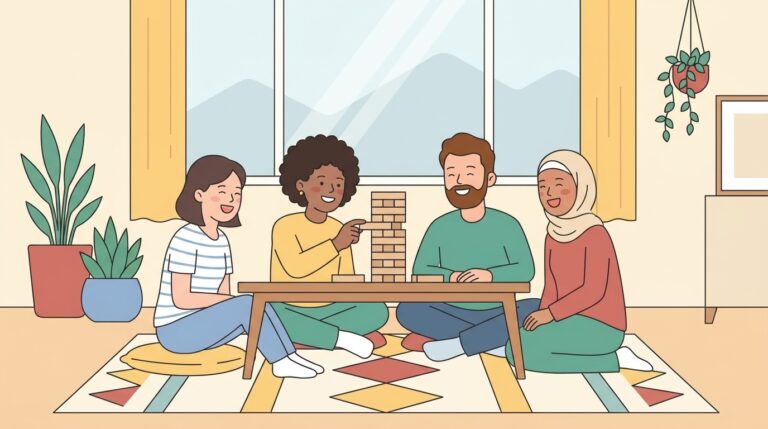
Let’s Play! Fun and Easy Korean Games at a Housewarming Party (집들이)
안녕하세요! (Hello!) I’m your Daily Hangul editor and your personal Korean culture guide.
Imagine this: You’ve just been invited to a 집들이 (jip-deuri – housewarming party) by your Korean friend. The food was delicious, the vibe is cozy, and suddenly, someone pulls out a board game or suggests a classic Korean game like Jenga or 3-6-9.
Your heart starts racing. “What if it’s my turn and I don’t know what to say?” “How do I ask them to go easy on me?”
Don’t worry! Today, we are going to learn 3 magical, super-easy Korean game expressions that will instantly turn you from a quiet observer into the life of the party. These are real, everyday phrases used by locals—not the stiff sentences you find in dusty textbooks. Let’s dive in!
Phase 2: 3 Core Expressions for Game Night
1. 내 차례야? (Nae cha-rye-ya?)
- Pronunciation: Nae cha-rye-ya? (Sounds like: “Nay cha-reh-ya?” with a rising tone at the end)
- Meaning: Is it my turn?
- K-Culture Moment: You will hear this constantly on Korean variety shows like Running Man or Going SEVENTEEN when members are frantically trying to figure out the game order.
- Editor’s Insight: This is a very friendly, casual expression. If you want to say this to someone older or in a slightly more polite setting, just change it to 제 차례예요? (Je cha-rye-yeo-yo?).
- Situation Spectrum: Casual: ✅ | Semi-formal: ⚠️ | Formal: 🚫
- 🤔 Think About It: In your culture, do people ask “Is it my turn?” or do they just wait quietly? How does asking this in Korean make the game feel more interactive?
2. 봐줘! (Bwa-jwo!)
- Pronunciation: Bwa-jwo! (Sounds like: “Bwah-jwor!” like trying to say “blue” without the ‘l’ sound)
- Meaning: Go easy on me! / Give me a break! (Literally: “See/Look at me”)
- K-Culture Moment: Usually said when a player makes a mistake and is about to receive a 벌칙 (beol-chik – penalty), like drinking a penalty shot or getting a light forehead slap.
- Editor’s Insight: To make this extra effective, pair it with a pleading face or cute aegyo (애교). If you want to be polite, say 봐주세요! (Bwa-ju-se-yo!).
- Situation Spectrum: Casual: ✅ | Semi-formal: ⚠️ | Formal: 🚫
- 🤔 Think About It: Why do you think Koreans use the verb “to see” (보다) to mean “to show mercy”? It implies: “Please look at my situation and be kind!”
3. 한 판 더 해! (Han pan deo hae!)
- Pronunciation: Han pan deo hae! (Sounds like: “Hahn pahn duh hay!”)
- Meaning: Let’s play one more round!
- K-Culture Moment: The universal cry at 2 AM in a Korean living room when nobody wants the fun to end.
- Editor’s Insight: ‘판’ (pan) is a unique counter word used for rounds of games or matches. If you want to suggest it politely, say 한 판 더 해요! (Han pan deo hae-yo!).
- Situation Spectrum: Casual: ✅ | Semi-formal: ⚠️ | Formal: 🚫
- 🤔 Think About It: Wanting to play “just one more round” is a great example of 정 (Jeong)—the warm feeling of social bonding and not wanting to say goodbye.
Phase 3: Textbook Korean vs. Real Korean
Let’s look at how textbooks teach game language versus how real Koreans actually talk!
Situation 1: Starting the Game
- 📖 Textbook Korean: “게임을 시작합시다.” (Ge-im-eul si-jak-hap-si-da.) – “Let us begin the game.”
- 🗣️ Real Korean: “게임 고?” (Game Go?) or “시작하자!” (Si-jak-ha-ja!) – “Game, go?” or “Let’s start!”
- 💡 Why the difference? Textbooks are too formal. In a casual housewarming setting, mixing English loanwords like “Go” is trendy, high-energy, and much more natural!
Situation 2: When You Lose
- 📖 Textbook Korean: “제가 졌습니다.” (Je-ga jyeot-seub-ni-da.) – “I have lost.”
- 🗣️ Real Korean: “아, 망했다!” (Ah, mang-haet-da!) – “Ah, I’m doomed/screwed!”
- 💡 Why the difference? Saying “I lost” formally sounds like you are conceding a political debate. “망했다” is dramatic, funny, and expresses your real frustration!
Phase 4: K-Culture Deep Dive & Non-verbal Manners
4-1. Nunchi & Gestures during Games
- The Double-Hand Clap (박수치기): When someone fails or does something funny, Koreans don’t just laugh—they clap their hands rapidly, often bending forward. Do this to show you are highly engaged!
- The Pleading Hands (손 모으기): When begging for mercy (“봐줘!”), rub your hands together gently like a movie character asking for a favor. It adds a hilarious, dramatic effect that your Korean friends will love.
4-2. The Golden Rule of Housewarming Games
In Korea, housewarming games are not about winning; they are about 눈치 (Nunchi – reading the room) and creating a fun atmosphere. If you win too easily, act humble. If you lose, accept the lighthearted penalty with a smile!
Phase 5: Real-life Roleplay Scenario
Setting: You are at Yumi’s cozy new apartment for her housewarming party. You, Yumi, and Minjun are playing Jenga.
- Yumi (Host / Friendly NPC): Very welcoming, wants everyone to have fun.
- Minjun (Competitive Friend): Playful, loves games, but easily amused.
🎭 The Jenga Showdown
- Yumi: 자, 이제 제 차례예요. 살살 해야지… (Ja, i-je je cha-rye-yeo-yo. Sal-sal hae-ya-ji…)
(Okay, now it’s my turn. I have to do this gently…) - Minjun: 오! 유미 성공! 다음 누구지? (Oh! Yumi seong-gong! Da-eum nu-gu-ji?)
(Oh! Yumi succeeded! Who’s next?) - You (A2): 내 차례야? (Nae cha-rye-ya?)
(Is it my turn?) - Yumi: 응, 맞아요! 살살 뽑아봐요! (Eung, ma-ja-yo! Sal-sal ppob-a-bwa-yo!)
(Yes, that’s right! Pull it out gently!) - You (A2): (Sweating while pulling a block) 아… 흔들려요! 봐줘! (Ah… heun-deul-lyeo-yo! Bwa-jwo!)
(Ah… it’s shaking! Go easy on me!) - Minjun: (Laughing) 봐주는 건 없어요! 끝까지 해야지! (Bwa-ju-neun geon eop-seo-yo! Kkeut-kka-ji hae-ya-ji!)
(No mercy! You have to do it till the end!) - You (A2): (Successfully places the block on top) 휴, 살았다! (Hyu, sa-rat-da!)
(Phew, I survived!) - Yumi: 와, 대단해! 다음 게임도 한 판 더 해요! (Wa, dae-dan-hae! Da-eum ge-im-do han pan deo hae-yo!)
(Wow, amazing! Let’s do one more round for the next game too!)
🔀 Interactive Choice Point
The Jenga tower is shaking violently on your next turn. What do you do?
- Choice A: “나 안 해!” (Na an hae! – I’m not doing this!) and knock the tower over on purpose.
- Choice B: “진짜 한 번만 봐줘요~” (Jinjja han beon-man bwa-jwo-yo~ – Really, just go easy on me once~) with a cute face.
- Choice C: Keep silent and try to pull a block with absolute serious focus.
💡 Feedback on Your Choice:
- Best Choice (Choice B): Excellent! Using “봐줘요” with a cute tone fits the housewarming vibe perfectly. It makes everyone laugh and feel close.
- Risk Choice (Choice C): It’s okay, but being too quiet might make the atmosphere a bit tense. Remember, it’s just a game!
- Bad Choice (Choice A): Oh no! Knocking it over on purpose might ruin the fun mood of the housewarming party.
Phase 6: 10-Second Emotion Shadowing Drill
Try reading these out loud with the right emotions! The slash / means a short pause.
아, / 제발 / 한 번만 / 봐줘![🥺 Pleading and cute]
(Ah, / please / just once / go easy on me!)대박, / 이제 / 내 차례야?[🤩 Excited and surprised]
(Wow, / now / is it my turn?)진짜 재미있다! / 한 판 더 해![🎉 High energy and happy]
(This is so fun! / Let’s do one more round!)
Phase 7: K-Culture Mini Dictionary
- 집들이 (Jip-deuri): Housewarming party. Traditionally, guests bring toilet paper (representing easy-unrolling success) or laundry detergent (representing bubbling wealth).
- 눈치 (Nunchi): The art of reading the room and sensing others’ feelings. Essential during party games!
- 벌칙 (Beol-chik): The penalty for losing a game. Common penalties include drinking a shot, getting a forehead flick, or making a funny face.
- 아깝다 (A-kkap-da): “So close!” or “What a waste!” Say this when someone almost wins but fails at the last second.
Phase 8: Survival Kit for Travelers
Top 3 Quick Survival Phrases:
- “화장실 어디예요?” (Hwa-jang-sil eo-di-ye-yo?) – Where is the bathroom?
- “이거 어떻게 해요?” (I-geo eo-tteoh-ge hae-yo?) – How do I do this?
- “대박!” (Dae-bak!) – Awesome! / No way!
🗺️ Editor’s Travel Note:
If you are going to a housewarming party in Korea, you might need to buy a gift or order delivery food. For navigation, don’t use Google Maps! Make sure to use the Naver Map App for accurate walking and subway directions. Also, if you want to order amazing Korean chicken or tteokbokki for the party, download the Baemin Delivery App to order like a local.
Phase 9: One Step Deeper (Thinking Points)
In many Western cultures, games are highly competitive, and rules are strictly followed. However, in Korean social gatherings, games are a tool to build 우리 (Uri – we/our) culture. The primary goal is to make sure nobody feels left out and everyone shares a laugh. Asking someone to “go easy on me” (봐줘) isn’t seen as weakness; it’s a playful way to connect.
💬 Your Turn: What is a popular casual game played at parties in your country? Let us know in the comments below!
Phase 10: FAQ & Avoiding Misunderstandings
Q: Can I use “봐줘 (Bwa-jwo)” to my boss or teacher during a game?
A: No! “봐줘” is strictly casual (반말). To your boss or teacher, you must say “봐주세요 (Bwa-ju-se-yo)” or “한 번만 봐주세요”.
Q: What is a safe housewarming gift in Korea?
A: Toilet paper, paper towels, or scented candles are classic, safe, and highly appreciated gifts in modern Korea!
Q: Is it rude to win every single game at a housewarming party?
A: It’s not “rude,” but if you win too much, it is polite to jokingly ask for a harder penalty or suggest “봐줄게요” (I’ll go easy on you) next time to keep the mood fun.
🚨 Common Mistakes Alert!
| Incorrect Action | Why it’s a mistake | Correct Action |
|---|---|---|
| Saying “내 차례야?” to an older person | Too casual, sounds impolite | Say “제 차례인가요?” instead |
| Knocking over game pieces in anger | Ruins the party vibe | Laugh loudly and say “아깝다!” |
| Refusing to participate in the penalty | Breaks the social contract | Take a small sip of your drink with a smile |
Phase 11: Action Mission & Engagement
- 🥉 Bronze Medal Mission: Say “내 차례야?” out loud 3 times in front of your mirror with an excited face.
- 🥈 Silver Medal Mission: Leave a comment below telling us your favorite Korean variety show using the word “대박!”.
- 🥇 Gold Medal Mission: At your next gathering or online Korean class, use “봐줘!” or “한 판 더 해!” with your friends!
🎮 K-Culture Mission: Watch one episode of Running Man or any K-Pop group’s reality show and try to spot the word “봐줘” or “차례” when they play games!
Phase 12: Interactive Quiz Challenge
Test your Korean game skills!
1. Which phrase means “Is it my turn?” in casual Korean?
- A) 봐줘!
- B) 내 차례야?
- C) 한 판 더 해!
2. True or False: You can say “봐줘” to your Korean boss at a company dinner.
- A) True
- B) False
👉 Click here to see the answers!
- Answer: B. “내 차례야?” means “Is it my turn?”.
- Answer: B (False). “봐줘” is too casual for a boss. You should say “봐주세요” instead!
Thank you for reading! Have a fun game night! 🎉







