

Phase 1: Empathy (스토리 몰입형 오프닝)
안녕하세요! Welcome back to Daily Hangul! I’m your lead editor and your local culture navigator.
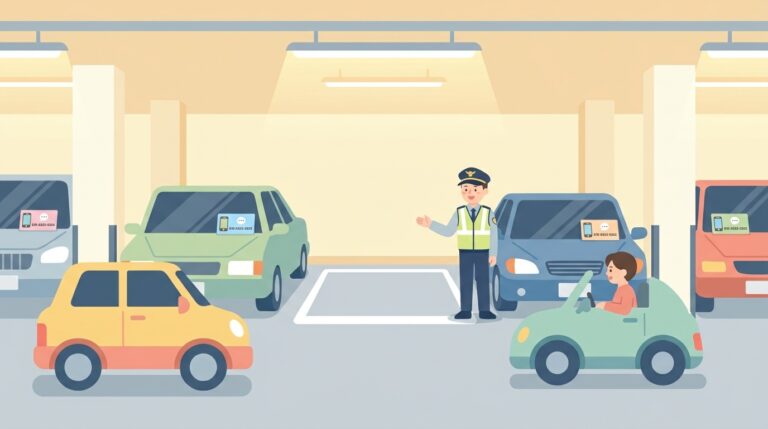
If you have ever watched a K-drama, you have probably seen dramatic scenes unfolding in a bright, modern underground parking lot of a sleek Korean apartment building. In Korea, apartment underground parking lots (지하 주차장 – Jiha juchajang) are fascinating spaces. They are clean, high-tech, and incredibly busy hubs of daily life.
But for foreigners, they can also be a maze of confusion. Have you ever faced the horror of being blocked by another car parked right in front of yours? Or struggled to find an empty spot late at night? Our student, Sarah from Chicago, once got trapped in a basement parking lot, not knowing how to ask her neighbor for help. Today, we will learn 3 simple survival expressions so you can navigate Korean parking lots like a true local!
Phase 2: Core Expressions (핵심 표현 3선 심층 분석)
1. 여기 주차해도 돼요? (Yeogi jucha-haedo dwaeyo?)
- Pronunciation: Yo-ghee joo-cha-hae-do dwae-yo? (Sounds like “Yo-key” + “joo-cha” + “hay-do” + “dway-yo”)
- Meaning: Is it okay to park here?
- K-Culture Moment: You will hear this phrase in K-dramas when a character visits a friend’s apartment complex and asks the security guard near the entrance gate.
- Editor’s Insight: “~해도 돼요?” is a magical grammar pattern for beginners meaning “Is it okay to do [action]?”. Just drop the verb “주차하다” (to park) into it. It is incredibly polite and warm!
- Situation Spectrum: Casual ⚠️ | Semi-formal ✅ | Formal ✅
- 🤔 Think About It: In many Western countries, parking spots are strictly personal or require expensive permits. In Korea, there is often a shared neighborly system. How does parking look in your home country?
2. 이중 주차 (Ijung jucha)
- Pronunciation: Ee-joong joo-cha (Rhymes with “bee-jung” + “joo-cha”)
- Meaning: Double parking (parking in front of another car in neutral gear)
- K-Culture Moment: In crowded cities like Seoul, space is limited. Neighbors block each other on purpose but leave their cars in neutral so others can gently push them out of the way!
- Editor’s Insight: This is a noun, not a full verb, but knowing this term will help you understand why someone parked right behind you. If someone asks “이중 주차 하셨어요?” (Did you double-park?), you will know what it means!
- Situation Spectrum: Casual ✅ | Semi-formal ✅ | Formal ✅
- 🤔 Think About It: Would you trust a stranger to push your car? This custom reflects the deep-rooted mutual trust and community mindset in Korean residential areas.
3. 자리가 없어요 (Jariga eopseoyo)
- Pronunciation: Ja-ri-ga up-suh-yo (Sounds like “Jah-ree” + “gah” + “up-soy-yo”)
- Meaning: There are no spots left.
- K-Culture Moment: You might hear a tired driver sighing this to their passenger while driving down to basement level 3 (지하 3층).
- Editor’s Insight: “자리” means seat or spot, and “없어요” means there isn’t any. It is simple, clear, and perfectly polite for A1 learners.
- Situation Spectrum: Casual ⚠️ | Semi-formal ✅ | Formal ✅
- 🤔 Think About It: How does language adapt to urban density? In Korean, saying “no space” focuses on the spot (자리) rather than the physical emptiness.
Phase 3: Textbook vs Real Korean (교과서 한국어 vs 진짜 한국어)
Situation 1: Asking where the parking lot is
- 📖 Textbook Korean: 주차장이 어디에 있습니까? (Juchajangi eodie itseumnika? – Where is the parking lot? – Very formal, feels like a military manual.)
- 🗣️ 진짜 한국어: 주차장 어디예요? (Juchajang eodiyeyo? – Where’s the parking lot? – Soft, natural, and standard for daily life.)
- 💡 Why it differs: Standard textbook Korean heavily relies on the formal “~습니까” form, but locals prefer the friendly, polite “~예요/이에요” in real-world conversations.
Situation 2: Requesting someone to move their double-parked car
- 📖 Textbook Korean: 당신의 차를 이동해 주십시오. (Dangsin-ui chareul idonghae jusipsio. – Please relocate your vehicle. – Extremely stiff.)
- 🗣️ 진짜 한국어: 차 좀 빼주세요. (Cha jom pae-juseyo. – Please move your car. / Literally: Please pull the car out.)
- 💡 Why it differs: Using the word “당신” (you) can sound confrontational in Korea. Instead, we omit the pronoun and use “좀” (please/slightly) to soften the request.
Phase 4: K-Culture Deep Dive & Non-verbal Manners (비언어적 매너)
4-1. Nunchi & Parking Etiquette
- The Phone Number Card: In Korea, every car owner places a small card with their phone number on the dashboard. If you block someone (이중 주차), they must be able to call you to move your car! Leaving your car without a phone number is considered very rude.
- Neutral Gear Magic: When double parking, you must leave your gear shift in Neutral (N) and release the parking brake. If you don’t, neighbors won’t be able to push your car, and you will get angry phone calls!
4-2. Culture Code: The Vertical Village
Korean apartments (아파트) are self-contained ecosystems. Underground parking lots are equipped with CCTV, automatic license plate readers, and electric vehicle chargers. Because space is at a premium, residents use high levels of collective cooperation, which is why “Nunchi” (social reading) is so highly valued even in a parking garage.
Phase 5: Real-Life Roleplay (실전 롤플레이 시나리오)
Scenario: You have just driven into the underground parking lot of your Korean friend’s apartment complex. It is crowded, and you are trying to find a spot. You meet Min-jun, a friendly resident holding a grocery bag.
- Min-jun (Resident): 안녕하세요! 처음 뵙겠네요. (Annyeonghaseyo! Cheoum boepgenneyo. – Hello! I think this is my first time seeing you.)
- You: 안녕하세요! 주차장 처음 와요. (Annyeonghaseyo! Juchajang cheoum wayo. – Hello! It’s my first time in this parking lot.)
- Min-jun: 아, 친구 집에 놀러 오셨어요? (Ah, chingu jibe nolleo osyeosseoyo? – Oh, are you visiting a friend’s home?)
- You: 네. 그런데 자리가 없어요. (Ne. Geureonde jariga eopseoyo. – Yes. But there are no spots.)
- Min-jun: 저기 빈자리 하나 있어요! (Jeogi binjari hana isseoyo! – There is an empty spot over there!)
- You: 🎭 (Pointing to the spot) 저기요? 여기 주차해도 돼요? (Jeogiyo? Yeogi jucha-haedo dwaeyo? – Over there? Is it okay to park here?)
- Min-jun: 네, 거기는 방문객 전용이라 괜찮아요. (Ne, geogineun bangmungaek jeonyong-ira gwaenchanayo. – Yes, that spot is for visitors, so it’s fine.)
- You: 정말 감사합니다! (Jeongmal gamsahamnida! – Thank you so much!)
🔀 Choose Your Next Move!
What will you say if another car is blocking your path?
* A) “차 저리 가요!” (Cha jeori gayo! – Car, go away!)
* B) “차 좀 빼주세요.” (Cha jom pae-juseyo. – Please move the car.)
* C) “여기 내 주차장이야!” (Yeogi nae juchajang-iya! – This is my parking lot!)
Feedback:
- Selection A: ⚠️ Risk. Cars can’t hear you! It sounds cute but a bit odd to address the vehicle directly.
- Selection B: 🌟 Best! Polite, standard, and gets the job done instantly without sounding rude.
- Selection C: 🚫 Bad. Highly rude and informal (반말). It might start a neighborhood fight!
Phase 6: 10-Second Shadowing Drill (10초 감정 섀도잉 드릴)
Practice saying these lines with the correct pause points (/) and emotions!
- “여기 / 주차해도 / 돼요?”
- [🥺 Ask politely with big eyes]
- Yeo-gi / ju-cha-hae-do / dwae-yo?
- “진짜 / 자리가 / 없어요.”
- [😭 Sigh dramatically as you spin the steering wheel]
- Jin-jja / ja-ri-ga / eop-seo-yo.
- “차 좀 / 빼주세요.”
- [🙏 Bowing slightly over the phone]
- Cha jom / pae-ju-se-yo.
Phase 7: K-Culture Mini Dictionary (핵심 키워드 4개)
- 지하 주차장 (Jiha juchajang): Underground parking lot. Most modern Korean buildings hide parking lots underground to keep ground levels green and safe.
- 이중 주차 (Ijung jucha): Double parking. The art of parking in front of other cars with the gear in neutral.
- 경비실 (Gyeongbisil): Security office. The go-to place if you have any problems with parking or entering the building.
- 방문객 (Bangmungaek): Visitor. Look for signs saying “방문객 주차” (Visitor Parking) when visiting friends.
Phase 8: Survival Kit for Travelers (여행자를 위한 생존 키트)
Top 3 Survival Phrases
- 주차 카드 주세요. (Jucha kadeu juseyo.) – Please give me a parking card. (Use at manual gates)
- 요금 얼마예요? (Yogeum eolmayeyo?) – How much is the fee?
- 지하 몇 층이에요? (Jiha myeot cheung-iyeyo?) – Which basement floor is it?
Editor’s Travel Note
When driving in Korea, downloading local map apps is a lifesaver! Google Maps doesn’t work well due to security laws. Make sure to download the Naver Map App or KakaoMap App before you rent a car. They will show you real-time available parking spots in major apartment complexes and shopping malls!
(Note: Parking fees and rules may vary by location.)
Phase 9: 한 발 더 깊이 (Deep Thoughts)
In Western cultures, the car is an extension of personal space, and moving someone else’s car is unthinkable. In Korea, however, pushing a neighbor’s double-parked car is a daily ritual. This reveals a deep sense of communal trust (정 – Jeong). Koreans assume that their neighbors will be careful and responsible. It’s a beautiful, unspoken contract of urban living.
💬 Your Turn: Would you feel comfortable leaving your car in neutral for strangers to push? Or having to push a stranger’s car to get to work? Let us know in the comments below!
Phase 10: FAQ & Common Mistakes (자주 묻는 질문)
Q: What should I do if a car is blocking me and it won’t push?
A: Check if the handbrake is on. If it is locked, look at the dashboard for a phone number sticker. Simply call or text the number and say: “차 좀 빼주세요” (Cha jom pae-juseyo).
Q: Can visitors park anywhere in a Korean apartment?
A: No, some spots are reserved for residents only. Always look for signs that say “방문객 전용” (Visitor Only) or ask the security guard (경비원).
Q: What does ‘B1’, ‘B2’ mean on the elevator?
A: ‘B’ stands for Basement. In Korean, it is called 지하 (Jiha). B1 is 지하 1층, B2 is 지하 2층, and so on.
🚨 Common Mistakes Alert!
- Mistake 1: Leaving your car gear in “P” (Park) during double parking.
- Correct Action: Keep it in “N” (Neutral) so people can push it.
- Mistake 2: Speaking informally to the security guard (e.g., saying “주차 어디야?”).
- Correct Action: Keep it polite by using “주차 어디예요?”.
- Mistake 3: Not putting your phone number on the windshield.
- Correct Action: Always leave a temporary phone number card when parking in Korea!
Phase 11: Action Mission (액션 미션)
- Bronze Mission: Practice saying “여기 주차해도 돼요?” three times in front of your mirror with a polite smile.
- Silver Mission: When watching your next K-drama, try to spot the parking lot scenes. Look for the phone number cards on the dashboards!
- Gold Mission: Next time you use a parking lot in Korea (or a Korean market), ask the clerk: “주차장 어디예요?” instead of using English!
Phase 12: Interactive Quiz Challenge (인터랙티브 퀴즈 챌린지)
1. What does “이중 주차” mean?
- A) Free parking
- B) Double parking
- C) Electric charging
Reveal Answer
Correct Answer: B. It refers to parking in front of another vehicle in neutral gear because of limited space.
2. Fill in the blank: “여기 주차해도 ________?” (Is it okay to park here?)
- A) 없어요
- B) 빼주세요
- C) 돼요
Reveal Answer
Correct Answer: C (돼요). “~해도 돼요?” is the grammar pattern for “Is it okay to do?”
3. True or False: You should always leave your emergency brake pulled tight when double-parking in Korea.
- A) True
- B) False
Reveal Answer
Correct Answer: B (False). You must release the emergency/parking brake so other drivers can push your car to get out!







