

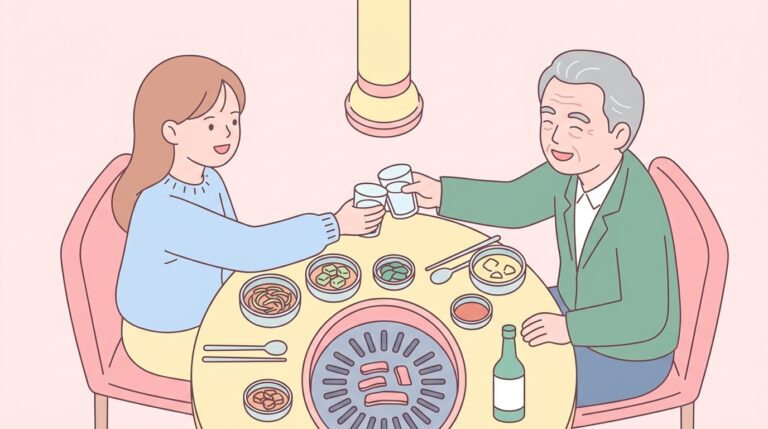
Banter Like a Local: How to Crack the Korean Generation Gap with Wit and Humor
Phase 1: Empathy (스토리 몰입형 오프닝)
안녕하세요! 매일한글 (Daily Hangul) 10-year veteran editor here!
Imagine this: You are at a bustling hoesik (회식 – company dinner) in Seoul. On your left sits Director Kim, a 55-year-old traditionalist who loves recounting his glory days. On your right is Min-ji, a 24-year-old new recruit who is quietly scrolling through her phone, communicating in emojis. The air is thick with unspoken tension—the classic Korean generation gap (세대 차이 – sedae cha-i). Director Kim drops a heavy, old-school joke, and the room falls dead silent.
What do you do? Do you freeze? Or do you use the ultimate Korean social superpower—wit (재치 – jae-chi)—to bridge the gap, make everyone laugh, and instantly become the most charming person in the room?
In hierarchical Korean society, humor is not just about making people laugh; it is a delicate social lubricant that shows you understand status, respect, and modern pop culture. Today, we are unlocking the secrets of C2-level Korean humor that will help you effortlessly connect with both the baby boomers (kkondae generation) and Gen Z (MZ generation). Let’s dive in!
Phase 2: Core Expressions (핵심 표현 3선 심층 분석)
1. 라떼는 말이야 (Latte-neun mariya)
- Pronunciation: Ra-tte-neun ma-ri-ya (Sounds like “Latte is horse”)
- Meaning: “Back in my day…” (Literally: “Speaking of Latte…”)
- K-Culture Moment: This is a famous play on words. Older Koreans often start their lectures with “나 때는 말이야…” (Na ttae-neun ma-ri-ya – “When I was young…”). Because “Na ttae” sounds exactly like the coffee “Latte”, younger generations turned it into a meme. Now, even older bosses use it self-deprecatingly to show they aren’t completely out of touch.
- Editor’s Insight: This is a double-edged sword. If an older person says it, they are mocking their own tendency to lecture. If you say it jokingly to someone older (with a big smile), you are playfully teasing them.
- Situation Spectrum: Casual (✅) / Semi-formal (⚠️) / Formal (🚫)
- 🤔 Think About It: How does your native language mock or playfully embrace the “Boomer” generation? Is it as coffee-centric as Korea’s “Latte”?
2. 아재개그 (Ahjae-gaegeu)
- Pronunciation: Ah-jae-gae-geu (Ah-jae sounds like “Ah-jay”, gae-geu like “gag”)
- Meaning: Dad jokes (Literally: “Middle-aged uncle jokes”)
- K-Culture Moment: In K-Dramas like Kkondae Intern, the older bosses constantly crack these puns. For example: “What is the most apologetic animal?” “사과 (Sa-gwa – Apple/Apology) -> 사과나무 (Sa-gwa-na-mu – Apple tree/Apologizing tree).” If you can react to these with a playful groan or, even better, crack one yourself, older Koreans will absolutely adore you.
- Editor’s Insight: To pull off an Ahjae-gaegeu, timing is everything. It shouldn’t be too clever; the goal is the collective groan and eye-roll from the room.
- Situation Spectrum: Casual (✅) / Semi-formal (✅) / Formal (🚫)
- 🤔 Think About It: In Korean, puns rely heavily on homophones. How does this compare to wordplay in your native language?
3. 낄끼빠빠 (Kkil-kkil-ppa-ppa)
- Pronunciation: Kkil-kkil-ppa-ppa (Sounds like “Keel-keel-pah-pah”)
- Meaning: “In when you should, out when you should” (Knowing when to join in and when to step back/shut up).
- K-Culture Moment: This is a crucial survival phrase in Korean social gatherings. A person who doesn’t do Kkil-kkil-ppa-ppa is someone who ruins the mood by talking too much during a joke or leaving when everyone is having fun.
- Editor’s Insight: At a C2 level, you use this to describe social dynamics. Saying “저는 오늘 낄끼빠빠 잘 하려고 조용히 있으려고요” (I’m going to practice good KKPP today and keep quiet) shows incredibly high emotional intelligence.
- Situation Spectrum: Casual (✅) / Semi-formal (⚠️) / Formal (🚫)
- 🤔 Think About It: Read-the-room culture (눈치 – Nunchi) is highly formalized in Korea. How does Kkil-kkil-ppa-ppa reflect this deep-rooted cultural trait?
Phase 3: Textbook Korean vs. Real Korean (교과서 한국어 vs 진짜 한국어)
Scenario 1: Reacting to an older colleague’s repetitive advice
- 📖 Textbook Korean: “좋은 말씀 감사합니다. 명심하겠습니다.” (Thank you for the good words. I will keep them in mind.) -> Too stiff, makes you sound like a robot, and doesn’t ease the tension.
- 🗣️ 진짜 한국어: “와, 역시 부장님 짬에서 나오는 바이브가 있으시네요!” (Wow, as expected, you have that vibe that only comes from pure experience!)
- 💡 Why it works: “짬에서 나오는 바이브” (vibe coming from one’s career/experience) is a famous slang term popularized by Korean hip-hop. It shows ultimate respect for their experience while using modern, trendy slang that bridges the age gap.
Scenario 2: Easing the tension when you make a small mistake
- 📖 Textbook Korean: “죄송합니다. 제가 실수를 했습니다.” (I am sorry. I made a mistake.) -> Very heavy and formal; can make a minor slip-up feel like a crisis.
- 🗣️ 진짜 한국어: “어머, 제가 아직 퓨처 인재라 조금 서툴렀네요! 너그럽게 봐주세요~” (Oh dear, I’m still a ‘future talent’, so I was a bit clumsy! Please look upon me kindly~)
- 💡 Why it works: “퓨처 인재” (Future Talent) is a humorous way to refer to yourself as a rookie who has potential but is currently making mistakes. It disarms the boss and invites them to mentor you rather than scold you.
Phase 4: K-Culture Deep Dive & Non-verbal Manners (비언어적 매너)
4-1. Nunchi & Gestures
When trying to use humor to bridge the generation gap in Korea, your body language speaks louder than your words:
* The Clap-Laugh (손뼉 치며 웃기): When an older colleague cracks a joke, don’t just smile. Give a light clap of your hands while laughing. It conveys genuine enjoyment and high energy.
* The Humorous Bow (유머러스한 폴더 인사): If you make a joke that is slightly daring, immediately follow it with a quick, dramatic 90-degree bow (폴더 인사) while smiling. This signaling tells them, “I am playing, but I still deeply respect your seniority.”
4-2. Cultural Code: The Office Dynamics in K-Dramas
Have you watched the drama Kkondae Intern (꼰대인턴) or Misaeng (미생)? These dramas highlight the intense generational divide in Korean office spaces. The older generation values loyalty, overtime, and face-to-face drinking sessions. The younger generation (MZ) values work-life balance (워라밸) and direct communication. To survive and thrive, characters who use “respectful playfulness” always win. By mastering this balance, you become a “social bridge” (insider or 인싸) in any group.
Phase 5: Real-Life Roleplay Scenario (실전 롤플레이 시나리오)
The Setting
A noisy Korean BBQ restaurant. Sarah (C2 Korean learner, 28) is having dinner with Department Head Park (52, a traditional boss who wants to appear hip but keeps telling “Latte” stories).
1. 부장님 (Park): 아, 요즘 애들은 통 회식에 안 와요. 우리 때는 말이야, 회식도 업무의 연장이었는데!
   (Ah, kids these days don't come to company dinners. Back in my day, company dinners were an extension of work!)

2. 세라 (Sarah): (🎭 웃으며 가볍게 손사래를 치며)
   아 부장님! 방금 그 말씀 완전히 '라떼는 말이야'의 정석이신데요?
   (Ah, Bujangnim! What you just said is the textbook definition of "Latte is horse"!)

3. 부장님 (Park): (🎭 당황했다가 허허 웃으며)
   어? 내가 그랬나? 하긴, 나도 꼰대가 다 됐지 뭐.
   (Eh? Did I? Well, I guess I've become a total kkondae too.)

4. 세라 (Sarah): (🎭 고기를 부장님 앞접시에 놓아드리며)
   에이, 부장님처럼 저희랑 소통하려고 하시는 분이 어디 계신다고요. 완전 '젊은 아재'이십니다!
   (Aw, where else can we find a boss who tries to communicate with us like you do? You are a total "young ahjae"!)

5. 부장님 (Park): (🎭 기분 좋아져서 술잔을 들며)
   고마워요, 세라 씨. 자, 그런 의미에서 오늘 밤 끝까지 달리는 거야! 고?
   (Thank you, Sarah. Well, in that spirit, we are running all the way tonight! Go?)

6. 세라 (Sarah): (🎭 센스 있게 잔을 아래로 맞부딪치며)
   부장님, 이때는 '낄끼빠빠'를 적용해서, 1차만 멋지게 달리고 2차는 각자 넷플릭스 보는 걸로 하시죠!
   (Bujangnim, this is where we should apply 'KKPP'! Let's run hard for round one, and for round two, we each watch Netflix at home!)

7. 부장님 (Park): (🎭 박장대소하며)
   하하하! 세라 씨한테 한 방 먹었네! 좋아, 깔끔하게 1차만 하고 해산!
   (Hahaha! Sarah, you got me there! Fine, let's keep it clean: round one only, then dismiss!)

8. 세라 (Sarah): (🎭 잔을 비우며)
   역시 부장님 최고십니다! 건배!
   (As expected, Bujangnim is the best! Cheers!)
🔀 Interactive Choice Point
Now it’s your turn! At Turn 6, if Director Park insists on going to a second round of drinking (2차) but you are exhausted, how do you handle it with humor?
- Option A: “부장님, 저 피곤해서 먼저 가겠습니다. 낄끼빠빠 아시죠?” (Bujangnim, I’m tired so I’m leaving. You know KKPP, right?)
- Option B: “부장님, 제 체력이 이미 ‘라떼’ 수준이라서요… 오늘은 부장님의 멋진 뒷모습을 보며 아름답게 퇴근하겠습니다!” (Bujangnim, my stamina is already at ‘Latte’ level… Today, I will look at your cool back as I beautifully head home!)
- Option C: “싫습니다. 부장님 혼자 가십시오.” (I don’t want to. Go by yourself.)
Feedback
- Best (Option B): Excellent! You self-deprecatingly mock your own stamina while complimenting his “cool back” (leadership). It maintains respect while firmly getting you out of the second round.
- Risk (Option A): Too blunt! Even though you used a trendy slang (낄끼빠빠), telling your boss to “know KKPP” can sound highly offensive and disrespectful.
- Bad (Option C): A complete social disaster. This is the fastest way to build a wall between you and the older generation.
Phase 6: 10-Second Shadowing Drill (10초 감정 섀도잉 드릴)
Practice these lines with the correct pause points (/) and emotional tone to sound like a native!
[😊 Playful and teasing]
“아 / 부장님! / 방금 그 말씀 / 완전 라떼는 말이야의 / 정석이신데요?”
(Ah / Bujangnim! / What you just said / is the absolute / textbook definition of “Latte is horse”!)-
[😆 Bursting into laughter with respect]
“와, / 역시 / 우리 부장님 / 짬에서 나오는 바이브가 / 장난이 아니십니다!”
(Wow, / as expected, / our Bujangnim / the vibe coming from your experience / is no joke!)
Phase 7: K-Culture Mini Dictionary (K-Culture 미니 사전)
- 꼰대 (Kkondae): An older person who constantly lectures younger people, believing they are always right.
- 아재 (Ahjae): A friendly, slightly old-fashioned middle-aged man. Unlike “Kkondae,” which is negative, “Ahjae” is warm and endearing.
- 주접 (Jujeob): Over-the-top, exaggerated praise or reactions. Usually used by younger fans toward idols, but can be used in the office to humorously flatter a boss.
- 맞장구 (Mat-jang-gu): Agreeing enthusiastically with someone’s story. Essential in Korean conversations across generations.
Phase 8: Survival Kit for Travelers (여행자를 위한 생존 키트)
If you find yourself drinking or dining with older Koreans during your travels, keep these three survival lines handy:
- “젊게 살 수 있는 비결 좀 가르쳐 주세요!”
- Jeolm-ge sal su in-neun bi-gyeol jom ga-reu-chyeo ju-se-yo!
- Pro Tip: “Please teach me the secret to staying young!” This works like magic on anyone over 40.
- “제 한국어 실력에 짬에서 나오는 바이브가 느껴지시나요?”
- Je han-gug-eo sil-lyeog-e jjam-e-seo na-o-neun ba-i-beu-ga neuk-kyeo-ji-si-na-yo?
- Pro Tip: “Do you feel the experienced vibe in my Korean skills?” It’s a great self-confident joke.
- “오늘 정말 낄끼빠빠 잘 하신 덕분에 즐거웠습니다!”
- O-neul jeong-mal kkil-kkil-ppa-ppa jal ha-sin deog-bun-e jeul-geo-wot-seub-ni-da!
- Pro Tip: Use this only with older seniors who explicitly joked about trying to stay hip. It means “Thanks to you reading the room so well today, we had fun!”
📌 Editor’s Travel Note:
To find the best traditional places loved by older Korean “Ahjaes” (the ultimate spots for cheap, authentic food like gukbap), skip global review apps. Download the Naver Map App or KakaoMap App and search for words like “기사식당” (drivers’ diners) or “노포” (historic local shops). Disclaimer: Operating hours of historic local shops can change without prior notice.
Phase 9: “One Step Deeper” (생각 질문)
In Western cultures, humor often flattens hierarchies; everyone is equal under the banner of a good laugh. In Korea, however, humor exists within the hierarchy. When you joke with a superior, you must first acknowledge their status, and then gently subvert it. It is a tightrope walk of respect and playfulness. This is why non-verbal cues, honorifics (존댓말), and Nunchi are so vital.
💬 Your Turn
Have you ever had a moment where humor successfully bridged a generation or cultural gap in your own country? Or did it end in an awkward silence? Share your stories in the comments below!
Phase 10: FAQ & Common Mistakes (FAQ 및 오해 방지)
Q: Is it really safe to call my boss a “꼰대” (Kkondae)?
A: Absolutely NOT as a direct label! Calling someone “꼰대” to their face in a serious tone is highly offensive. However, if they jokingly call themselves a kkondae, you can playfully say, “에이, 부장님이 무슨 꼰대이십니까? 완전 트렌디하신데요!” (No way, how are you a kkondae? You’re completely trendy!).
Q: When is the right time to use “아재개그” (Dad jokes)?
A: The best time is during an awkward silence, especially when transitioning between formal business discussions and casual dinners. It breaks the ice and shows you don’t take yourself too seriously.
Q: Can I use “낄끼빠빠” in a formal business email?
A: No, never. “낄끼빠빠” is strictly colloquial. In formal writing or emails, use “상황에 맞게 대처하다” (to act according to the situation) instead.
🚨 Common Mistakes Alert!
| Wrong Action (외국인 학습자의 실수) | Why it fails | Correct Action (올바른 대처법) |
|---|---|---|
| Using “라떼는 말이야” in a serious, angry tone. | It makes you sound genuinely arrogant and out-of-touch. | Use it with a exaggerated wink, smile, or self-deprecating laugh. |
| Laughing loudly at a boss’s mistake without honorifics. | It shatters their social face (체면) instantly. | Soften the moment with “그럴 수도 있죠!” (That can happen!) while smiling gently. |
| Overusing slang like “존맛탱” (JMT) in front of elderly seniors. | They might not understand it, or find it vulgar. | Use “진짜 맛있네요” or “기가 막힙니다” instead. |
Phase 11: Action Mission & Engagement (액션 미션)
- Bronze Mission 🥉 (Solo): Practice the two shadowing drills in Phase 6 until you can say them in under 10 seconds with natural emotions.
- Silver Mission 🥈 (Social): Leave a comment on our Instagram page (@DailyHangul) using the phrase 라떼는 말이야 in a funny sentence!
- Gold Mission 🥇 (Real Life): Next time you talk to a senior Korean colleague or friend, compliment them by using “짬에서 나오는 바이브” and observe their reaction!
🎮 K-Culture Mission
Watch one episode of the variety show Running Man (런닝맨) or the drama Kkondae Intern. Write down at least one moment where a character uses humor to escape an awkward situation with a senior!
Phase 12: Interactive Quiz Challenge (인터랙티브 퀴즈 챌린지)
1. Situation Quiz
Your senior colleague just dropped a terribly unfunny “Ahjae-gaegeu” (dad joke). Which reaction is the most socially polished for a C2 speaker?
* A) “재미없습니다.” (It’s not funny.)
* B) “(박수를 가볍게 치며) 아 부장님, 진짜 배꼽 빠질 뻔했습니다! 역시 최고예요!” (Clapping lightly: Ah Bujangnim, my belly button almost fell off from laughing! You’re the best!)
* C) “그건 10년 전 유행입니다.” (That was a trend 10 years ago.)
🔍 Reveal Answer & Explanation
Correct Answer: B
Even if the joke is terrible, playing along with a warm “주접” (exaggerated praise/reaction) shows you understand Korean social harmony and respect their effort to make you laugh. Option A and C are social suicide.
2. Fill-in-the-Blanks
Fill in the blank with the correct slang:
“우리 부장님은 회식 자리에서 언제 빠져야 할지 정확히 아셔. 정말 ( )의 달인이셔!”
🔍 Reveal Answer & Explanation
Correct Answer: 낄끼빠빠 (Kkil-kkil-ppa-ppa)
Explanation: Knowing exactly when to leave a dinner so the younger staff can enjoy themselves is the ultimate definition of 낄끼빠빠 (knowing when to step in and when to step out).
3. True or False
True or False: “라떼는 말이야” is an expression only used by older people to lecture youngsters.
* True
* False
🔍 Reveal Answer & Explanation
Correct Answer: False
Explanation: While it originated from older people’s lectures, younger people now use it ironically to mock themselves when they sound old-fashioned, making it a highly versatile, cross-generational humor tool!







