

Mastering the Art of the Subway Lineup: Your Ultimate Guide to Korean Transit Etiquette
Phase 1: Empathy (스토리 몰입형 오프닝)
안녕하세요! Your Daily Hangul editor and local cultural navigator is here!
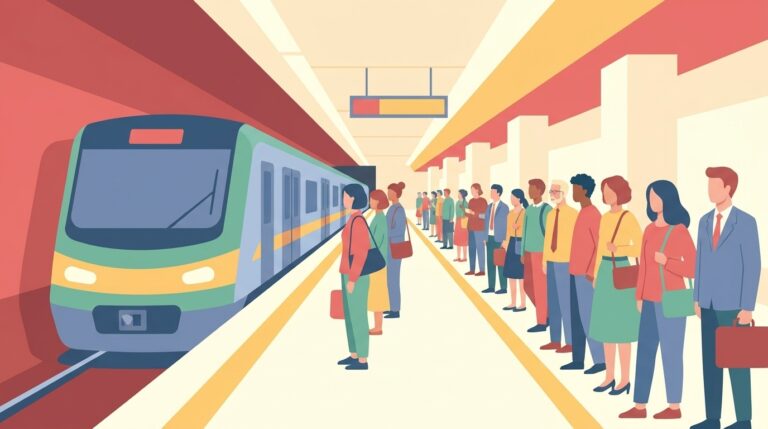
Picture this: It’s 8:15 AM on a Tuesday. You are standing on the platform of Sindorim Station (신도림역)—one of Seoul’s busiest subway hubs. Waves of commuters are rushing past you. A train approaches, and suddenly, the crowd thickens. You want to get on, but you notice something: people are forming neat, dual-column lines exactly behind the yellow safety lines on the floor. Someone accidentally nudges you, and you wonder: Do I push forward? Do I wait? What do I say if I get cut in line?
If you’ve ever felt overwhelmed by the fast-paced flow of Korean public transportation, don’t worry. You are not alone! Many of my students have shared how “terrified” they were of making a social faux pas during Seoul’s rush hour. Mastering the art of 줄 서서 타기 (jul-eul seo-seo ta-gi / lining up to board) isn’t just about following rules; it’s about sliding effortlessly into the daily rhythm of Korean life. Today, we’ll equip you with the exact phrases, cultural cheat codes, and unspoken rules so you can board like a true Seoulite.
Phase 2: 핵심 표현 3선 심층 분석 (Deep Dive into 3 Core Expressions)
1. 줄 서 주세요 (jul seo ju-se-yo)
- Pronunciation: Jul-seo-ju-seh-yo (Sounds like: “jool” + “suh” + “joo-say-yo”)
- Meaning: Please line up. (Literal: Please stand in line.)
- K-Culture Moment: You will hear this polite but firm phrase in busy subway stations when a station guide is directing crowds, or when an elderly passenger gently reminds someone who accidentally bypassed the queue.
- Editor’s Insight: The word 줄 (jul) means “line” or “rope,” and 서다 (seo-da) means “to stand.” While “주세요 (ju-se-yo)” makes it polite, saying this to someone older might feel slightly direct. If you need to say it, keep your tone soft and friendly.
- Situation Spectrum:
- Casual (to friends): 줄 서야 돼 (jul seo-ya dwae) ⚠️
- Semi-formal (to strangers): 줄 서 주세요 (jul seo ju-se-yo) ✅
- Formal (announcements): 줄을 서 주시기 바랍니다 (jul-eul seo ju-si-gi ba-ram-ni-da) ✅
- 🤔 Think About It: In your home country, how do people react if someone cuts in line? In Korea, maintaining order is seen as a collective duty to keep society running smoothly.
2. 먼저 타세요 (meon-jeo ta-se-yo)
- Pronunciation: Meon-jeo-ta-seh-yo (Sounds like: “mun-juh” + “tah-say-yo”)
- Meaning: Please go ahead and board first.
- K-Culture Moment: Imagine you are carrying a large suitcase and blocking the entrance. A polite commuter behind you gestures for you to go, or you step aside and let a hurried mother go first. This is the phrase to use!
- Editor’s Insight: 먼저 (meon-jeo) means “first” or “ahead,” and 타다 (ta-da) means “to ride/board.” Using this phrase shows incredible “눈치 (nunchi)” (social wit) and respect for others’ time.
- Situation Spectrum:
- Casual: 먼저 타 (meon-jeo ta) ⚠️
- Semi-formal: 먼저 타세요 (meon-jeo ta-se-yo) ✅
- Formal: 먼저 탑승하십시오 (meon-jeo tap-seung-ha-sip-si-o) 🚫 (Too robotic for daily life)
- 🤔 Think About It: Offering your turn to someone else is a small but powerful way to build a warm connection in a busy city. When was the last time you let someone go first?
3. 죄송한데 잠시만요 (joe-song-han-de jam-si-man-yo)
- Pronunciation: Joe-song-han-deh jam-si-man-yo (Sounds like: “jweh-song-han-deh” + “jahm-shee-mahn-yo”)
- Meaning: I’m sorry, but excuse me for a second.
- K-Culture Moment: The train doors are about to close, and you need to squeeze through the line, or you are trying to get off but people are blocking the door to get on.
- Editor’s Insight: While “실례합니다 (sil-lye-hap-ni-da)” is taught in textbooks for “excuse me,” locals rarely use it on subways. Instead, we use 죄송한데 (I’m sorry, but…) combined with 잠시만요 (just a moment) to sound polite and non-confrontational.
- Situation Spectrum:
- Casual: 미안, 나 먼저 갈게 (mian, na meon-jeo gal-ge) 🚫 (Too rude for strangers)
- Semi-formal: 죄송한데 잠시만요 (joe-song-han-de jam-si-man-yo) ✅
- Formal: 죄송합니다만 잠시 길 좀 비켜주시겠습니까 (joe-song-hap-ni-da-man jam-si gil jom bi-kyeo-ju-si-get-seup-ni-ka) ⚠️ (A bit too dramatic for a quick exit)
- 🤔 Think About It: Why do you think Koreans apologize (“죄송한데”) even when they are just walking past someone? It shows deep respect for personal boundaries in crowded spaces.
Phase 3: 교과서 한국어 vs 진짜 한국어 (Textbook vs Real Korean)
Scenario A: Asking someone if they are waiting in line
- 📖 Textbook Korean: 당신은 줄을 서 있습니까? (dang-sin-eun jul-eul seo it-seup-ni-ka? – “Are you standing in line?”)
- 🗣️ 진짜 한국어: 혹시 줄 서 계신 거예요? (hok-si jul seo gye-sin geo-yeo? – “Excuse me, are you waiting in line?”)
- 💡 왜 다를까? Textbook Korean uses “당신 (dang-sin)” which can sound aggressive or unnatural in real-life speech. Real Korean uses “혹시 (by any chance)” to soften the question and uses the honorific “계시다 (gye-si-da)” to respect the stranger.
Scenario B: Asking people to let you through when boarding/exiting
- 📖 Textbook Korean: 비켜주십시오. (bi-kyeo-ju-sip-si-o – “Please move aside.”)
- 🗣️ 진짜 한국어: 잠시만 지나갈게요! (jam-si-man ji-na-gal-ge-yo – “Just passing through for a second!”)
- 💡 왜 다를까? “비켜주십시오” sounds like an order given by police or authority figures. “지나갈게요 (I will pass through)” is friendly, clear, and perfectly polite.
Phase 4: K-Culture 딥다이브 & 비언어적 매너 (K-Culture Deep Dive & Non-verbal Manners)
4-1. 눈치 (Nunchi) & Subway Gestures
When queuing to board a train in Korea, silence is golden, but body language speaks volumes.
* The Triangle Formation: When waiting for the train, you will notice people forming two lines on either side of the sliding screen doors. The center space is kept absolutely clear for people exiting the train. Never stand directly in the middle of the doors!
* The Gentle Hand Gesture: If you want to let someone pass or board first, extend your arm slightly with your palm facing upward and tilt your head. Avoid pointing with a single finger, as it can seem rude.
* Eye Contact: Keep your gaze soft. Staring directly at people in a crowded space is considered intrusive. Most locals look at their phones or the route maps above the doors.
4-2. The “Ppalli-Ppalli” vs. “Orderly” Paradox
Korea is famous for its 빨리빨리 (ppalli-ppalli – hurry, hurry) culture. Everything moves fast. However, when it comes to subway boarding, this speed is governed by strict, unspoken order. If someone breaks the line, it disrupts the flow of hundreds of people. The efficiency of the Seoul subway system relies entirely on this collective social contract: “We move fast, but we move together.”
Phase 5: 실전 롤플레이 시나리오 (Real Roleplay Scenario)
Setting: Gangnam Station (강남역) during the Friday evening rush hour. The platform is packed. You are trying to find the end of the line for Line 2 heading to Sinchon.
Characters:
* You (The smart commuter)
* Minho (민호): A polite, busy office worker standing near the screen doors.
- You: 저기요, 혹시 / 이거 줄인가요?
(Jeo-gi-yo, hok-si / i-geo jul-in-ga-yo?)
(Excuse me, by any chance, is this the line?) -
Minho: (Looks up, pointing to the floor) 아, 네! 여기 뒤로 서시면 돼요.
(Ah, ne! Yeo-gi dwi-ro seo-si-myeon dwae-yo.)
(Ah, yes! You can stand behind me here.) -
You (Looking at the yellow arrows): 아, 감사합니다! 하마터면 그냥 탈 뻔했네요.
(Ah, gam-sa-hap-ni-da! Ha-ma-teo-myeon geu-nyang tal ppeon-haet-ne-yo.)
(Ah, thank you! I almost boarded without lining up.) -
Minho: (Smiles kindly) 사람이 많아서 헷갈리죠? 괜찮아요.
(Sa-ram-i man-a-seo het-gal-ri-jo? Gwen-cha-na-yo.)
(It’s confusing because there are so many people, right? It’s okay.) -
[The train arrives and doors open. Some people try to push in before passengers exit]
-
You (Gently to the person pushing): 죄송한데, 내린 다음에 탈게요!
(Joe-song-han-de, nae-rin da-eum-e tal-ge-yo!)
(Excuse me, we should board after people get off!) -
Minho (Nodding in agreement): 맞아요. 다 내린 다음에 타야죠.
(Ma-ja-yo. Da nae-rin da-eum-e ta-ya-jo.)
(That’s right. We should board after everyone gets off.)
🔀 Interactive Choice Point
The train doors are open, but there is a very elderly grandmother (할머니) carrying a heavy shopping bag standing right behind you, struggling to get on.
- Choice A: Say “먼저 타세요 (Please go first)” and step aside to let her board.
- Choice B: Hurry up and get on first to secure a seat, thinking she will manage anyway.
- Choice C: Say “저기요! 빨리 타세요! (Excuse me! Hurry up and board!)” to make her move faster.
💡 Feedback Matrix
- Choice A (Best): Fantastic! You practiced respect and used a wonderful phrase. Minho and everyone on the platform will look at you with warm, appreciative eyes. You’ve earned 100 Nunchi points!
- Choice B (Bad): Oops. While you got a seat, you might feel the heavy, silent judgment of nearby commuters. Respecting the elderly is a core value in Korea.
- Choice C (Risk): Yikes! Telling an elder to “hurry up” using “저기요” sounds highly impatient and disrespectful. This will cause awkward tension on the platform.
Phase 6: 10초 감정 섀도잉 드릴 (10-Second Emotion Shadowing Drill)
Practice these with the right emotions to sound like a native!
- [😊 Warm and polite]
먼저 / 타세요!
(Meon-jeo / ta-se-yo!)
“Go ahead / and board first!” -
[😰 Slightly urgent but respectful]
죄송한데 / 잠시만 / 지나갈게요!
(Joe-song-han-de / jam-si-man / ji-na-gal-ge-yo!)
“Excuse me / just a second / passing through!” -
[🤔 Softly asking for clarification]
혹시 / 이거 / 줄 서신 거예요?
(Hok-si / i-geo / jul seo-sin geo-yeo?)
“By any chance / is this / the line you are waiting in?”
Phase 7: K-Culture 미니 사전 (K-Culture Mini Dictionary)
- 지옥철 (Ji-ok-cheol) | “Hell-train”
- A combination of “지옥 (ji-ok – hell)” and “지하철 (ji-ha-cheol – subway).” It describes the extremely crowded subways during rush hours (8-9 AM and 6-7 PM).
- 백팩 민폐 (Baek-paek min-pye) | “Backpack Nuisance”
- Refers to commuters who wear bulky backpacks on their backs in crowded trains, hitting other passengers. The polite thing is to carry your backpack in front of you or place it between your legs.
- 노약자석 (No-yak-ja-seok) | “Elderly & Disabled Seats”
- Seats located at the very ends of each train car. Even if the train is packed, younger people leave these seats empty out of respect.
- 임산부 배려석 (Im-san-bu bae-ryeo-seok) | “Pregnant Women Priority Seats”
- Bright pink seats designated for pregnant women. Locals usually keep these empty to show care and consideration.
Phase 8: 여행자를 위한 생존 키트 (Survivor Kit for Travelers)
Survival Expressions TOP 3
- 내릴게요! (nae-ril-ge-yo!)
- Meaning: I’m getting off! (Use this if you are stuck behind people when the train reaches your station.)
- 카드가 안 돼요. (ka-deu-ga an dwae-yo.)
- Meaning: My card isn’t working. (Use this at the turnstile if your transit card errors out.)
- 반대 방향은 어디예요? (ban-dae bang-hyang-eun eo-di-yeo?)
- Meaning: Where is the opposite direction? (Use this if you accidentally queued for the wrong direction.)
Editor’s Travel Note
Before navigating the Seoul subway network, download the KakaoMetro app or Naver Map app. They provide real-time updates on train locations and tell you exactly which door number (e.g., 3-4, 7-2) is closest to your transfer or exit, saving you tons of walking!
Phase 9: “한 발 더 깊이” (One Step Deeper)
In many Western cultures, personal space is highly guarded, and pushing can quickly lead to verbal confrontations. In Korea, however, because cities are incredibly dense, some physical contact during rush hour is tolerated as an inevitable part of urban life. The magic lies in the silence and the collective effort to stay orderly. When everyone queues neatly, it creates a sense of predictable harmony amid the chaos. It’s a beautiful reflection of Korean communal harmony (정 – jeong).
💬 Your Turn: Have you ever ridden a crowded subway in Korea? What surprised you the most about the local etiquette? Leave a comment below!
Phase 10: FAQ & 오해 방지 (FAQ & Avoiding Misunderstandings)
Q: Can I sit in the pink seats if the subway is completely empty?
A: While there is no official fine, it is highly recommended to leave the pink 임산부 배려석 (Pregnant Women Priority Seats) empty. It allows early-stage pregnant women, who might not look pregnant, to sit comfortably without having to ask for a seat.
Q: What should I do if someone cuts in front of me in line?
A: Don’t yell or push. Gently clear your throat or tap them on the shoulder and politely say, “죄송한데, 여기 줄 서 있는 거예요.” (Joe-song-han-de, yeo-gi jul seo in-neun geo-yeo – Excuse me, we are waiting in line here). Most people will apologize and move immediately.
Q: Why do elderly people get off the train so fast and sometimes push?
A: In Korea, the older generation lived through incredibly rapid economic development where speed was essential for survival. While it can feel startling, try to practice “Nunchi” and gently yield the way to show respect to your elders.
🚨 Common Mistakes Board
- Mistake 1: Standing right in front of the subway doors when the train arrives.
- Correct Action: Step to the sides (behind the yellow line guides) and let all passengers exit completely before you step in.
- Mistake 2: Talking loudly with friends or on the phone.
- Correct Action: Keep your voice low or send text messages. Loud phone conversations are frowned upon in Korean public transport.
- Mistake 3: Keeping your large backpack on your back.
- Correct Action: Hold it in front of you or put it down by your feet.
Phase 11: 액션 미션 & 참여 유도 (Action Mission & Community Engagement)
Complete Your Daily Hangul Challenge!
- 🥉 Bronze Mission: Read the 3 core expressions aloud 5 times using the 10-Second Shadowing Drill.
- 🥈 Silver Mission: Share this post on your social media with the hashtag
#DailyHanguland tag one friend you want to visit Korea with! - 🥇 Gold Mission: The next time you ride the subway (or even bus) in Korea, use “먼저 타세요 (Please go first)” with a polite head nod to a local passenger!
🎮 K-Culture Mission: Watch any modern K-Drama (like My Liberation Notes or Extraordinary Attorney Woo) and spot a scene set in the Seoul subway. Look at how the characters line up and hold their bags!
Phase 12: 인터랙티브 퀴즈 챌린지 (Interactive Quiz Challenge)
1. What is the most polite, natural way to tell someone to go ahead of you on the subway?
a) 저기요, 가세요 (Jeo-gi-yo, ga-se-yo)
b) 먼저 타세요 (Meon-jeo ta-se-yo)
c) 일어서세요 (Il-eo-seo-se-yo)
🔍 Tap to see the Answer & Explanation
Correct Answer: b) 먼저 타세요 (Meon-jeo ta-se-yo)
Explanation: “먼저 타세요” is the perfect, polite phrase to offer your turn to someone else. Option ‘a’ sounds too blunt, and ‘c’ means “please stand up.”
2. True or False: You can sit in the elderly/disabled seats (노약자석) if you feel extremely tired, even if you are young and healthy.
- True
- False
🔍 Tap to see the Answer & Explanation
Correct Answer: False
Explanation: Even if you are extremely tired, these seats are strictly reserved for the elderly, disabled, and pregnant. It’s better to stand and wait for a regular seat to open up.
Disclaimer: Public transportation rules and dynamic pricing details are subject to change. Always refer to official Seoul Metro announcements for the latest regulations.







