

Stayed Up Late Watching K-Dramas? Here is How to Ask for Checkout Time in Korean!
안녕하세요! (An-nyeong-ha-se-yo! Hello!) I’m your Korean study bestie and Chief Editor at Daily Hangul.
Imagine this: You spent your last night in Seoul having a fabulous Chimaek (chicken and beer) party while binge-watching the latest K-drama in your cozy hotel room. You wake up, look at the clock, and panic. What time is checkout? Can I stay just one more hour?
Don’t worry! Today, we are going to learn how to ask about checkout times and luggage storage like a true local. As an A1 beginner, you only need a few magic words to handle this smoothly. Let’s dive in!
Phase 2: Three Magic Expressions for Checkout
1. 체크아웃 시간이 몇 시예요? (What time is checkout?)
- Pronunciation: Che-keu-at-shi-gan-i myeot-shi-ye-yo? (Sounds like: Check-ooh-out she-gahn-ee myut-she-yeh-yo?)
- Meaning: What time is checkout? (Literal: “Checkout time is what hour?”)
- K-Culture Moment: You’ll hear this at boutique hotels in Hongdae or traditional Hanok stays in Bukchon.
- Editor’s Insight: This is the most reliable, polite, yet natural phrase to use at any front desk in Korea.
- Situation Spectrum: Casual: ⚠️ | Semi-formal: ✅ | Formal: ✅
- 🤔 Think About It: Why do you think Korean hotel staff always use the English loan word ‘체크아웃’ (checkout) instead of a native Korean word? (Hint: It makes international travel easier for everyone!)
2. 체크아웃 시간 좀 연장할 수 있을까요? (Can I extend the checkout time?)
- Pronunciation: Che-keu-at-shi-gan jom yeon-jang-hal su is-seul-kka-yo? (Sounds like: Check-ooh-out she-gahn johm yuhn-jahng-hahl soo ees-seul-gah-yo?)
- Meaning: Can I please extend the checkout time?
- K-Culture Moment: Essential when you stayed up way too late singing at a Noraebang (karaoke bar).
- Editor’s Insight: The tiny word 좀 (jom) means “a little bit” or “please.” It acts like magic fairy dust to make your request sound polite and soft!
- Situation Spectrum: Casual: 🚫 | Semi-formal: ✅ | Formal: ✅
- 🤔 Think About It: How does adding “a little bit” (좀) change the tone of a request in your native language?
3. 짐 좀 맡겨도 될까요? (Can I leave my luggage here?)
- Pronunciation: Jim jom mat-gyeo-do doel-kka-yo? (Sounds like: Jeem johm maht-gyuh-doh dwel-gah-yo?)
- Meaning: Can I leave my bags here for a while?
- K-Culture Moment: Perfect for when you checkout at 11:00 AM but your flight from Incheon Airport is at 8:00 PM.
- Editor’s Insight: ‘짐’ (jim) means luggage/bags. Korean hotels are incredibly safe and almost always offer this service for free.
- Situation Spectrum: Casual: ⚠️ | Semi-formal: ✅ | Formal: ✅
- 🤔 Think About It: Trust and safety are huge in Korea; people often leave laptops on cafe tables. This is why bag storage is so stress-free!
Phase 3: Textbook Korean vs. Real-Life Korean
Scenario 1: Asking the checkout time
- 📖 Textbook Style: 퇴실 시간이 몇 시입니까? (Toesil sigani myeot siimnikka?) – “At what hour is the room vacation?” (Very robotic, sounds like a military manual!)
- 🗣️ Real-Life Style: 체크아웃 몇 시예요? (Chekeu-aut myeot si-ye-yo?) – “What time is checkout?”
- 💡 Why the difference? Modern Koreans prefer simple loan words like “체크아웃” over heavy Hanja (Sino-Korean) words like “퇴실” in daily conversations.
Scenario 2: Leaving luggage
- 📖 Textbook Style: 제 수하물을 보관해 주십시오. (Je suhamureul bogwanhae jusipsio.) – “Please store my baggage.” (Too formal, like you’re talking to a president.)
- 🗣️ Real-Life Style: 짐 좀 맡겨주세요. (Jim jom mat-gyeo-juseyo.) – “Please watch my bags.”
- 💡 Why the difference? “짐” (bag/stuff) is much friendlier and easier to pronounce than “수하물” (baggage).
Phase 4: K-Culture & Hotel Etiquette
4-1. The “Two-Hand” Rule (두 손 문화)
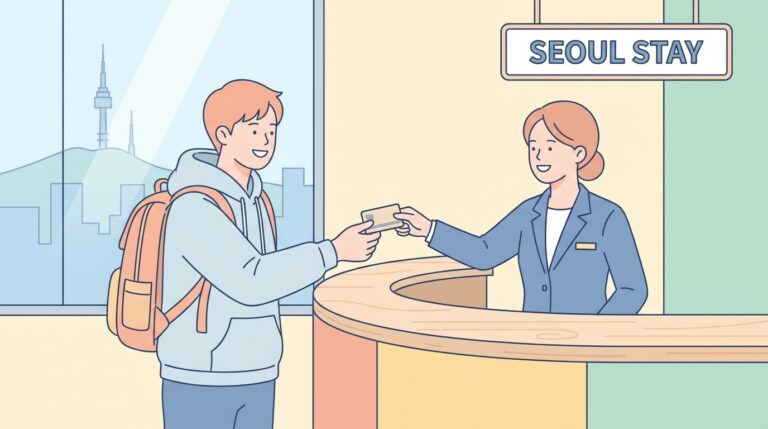
When you hand over your room card key or credit card at checkout, always use two hands (or support your right elbow with your left hand). This is a vital sign of respect in Korea! Keep eye contact and give a slight, friendly nod.
4-2. The “Hokangseu” (호캉스) Trend
Koreans love 호캉스 (Hokangseu)—a portmanteau of “Hotel” and “Vacance” (vacation). Instead of traveling far, locals book luxury hotels in Seoul just to relax, eat room service, and swim. Because of this, weekend checkout lines can be very busy!
Phase 5: Roleplay at the Front Desk
Background: You are checking out of the beautiful “L’Escape Hotel” in Seoul. The friendly receptionist, Min-ji, greets you with a warm smile.
- Min-ji (Staff): 안녕하세요! 체크아웃 도와드릴까요?
(An-nyeong-ha-se-yo! Che-keu-at do-wa-deu-ril-kka-yo?)
“Hello! May I help you with checkout?” -
You: 네, 체크아웃 할게요.
(Ne, che-keu-at hal-ge-yo.)
“Yes, I’ll checkout.” -
Min-ji (Staff): 방 번호가 어떻게 되세요?
(Bang beon-ho-ga eo-tteo-ke doe-se-yo?)
“What is your room number?” -
You: 802호예요. 그리고… [Choose your response below!]
(Pal-baek-i-ho-ye-yo. Geu-ri-go…)
“It is room 802. And…”
🔀 Your Turn! Choose your adventure:
- Option A: “체크아웃 시간 좀 연장할 수 있을까요?” (Can I extend checkout?)
- Option B: “짐 좀 맡겨도 될까요?” (Can I leave my bags here?)
- Option C: “체크아웃 시간 언제예요?” (When is checkout time? – even though you are already checking out!)
📢 Feedback on your choice:
- Best Choice (Option B): Min-ji will smile and say “네, 가능합니다!” (Yes, you can!) and give you a luggage tag. Perfect for exploring Seoul luggage-free!
- Good Try (Option A): Min-ji will check her system. If you’re lucky, she’ll give you an extra hour. (Note: Late checkouts might incur a fee!).
- Awkward (Option C): Since you are already at the desk checking out, asking “when is checkout” might confuse her slightly, but she will politely answer!
Phase 6: 10-Second Shadowing Drill
Let’s practice speaking with real emotion! Follow the slashes / to pause, and match the feeling in the brackets.
- [😊 Friendly & Warm]
체크아웃 / 시간이 / 몇 시예요?
(Che-keu-at / shi-gan-i / myeot-shi-ye-yo?) -
[🥺 Polite & Asking a favor]
짐 좀 / 맡겨도 / 될까요?
(Jim jom / mat-gyeo-do / doel-kka-yo?)
Phase 7: K-Culture Mini Dictionary
- 호캉스 (Hokangseu) | Hotel + Vacance. The Korean trend of having a staycation in a local luxury hotel.
- 레이트 체크아웃 (Reiteu Chekeu-aut) | Late Checkout. Highly sought-after by weekend staycationers.
- 카드키 (Kadeu-ki) | Card Key. The hotel room card you tap to open your door.
- 프론트 (Peuronteu) | Front Desk. Where you go to solve all your hotel mysteries.
Phase 8: Survivor Kit for Travelers
Survival Phrases TOP 3:
- 와이파이 비밀번호가 뭐예요? (Wa-i-pa-i bi-mil-beon-ho-ga mwo-ye-yo?) – What is the Wi-Fi password?
- 수건 더 주세요. (Su-geon deo ju-se-yo.) – More towels, please.
- 감사합니다! (Gam-sa-ham-ni-da!) – Thank you!
💡 Editor’s Travel Note: Don’t get lost in Seoul! Before you step out of the hotel, make sure to download the Naver Map App since Google Maps doesn’t work well for walking directions in Korea.
Phase 9: One Step Deeper
In Korean culture, asking for favors directly can sometimes feel a bit harsh. That’s why Koreans use softer grammatical endings and words like “좀” (jom – please/a bit). By saying “짐 좀 맡겨도 될까요?” instead of “짐 맡겨주세요” (Store my bags), you instantly sound like a gentle, respectful traveler who understands Korean social harmony (Jeong).
💬 Your Turn: Have you ever used the word “좀” in Korea? Let me know in the comments below!
Phase 10: FAQ & Mistakes
Q: Can I use “체크아웃” with older hotel owners at traditional Hanok stays?
A: Yes! “체크아웃” (checkout) is universally understood across Korea, from luxury five-star hotels to cozy countryside guesthouses.
Q: Is there normally a fee for leaving bags after checkout?
A: In 99% of Korean hotels, luggage storage on your checkout day is completely free!
Q: What if I accidentally lose my room key card?
A: Just go to the desk and say: “카드키를 잃어버렸어요” (Kadeu-ki-reul ireoboryeosseoyo – I lost my card key). Most hotels won’t charge you for plastic card keys!
🚨 Common Mistake Alert!
- Bad: “체크아웃 시간 연장해!” (Yeonjang-hae!)
- Why: This is informal (Banmal). Using this with hotel staff is considered rude.
- Correct Action: Always end your sentence with “~요” (yo) or “~을까요?” (eul-kka-yo?) to remain polite!
Phase 11: Action Missions
- 🥉 Bronze Mission: Say “체크아웃 시간이 몇 시예요?” aloud in front of your mirror 3 times.
- 🥈 Silver Mission: Write down “짐 좀 맡겨도 될까요?” in your travel notebook.
- 🥇 Gold Mission: Use at least one of these phrases during your next stay in Korea, or write a mock dialogue in our comments!
Phase 12: Interactive Quiz
Q1. Which phrase means “Can I leave my luggage here?”
1) 수건 더 주세요.
2) 짐 좀 맡겨도 될까요?
3) 체크아웃 몇 시예요?
Reveal Answer
Answer: 2) 짐 좀 맡겨도 될까요? (Jim jom mat-gyeo-do doel-kka-yo?)
Explanation: ‘짐’ means luggage. Option 1 is asking for towels, and Option 3 is asking about checkout time.
Q2. True or False: You should hand your card key to the staff using only one hand.
Reveal Answer
Answer: False! Always use two hands to show respect in Korea!
“, 200, “A friendly flat-design illustration of a cute traveler handing a card key with both hands to a smiling hotel receptionist over a modern pastel-colored front desk in Seoul.”, “Check Out Like a Local: Easy Korean Hotel Phrases for Beginners”, “Korean Hotel Checkout Phrases: Essential Expressions for Beginners”, “Learn simple Korean phrases to ask for hotel checkout time and luggage storage. Perfect for A1 beginners traveling to Korea!”, “Korean phrasebook, travel Korean, Daily Hangul, Korean hotel vocabulary, learn Korean for beginners”
}







