

Symphony by the Han River: The Advanced Guide to Navigating Seoul’s Outdoor Festivals and Concert Etiquette
안녕하세요! It’s your chief editor and trusty cultural navigator from Daily Hangul.
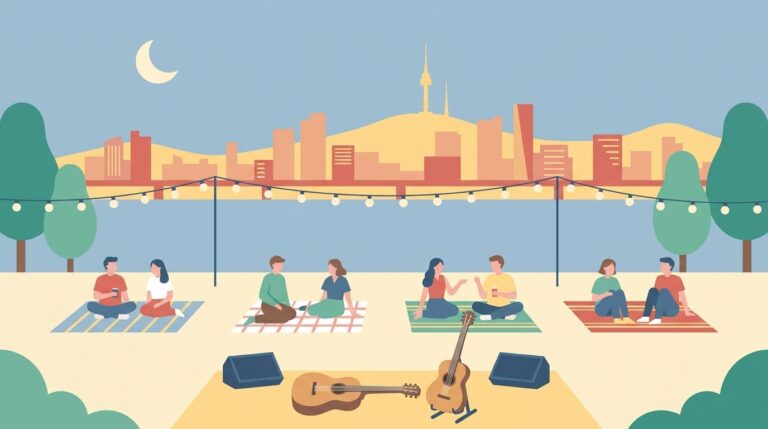
Imagine this: the sweltering Seoul summer heat begins to yield to a crisp, cool evening breeze. The sun dips below the horizon, painting the sky over the Han River (한강) in bruised shades of violet and amber. You are sitting on a picnic mat, the smell of convenience store ramen and fried chicken (chimaek) wafting through the air, while the distant thrum of a bassline promises a night of unforgettable live music.
Whether it’s the legendary Hangang Summer Festival (한강몽땅 여름축제), a breezy jazz night at Yeouido, or an intense outdoor K-pop showcase, outdoor concerts in Seoul are a multisensory masterpiece.
However, for even the most grammatically fluent C2-level learners, navigating the unspoken, highly nuanced social contract of Korean outdoor gatherings can feel like walking an emotional tightrope. How do you claim your tiny square of picnic territory without appearing greedy? How do you gently ask someone to lower their giant fan slogan without ruining the boonwigi (분위기 – atmosphere)?
Today, we are going deep. We are bypassing the textbook pleasantries to master the sophisticated, high-context linguistic maneuvers that will make you sound less like a textbook-touting tourist and more like a socially fluent, highly respectful local. Let’s dive in!
Phase 2: Three Crucial Expressions, Deeply Analyzed
To truly blend in at a Han River concert, you must master the art of soft-negotiation. Korean interpersonal communication relies heavily on minimizing direct confrontation. Here are three high-level phrases that will save your night.
1. 혹시 조금만 자리를 좁혀 주실 수 있을까요? (Hoksi jogeumman jarireul jophyeo jusil su isseulkkayo?)
- Pronunciation: Hok-shi jo-geum-man ja-ri-reul jo-pyeo ju-shil su i-sseul-kka-yo?
- Sound-alike guide: “Hawk-she jo-goom-man jah-ree-ruhl jo-pyuh joo-sheel soo ee-sseul-kah-yo?”
- Meaning: “Excuse me, but would it be possible to squeeze in just a tiny bit?”
- K-Culture Moment: You will hear this whispered in gentle, pleading tones as the sunset peak-hour hits at Banpo Hangang Park, and hundreds of latecomers are looking for a place to spread their dotjari (돗자리 – picnic mat).
- Editor’s Insight: The magic word here is 혹시 (perhaps/by any chance) combined with the grammar pattern -어/아 주실 수 있을까요? (could you possibly do me the favor of…). It frames your request not as an entitlement, but as a humble favor. It instantly disarms the listener.
- Situation Spectrum:
- Friends & Casual: ✅ (Slightly modified: 얘들아, 조금만 좁혀봐)
- Semi-formal (Strangers at festival): ✅ (Perfect balance of politeness and approachability)
- Formal (VIP seating staff): ⚠️ (Too casual; use 좌석 조정을 부탁드려도 되겠습니까?)
- 🤔 Think About It: Notice how the subject “you” is completely omitted here. In Korean, explicitly stating “you” (당신/너) when making requests to strangers can feel pointing and aggressive. Why does your native language require a pronoun, while Korean relies on pure context to foster a sense of shared space?
2. 떼창의 묘미를 해치지 않게 조심할게요 (Ttechang-ui myomireul haechiji anke josimhalgeyo)
- Pronunciation: Tte-chang-ui myo-mi-reul hae-chi-ji an-ge jo-shim-hal-ge-yo
- Sound-alike guide: “Deh-chang-wee myo-mee-ruhl hae-chee-jee ahn-geh jo-sheem-hal-geh-yo”
- Meaning: “I will make sure not to ruin the beauty of the crowd-singing (by singing off-key/screaming too close to your camera).”
- K-Culture Moment: 떼창 (Ttechang) is the pride of Korean concert culture. It is when the entire crowd sings the lyrics of a song in perfect, booming unison. Artists from Coldplay to BTS have wept on stage because of the sheer power of Korean ttechang.
- Editor’s Insight: This is an incredibly advanced cultural phrase. Telling someone this shows you understand the sacred boundary between passionate participation and ruining someone else’s fancam or sensory experience. It proves you have high nunchi (눈치 – situational wits).
- Situation Spectrum:
- Casual / Peers: ✅
- Semi-formal (To your neighbor sharing a mat): ✅
- Formal / Elderly: 🚫 (They might find the slang 떼창 slightly too informal, though they understand the concept of 합창 – chorus).
3. 시야가 살짝 가려져서요, 조금만 낮춰 주시면 감사하겠습니다 (Siyaga saljjak garyeojyeoseoyo, jogeumman natchuwo jusimyeon gamsahagessseumnida)
- Pronunciation: Shi-ya-ga sal-jjak ga-ryeo-jyeo-seo-yo, jo-geum-man na-chuo ju-shi-myeon gam-sa-ha-get-seum-ni-da
- Sound-alike guide: “She-yah-gah sal-jjak gah-ryuh-jyuh-suh-yo, jo-goom-man nah-chwo joo-shee-myuhn gahm-sah-ha-get-soom-nee-dah”
- Meaning: “My line of sight is slightly blocked, so I would be incredibly grateful if you could lower [your banner/umbrella] just a bit.”
- K-Culture Moment: At outdoor concerts, sudden summer rain prompts people to open umbrellas (usan), or passionate fans hold up massive cheering slogans (slogan). Both are notorious sight-blockers.
- Editor’s Insight: The beauty of this sentence lies in the ending -아/어서요 (because of…). In Korean, ending a sentence with a “because” clause and leaving the consequence unsaid is a highly polite, indirect way of expressing a grievance without sounding accusatory.
- Situation Spectrum:
- Friends & Casual: ⚠️ (Sounds too stiff. Use: 나 앞이 안 보여, 이것 좀 내려줘!)
- Semi-formal (Concert setting): ✅
- Formal (Official setting): ✅
Phase 3: Textbook Korean vs. Real Korean Showcase
When you study from standard textbooks, the Korean presented is often grammatically pristine but socially sterile. Let\’s look at how native Koreans actually communicate under the open sky of the Han River.
Scenario A: Asking to occupy a tiny vacant spot next to someone\’s mat
- 📖 Textbook Version: 여기에 저희 돗자리를 깔아도 되겠습니까? (Yeogie jeohui dotjarireul kkarado doegessseumnika? – “Would it be acceptable if we laid down our picnic mat here?”)
- Why it feels weird: It sounds like an official requesting permission from a government minister. It creates unnecessary social distance.
- 🗣️ Real Korean: 혹시 여기 자리 비어 있나요? 저희 조금만 걸쳐 앉아도 될까요? (Hoksi yeogi jari bieo innayo? Jeohui jogeumman geolcheo anjado doelkkayo? – “Is this spot free by any chance? Do you mind if we squeeze in just on the edge?”)
- Why it works: 걸쳐 앉다 (to sit on the edge/border) shows you are trying to minimize your physical intrusion, appealing to the Korean spirit of spatial generosity.
Scenario B: When someone is talking too loudly during a quiet acoustic ballad
- 📖 Textbook Version: 시끄럽습니다. 조용히 해 주십시오. (Sikkeureopseumnida. Joyonghi hae jusipsio. – “It is noisy. Please be quiet.”)
- Why it feels weird: This is incredibly confrontational and will instantly create a hostile atmosphere (and ruin your night).
- 🗣️ Real Korean: 죄송한데, 공연 소리가 잘 안 들려서요… 조금만 조용히 해 주시면 감사하겠습니다. (Joesonghande, gongyeon sori-ga jal an deullyeoseoyo… jogeumman joyonghi hae jusimyeon gamsahagessseumnida. – “I\’m so sorry, but the performance is a bit hard to hear… I\’d really appreciate it if you could speak a little softer.”)
- Why it works: You are framing the issue around your inability to hear the performance (공연 소리가 잘 안 들려서요) rather than accusing them of being loud. It preserves their “face” (체면).
Phase 4: K-Culture Deep Dive & Non-verbal Manners
4-1. The Fine Art of Eye-Nunchi (눈치)
In a crowded Korean outdoor festival, your most powerful tool is not your voice; it is your 눈치 (Nunchi)—your ability to read the vibe of the room (or in this case, the lawn).
- The Trash Bag Protocol (분리수거): When you buy chimaek or Han River ramen, you will receive plastic bags. Do not wait for a trash can to appear. Local etiquette dictates that you meticulously bag your own trash immediately. When leaving, you will witness a beautiful, unspoken collective ritual: hundreds of citizens quietly sorting their recyclables (bunri-sugeo) at designated stations near the convenience store. To leave even a single piece of plastic behind is considered a massive blow to your social standing.
- The Umbrella Rule (우비 vs. 우산): If it starts drizzling during a Han River live set, do not open your umbrella. Doing so instantly blocks the view of at least five people behind you. Instead, look around. You\’ll notice everyone swiftly reaching for their 우비 (ubi – raincoats). Having a cheap raincoat packed in your bag is the ultimate sign of a seasoned, empathetic concert-goer.
Phase 5: The Interactive Roleplay: “The Sunset Showdown at Nanji Park”
The Setting: It is 7:15 PM at the Nanji Hangang Park. The breeze is carrying the scent of sweet soy-glazed chicken. An indie band is about to play their legendary hit. You are sharing a small patch of grass with your Korean friend, 민지 (Minji). Suddenly, a group of excited fans directly in front of you stands up, hoisting a massive, sparkling slogan board.
민지 (Minji): (Sighs softly, looking at the giant banner blocking the stage)
            아... 진짜 한강까지 와서 앞이 하나도 안 보이네. 어쩌지?
            (Ah... we came all the way to the Han River, and now I can't see a thing. What should we do?)

Reader (You): (Squinting)
            저기요, 시야가 너무 가려서 그런데요...
            (Excuse me, but our view is completely blocked...)

Excited Fan: (Startled, turns around holding the banner)
            앗, 죄송해요! 저희 최애 멤버가 지금 올라올 시간이라 조금만 높이 들려고 했거든요.
            많이 불편하세요?
            (Oh, sorry! Our favorite member is about to come on, so we wanted to hold it up high for just a second. Is it really bothersome?)
🔀 Decision Point: How do you respond?
- Option A: “네, 아주 불편해요. 당장 내려 주세요.” (Ne, aju bulpyeonhaeyo. Dangjang naeryeo juseyo. – “Yes, it’s highly inconvenient. Lower it immediately.”)
- Option B: “아, 최애 멤버 분 오시는 건 알겠는데요, 뒤에 앉은 사람들도 배려해 주셔야죠. 돗자리 구역이잖아요.”
(Ah, choeae membeo bun osineun geon algenneundeyo, dwie anjeun saramdeuldo baeryeohae jusyeoyajyo. Dotjari guyeogijanhayo.- “Oh, I understand your favorite member is coming, but you should also respect the people sitting behind you. This is a picnic mat zone, after all.”)
- Option C: “최애 멤버 무대 진짜 기대되시죠! 저희도 같이 보고 싶어서 그러는데, 무대 시작하면 슬로건만 조금 가슴 높이로 낮춰 주실 수 있을까요?”
(Choeae membeo mudae jinjja gidaedoesijyo! Jeohuido gati bogo sipeoseo geureonende, mudae sijakhamyeon seullogeonman jogeum gaseum nopiro natchuwo jusil su isseulkkayo?- “You must be so excited for your favorite’s stage! We really want to enjoy it with you, so when the stage starts, would you mind lowering your slogan just to chest height?”)
🏆 Selection Analysis:
- If you chose Option A: 🚫 The Harmony-Breaker. While grammatically correct, this is far too cold and blunt for a festival atmosphere. It will create immediate tension, making the rest of the night highly uncomfortable for you and Minji.
- If you chose Option B: ⚠️ The Passive-Aggressive Teacher. You are technically right about the rules of the “picnic mat zone” (돗자리 구역), but lecturing strangers about “respect” (배려) in public can feel condescending and provoke defensiveness.
- If you chose Option C: 🎉 The Master of Nunchi (Best Choice). You validated their excitement first (최애 멤버 무대 진짜 기대되시죠!), aligned yourself with them as a fellow music lover (저희도 같이 보고 싶어서), and offered a highly specific, polite compromise (가슴 높이로 낮춰 주실 수 있을까요?). They will gladly lower the banner and likely offer you some of their snacks as an apology!
Phase 6: 10-Second Emotional Shadowing Drill
Let’s train your tongue to carry the exact emotional frequencies of a native Seoulite at an outdoor festival. Practice these aloud, paying attention to the breath pauses marked by /.
1. [😊 Elated and completely swept away by the music]
- Korean: 와/ 진짜 미쳤다/ 소름 돋았어/ 대박이야!
- Romanization: Wa / jinjja michyeotda / soreum dodasseo / daebagiya!
- English: “Wow, this is insane. I literally have goosebumps. Incredible!”
2. [🥺 Extremely polite, soft, but firm pleading]
- Korean: 저기요/ 진짜 죄송한데요/ 저희가 시야가 조금 가려서요/ 아주 조금만 낮춰주시면/ 감사하겠습니다.
- Romanization: Jeogiyo / jinjja joesonghandeyo / jeohuiga siyaga jogeum garyeoseoyo / aju jogeumman natchuwojusimyeon / gamsahagessseumnida.
- English: “Excuse me, I’m truly sorry, but our view is a little blocked… I would be so incredibly grateful if you could lower it just a tiny bit.”
Phase 7: K-Culture Mini Dictionary
| Word (한글 + Romanization) | English Translation | Cultural Nuance & Context |
|---|---|---|
| 피케팅 (Piketing) | “Blood-ticketing” | A portmanteau of 피 (Pi – blood) and 티케팅 (Tiketing). It describes the agonizingly competitive process of trying to book festival tickets online before they sell out in 0.5 seconds. |
| 돗자리 (Dotjari) | Picnic Mat | The sacred unit of territory at the Han River. Setting up a dotjari is the official signal that you are settling down for the evening. |
| 떼창 (Ttechang) | Collective Chanting / Unison Singing | The crown jewel of Korean crowd culture. Singing the lyrics in unison, often louder than the actual artist’s sound system. |
| 분리수거 (Bunri-sugeo) | Meticulous Recycling | The ultimate social citizenship test. Sorting plastic, cans, food waste, and paper at the end of a Han River night. |
Phase 8: Traveler’s Survival Kit
If you find yourself near the Han River tonight, keep these three survival phrases ready in your pocket:
- “돗자리 대여 어디서 해요?” (Dotjari daeyeo eodiseo haeyo?)
- Meaning: “Where can I rent a picnic mat?”
- Pro Tip: Don’t buy a cheap plastic mat that you will throw away. Near almost every major Han River park exit, local shops rent out comfortable mats, tables, and even small lights for a few thousand won.
- “배달존이 어디인가요?” (Baedal-jon-i eodi-ingayo?)
- Meaning: “Where is the food delivery zone?”
- Pro Tip: Because Han River parks are massive, food delivery drivers cannot find individual picnic mats. You must go to the designated Han River Delivery Zones on NAVER Map to collect your fried chicken!
- “우비 혹시 편의점에 파나요?” (Ubi hoksi pyeonuijeome panayo?)
- Meaning: “Do they sell raincoats at the convenience store by any chance?”
- Pro Tip: Always ask this the moment the first drop of rain falls, as convenience stores inside the parks sell out of ubi within minutes.
Phase 9: A Deeper Thought — The Beautiful Paradox of Korean “Jeong” (정) in Crowded Spaces
In many Western cultures, personal space is treated as an invisible, sacred bubble. When that bubble is breached, people feel immediate discomfort or frustration. In Korea, however, space has historically been a shared, communal resource. This stems from 정 (Jeong)—a deep-seated sense of communal affection and mutual belonging.
When you attend an outdoor concert in Seoul, you are not just an individual consumer of music; you are part of a temporary village. Yes, the mats are overlapping. Yes, you might accidentally hear your neighbor’s break-up story. But this very density is what makes things like Ttechang (떼창) possible. The collective effervescence of a Korean crowd comes from the willingness to melt your individual bubble into a shared experience. Next time you feel your space getting squeezed, take a deep breath, look around, and embrace the warmth of the collective.
💬 Your Turn: How does your culture view personal space during outdoor public events? Would people find the closeness of a Korean festival comforting or overwhelming? Let us know in the comments below!
Phase 10: FAQ & Common Pitfalls
Q: Can I bring my own alcohol to a Han River outdoor music festival?
A: Yes! Unlike many countries where public drinking is strictly banned, drinking alcohol in public parks is completely legal and culturally normal in Korea. However, the catch is how you drink. Public intoxication, loud yelling, or stumbling around is heavily frowned upon and will get you a icy glare from everyone nearby. Drink quietly and enjoy the chimaek vibe responsibly.
Q: What should I do if my picnic mat accidentally overlaps with someone else’s?
A: Simply apologize softly and pull it back slightly. Use the phrase: “앗, 죄송합니다. 돗자리가 조금 넘어갔네요.” (Ah, sorry. Our mat slid over a bit). Usually, the other party will smile and say “괜찮습니다!” (It’s perfectly fine).
Q: Do I need to tip the food delivery driver at the Delivery Zone?
A: No, absolutely not. Tipping is not a part of Korean culture. In fact, attempting to tip can cause confusion. The delivery fee is already included in your app payment.
🚨 Three Common Mistakes to Avoid:
- Setting up your mat in the walking pathways: Look for the painted lines on the concrete. Blocking public walkways with your dotjari is a major faux pas.
- Using speakerphones or Bluetooth speakers during a live concert: While waiting for the show to start, keep your personal music volume very low so you don’t drown out other people’s conversations.
- Throwing food waste in the regular trash: Korean recycling laws require food waste (eomsikmul sseureogi) to be disposed of in separate, dedicated bins.
Phase 11: Your Daily Hangul Action Mission!
- 🥉 Bronze (Mirror Challenge): Practice the pleading phrase “시야가 살짝 가려져서요… 조금만 낮춰주시면 감사하겠습니다” in front of a mirror. Master the gentle, indirect head tilt that makes the request completely irresistible.
- 🥈 Silver (Social Media Challenge): Go to YouTube, find a legendary video of a Korean crowd doing 떼창 (Ttechang) (we highly recommend Coldplay’s ‘Fix You’ in Seoul), and leave a comment in Korean: “진짜 떼창의 묘미는 대박이네요!” (The beauty of crowd-singing is truly incredible!).
- 🥇 Gold (The Real World Challenge): The next time you visit Han River, rent a picnic mat, buy some chimaek, and successfully navigate the 분리수거 (recycling) station using only your eyes (nunchi) to match the locals’ meticulous sorting habits!
Phase 12: Interactive Quiz Challenge
1. Situational Judgment
You are sitting at a Han River concert, and someone behind you is whispering that they cannot see because of your tall beach hat. What is the most culturally graceful response?
* A) “제가 제 돈 내고 들어왔는데 왜 그러세요?” (I paid for my own ticket, why are you like this?)
* B) “아, 죄송해요! 모자 때문에 안 보이셨구나. 바로 벗을게요!” (Oh, I’m so sorry! You couldn’t see because of my hat. I’ll take it off right away!)
* C) “그럼 뒤로 가셔서 앉으세요.” (Then go sit in the back.)
2. Fill in the Blank
Complete the following sentence to politely ask someone to squeeze their mat to make some room:
“혹시 자리가 부족해서 그러는데, 조금만 자리를 ________ 주실 수 있을까요?”
3. True or False
- Q: It is considered polite to open an umbrella at an outdoor standing-only K-Pop concert when it starts raining suddenly. (T/F)
🔍 Click here to reveal the answers and explanations!
-
Correct Answer: B
Explanation: Acknowledging their discomfort and taking action immediately with a bright “죄송해요!” will instantly diffuse any potential conflict and keep the concert atmosphere warm. -
Correct Answer: 좁혀
Explanation: 좁히다 means “to narrow” or “to make smaller.” 자리를 좁히다 is the standard, natural expression for squeezing closer together to share space. -
Correct Answer: False
Explanation: Opening umbrellas in a crowded standing zone blocks everyone’s view behind you. Always wear a 우비 (raincoat) instead!







