

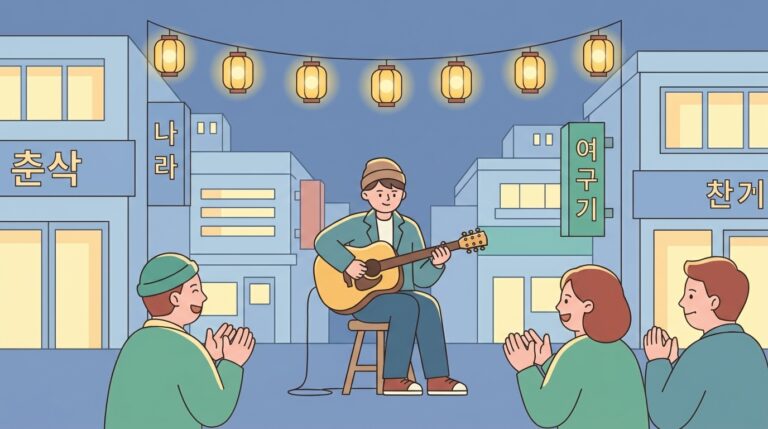
Hongdae Street Vibes: Navigating Busking Permits and Noise Complaints Like a Local Artist
Phase 1: Empathy (An Artist’s Dilemma under the Neon Lights)
안녕하세요! (Annyeonghaseyo!) It is your trusted Korean culture navigator and chief editor at Daily Hangul. If you have ever walked through the vibrant streets of Hongdae (홍대) or Sinchon (신촌) on a breezy Friday evening, you know that street performances—busking (버스킹)—are the very heartbeat of Seoul’s youth culture. Perhaps you have dreamed of setting up your microphone, strumming your acoustic guitar, and sharing your music with a warm Korean crowd, just like a scene straight out of a healing K-Drama like Our Beloved Summer or the acoustic travel show Begin Again.
But here is the reality check: you are mid-song, hitting that perfect high note, when a uniformed district warden or an anxious local shop owner approaches you, pointing at a smartphone decibel-meter app. “Excuse me, we have received a civil complaint about the noise.”
Suddenly, your romantic musical dream collides head-on with Korea’s highly organized administrative systems and dense urban layout. In Korea, public spaces are meticulously shared, and maintaining the delicate balance between individual artistic expression (흥 – Heung) and the rights of local residents to peace and quiet (정온권 – Jeong-on-gwon) is an art form in itself.
Mastering the sophisticated linguistic strategies to navigate busking permits (공연 허가) and de-escalate noise complaints (소음 민원) will not only save your street performance from being shut down, but it will also mark you as a deeply respectful, culturally fluent C2-level speaker who knows how to operate within the subtle social contract of Korean society.
Phase 2: Core Expressions Deep Dive
1. 공연 허가를 신청하다 (gong-yeon heo-ga-reul sin-cheong-hada)
- Pronunciation: [Gong-yeon heo-ga-reul sin-cheong-hada] / Sound-alike: “Gong-yawn huh-gah-rul seen-chong-hah-dah”
- Meaning: To apply for a public street performance permit.
- K-Culture Moment: In K-Dramas, street musicians are often portrayed as romantic rebels performing spontaneously. In real-world Seoul, however, spots like the Hongdae Walkable Street (걷고싶은거리) require competitive online reservations through municipal portals, transforming street art into a highly organized civic system.
- Editor’s Insight: The noun 허가 (heo-ga) means official permit or authorization. Paired with 신청하다 (sin-cheong-hada – to apply), using this phrase shows that you are not a clueless tourist doing guerrilla performances, but an informed artist who respects local municipal ordinances.
- Situation Spectrum:
- Casual (Friends/Peers): ⚠️ (Slightly formal, but natural when discussing admin steps)
- Semi-formal (Local coordinators): ✅
- Formal (District officials/Police): ✅
- 🤔 Think About It: Why has Korea transformed spontaneous street art into an organized booking system? How does this reflect the broader Korean societal value of collective organization and minimizing public inconvenience?
2. 소음 민원이 들어오다 (so-eum min-won-i deu-reo-o-da)
- Pronunciation: [So-eum min-won-i deu-reo-o-da] / Sound-alike: “So-um mean-won-ee deuh-ruh-oh-dah”
- Meaning: Literal: “A noise civil complaint has entered.” Real-world: To receive a noise complaint from local residents or shop owners.
- K-Culture Moment: You often see indie bands in dramas practicing in cramped basement studios, only for the landlord to knock furiously because of a neighbor’s min-won (civil complaint).
- Editor’s Insight: 민원 (min-won) is a powerhouse of a word in Korea. It refers to official grievances filed by citizens to public offices. When someone says “민원이 들어왔어요,” it carries an objective, systemic weight—it means the authority figures’ hands are tied because a formal complaint has been officially registered.
- Situation Spectrum:
- Casual (Bandmates): ✅
- Semi-formal (Shop owners): ✅
- Formal (Warden/Police): ✅
- 🤔 Think About It: In many Western cultures, a neighbor might confront you directly if you are too loud. In Korea, people often prefer filing a min-won through official channels to avoid direct, emotional confrontation. How does this fit into the concept of maintaining social harmony (Pyeonghwa)?
3. 데시벨을 낮추다 (de-si-bel-eul nat-chu-da)
- Pronunciation: [De-si-bel-eul nat-chu-da] / Sound-alike: “Deh-shee-bell-ul naht-choo-dah”
- Meaning: To lower the decibels (volume).
- K-Culture Moment: Street safety officers patrolling Sinchon or Hongdae carrying hand-held decibel meters to ensure performances stay under the legal daytime limit (usually 60 to 65 dB).
- Editor’s Insight: While you can say “소리를 줄이다” (lower the sound), using the scientific loanword 데시벨 (decibel) elevates your language to a highly objective level. It signals to officials that you are ready to comply with precise technical standards rather than arguing subjectively.
- Situation Spectrum:
- Casual (Bandmates): ✅
- Semi-formal (Coordinators): ✅
- Formal (Police/Inspectors): ✅
- 🤔 Think About It: Why does using technical vocabulary like decibel work better when de-escalating regulatory conflicts in Korea than emotional appeals about artistic freedom?
Phase 3: Textbook vs. Real Korean (Real Korean Showcase)
Situation 1: Explaining to a street warden that you have a permit
- 📖 Textbook Korean: “저는 이 구역에서 버스킹을 할 수 있는 공식 허가증을 소지하고 있습니다.” (I am in possession of an official permit to busk in this zone.)
- 🗣️ Real Korean: “저희 여기 구청에 미리 예약하고 허가받아서 진행하는 중이거든요. 여기 예약 내역 보여드릴게요.” (We actually booked this spot through the district office and got approval beforehand. Let me show you our reservation details.)
- 💡 Why is it different? The textbook version sounds like a defensive legal deposition. Real-world Korean uses soft sentence-ending markers like -거든요 (-geodeun-yo – because/you see) to politely explain the context, and uses 구청 (gu-cheong – district office) to show they followed the official local pipeline.
Situation 2: De-escalating with an unhappy local shop owner
- 📖 Textbook Korean: “소음 배출을 즉각적으로 중단하거나 데시벨을 감소시키겠습니다.” (I will immediately cease noise emissions or decrease the decibels.)
- 🗣️ Real Korean: “아, 사장님! 불편을 드려 정말 죄송합니다. 저희가 앰프 볼륨을 바로 좀 낮출게요. 이 정도 소리면 영업하시는 데 방해 안 될까요?” (Oh, boss! I am so sorry for the inconvenience. We will lower our amp volume right away. If it’s around this level, would it not interfere with your business?)
- 💡 Why is it different? Street business owners are referred to affectionately as 사장님 (sa-jang-nim – boss/owner). By proactively apologizing for their 불편 (bul-pyeon – inconvenience) and asking for active feedback (“Is this level okay?”), you turn a potential confrontation into a collaborative, respectful negotiation.
Phase 4: K-Culture Deep Dive & Non-verbal Manners
4-1. Nunchi (눈치) & Non-verbal Etiquette
When dealing with street noise complaints in Korea, your body language speaks louder than your amplifier.
* The Head Tilt and Bow: Never stand perfectly straight with crossed arms when a warden or elder shop owner approaches. This is seen as combative. Tilt your head slightly forward, lower your shoulders, and offer a soft, quick bow (around 15 degrees). It signals immediate respect.
* The Double-Handed Phone Show: When presenting your digital reservation or permit on your smartphone, always hold the phone with both hands, or support your right wrist/forearm with your left hand. This classic Confucian gesture of respect instantly disarms tense administrative situations.
* Immediate Muting: The moment an official approaches, turn down your master volume before you start speaking. Showing immediate compliance non-verbally makes them far more lenient during the linguistic negotiation.
4-2. The Sonic Battleground: Business vs. Busking
In Korea, space is at a premium. Small business owners pay incredibly high rents (임대료) to secure spots on crowded streets. When street performers set up powerful amplifiers right outside their shop doors, it physically deters customers who want to chat or hear the store’s own music. Thus, municipal offices have implemented strict digital reservation systems. Understanding this socioeconomic tension helps you realize that a noise complaint isn’t an attack on your art; it is a survival issue for the local merchant.
Phase 5: Live Roleplay Scenario
The Setting
A cool, neon-lit Friday evening on Hongdae’s Walkable Street. Your acoustic-pop duo has just started their set. A crowd of thirty people is swaying along. Suddenly, Min-jun (민준), a municipal street coordinator wearing a yellow high-visibility vest and carrying a decibel meter, walks into your performance perimeter.
The Cast
- You (Advanced Indie Artist): Courteous, law-abiding, and syntactically precise.
- Min-jun (민준): A stressed local district coordinator trying to balance merchant complaints and youth culture.
The Dialogue
- 민준: “저기, 잠시만요. 연주 중에 죄송한데 볼륨을 좀 줄여주셔야겠어요.”
(Jeo-gi, jam-si-man-yo. Yeon-ju jung-e joe-song-han-de bol-ryum-eul jom jul-yeo-ju-syeo-ya-get-eo-yo.)
“Excuse me, just a moment. I am sorry to interrupt your performance, but you will need to lower your volume.” -
You (🎭 Bows slightly, turns down master volume): “아, 네! 바로 줄였습니다. 혹시 저희 공연 소리가 너무 컸나요?”
(Ah, ne! Ba-ro jul-yeot-seup-ni-da. Hok-si jeo-hui gong-yeon so-ri-ga neo-mu keot-na-yo?)
“Ah, yes! I have lowered it right away. Was our performance sound a bit too loud?” -
민준: “네, 근처 상가에서 소음 민원이 연달아 들어와서요. 방금 데시벨을 측정해 보니 기준치인 65데시벨을 초과하셨습니다.”
(Ne, geun-cheo sang-ga-e-seo so-eum min-won-i yeon-da-ra deu-reo-wa-seo-yo. Bang-geum de-si-bel-eul cheuk-jeong-hae bo-ni gi-jun-chi-in yuk-sip-o-de-si-bel-eul cho-gwa-ha-syeot-seup-ni-da.)
“Yes, we have received consecutive noise complaints from nearby shops. I just measured the decibels, and you have exceeded the standard limit of 65 decibels.” -
You: “아, 그렇군요. 저희가 공식적으로 마포구청 예약 시스템을 통해 7시부터 9시까지 버스킹 존 사용 허가를 받은 상태인데도 데시벨 규정을 엄격히 지켜야 하는군요.”
(Ah, geu-reot-gun-yo. Jeo-hui-ga gong-sik-jeok-eu-ro Ma-po-gu-cheong ye-yak si-seu-tem-eul tong-hae il-gop-si-bu-teo a-hop-si-kka-ji beos-king jon sa-yong heo-ga-reul ba-deun sang-tae-in-de-do de-si-bel gyu-jeong-eul eom-gyeok-hi ji-kyeo-ya ha-neun-gun-yo.)
“Ah, I see. Even though we officially received permission to use this busking zone from 7 PM to 9 PM through the Mapo-gu reservation system, we must still strictly adhere to the decibel regulations.” -
민준 (🎭 Nods, appreciating your knowledge of the system): “네, 맞습니다. 허가를 받으셨어도 주변 상인분들의 정온권을 보장해야 하기 때문에 앰프 출력을 계속 낮게 유지해 주셔야 합니다.”
(Ne, mat-seup-ni-da. Heo-ga-reul ba-deu-syeos-eo-do ju-byeon sang-in-bun-deul-ui jeong-on-gwon-eul bo-jang-hae-ya ha-gi tae-mun-e aem-peu chul-ryeok-eul gye-sok nat-ge yu-ji-hae ju-syeo-ya ham-ni-da.)
“Yes, that is correct. Even with a permit, we must guarantee the nearby merchants’ right to peace, so you must keep your amplifier output low throughout.” -
You: “충분히 이해합니다. 혹시 이 정도 앰프 볼륨이면 상가에 피해가 안 갈까요? 소리가 어디까지 울리는지 저희가 서 있는 위치에서는 가늠하기가 조금 어려워서요.”
(Chung-bun-hi i-hae-ham-ni-da. Hok-si i jeong-do aem-peu bol-ryum-i-myeon sang-ga-e pi-hae-ga an gal-kka-yo? So-ri-ga eo-di-kka-ji ul-ri-neun-ji jeo-hui-ga seo in-neun wi-chi-e-seon ga-neum-ha-gi-ga jo-geum eo-ryeo-wa-seo-yo.)
“I completely understand. Would this level of amp volume avoid causing any trouble to the shops? It’s a bit difficult for us to gauge how far the sound travels from where we are standing.” -
민준 (🎭 Checks his meter): “음, 지금 60데시벨 정도 나오네요. 이 정도 선을 유지해 주시면 민원이 더 들어오지 않을 겁니다. 협조해 주셔서 감사합니다.”
(Eum, ji-geum yuk-sip-de-si-bel jeong-do na-o-ne-yo. I jeong-do seon-eul yu-ji-hae ju-si-myeon min-won-i deo deu-reo-o-ji a-neul geom-ni-da. Hyeop-jo-hae ju-syeo-seo gam-sa-ham-ni-da.)
“Hmm, it is reading about 60 decibels now. If you maintain this level, we shouldn’t get any more complaints. Thank you for your cooperation.” -
You: “아닙니다, 당연히 상생해야죠. 혹시 이후에라도 민원이 또 발생하면 저희한테 즉시 말씀해 주세요. 바로 조치하겠습니다.”
(A-nip-ni-da, dang-yeon-hi sang-saeng-hae-ya-jyo. Hok-si i-hu-e-ra-do min-won-i tto bal-saeng-ha-myeon jeo-hui-han-te jeuk-si mal-sseum-hae ju-se-yo. Ba-ro jo-chi-ha-get-seup-ni-da.)
“Not at all, we should naturally coexist. If any further complaints arise later, please let us know immediately. We will take action right away.” -
민준: “좋은 공연 보여주시고, 즐거운 저녁 시간 되세요!”
(Jo-eun gong-yeon bo-yeo-ju-si-go, jeul-geo-un jeo-nyeok si-gan doe-se-yo!)
“Have a great performance, and enjoy your evening!” -
You (🎭 Bowing warmly): “감사합니다! 수고 많으십니다!”
(Gam-sa-ham-ni-da! Su-go man-eu-sip-ni-da!)
“Thank you! Thank you for your hard work!”
🔀 Decision Point
Imagine Min-jun returns ten minutes later because a specific shop owner is still angry, despite your decibel level being legally compliant.
- Choice A: “저희 법적 기준인 60데시벨 지키고 있는데 왜 자꾸 그러시죠? 이건 부당합니다.”
(We are keeping to the legal limit of 60dB, why do you keep doing this? This is unfair.) - Choice B: “아, 그러시군요. 괜찮으시다면 제가 그 매장 사장님께 직접 찾아가서 양해를 구하고 조율해 봐도 될까요?”
(Ah, I see. If it is alright, may I visit the shop owner myself to ask for their understanding and sort things out?) - Choice C: “그럼 오늘 공연은 그냥 여기서 접을게요. 한국은 버스킹하기 너무 힘드네요.”
(Then we will just pack up our performance today. It is too hard to busk in Korea.)
🏆 Best Choice: Choice B
Why? In high-context Korean society, relationships and personal effort (양해를 구하다 – to ask for understanding) solve bureaucratic deadlocks. Proactively offering to speak politely to the shopkeeper displays peak cultural fluency, high emotional intelligence, and respect for the local merchant’s livelihood.
🚫 Bad/Risk Choice: Choice A
Why? Standing strictly on legal rights (“I am compliant, so leave me alone”) is seen as aggressive, self-centered, and lacking 인정 (in-jeong – human warmth/compassion). It will likely make the warden less willing to help you find alternative spots in the future.
Phase 6: 10-Second Emotion Shadowing Drill
Inject raw soul and natural prosody into your pronunciation. Practice pausing at the slashes (/) and channeling the recommended emotional states.
Drill 1
- Expression: “불편을 드려 / 정말 죄송합니다. / 저희가 볼륨 바로 줄일게요!”
- Pronunciation: [Bul-pyeon-eul deu-ryeo / jeong-mal joe-song-ham-ni-da. / Jeo-hui-ga bol-ryum ba-ro jul-il-ge-yo!]
- Emotion Target: [🥺 Apologetic, highly cooperative, and warm]
- Pacing Guide: Soften your tone on deu-ryeo, and bring a swift, energetic promise on ba-ro jul-il-ge-yo!
Drill 2
- Expression: “혹시 저희 공연이 / 영업에 방해가 된다면 / 편하게 말씀해 주세요.”
- Pronunciation: [Hok-si jeo-hui gong-yeon-i / yeong-eop-e bang-hae-ga doen-da-myeon / pyeon-ha-ge mal-sseum-hae ju-se-yo.]
- Emotion Target: [😊 Courteous, professional, and neighborly]
- Pacing Guide: Pause gently after gong-yeon-i and emphasize pyeon-ha-ge (comfortably/freely) to make the listener feel zero pressure.
Phase 7: K-Culture Mini Dictionary
| Word / Phrase | Romanization | Real-world Contextual Usage |
|---|---|---|
| 상생 (相生) | Sang-saeng | “Coexistence / Win-win.” A massive civic buzzword in Korea representing how mega-corporations, street artists, and small businesses must mutually survive together. |
| 정온권 (靜穩權) | Jeong-on-gwon | “Right to quietude.” The legal and social concept that residents have a right to live in peace without excessive urban acoustic disturbance. |
| 걷고싶은거리 | Geotgo-sipeun-geori | “The Street You Want to Walk.” The iconic stretch of Hongdae zone dedicated to street performances, pedestrian walks, and cultural arts. |
| 단속 (團束) | Dan-sok | “Crackdown / Regulation.” Used when officials or police enforce local ordinances regarding noise, illegal street vendors, or unpermitted activities. |
Phase 8: Traveler’s Survival Kit
Survival Cards for Performing Artists
- Card 1: Checking Permit Status
- Korean: “여기 버스킹 예약 구역인가요, 아니면 자유 구역인가요?”
- Romanization: Yeo-gi beos-king ye-yak gu-yeok-in-ga-yo, a-ni-myeon ja-yu gu-yeok-in-ga-yo?
- Pro Tip: Ask fellow street performers this to know if you need to register on a portal or if it’s first-come, first-served.
- Card 2: Dealing with Angry Merchants
- Korean: “사장님, 데시벨 측정기로 재면서 볼륨 맞출 테니 조금만 양해해 주실 수 있을까요?”
- Romanization: Sa-jang-nim, de-si-bel cheuk-jeong-gi-ro jae-myeon-seo bol-ryum mat-chul te-ni jo-geum-man yang-hae-hae ju-sil su is-seul-ka-yo?
- Pro Tip: Proposing to measure the sound level yourself demonstrates that you are a professional who respects their space.
- Card 3: Inquiring about Permit Offices
- Korean: “버스킹 허가 관련해서 어느 부서에 문의해야 하나요?”
- Romanization: Beos-king heo-ga gwan-ryeon-hae-seo eo-neu bu-seo-e mun-ui-hae-ya ha-na-yo?
- Pro Tip: Use this at any local District Office (구청) to find the right department handling cultural street performances.
📌 Editor’s Travel Note
Before setting up any sound equipment in Seoul, make sure to visit the local district office website (such as the Mapo-gu office or Seodaemun-gu office) to check current ordinances. You can utilize the Seoul Metropolitan Government’s Official Web Map to look up designated cultural zones where street performances are actively encouraged and subsidized!
Phase 9: Deep Reflection — “한 발 더 깊이” (Going Deeper)
In Western street performance culture, the street is historically viewed as an open stage of free expression where artists push physical and social boundaries. However, in Korea, the street is conceptualized as a highly shared, collective living room. This is why you will see street performers voluntarily stopping their music when an ambulance passes or when a blind pedestrian walks by.
This social compact stems from the values of 배려 (bae-ryeo – consideration for others) and 민폐 (min-pye) avoidance—the deep-seated dread of causing inconvenience to other members of the public. When you perform in Korea, you are not just showcasing your personal talent; you are participating in a communal dance of space sharing. True fluency at the C2 level is recognizing that dialing down your amplifier by 5 decibels is actually a powerful gesture of cultural respect that wins the hearts of locals faster than any perfect guitar solo.
💬 Your Turn: How does your hometown handle street busking? Do you have strict digital permits and decibel limits, or is it more spontaneous? Let us know your thoughts in the comments below!
Phase 10: FAQ & Common Mistakes
Q: Can a tourist with a regular tourist visa (B-1/B-2/K-ETA) legally busk in Korea?
A: Yes, but with strict conditions. You cannot engage in commercial, profit-making busking (e.g., selling CDs, setting up donation boxes, or putting up a Venmo/toss QR code for tips) on a tourist visa, as this violates immigration labor laws. However, purely artistic, non-profit performances with a pre-arranged municipal permit are generally tolerated.
Q: What is the maximum legal decibel limit for street performances in Seoul?
A: It depends on the zone and time. Generally, under local Mapo-gu and Seodaemun-gu ordinances, daytime street noise must not exceed 65 dB, while nighttime performances (after 8:00 PM) must stay below 60 dB. Violating this after official warnings can result in immediate revocation of your permit.
Q: What should I do if the police are called regarding my busking?
A: Stay extremely calm and polite. The police in Korea are rarely aggressive unless provoked. Show them your ID/Passport, present your booking permit, and immediately offer to turn down the sound or pack up. Fighting or arguing with police officers (경찰관) over “free speech” will lead to administrative fines.
🚨 Common Mistakes Warning Board
- Unregulated Amplifiers: Bringing massive, concert-grade battery amps (like the Roland Cube Street EX) and cranking them to full volume in small alleyways. Correct Action: Keep your amp output below 50% and direct the speakers away from shop entrances.
- Ignoring Small Business Owners: Brushing off a shop owner’s request to lower the volume by claiming you have a municipal permit. Correct Action: The permit is not a license to annoy. Always compromise.
- Guerrilla Busking in Non-Designated Zones: Assuming any sidewalk in Hongdae is a stage. Correct Action: Look for painted circles on the ground that designate official “Busking Zones” (버스킹 존).
Phase 11: Action Missions
- 🥉 Bronze (At-Home Challenge): Record yourself saying the phrase “불편을 드려 정말 죄송합니다. 볼륨 낮출게요.” using the apologetic emotion markers from Phase 6. Listen to ensure your tone sounds soft and accommodating, not defensive.
- 🥈 Silver (Network Challenge): Search Instagram or YouTube for the hashtag
#홍대버스킹(Hongdae Busking). Find a street artist’s clip, and write a polite comment in Korean cheering them on: “멋진 공연 감사해요! 상생하는 모습이 보기 좋습니다.” (Thank you for the wonderful performance! It’s great to see people coexisting beautifully.) - 🥇 Gold (Real-World Challenge): The next time you are in Seoul, walk up to a registered busking zone, find an artist setting up, and ask them: “여기 구청에 미리 허가받아야 하는 곳인가요?” (Is this a place where you have to get a permit from the district office in advance?)
- 🎮 K-Culture Mission: Watch the acoustic travel variety show Begin Again (비긴어게인). Take notes on how professional Korean singers set up their street gear and interact with local authorities and crowds abroad. How does their body language match the concepts of bae-ryeo discussed today?
Phase 12: Interactive Quiz
1. Situation Judgment
Q: You are busking and an elderly resident comes out of an apartment building complaining that their baby cannot sleep. What is the most culturally appropriate C2-level response?
* A) “여기는 법적으로 허가된 버스킹 존이라 규정 시간까지는 공연할 권리가 있습니다.”
* B) “아, 정말 죄송합니다. 아기가 자는 시간인 줄 몰랐습니다. 저희가 앰프를 끄고 어쿠스틱(통기타)으로만 작게 진행하거나 바로 정리하겠습니다.”
* C) “경찰에 신고해서 법적으로 해결하세요.”
Click for Answer & Explanation
Correct Answer: B
In Korea, causing stress to family homes, especially regarding babies or students preparing for college entrance exams (수능), is a major social issue. Choosing B demonstrates supreme cultural intelligence, empathy, and social grace. Option A, while legally true, makes you look incredibly selfish.
2. Fill-in-the-Blank
Q: Fill in the blank with the appropriate word to show administrative awareness:
“버스킹을 하려면 먼저 마포구청 홈페이지에서 공식 공연 _________를 신청해야 합니다.”
Click for Answer & Explanation
Correct Answer: 허가 (heo-ga – permit/authorization)
To perform legally in public zones, you must apply for a performance permit (공연 허가).
3. True or False
Q: In Korea, if you receive a 소음 민원 (noise complaint), it means you are automatically being arrested or charged with a misdemeanor.
* True
* False
Click for Answer & Explanation
Correct Answer: False
A civil complaint (민원) is simply an official administrative request for mediation. It is a prompt to adjust your volume and cooperate with city guidelines, not an immediate criminal charge.







