

Speak Like a Local: How to Ask for Room Cleaning in Korean Hotels (A1 Guide)
Phase 1: Empathy – Your Cozy Seoul Morning Scenario
안녕하세요! (Annyeonghaseyo!) Hello, my dear friend! I’m your lead editor at Daily Hangul, your cozy Korean guide.
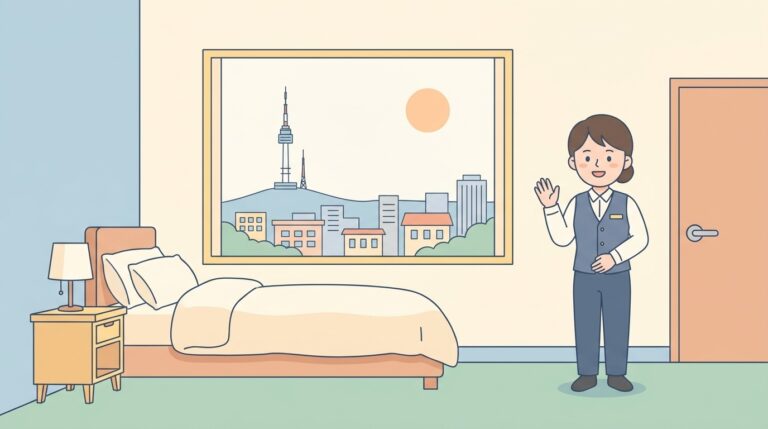
Imagine this: You wake up in a stylish hotel room overlooking the glittering lights of Namsan Tower. You just spent the previous night dancing at a K-Pop concert in Hongdae and eating delicious Tteokbokki (spicy rice cakes). Now, your room is a beautifully chaotic mess of shopping bags, K-beauty skincare sheets, and empty water bottles.
You want to step out to grab a delicious warm bowl of Gukbap (hot soup), but you really need your room cleaned while you’re out. You see a friendly housekeeper in the hallway. You make eye contact… and your mind goes blank. How do you ask them to clean your room? Do you just point and wave?
Don’t worry! In Korea, polite service communication is an art of mutual respect. Today, we will learn how to ask for room cleaning like a polite, native Korean. Using these simple phrases won’t just get your room sparkling clean—it will also win you the warmest smiles from the hotel staff (and maybe even a few extra free bottles of water!). This guide is built on real-world feedback from hundreds of beginner travelers just like you. Let’s dive in!
Phase 2: Core 3 Expressions Deep Dive
Here are the top 3 magic expressions you need for your hotel stay. Let’s break them down easily!
1. 방 청소 부탁해요 (Bang cheong-so bu-tak-hae-yo)
- Pronunciation: bahng chuhng-so boo-tahk-hae-yo
- Sound-alike Guide: Think of Bang (like a loud sound) + cheong-so (sounds like ‘chung’ + ‘so’ in soda) + bu-tak-hae-yo (sounds like ‘boo-tock-hey-yo’).
- Meaning:
- Literal: “Room cleaning, please request.”
- Real-world Nuance: “Please clean my room.”
- K-Culture Moment: You will hear this phrase in almost every K-drama where characters stay at beautiful hotels, such as the luxury suites in King the Land or Business Proposal.
- Editor’s Insight: The ending -요 (-yo) is the magic polite key. It is safe, warm, and highly respectful to use with any hotel staff member.
- Situation Spectrum:
- Casual (Friends): ⚠️ (Too polite for close friends, but okay)
- Semi-formal (Staff/Colleagues): ✅ (Perfect!)
- Formal (Boss/Elders): ✅
- 🤔 Think About It: Why does Korean use “부탁해요” (please request/I ask of you) instead of a direct command like “Clean this”? It’s because Korean culture deeply values soft requests that respect the other person’s effort.
2. 수건 좀 더 주세요 (Su-geon jom deo ju-se-yo)
- Pronunciation: soo-guhn johm duh joo-seh-yo
- Sound-alike Guide: Sue (like the name) + gun (like a water gun) + jom (sounds like ‘chom’) + deo (sounds like ‘duh’) + ju-se-yo (sounds like ‘joo-say-yo’).
- Meaning:
- Literal: “Towels a bit more give, please.”
- Real-world Nuance: “Could I have some more towels, please?”
- K-Culture Moment: After walking miles through the beautiful Bukchon Hanok Village or shopping in Myeongdong, you need a long, hot shower. You realize you’ve used all your towels. This is when you use this phrase!
- Editor’s Insight: The word 좀 (jom) literally means “a little,” but in real Korean life, it acts like a giant softener. It makes your request sound much sweeter and less demanding.
- Situation Spectrum:
- Casual: ⚠️
- Semi-formal: ✅ (Highly recommended)
- Formal: ✅
- 🤔 Think About It: In your native language, do you have a word that doesn’t mean “please” but automatically makes a sentence sound twice as polite? That is the magic power of 좀 (jom) in Korea!
3. 지금 청소해 주세요 (Ji-geum cheong-so-hae ju-se-yo)
- Pronunciation: jee-geum chuhng-so-hae joo-seh-yo
- Sound-alike Guide: Ji-geum (sounds like ‘jee-gum’) + cheong-so-hae (‘chung-so-hey’) + ju-se-yo (‘joo-say-yo’).
- Meaning:
- Literal: “Now clean, please do.”
- Real-world Nuance: “Please clean (my room) right now.”
- K-Culture Moment: You are standing at the lobby desk, about to leave for a delicious street-food tour. You want to tell the staff they can clean the room immediately while you are out.
- Editor’s Insight: 지금 (ji-geum) means “now”. Use this only when you are actively leaving the room so the housekeeping team has free access.
- Situation Spectrum:
- Casual: 🚫
- Semi-formal: ✅
- Formal: ✅
- 🤔 Think About It: Notice how the base verb for cleaning (청소하다 – cheong-so-ha-da) changes to 청소해 주세요 (cheong-so-hae ju-se-yo). In Korean, adding -해 주세요 means “please do this action for my benefit.”
Phase 3: Textbook Korean vs. Real Korean
Let’s compare what dusty grammar books teach you versus what Koreans actually say in modern hotels!
Situation 1: Requesting a clean at the front desk
- 📖 Textbook Korean: “객실 청소를 정중히 요청합니다.” (Gaek-sil cheong-so-reul jeong-jung-hi yo-cheong-ham-ni-da. – “I politely request room cleaning.”)
- Why it’s awkward: It sounds like a legal contract or a robot speaking!
- 🗣️ Real Korean: “방 청소 좀 부탁드릴게요.” (Bang cheong-so jom bu-tak-deul-ril-ge-yo. – “Could you please clean my room?”)
- Why we use it: 부탁드릴게요 is the ultra-polite, warm, and natural cousin of 부탁해요. It shows a beautiful, humble respect to hotel workers.
Situation 2: Informing staff about trash collection
- 📖 Textbook Korean: “쓰레기를 수거해 가십시오.” (Sseu-re-gi-reul su-geo-hae ga-sip-si-o. – “Carry away the garbage.”)
- Why it’s awkward: It is too stiff and sounds like an order given by a military commander!
- 🗣️ Real Korean: “쓰레기 좀 버려 주세요.” (Sseu-re-gi jom beo-ryeo ju-se-yo. – “Please throw away the trash.”)
- Why we use it: It is simple, clear, and perfectly polite for everyday travel.
Phase 4: K-Culture Deep Dive & Non-Verbal Manners
4-1. The Soft Bow and Palm Etiquette
To truly communicate like a local, you need the physical body language. In Korea, we practice the 목인사 (Mok-in-sa)—a gentle, 15-degree head nod/bow. When you approach the front desk or pass a housekeeper in the hallway, slightly nod your head as you say “안녕하세요” (Annyeonghaseyo).
Also, if you are handing over your hotel card-key, use both hands or support your right elbow with your left hand. It is an ancient gesture of respect that makes a massive difference in how you are perceived!
4-2. The No-Tipping Rule in Korea
Here is a crucial travel tip for South Korea: Tipping is not expected or required! In fact, if you leave cash on the bed for the cleaning staff, they might think you accidentally forgot your money. They might even run down the lobby to return it to you!
Instead of money, the best way to show your gratitude is to leave a small sticky note on the desk saying:
“감사합니다!” (Gam-sa-ham-ni-da! – Thank you!)
Phase 5: Live Roleplay – The Myeongdong Boutique Hotel
Let’s practice! You are the main character in this story.
- The Setting: You are in the bright, fragrant lobby of a chic hotel in Myeongdong. Soft piano covers of BTS songs are playing.
- The Cast:
- You (The excited traveler)
- Min-ji (The super friendly hotel receptionist with a kind smile)
Min-ji: (Smiles warmly) 안녕하세요! 무엇을 도와드릴까요?
        [An-nyeong-ha-se-yo! Mu-eot-eul do-wa-deul-ril-ka-yo?]
        (🎭 Stage Direction: She bows slightly with her hands crossed.)
        "Hello! How can I help you?"

You: 안녕하세요! 저... 방 청소 좀 부탁해요.
     [An-nyeong-ha-se-yo! Jeo... bang cheong-so jom bu-tak-hae-yo.]
     (🎭 Stage Direction: You bow back gently and smile.)
     "Hello! Um... please clean my room."

Min-ji: 아, 네! 몇 호실이세요?
        [Ah, ne! Myeot ho-sil-i-se-yo?]
        "Ah, yes! Which room number is it?"

You: 802호예요.
     [Pal-baek-i-ho-ye-yo.]
     "It's Room 802."

Min-ji: 네, 알겠습니다. 지금 바로 청소해 드릴까요?
        [Ne, al-get-seum-ni-da. Ji-geum ba-ro cheong-so-hae deul-ril-ka-yo?]
        "Yes, understood. Shall we clean it right now?"
🔀 Decision Point: What do you say next?
- Option A: “네, 지금 해 주세요.” (Ne, ji-geum hae ju-se-yo.)
- Option B: “아니요, 나중에요.” (An-i-yo, na-jung-e-yo.)
- Option C: “청소하지 마세요!” (Cheong-so-ha-ji ma-se-yo!)
💡 Choice Analysis:
- Best Choice – Option A: “Yes, please do it now.” It is clear, polite, and lets Min-ji schedule the staff immediately while you go grab some street food!
- Good Choice – Option B: “No, later please.” (Na-jung-e means later). This is very natural if you plan to stay in the room for a few more hours to rest.
- Risk Choice – Option C: “Do not clean!” This sounds very angry and aggressive in Korean, like you are hiding a secret! Avoid this unless you want to sound like a grumpy villain in a drama.
Phase 6: 10-Second Emotion Shadowing Drill
Let’s bring your Korean to life! Repeat these sentences by following the rhythm and emotion cues below.
- [😊 Friendly & Cheerful]
- “방 청소 / 좀 / 부탁해요!”
- Rhythm: Bang cheong-so / (pause) / jom / bu-tak-hae-yo!
- [🥺 Polite & Needy – when you really need dry towels]
- “수건 / 좀 / 더 / 주세요~”
- Rhythm: Su-geon / jom / (pause) / deo / ju-se-yo~
- [🏃 Quick & Clear – when rushing out]
- “지금 / 청소 / 해 주세요!”
- Rhythm: Ji-geum / cheong-so / hae-ju-se-yo!
Phase 7: K-Culture Mini Dictionary
| Word (Korean) | Romanization | English Meaning | Cultural Insight |
|---|---|---|---|
| 호캉스 | Ho-cance | Hotel Vacation | A blend of “Hotel” and “Vacance”. Koreans love spending weekends relaxing inside high-end local hotels as a mini-getaway. |
| 카드키 | Ka-deu-ki | Card Key | The hotel plastic key card. Always hand this back with two hands when checking out! |
| 어메니티 | Eo-me-ni-ti | Amenities | Note: Due to eco-friendly laws in South Korea, hotels do not provide free plastic toothbrushes. You must bring yours or buy one! |
| 경치 | Gyeong-chi | View / Scenery | Seoul hotels offer beautiful Gyeong-chi, like a Han River view (한강뷰) or mountain view (산뷰). |
Phase 8: Traveler’s Survival Kit
Survival Cards for Hotel Stays
- Card 1: 와이파이 비밀번호가 뭐예요?
- Pronunciation: Wa-i-pa-i bi-mil-beon-ho-ga mwo-yeo-yo?
- Tip: “What is the Wi-Fi password?” Indispensable for posting your K-food pictures on social media!
- Card 2: 체크아웃 몇 시예요?
- Pronunciation: Che-keu-a-ut myeot si-ye-yo?
- Tip: “What time is check-out?” Great for planning your last morning.
- Card 3: 짐 좀 맡겨주세요.
- Pronunciation: Jim jom mat-gyeo-ju-se-yo.
- Tip: “Please look after my luggage.” Use this if you want to explore the city after checking out.
📌 Editor’s Travel Note:
Google Maps does not work well in South Korea due to national security regulations! For accurate walking directions and subway times, download the Naver Map App or KakaoMap before you arrive. For instant translation, the Papago Translation App is a lifesaver.
Phase 9: Deep Thought – Respect and Service in Korea
In South Korea, there is a deep cultural concept of 정 (Jeong)—a feeling of warm attachment, empathy, and connection to others. Even in business transactions, Koreans appreciate a touch of human warmth.
When you ask hotel housekeepers or receptionists politely using “부탁해요” (please request) and offer a small bow, you are recognizing their hard work. In a fast-paced society like Seoul, this tiny moment of genuine courtesy shines brightly.
💬 Your Turn: How do you politely request services in your home country? Is tipping common where you live? Let us know in the comments below!
Phase 10: FAQ & Common Mistakes
Q: Can I just leave a “Please Clean Room” sign on the door?
A: Yes! Most modern Korean hotels have convenient electronic wall buttons near the door. Just press the green “청소 요청” (Make up room) button before leaving. If it’s a traditional door, look for the double-sided door hanger.
Q: Is it okay to say “청소해” (Cheong-so-hae) to hotel staff?
A: No! Saying Cheong-so-hae without “요 (yo)” or “주세요 (ju-se-yo)” is informal slang (Banmal). It sounds like you are ordering a servant around. Always add -요 to stay safe and polite!
Q: What if I have trash that doesn’t fit in the tiny bin?
A: Place it neatly in a plastic shopping bag next to the bin and say: “쓰레기 좀 치워 주세요” (Sseu-re-gi jom chi-wo ju-se-yo – “Please clear the trash, please”).
🚨 Common Mistakes Alert!
- Mistake: Forgetting to say “요 (yo)”. (Sounds disrespectful).
- Mistake: Handing over your card-key with one hand carelessly. (Looks cold/rude).
- Mistake: Leaving cash on the bed as a tip. (Confuses the staff!).
Phase 11: Action Missions
- 🥉 Bronze (At Home): Look in your bathroom mirror. Practice nodding at 15 degrees while saying “방 청소 부탁해요!” five times.
- 🥈 Silver (On Socials): Write a post on your social media about your dream Korean hotel stay, using the hashtag #DailyHangul and mentioning 호캉스 (Hocance)!
- 🥇 Gold (In Korea): The next time you stay in a hotel, ignore the automatic door signs. Walk down to the lobby and tell the receptionist: “방 청소 좀 부탁드릴게요!”
Phase 12: Interactive Quiz Challenge
Test your knowledge to see if you are ready for your Seoul hotel adventure!
1. Which phrase means “Please clean my room”?
- A) 수건 주세요
- B) 방 청소 부탁해요
- C) 지금 배고파요
👉 Click to see the Answer
Correct Answer: B
* Explanation: B means “Please clean my room.” (A means “Please give me towels,” and C means “I am hungry now!”)
2. True or False: You must leave a 10% cash tip on your hotel bed in Seoul.
- A) True
- B) False
👉 Click to see the Answer
Correct Answer: B (False)
* Explanation: Tipping is not customary in South Korea. A friendly note saying “감사합니다” (Thank you) is highly preferred!
3. Complete the blank: “수건 ___ 더 주세요.”
- A) 안
- B) 못
- C) 좀
👉 Click to see the Answer
Correct Answer: C (좀 – jom)
* Explanation: Adding “좀” makes the request soft, natural, and polite!







