

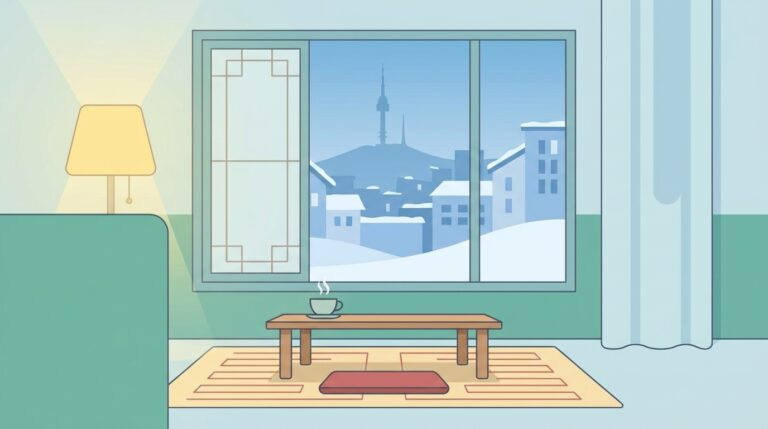
Winter Is Coming! How to Survive Korea’s Brutal Cold Waves Like a True Seoulite
Phase 1: Empathy — Waking Up in a Frozen K-Drama
안녕하세요! (An-nyeong-ha-se-yo! “Hello!”) It’s your favorite Korean big sister and chief editor of Daily Hangul.
Picture this: You fell in love with Korean winters through gorgeous K-Dramas like Goblin or Crash Landing on You. You imagined yourself walking through softly falling snow in a stylish trench coat, sharing a warm cup of sweet potato latte with someone special.
Then, January hits Seoul.
Suddenly, the temperature drops to -15°C (5°F), the Siberian wind hits your face like a physical slap, and your phone buzzed violently with a loud, ominous siren sound. It’s an emergency alert: 한파주의보 (Han-pa-ju-ui-bo — Cold Wave Warning).
You rush to turn on the tap, but only a depressing silence greets you. Your pipes are frozen. This is the ultimate Korean winter rite of passage: 동파 (Dong-pa — Frozen/Burst Pipes).
This happened to one of my lovely B2 students, Sarah from Los Angeles. She woke up shivering in her cozy Mapo-gu officetel, unable to brush her teeth or take a shower, completely lost in a sea of Korean boiler buttons. Today, we are going to make sure that never happens to you. By the end of this guide, you won’t just survive the brutal Korean winter; you’ll talk about it, prepare for it, and conquer it like a true local. Let’s dive in! ❄️
Phase 2: Deep Dive into 3 Core Winter Expressions
To navigate a Korean winter without freezing your toes (or your wallet), you need to master these three survival phrases.
1. 한파주의보 (Han-pa-ju-ui-bo)
- Pronunciation: [han-pa-ju-ui-bo] / Sound-alike: “Hahn-pah-joo-ee-boh”
- Meaning: Cold Wave Warning / Alert
- K-Culture Moment: You will see this word flash across the subway screens, on news broadcasts, and as a loud push notification on your phone. When a “한파주의보” is issued, it means the temperature is expected to drop by more than 10°C overnight to below -12°C.
- Editor’s Insight: If a Korean friend sends you a KakaoTalk message saying, “오늘 한파주의보래요!” (They say there’s a cold wave warning today!), they aren’t just making small talk. It is a warm, caring signal telling you to wear your long padding jacket (롱패딩).
- Situation Spectrum:
- Friends/Casual: ✅
- Coworkers/Semi-formal: ✅
- Boss/Formal: ✅ (Everyone uses this official term!)
- 🤔 Think About It: Why does Korean culture place such a high priority on sharing weather warnings? In Korea, checking in on someone’s physical comfort during harsh weather is a fundamental way of showing Jeong (정 — affection and care).
2. 동파 방지 (Dong-pa Bang-ji)
- Pronunciation: [dong-pa bang-ji] / Sound-alike: “Dong-pah-bahng-jee”
- Meaning: Prevention of frozen/burst water pipes (literally, “Freeze-burst prevention”).
- K-Culture Moment: Look around the hallways of any Korean apartment building in December, and you will see boxes stuffed with old blankets or bubble wrap covering the water meters. This is the nationwide ritual of 동파 방지.
- Editor’s Insight: 동파 is a nightmare. If your water meter bursts, you have to pay for repairs, and you won’t have running water for days. To prevent this, Koreans leave their taps dripping slightly when they go to bed or leave the house during a cold wave.
- Situation Spectrum:
- Friends/Casual: ✅ (e.g., “너 동파 조심해!” – Be careful of frozen pipes!)
- Coworkers/Semi-formal: ✅
- Landlord/Formal: ✅ (You will definitely hear this from your landlord!)
3. 외출 모드 (Oe-chul Mo-deu)
- Pronunciation: [oe-chul mo-deu] / Sound-alike: “Way-chool moh-deu”
- Meaning: Boiler “Outing / Away” Mode.
- K-Culture Moment: On every Korean floor-heating (온돌 – Ondol) controller, there is a button that says 외출 (Oe-chul – Outing).
- Editor’s Insight: Many foreigners make the mistake of turning off their boiler completely when they go out to save money. Do not do this! If you turn it off during a 한파, the pipes will freeze. Leaving it on “외출 모드” keeps the water temperature just warm enough to prevent freezing while consuming minimal gas.
- Situation Spectrum:
- Friends/Casual: ✅
- Coworkers/Semi-formal: ✅
- Boss/Formal: ✅
- 🤔 Think About It: The concept of keeping a home “alive” even when you are absent shows the deep connection Koreans have with their living spaces. The house is a system that needs constant care.
Phase 3: Textbook Korean vs. Real Korean Showcase
Let’s look at how textbooks teach winter expressions versus how actual Koreans scream them in the streets.
Scenario 1: Expressing how freezing it is
- 📖 Textbook Korean: “오늘 날씨가 아주 춥습니다.” (Today the weather is very cold.)
- 🗣️ Real Korean: “오늘 날씨 진짜 미쳤어요! 귀가 떨어져 나갈 것 같아요!” (Today’s weather is seriously crazy! I feel like my ears are going to fall off!)
- 💡 Why the difference?: Textbook Korean is polite but dry. Real Koreans use dramatic, sensory-rich expressions. Saying your ears are falling off (귀가 떨어져 나가다) is the standard way to complain about the biting winter wind.
Scenario 2: Warning someone about icy streets
- 📖 Textbook Korean: “길이 미끄러우니 조심하십시오.” (Please be careful as the road is slippery.)
- 🗣️ Real Korean: “길 다 얼었으니까 조심해서 걸어요. 빙판길 대박이에요.” (Since the roads are completely frozen, walk carefully. The icy roads are crazy intense.)
- 💡 Why the difference?: Koreans love using the word 빙판길 (Bing-pan-gil — icy road) and the slang 대박 (Dae-bak — crazy/awesome/intense) to emphasize how dangerous the walking conditions are after a snowstorm.
Phase 4: K-Culture Deep Dive & Non-verbal Manners
4-1. Winter Body Language & Social Etiquette
- The Shiver and Huddle: In Korea, when you walk outside in the winter, it is socially acceptable (and expected) to hunch your shoulders and walk quickly. But here is the golden rule: keep your hands out of your pockets when walking on icy stairs! It’s a matter of safety.
- The Hot Pack Share: If you have a hand warmer (핫팩 – Hat-paek), shaking it up and gently pressing it against your friend’s cold cheek or placing it in their coat pocket is an incredibly intimate, caring gesture of Jeong (정).
4-2. Cultural Code: Ondol and Winter Street Food
- 온돌 (Ondol): Unlike Western heating that warms the air, Korea’s traditional heating warms the floor. This is why Koreans historically sit, eat, and sleep on the floor. In winter, coming home to a warm ondol floor is like being hugged by your house.
- 붕어빵 (Bungeoppang) Solidarity: When the cold hits, tiny street carts pop up selling bungeoppang (sweet red bean/custard fish-shaped pastries) and steaming eomuk (fish cake) soup. Standing around a red tent, sipping free fish cake broth, is how locals stay warm. Always keep 3,000 KRW in cash in your pocket for these winter emergencies!
Phase 5: Interactive Winter Survival Roleplay
The Setting: It’s 8:00 AM on a Friday. The temperature outside is -14°C. You are walking down the hallway of your apartment building in Seoul, clutching your long padding coat tightly. You run into Auntie Kim (김 선배 / Kim Sunbae), the friendly but intense building manager.
Cast:
- You (An expat living in Seoul)
- Kim Sunbae (The experienced building manager)
Dialogue:
- Kim Sunbae: (🎭 Frowning while wrapping an old sweater around a pipe) “어휴, 날씨 진짜 미쳤네! 오늘 한파주의보 내린 거 알아요?”
- Eohyu, nal-ssi jin-jja mi-chyeon-ne! O-neul han-pa-ju-ui-bo nae-rin geo a-ra-yo?
- “Whew, today’s weather is seriously crazy! Did you know a cold wave warning was issued today?”
- You: (🎭 Shivering, rubbing your hands together) “네, 아침에 재난문자 받았어요. 너무 추워요!”
- Ne, a-chim-e jae-nan-mun-ja ba-dat-seo-yo. Neo-mu chu-wo-yo!
- “Yes, I got the emergency disaster text this morning. It’s so cold!”
- Kim Sunbae: (🎭 Pointing toward the hallway floor) “물은 잘 나와요? 혹시 계량기 안 얼었나 확인해 봐요.”
- Mul-eun jal na-wa-yo? Hok-shi gye-ryang-gi an eo-reot-na hwa-gin-hae bwa-yo.
- “Is the water running okay? Check if your water meter isn’t frozen, just in case.”
- You: (🎭 Looking confused) “물은 나오는데… 계량기 확인은 어떻게 해요?”
- Mul-eun na-o-neun-de… gye-ryang-gi hwa-gin-eun eo-tteo-ke hae-yo?
- “The water is coming out… but how do I check the water meter?”
- Kim Sunbae: (🎭 Clicking her tongue warmly) “복도에 있는 파란 문 열어봐요. 거기에 헌 옷이나 에어캡 꼭 넣어둬야 동파 방지가 돼요!”
- Bok-do-e in-neun pa-ran mun yeo-reo-bwa-yo. Geo-gi-e heon ot-i-na e-eo-kaep kkok neo-eo-dwo-ya dong-pa bang-ji-ga dwae-yo!
- “Open the blue door in the hallway. You must put old clothes or bubble wrap in there to prevent the pipes from freezing and bursting!”
- You: (🎭 Nodding vigorously) “아, 그렇구나! 집에 안 입는 티셔츠 많은데 바로 넣어야겠어요.”
- Ah, geu-reot-gu-na! Jib-e an im-neun ti-syeo-cheu man-eun-de ba-ro neo-eo-ya-get-seo-yo.
- “Ah, I see! I have plenty of t-shirts I don’t wear, I should put them in right away.”
- Kim Sunbae: (🎭 Leaning in closer) “그리고 주말에 부산 여행 간다면서요? 보일러 절대 끄고 가면 안 돼요!”
- Geu-ri-go ju-mal-e Bu-san yeo-haeng gan-da-myeon-seo-yo? Bo-il-reo jeol-dae kkeu-go ga-myeon an dwae-yo!
- “Also, didn’t you say you’re traveling to Busan this weekend? You must never turn off your boiler completely when you go!”
- You: (🎭 Surprised) “어? 보일러 끄고 가면 가스비 절약되지 않나요?”
- Eo? Bo-il-reo kkeu-go ga-myeon ga-seu-bi jeol-yak-doe-ji an-na-yo?
- “Oh? If I turn off the boiler, wouldn’t I save on the gas bill?”
- Kim Sunbae: (🎭 Waving her hands in panic) “아이고! 끄고 갔다가 배관 얼어서 터지면 수리비가 몇십만 원 나와요! 큰일 나!”
- Ai-go! Kkeu-go gat-da-ga bae-gwan eo-reo-seo teo-ji-myeon su-ri-bi-ga myeot-sip-man won na-wa-yo! Keun-il na!
- “Oh my goodness! If you turn it off, the pipes will freeze and burst, and repairs will cost hundreds of thousands of won! That’s a huge disaster!”
- You: (🎭 Eyes wide with realization) “헐, 진짜요? 그럼 어떻게 해놓고 가야 해요?”
- Heol, jin-jja-yo? Geu-reom eo-tteo-ke hae-no-ko ga-ya hae-yo?
- “Heol, really? Then how should I leave it set before I go?”
🔀 Decision Point: What is your response to Kim Sunbae?
- A. “그냥 보일러 온도를 30도로 세게 틀어놓고 갈게요!” (I’ll just leave the boiler temperature high at 30°C!)
- B. “보일러 조절기에서 ‘외출’ 모드로 설정해 놓고 갈게요.” (I will set the boiler controller to ‘Outing’ (Away) mode.)
- C. “수돗물을 완전히 잠그고 갈게요.” (I’ll turn off the main water valve completely.)
💡 Choices Analysis:
- Best Choice: B. Setting your boiler to 외출 (Oe-chul) keeps the temperature at a baseline of around 8–12°C. This uses very little gas but guarantees your pipes won’t freeze. Kim Sunbae will pat you on the back and call you a smart foreigner!
- Bad Choice: A. Keeping it at 30°C for three days will prevent freezing, but you will receive a gas bill of over 200,000 KRW ($150 USD) next month. Ouch!
- Risk Choice: C. Just shutting off the valve without leaving heat on doesn’t prevent the water already inside the pipe from freezing and cracking the pipes.
Phase 6: 10-Second Emotion Shadowing Drill
Let’s practice speaking with real Korean emotion. Read these aloud, mimicking the feelings in the brackets. The slash / represents a natural breathing pause.
1. [😤 Shivering and dramatic — complaining to a friend]
- Korean: “오늘 날씨 진짜 미쳤어! / 귀가 떨어져 나갈 것 같아!”
- Pronunciation: O-neul nal-ssi jin-jja mi-cheot-seo! / Gwi-ga tteo-reo-jyeo na-gal geot ga-ta!
- English: “Today’s weather is seriously crazy! My ears feel like they’re falling off!”
2. [🥺 Worried and caring — advising your partner]
- Korean: “날씨 너무 추운데 / 보일러 외출로 해놨어? / 동파되면 안 돼!”
- Pronunciation: Nal-ssi neo-mu chu-un-de / bo-il-reo oe-chul-ro hae-nwat-seo? / Dong-pa-doe-myeon an dwae!
- English: “The weather is so cold, did you set the boiler to ‘Away’ mode? We can’t let the pipes freeze!”
Phase 7: K-Culture Mini Dictionary
| Word (Hangul / Romanization) | English Translation | Real-world Context & Usage |
|---|---|---|
| 온돌 (Ondol) | Underfloor heating | Korea’s traditional heating system. It’s why you take off your shoes at the entrance and love lying on the floor. |
| 핫팩 (Hat-paek) | Hand warmer / Hot pack | Sold at every convenience store for 1,000 KRW. Absolute winter lifesavers for outdoor walking. |
| 한파 (Han-pa) | Cold wave | Used in weather reports when Siberian winds bring freezing arctic air down to the Korean peninsula. |
| 동파 (Dong-pa) | Frozen pipe bursting | The worst-case winter scenario. Everyone’s landlord will text about this at least twice a year. |
Phase 8: Traveler’s Winter Survival Kit
If you are visiting Korea during the winter months (December to February), keep these survival tools ready!
Survival Phrases TOP 3
- “따뜻한 물 잘 나와요?” (Dda-tteut-han mul jal na-wa-yo?)
- Pro Tip: Ask your hotel or Airbnb host this immediately if you suspect the cold wave is affecting the building.
- “여기에 핫팩 있어요?” (Yeo-gi-e hat-paek it-seo-yo?)
- Pro Tip: Walk into any CU, GS25, or 7-Eleven and say this to find the hand warmers immediately.
- “수돗물 조금 틀어놓으세요.” (Su-dot-mul jo-geum teu-reo-no-seu-yo.)
- Pro Tip: Tell your roommates or housemates to let the tap drip when leaving overnight.
📌 Editor’s Travel Note:
- Emergency App: Download the official Safety Korea (안전디딤돌) App on Google Play to receive real-time weather alerts in English.
- Transit Tip: Subway and bus seats in Seoul are heated! If you are freezing, hop onto a Seoul bus or subway car; the seats will warm your body instantly.
Phase 9: Think Deeper — “The Shared Warmth of Korea”
Korean winter is physically brutal, but culturally, it is incredibly warm. The traditional concept of Ondol goes beyond physical engineering; it shaped how Koreans bond. In ancient times, the entire family would gather on the warmest spot of the floor (called 아랫목 – A-raet-mok), sharing a single blanket and eating roasted sweet potatoes.
Today, you see this legacy in how communities handle 한파 and 동파. Neighborly love in Korea looks like leaving blankets in public pipe areas, and landlords checking in on foreign students to make sure they aren’t shivering.
💬 Your Turn: How does your home country deal with extreme winter weather? Do you have unique heating systems or community rituals like Korea? Let us know in the comments below!
Phase 10: FAQ & Mistake Prevention
Q: What should I do if my water is already frozen (동파)?
A: Do not pour boiling water directly onto frozen pipes! This can cause the pipes to crack or burst. Instead, wrap the frozen pipe or faucet with a warm wet towel, and use a hairdryer on a low-warm setting to gently melt the ice.
Q: Will leaving the water dripping result in a massive water bill?
A: No. Letting the faucet drip a tiny bit (about a thin stream of water) costs almost nothing compared to the hundreds of thousands of won you would pay to replace a burst water meter.
Q: Can I just leave the boiler on “Sleep Mode” (취침) instead of “Away Mode” (외출)?
A: “Sleep Mode” keeps the floor warm for you to sleep comfortably, which uses more gas. “Away Mode” is designed specifically to run at the absolute minimum energy required to prevent freezing.
🚨 Common Mistakes Alert!
- The ‘Off’ Trap: Turning the boiler completely off when traveling. (Correction: Always set it to 외출 (Oe-chul).)
- The Boiling Water Mistake: Pouring hot boiling water on frozen meters. (Correction: Use lukewarm water or a hairdryer.)
- Ignoring the Hallway Closet: Forgetting to pack the outdoor water meter cabinet with insulation. (Correction: Stuff it with bubble wrap or old winter clothes.)
Phase 11: Action Missions
- 🥉 Bronze (Mirror Challenge): Look in the mirror and practice saying: “오늘 날씨 미쳤어! 귀가 떨어져 나갈 것 같아!” with high-intensity shivering acting.
- 🥈 Silver (Network Challenge): Take a photo of your cozy winter setup (tea, blanket, or boiler controller) and post it on your Instagram Story or Twitter with the hashtag
#DailyHanguland the caption: “동파 방지 완료!” (Freeze prevention complete!) - 🥇 Gold (Real-Life Challenge): Walk to your local convenience store, find the hot pack section, and purchase one using only Korean: “핫팩 어디 있어요?”
Phase 12: Interactive Quiz Challenge
1. Which boiler mode should you use when leaving your house for a winter weekend trip?
a) 온수 (Only Hot Water)
b) 취침 (Sleep)
c) 외출 (Outing/Away)
View Answer & Explanation
Correct Answer: c) 외출 (Outing/Away)
Explanation: This mode keeps the temperature of the pipes just above freezing using minimal gas, protecting your house from 동파 (pipe bursting) while keeping your utility bill low!
2. True or False: If your pipes freeze, you should immediately pour boiling water on them.
- True
- False
View Answer & Explanation
Correct Answer: False
Explanation: Pouring boiling water directly on frozen metal or plastic pipes can cause thermal shock, causing them to crack. Always use lukewarm water, warm towels, or a hairdryer!
3. Translate: “I feel like my ears are going to fall off!”
View Answer & Explanation
Correct Answer: 귀가 떨어져 나갈 것 같아요! (Gwi-ga tteo-reo-jyeo na-gal geot ga-ta-yo!)
Explanation: This is the ultimate, natural idiomatic phrase used by Koreans to express the biting winter cold.







