

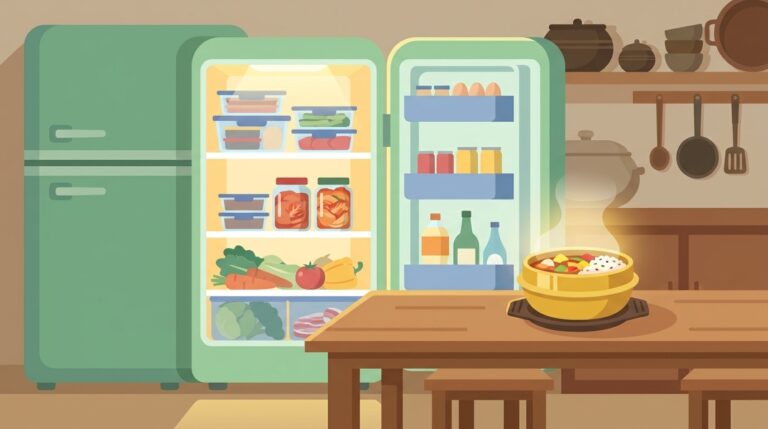
Turn Your Empty Korean Fridge into a Gourmet K-Drama Feast: Master the Art of Naeng-teol!
Phase 1: Empathy (Welcome to the Fridge-Raiding Club!)
안녕하세요! (An-nyeong-ha-se-yo!) Your friendly Korean neighborhood tutor and local culture navigator is here!
Imagine this: You come home after a long, exhausting day of exploring the bustling streets of Seoul or finishing a grueling Korean class. You’re starving, but your feet are sore, and your wallet is crying. You drag yourself to the refrigerator, swing the door open, and… sigh. All you see is a half-empty jar of kimchi, a lonely block of tofu, some leftover rice from yesterday, and a single slice of American cheese.
In a typical Western context, you might sigh and order delivery. But if you’ve watched K-Dramas, you know exactly what comes next. The main character takes out a giant stainless steel basin, throws all those seemingly mismatched leftovers in with a massive dollop of Gochujang (고추장 – chili paste) and a drizzle of sesame oil, and aggressively mixes it while venting about their day.
In Korea, we don’t look at an empty fridge and see nothing. We see opportunity.
Today, we are going to learn the high-yield, super-authentic intermediate phrases that will help you talk about this culinary magic trick. Whether you are living in Korea trying to explain your dinner to your roommates or chatting with Korean friends on social media, these expressions will make you sound incredibly natural, witty, and culturally savvy. Let’s dive in!
Phase 2: Deep Dive into 3 Core Expressions
To master the art of survival cooking, you need these three essential expressions in your linguistic toolkit.
1. 냉장고를 털다 (Naeng-jang-go-reul teol-da)
- Pronunciation: [naeng-jang-go-reul teol-da] / Sound-alike: “Nang-jahng-go rule tuhl-dah”
- Meaning: Literally “to rob/burglarize the refrigerator.” In reality, it means “to empty/clear out the fridge to make a meal.”
- K-Culture Moment: You’ll hear this constantly on Korean variety shows like Please Take Care of My Refrigerator (냉장고를 부탁해) or Mukbang channels. It carries a fun, playful vibe of “raiding” your own kitchen.
- Editor’s Insight: The verb 털다 (teol-da) means to dust off or rob. When you say you are “robbing” your fridge, you aren’t doing anything illegal—you’re just declaring war on food waste!
- Situation Spectrum:
- Friends & Casual (반말): ✅ (e.g., “오늘 냉장고 털자!”)
- Coworkers & Semi-formal (존댓말): ✅ (e.g., “오늘 저녁은 냉장고 털어서 요리하려고요.”)
- Boss & Strict Formal: ⚠️ (Slightly too slangy; use “냉장고에 남은 재료를 정리하다” instead.)
- 🤔 Think About It: In English, we might say “scavenging the fridge.” Why do you think Koreans use the active, almost dramatic verb “to rob” (털다) for this simple chore? Does your native language have an equally dramatic expression?
2. 남은 재료로 대충 만들다 (Nam-eun jae-ryo-ro dae-chung man-deul-da)
- Pronunciation: [nam-eun jae-ryo-ro dae-chung man-deul-da] / Sound-alike: “Nahm-eun jae-ryo-roh dae-choong mahn-deul-dah”
- Meaning: To whip something up roughly/carelessly with leftover ingredients.
- K-Culture Moment: This is the ultimate humble-brag. In K-Dramas, when a friend drops by unexpectedly, the host might throw together a gorgeous noodle dish in five minutes and say, “대충 만들었어” (I just threw it together roughly), while it actually tastes like heaven.
- Editor’s Insight: The magic word here is 대충 (dae-chung). While dictionaries translate it as “carelessly” or “half-heartedly,” in casual cooking, it actually means “effortlessly” or “without a strict recipe.” It’s the hallmark of a confident home cook!
- Situation Spectrum:
- Friends & Casual (반말): ✅ (e.g., “대충 만들어 먹었어.”)
- Coworkers & Semi-formal (존댓말): ✅ (e.g., “그냥 남은 걸로 대충 만들었어요.”)
- Boss & Strict Formal: 🚫 (Can sound like you don’t care about quality.)
- 🤔 Think About It: How does “대충” shift from a negative word (slacking off) to a positive sign of cooking mastery? Reflect on how tone of voice changes this word’s meaning.
3. 한 끼 때우다 (Han kki ttae-u-da)
- Pronunciation: [han kki ttae-u-da] / Sound-alike: “Hahn kkee ttae-oo-dah”
- Meaning: To scrape by/tide over with a quick, simple, or low-effort meal.
- K-Culture Moment: Think of convenience store lunches or eating cold rice mixed with water and side dishes when you’re too lazy to turn on the stove.
- Editor’s Insight: The verb 때우다 (ttae-u-da) originally means to patch up a hole or solder a metal joint. Therefore, “한 끼 때우다” literally means “to patch up a meal gap.” It implies you aren’t having a luxurious dining experience; you’re just filling your stomach so you can keep going.
- Situation Spectrum:
- Friends & Casual (반말): ✅ (e.g., “점심 대충 라면으로 때웠어.”)
- Coworkers & Semi-formal (존댓말): ✅ (e.g., “오늘 저녁은 대충 때우려고요.”)
- Boss & Strict Formal: ⚠️ (Can make you sound a bit pitiful or unprofessional if used in a formal lunch invitation.)
- 🤔 Think About It: Koreans are extremely passionate about food (often greeting each other with “Have you eaten?”). Why do you think a culture so obsessed with proper dining developed such a vivid, industrial term like “patching up a meal”?
Phase 3: Textbook Korean vs. Real-World Korean
When you study with standard textbooks, you learn polite, grammatically perfect, but sometimes incredibly robotic sentences. Let’s see how native speakers actually talk when they want to clean out the fridge.
Scenario 1: Suggesting a leftover meal to a roommate
- 📖 Textbook Korean: “집에 음식이 없으니 남은 재료로 요리합시다.”
(Ji-be eum-si-gi eop-seu-ni nam-eun jae-ryo-ro yo-ri-hap-si-da.)
Translation: “Since there is no food at home, let us cook with the remaining ingredients.” - 🗣️ Real Korean: “우리 오늘 냉털해서 대충 때우자!”
(U-ri o-neul naeng-teol-hae-seo dae-chung ttae-u-ja!)
Translation: “Let’s just do a ‘fridge raid’ and throw something quick together today!” - 💡 Why is it different? Koreans love efficiency and trendy abbreviations. 냉털 (Naeng-teol) is the ultimate modern slang for 냉장고 털기 (fridge-emptying). It sounds warm, active, and fun!
Scenario 2: Explaining what you made for dinner to a friend
- 📖 Textbook Korean: “남은 야채와 밥을 볶아서 비빔밥을 만들었습니다.”
(Nam-eun ya-chae-wa ba-beul bok-ga-seo bi-bim-ba-beul man-deul-eot-seum-ni-da.)
Translation: “I fried the remaining vegetables and rice to make bibimbap.” - 🗣️ Real Korean: “냉장고에 남은 야채 다 때려 넣고 비벼 먹었어.”
(Naeng-jang-go-e nam-eun ya-chae da ttae-ryeo neot-go bi-byeo meog-eot-seo.)
Translation: “I just dumped every single leftover vegetable from the fridge in there and mixed it up.” - 💡 Why is it different? The verb 때려 넣다 (ttae-ryeo neot-da) literally means “to beat and put in,” but colloquially, it means to throw ingredients in aggressively and generously. It paints a vivid, humorous picture of dynamic home cooking!
Phase 4: K-Culture Deep Dive & Non-Verbal Manners
4-1. Nunchi (눈치) & Table Manners for Leftovers
Even when cooking with leftovers, Korean Nunchi (tact/situational awareness) and social dynamics still apply!
If you are making a “fridge empty” meal for someone else (even a close friend or partner), always present it with a touch of humility. Serving a dish and saying “I made this masterpiece for you!” can feel a bit boastful. Instead, say:
“냉장고에 남은 게 별로 없어서… 입에 맞을지 모르겠네요.”
(There wasn’t much in the fridge… I hope it suits your taste.)
This classic Korean modesty makes the guest feel respected, and when they taste how delicious your Naeng-teol creation is, they will be twice as impressed!
4-2. The Soul of the “Yang-eun Nembi” (양은냄비)
Have you ever wondered why K-Drama characters always eat leftover bibimbap or ramyun out of a beaten-up, yellow nickel-silver pot (양은냄비) or a giant steel bowl?
These lightweight pots heat up almost instantly, making them perfect for fast cooking. But culturally, they represent comfort, nostalgia, and zero pretension. Mixing leftovers in a giant pot and sharing it with spoons directly (a common communal dining practice) is a sign of ultimate intimacy (Jeong / 정). If someone invites you to eat Naeng-teol bibimbap directly from the pot with them, congratulations—you have officially entered their inner circle!
Phase 5: The Interactive Roleplay Scenario
The Setting: It’s a rainy Sunday evening in your cozy Seoul sharehouse. The sound of rain patters against the window. Your stomach rumbles loudly. You walk to the kitchen and bump into your Korean roommate, Minjun (민준), who is staring blankly into the open refrigerator.
Characters:
* You: A hungry, slightly tired expat looking for a quick bite.
* Minjun (민준): Your warm, energetic roommate who can create gourmet dishes out of thin air.
The Dialogue
- You:
민준 씨, 배 안 고파요? 저녁 뭐 먹을 거예요?
(Min-jun ssi, bae an go-pa-yo? Jeo-nyeok mwo meog-eul geo-yeo-yo?)
“Minjun, aren’t you hungry? What are you having for dinner?” -
Minjun (🎭 Holding his chin, looking disappointed):
아, 배고파서 냉장고 보고 있었는데… 먹을 게 진짜 없네요.
(A, bae-go-pa-seo naeng-jang-go bo-go is-seot-neun-de… meog-eul ge jin-jja eop-ne-yo.)
“Ah, I was looking inside because I’m hungry… but there’s seriously nothing to eat.” -
You:
배달 시켜 먹을까요?
(Bae-dal si-kyeo meog-eul-kka-yo?)
“Should we order delivery?” -
Minjun (🎭 Shaking his head while pointing at a few items):
오늘 배달은 너무 늦게 올 것 같아요. 어? 여기 먹다 남은 삼겹살 조금이랑 시든 상추가 있네요!
(O-neul bae-dal-eun neo-mu neut-ge ol geot gat-a-yo. Eo? Yeo-gi meog-da nam-eun sam-gyeop-sal jo-geum-i-rang si-deun sang-chu-ga in-ne-yo!)
“I think delivery will take too long today. Huh? Look, there’s a tiny bit of leftover pork belly and some slightly wilted lettuce here!” -
You:
어! 찬밥도 두 공기 있어요. 이걸로 요리할 수 있어요?
(Eo! Chan-bap-do du gong-gi is-seo-yo. I-geol-ro yo-ri-hal su is-seo-yo?)
“Oh! There are also two bowls of cold rice. Can we cook something with this?” -
Minjun (🎭 Eyes lighting up with a mischievous grin):
그럼요! 우리 오늘 냉털 한 번 제대로 해볼까요?
(Geu-reom-yo! U-ri o-neul naeng-teol han beon jae-dae-ro hae-bol-kka-yo?)
“Of course! Shall we do a proper ‘fridge raid’ today?” -
You:
좋아요! 제가 뭘 도우면 돼요?
(Jo-a-yo! Je-ga mwol do-u-myeon dwae-yo?)
“Great! What can I do to help?” -
Minjun (🎭 Handing you a knife and a cutting board):
그럼 야채랑 남은 재료들을 다 작게 썰어 주세요.
(Geu-myeon ya-chae-rang nam-eun jae-ryo-deul-eul da jak-ge sseol-eo ju-se-yo.)
“Then please chop up the vegetables and leftovers into small pieces.” -
You (🎭 Chopping quickly):
다 썰었어요! 이제 프라이팬에 다 넣어요?
(Da sseol-eot-seo-yo! I-je peu-ra-i-paen-e da neo-heo-yo?)
“Done chopping! Do we put everything in the frying pan now?” -
Minjun (🎭 Pouring oil on the hot pan with style):
네! 여기 고추장이랑 참기름도 때려 넣고 같이 볶으면 끝이에요!
(Ne! Yeo-gi go-chu-jang-i-rang cham-gi-reum-do ttae-ryeo neot-go gat-i bok-eum-myeon kkeut-i-e-yo!)
“Yes! Just throw in some red chili paste and sesame oil generously, fry it all up, and we’re done!”
🔀 Decision Point: What do you say when Minjun presents the finished fried rice?
- A: “와! 남은 재료로 대충 만들었는데 진짜 맛있어 보여요!”
- B: “이거 너무 대충 만들어서 먹기 싫어요.”
- C: “냉장고를 털어서 감옥에 가고 싶지 않아요.”
🏆 Best Choice Analysis:
- A is the PERFECT answer! “와! 남은 재료로 대충 만들었는데 진짜 맛있어 보여요!” (Wow! You whipped this up so quickly with leftovers, but it looks absolutely delicious!)
Using “대충 만들다” here highlights Minjun’s effortless culinary skills. It is a wonderful compliment that feels incredibly native.
🚨 Bad/Risk Choice Analysis:
- If you chose B: (“I don’t want to eat this because you made it so carelessly.”) Oh dear! You misused the nuance of “대충.” Here, it sounds like you are insulting his effort. Minjun might eat the fried rice all by himself!
- If you chose C: (“I don’t want to go to jail for robbing the fridge.”) You took “냉장고를 털다” way too literally! Don’t worry, the kitchen police won’t arrest you for making fried rice.
Phase 6: 10-Second Emotion Shadowing Drill
Let’s put some soul into your pronunciation! Practice these sentences by focusing on the emotional markers and pauses (/).
- [🥺 Exhausted and lazy – after a long workday]
- “오늘 저녁은 / 그냥 / 대충 때우자…”
- [O-neul jeo-nyeok-eun / geu-nyang / dae-choong ttae-oo-jah…]
- “Let’s just… whip up something simple… for dinner tonight…”
- [😊 Excited and proud – looking at a surprisingly gourmet leftover dish]
- “대박! / 냉털한 것치고 / 너무 맛있는데?!”
- [Dae-bak! / Naeng-teol-hahn geot-chee-go / neo-moo mah-sit-neun-deh?!]
- “Awesome! For a fridge-clearing meal, this is insanely delicious!”
Phase 7: K-Culture Mini Dictionary
| Word (한글/Romanization) | English Meaning | Cultural Context & Usage |
|---|---|---|
| 냉털 (Naeng-teol) | Fridge-emptying | A cute compound slang of 냉장고 (fridge) + 털기 (robbing/emptying). Used widely on Instagram under hashtags like #냉털요리 to show off creative leftover meals. |
| 때려 넣다 (Ttae-ryeo neot-da) | To throw/dump in | Highly expressive cooking slang. It evokes the image of throwing ingredients into a pot quickly and generously without measuring. |
| 대충 (Dae-chung) | Effortlessly / Roughly | While technically meaning “carelessly,” in everyday life, it often implies doing something quickly and practically without fuss. |
| 집밥 (Jip-bap) | Home-cooked meal | More than just food, “집밥” represents comfort, warmth, and maternal love. Even a simple leftover meal can feel like warm jip-bap. |
Phase 8: Traveler’s Survival Kit
Even if you are staying in a hotel or guesthouse, you can still survive like a local. Here are 3 vital phrases to carry with you:
Survival Cards
- “이거 냉장고에 넣어 주실 수 있나요?”
- [I-geo naeng-jang-go-e neo-eo ju-sil su in-na-yo?]
- Pro Tip: If you bought some food from a market or convenience store but your hostel room doesn’t have a fridge, use this polite phrase to ask the staff to store it for you.
- “남은 음식 포장해 주세요.”
- [Nam-eun eum-sik po-jang-hae ju-se-yo.]
- Pro Tip: Korean restaurant portions can be massive. Don’t waste it! Pack it up, take it home, and it will become the perfect star ingredient for your next Naeng-teol session.
- “대충 빨리 먹을 수 있는 걸로 추천해 주세요.”
- [Dae-chung ppal-li meog-eul su in-neun geol-ro chu-cheon-hae ju-se-yo.]
- Pro Tip: Use this at street food stalls or small diners (Bunsikjip) when you are in a rush and just need to patch up a meal (한 끼 때우다).
📌 Editor’s Travel Note
When navigating food in Korea, don’t rely on Google Maps (which is often outdated due to local security regulations). Instead, download the Naver Map App Download Page to find local grocery stores (Mart / 마트) near your location. If you want to order food but are too tired to cook or do Naeng-teol, download the Baedalui Minjok App Store page to experience Korea’s legendary 24/7 delivery culture.
Phase 9:
Frequently Asked Questions (FAQ)
Q: What does "냉장고를 털다 (Naeng-jang-go-reul teol-da)" mean in Korean and how do you pronounce it?
A: In Korean, "냉장고를 털다 (Naeng-jang-go-reul teol-da)" is pronounced [naeng-jang-go-reul teol-da] and means: Literally "to rob/burglarize the refrigerator." In reality, it means "to empty/clear out the fridge to make a meal."
Q: What does "남은 재료로 대충 만들다 (Nam-eun jae-ryo-ro dae-chung man-deul-da)" mean in Korean and how do you pronounce it?
A: In Korean, "남은 재료로 대충 만들다 (Nam-eun jae-ryo-ro dae-chung man-deul-da)" is pronounced [nam-eun jae-ryo-ro dae-chung man-deul-da] and means: To whip something up roughly/carelessly with leftover ingredients.
Q: What does "한 끼 때우다 (Han kki ttae-u-da)" mean in Korean and how do you pronounce it?
A: In Korean, "한 끼 때우다 (Han kki ttae-u-da)" is pronounced [han kki ttae-u-da] and means: To scrape by/tide over with a quick, simple, or low-effort meal.







