

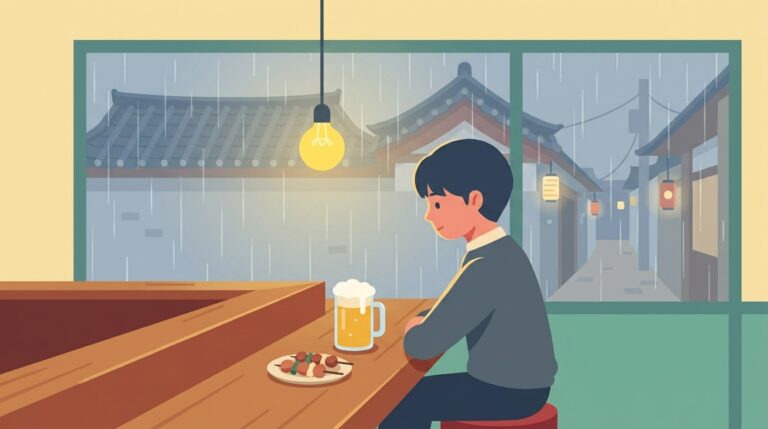
How to Enjoy Honsul like a Local: Your Guide to Solo Drinking in Korea
Phase 1: Empathy (Welcome, Solo Explorer!)
안녕하세요! (Annyeonghaseyo!) I’m your lead editor at Daily Hangul, and your personal Korean culture guide.
Imagine this: You’ve spent a magical but exhausting day exploring the neon-lit alleys of Hongdae. Your feet are tired, and you crave a crispy, golden plate of Korean fried chicken and a freezing cold draft beer. You spot a lively pub, but as you peek inside, you see groups of friends laughing loudly and sharing massive plates.
You hesitate. “Can I go in alone? Is it weird to drink by myself here? Will they even serve me?”
If you have ever felt this wave of social anxiety in Korea, you are not alone! Many of my intermediate students tell me they ended up eating instant noodles in their hotel rooms because they felt too intimidated to walk into a pub by themselves.
But here is the exciting truth: Korea is currently in the middle of a massive lifestyle shift. The rise of one-person households (1인 가구 – il-in gagu) has birthed an incredibly trendy, therapeutic culture called 혼술 (Honsul – solo drinking). Learning how to navigate this world won’t just save you from hunger; it will unlock a deeply relaxing, authentic side of Korean life that most tourists completely miss. Let’s learn how to do it with confidence and flair!
Phase 2: Core Phrases Deep Dive
Here are the three most essential expressions you need to master the art of solo drinking in Korea.
1. 혼술 (Honsul)
- Pronunciation: [hon-sul] / Sound-alike guide: “Hon” (like the first syllable of ‘honey’) + “sul” (like ‘soul’ with a short ‘u’ sound).
- Meaning: Solo drinking (Literal: Alone [혼자] + Alcohol [술]).
- K-Culture Moment: This term became nationwide news through the hit K-Drama Drinking Solo (혼술남녀), which highlighted how young Koreans use quiet drinking sessions to heal from intense study and work pressure.
- Editor’s Insight: Saying you enjoy “혼술” doesn’t mean you are lonely. In Korea today, it signals that you are an independent, stylish person who knows how to enjoy quality “me-time.”
- Situation Spectrum:
- Friends & Casual: ✅
- Co-workers & Semi-formal: ✅
- Bosses & Formal: ⚠️ (May sound slightly too casual to older superiors, but still acceptable in casual conversation).
- 🤔 Think About It: Why do you think modern Koreans combine words into two-syllable trends (like 혼밥 – solo eating, or 혼술 – solo drinking)? How does your own culture view drinking alone?
2. 혼자 왔는데 괜찮을까요? (Honja wanneunde gwaenchanheulkkayo?)
- Pronunciation: [hon-ja wan-neun-de gwaen-chan-heul-kka-yo?] / Sound-alike guide: “Hon-jah wan-noon-deh gwen-chan-hul-kah-yo?”
- Meaning: I came alone, is that okay?
- K-Culture Moment: Walking into a small, cozy neighborhood Izakaya (Japanese-style pub) or an Eojjeoda-bap집 (casual bistro) and politely asking the host this question.
- Editor’s Insight: Because traditional Korean food culture is deeply communal, some barbecue or hotpot places require a minimum of two portions. Asking this upfront with a polite smile shows incredible manners and saves you from any awkward moments.
- Situation Spectrum:
- Friends & Casual: ⚠️ (Too polite for close friends)
- Pub Owners & Staff: ✅
- High-end Bars: ✅
- 🤔 Think About It: By phrasing this as a soft question (“Would it be okay?”) rather than a demand (“Table for one”), you show respect for the restaurant’s system. How does the level of politeness in food service differ in your country?
3. 생맥주 한 잔이랑 [안주] 주세요 (Saengmaekju han jan-irang [anju] juseyo)
- Pronunciation: [seng-maek-ju han jan-i-rang [an-ju] ju-se-yo] / Sound-alike guide: “Seng-mek-joo han jahn-ee-rahng [ahn-joo] joo-seh-yo.”
- Meaning: Please give me a draft beer and some [drinking snacks].
- K-Culture Moment: Sitting at the bar counter, scanning the menu for Anju (안주 – snacks paired with alcohol) like French fries, dried squid, or chicken skewers, and ordering like a seasoned local.
- Editor’s Insight: In Korea, drinking alcohol almost always requires eating food (안주). Ordering just a drink without food is quite rare and might make the owner worry you’ll get drunk too fast!
- Situation Spectrum:
- Casual Pubs: ✅
- Semi-formal Diners: ✅
- Formal Lounges: ✅
- 🤔 Think About It: Why does Korean culture place such a high emphasis on pairing food with alcohol? (Hint: It keeps the stomach coated and makes social/solo drinking a healthier, longer activity!)
Phase 3: Textbook Korean vs. Real Korean
Sometimes, textbooks teach you phrases that make you sound like an instruction manual. Let’s see how real locals talk when they go out for a solo drink!
Scenario 1: Finding a seat at a cozy pub
- 📖 Textbook Korean: 일인용 좌석이 있습니까? (Is there a single-person seat?)
- 🗣️ Real Korean: 혼자 가볍게 한잔하러 왔는데, 어디 앉으면 될까요? (I just came for a quick, light drink by myself, where should I sit?)
- 💡 Why it’s different: The textbook version is too cold and rigid. The real version uses the friendly phrase “가볍게 한잔” (a light drink) which immediately relaxes the host and signals that you won’t take up a large table for too long.
Scenario 2: Ordering a small, solo-friendly snack
- 📖 Textbook Korean: 일인분 음식을 주문하고 싶습니다. (I want to order a one-person portion of food.)
- 🗣️ Real Korean: 여기 혼자 먹기 좋은 안주 추천해 주실 수 있나요? (Could you recommend a good snack to eat alone here?)
- 💡 Why it’s different: Many pub menus are designed for groups. By asking the host directly for a recommendation “good for eating alone” (혼자 먹기 좋은), they will often happily point out half-portion options or light dishes not prominently listed.
Phase 4: K-Culture Deep Dive & Non-verbal Manners
4-1. Nunchi (눈치) & Solo Drinker’s Body Language
When you go out for honsul in Korea, you want to balance your desire for privacy with polite awareness of your surroundings.
* The Bar Counter (다찌석 – Dacci-seok): If a pub has bar seating, always choose it! It is considered polite for solo customers so that larger tables remain open for groups.
* The Wave & Eye Contact: Do not shout “여기요!” (Yeogiyo! – Over here!) too loudly in a quiet bar. Catch the server’s eye, give a small nod, and raise your hand slightly.
* Pouring Your Own Drink: Traditional Korean etiquette says you should never pour your own drink (it’s bad luck!). However, during honsul, this rule is happily suspended. Pouring your own glass slowly is part of the therapeutic process.
4-2. The Rise of the 1-Person Household (1인 가구)
For decades, eating and drinking in Korea was a collective ritual. But today, with over 34% of Korean households living alone, young Koreans are reclaiming their personal space. Honsul is no longer seen as a sad activity for people without friends; instead, it is a conscious choice to escape the high-pressure social demands of Korean workplaces. It is an act of self-care.
Phase 5: Live Roleplay Scenario
Setting: It’s a rainy Thursday night in Mapo, Seoul. You slide open the wooden door of “Sora Pub,” a tiny neighborhood bar. The warm glow of yellow light bulbs and soft indie music wash over you. Min-woo, the friendly young owner, greets you from behind the bar.
Min-woo (Host): 어서 오세요! 몇 분이세요?
               [Eoseo oseyo! Myeot bun-iseyo?]
               (🎭 Welcoming you with a polite bow)
               "Welcome! How many in your party?"

You: 아, 안녕하세요. 저... 혼자 왔는데 괜찮을까요?
     [Ah, annyeonghaseyo. Jeo... honja wanneunde gwaenchanheulkkayo?]
     (🎭 Smiling warmly, gesturing to yourself)
     "Ah, hello. I... came alone, is that okay?"

Min-woo: 아, 물론이죠! 저기 카운터석 편하신 데 앉으세요.
         [Ah, mullonijo! Jeogi kaunteoseok pyeonhasin de anjeuseyo.]
         (🎭 Pointing to the cozy bar counter stool next to the window)
         "Ah, of course! Please sit anywhere comfortable at the counter over there."

You: 감사합니다. (Sits down) 메뉴판 좀 볼 수 있을까요?
     [Gamsahabnida. Menyupan jom bol su isseulkkayo?]
     (🎭 Shifting into your seat, looking curious)
     "Thank you. Could I see the menu?"

Min-woo: 여기 있습니다! 저희 집은 시원한 하이볼이랑 꼬치구이가 인기 많아요.
         [Yeogi isseubnida! Jeohui jibeun siwonhan haiborirang kkochiguiga ingi manhayo.]
         (🎭 Handing you a neat, hand-written paper menu)
         "Here you go! Our house highballs and grilled skewers are very popular."

You: 와, 맛있겠네요! 그럼 하이볼 한 잔이랑 모둠 꼬치 주세요.
     [Wa, masitgenneyo! Geureom haibol han jan-irang modum kkochi juseyo.]
     (🎭 Pointing to the menu enthusiastically)
     "Wow, sounds delicious! Then please give me one highball and the assorted skewers."

Min-woo: 네, 금방 준비해 드리겠습니다! 하이볼은 단맛으로 해 드릴까요, 드라이하게 해 드릴까요?
         [Ne, geumbang junbihae deurigetseubnida! Haiboleun danmaseuro hae deurilkayo, deuraihage hae deurilkayo?]
         (🎭 Adjusting his apron, waiting for your preference)
         "Sure, I'll prepare that right away! Would you like the highball sweet or dry?"

You: 드라이하게 해 주세요. 너무 단 건 별로 안 좋아해서요.
     [Deuraihage hae juseyo. Neomu dan geon byeollo an joahaeseoyo.]
     (🎭 Nodding politely with a friendly chuckle)
     "Dry, please. I don't really like things that are too sweet."

Min-woo: 알겠습니다! 빗소리 들으면서 천천히 즐기세요.
         [Algetseubnida! Bitsori deureumyeonseo cheoncheonhi jeulgiseyo.]
         (🎭 Turning around to prepare your fresh drink)
         "Understood! Enjoy yourself slowly while listening to the rain."
🔀 Decision Point!
As you are eating your skewers, Min-woo puts down a small dish of spicy silken tofu on the house (서비스 – Service).
- Option A: “이거 안 시켰는데요?” (I didn’t order this.)
- Option B: “우와, 서비스인가요? 너무 감사합니다! 잘 먹을게요.”
- Option C: “매워요! 못 먹어요.” (It’s spicy! I can’t eat it.)
Best Choice: Option B
- Why: In Korea, “서비스” (Service) means a free complimentary dish given to build rapport. Accepting it with a bright, appreciative “너무 감사합니다! 잘 먹을게요” (Thank you so much! I will eat it well) will instantly make you the owner’s favorite customer, and might spark a delightful conversation!
- Risk Choice: Option A or C
- Why: Option A sounds overly suspicious and slightly defensive. Option C is too blunt and might make the host feel bad for trying to be nice. If you can’t eat spicy food, simply accept it politely first, try a tiny bit, and say thank you anyway!
Phase 6: 10-Second Emotion Shadowing Drill
Let’s practice saying these lines with the exact emotional pitch of a local. Pay attention to the slash / marks, which indicate short pauses.
- [🥺 Exhausted but craving a drink – After a long day of sightseeing]
- “오늘 진짜 / 힘든 하루였어… / 시원한 맥주 / 당기네.”
- O-neul jin-jja / him-deun ha-ru-yeot-eo… / si-won-han maek-ju / dang-gi-ne.
- “Today was such / a tough day… / I am really craving / a cold beer.”
- [😊 Bright & Friendly – Ordering at the counter]
- “사장님, / 여기 / 생맥주 한 잔이랑 / 먹태 하나 / 주세요!”
- Sa-jang-nim, / yeo-gi / saeng-maek-ju han jan-i-rang / meok-tae ha-na / ju-se-yo!
- “Boss, / draft beer / one glass and / some dried pollack / please!”
- [😎 Relaxed & Confident – Responding to a friend asking where you are]
- “나 지금 / 집 앞인데, / 가볍게 / 혼술하고 있어.”
- Na ji-geum / jip ap-in-de, / ga-byeop-ge / hon-sul-ha-go isse-o.
- “I’m in front of my house right now, / just having a light / solo drink.”
Phase 7: K-Culture Mini-Dictionary
| Word (Korean + Romanization) | English Translation | Real-world Context & Usage |
|---|---|---|
| 혼밥 (Hon-bap) | Eating alone | The sister term to honsul. It refers to dining by yourself. Many restaurants now have solo seating spaces specifically for Hon-bap lovers. |
| 안주 (Anju) | Food paired with alcohol | A mandatory concept in Korean drinking. Eating anju keeps you sober longer and balances the bitter notes of Korean drinks like Soju. |
| 치맥 (Chi-maek) | Chicken + Beer | The ultimate, world-famous Korean comfort food pairing. Often enjoyed at home as a premium honsul treat. |
| 편맥 (Pyeon-maek) | Convenience Store Beer | Drinking a cheap, ice-cold can of beer at the plastic tables set up outside a convenience store (like GS25 or CU). The ultimate budget-friendly honsul! |
Phase 8: Traveler’s Survival Kit
Top 3 Survival Phrases for Solo Drinkers
- “남은 음식 포장해 주실 수 있나요?”
- Nameun eumsik pojanghae jusil su innayo?
- Pro Tip: If you ordered too much anju because you are alone, use this phrase to ask them to pack the leftovers for you!
- “여기는 뭐가 제일 잘 나가요?”
- Yeogineun mwo-ga je-il jal na-ga-yo?
- Pro Tip: “What is the most popular dish here?” Use this if the menu has no pictures and you are feeling overwhelmed.
- “화장실 어디에 있어요?”
- Hwajangsil eodi-e isseoyo?
- Pro Tip: Keep this handy! Many old Korean pubs have restrooms located outside the main shop building, requiring a key or a passcode.
📌 Editor’s Travel Note: To find the absolute best solo-friendly bars in Seoul, avoid Google Maps (which has outdated data in Korea). Download the Naver Map App and search for “혼술” or “1인석 바” (1-person seat bar) to get real-time recommendations and honest local reviews.
Phase 9: Deep Reflection — “One Step Deeper”
In many Western cultures, drinking alone at a bar can sometimes carry a stereotype of loneliness or isolation. However, in modern South Korea, honsul represents a beautiful, silent revolution. For generations, Koreans lived under strict, hierarchical collectivism—where you always had to drink when your boss poured, eat what the group wanted, and suppress your individual preferences.
Honsul is the young generation’s quiet way of saying: “Today, I choose myself. I choose my own pace, my own music, and my own thoughts.” It is a celebration of personal boundaries in a busy world.
💬 Your Turn: How does your home country view solo drinking? Is it seen as a relaxing self-care ritual, or is it purely social? Let us know in the comments below!
Phase 10: FAQ & Common Mistakes
Q: Can I order just one portion of Korean Barbecue (Samgyeopsal) for Honsul?
A: Generally, No (Depends). Because barbecue requires setting up hot charcoal, most BBQ places have a minimum order of 2 portions (2인분). However, if you are hungry enough, you can simply say: “혼자인데 2인분 주문해도 되나요?” (I am alone, but can I order 2 portions?)—they will gladly welcome you!
Q: Is it safe for a solo traveler to do Honsul at night?
A: Yes! Korea is incredibly safe, and violent crime is extremely low. However, stick to brightly lit, popular neighborhoods like Mapo, Yeonnam-dong, or Euljiro, and avoid over-drinking so you can navigate your way back home safely.
Q: Do I need to tip the bartender or owner if they give me good service?
A: No! Tipping is absolutely not practiced in Korea and can actually cause confusion or awkwardness. If you want to show appreciation, simply leave a 5-star review on Naver Maps!
🚨 Solo Drinking Mistakes to Avoid!
- Pouring with One Hand to an Elder: If the friendly owner or a local adjacent to you strikes up a conversation and pours you a drink, always hold your glass with two hands as a sign of respect.
- Sitting at a Large Table during Rush Hour: If it is 8:00 PM on a Friday, don’t sit alone at a 4-person table. You will feel rushed, and the staff might politely ask you to move to the bar.
- Skipping the “Anju”: Ordering beer after beer without food looks highly unusual in Korea. Always order at least a small snack to keep the cultural harmony.
Phase 11: Action Missions
- 🥉 Bronze (At-Home Challenge): Buy a can of Korean beer (like Cass or Terra) from your local market, prepare a small plate of snacks, and practice saying: “오늘 정말 수고했어” (You did great today) to yourself before taking a sip.
- 🥈 Silver (Social Challenge): Take a photo of your cozy solo setup, post it on social media, and tag it with #혼술 and #매일한글 to share your learning journey with us!
- 🥇 Gold (Real-world Challenge): On your next trip to Korea, walk into a cozy neighborhood pub, sit at the bar counter, and confidently ask: “혼자 왔는데 괜찮을까요?”
Phase 12: Interactive Quiz Challenge
Test your knowledge of Korean drinking culture with this quick quiz!
Q1. What is the cultural term for the snacks you eat specifically with alcohol?
Answer: 안주 (Anju). Eating anju is a fundamental part of Korean drinking etiquette and helps keep your stomach happy!
Q2. True or False: In Korea, you must always wait for someone else to pour your drink, even when you are doing Honsul.
Answer: False! While group drinking has strict pouring rules, during Honsul (혼술), you are the king or queen of your own glass. Pouring for yourself is perfectly fine and therapeutic.
Q3. You want to ask the host for a seat at the bar. Which phrase sounds most natural?
Answer: “혼자 가볍게 한잔하러 왔는데, 어디 앉으면 될까요?” (I just came for a quick drink alone, where should I sit?) It sounds warm, polite, and instantly builds a friendly connection with the host.







