

Who on Earth Are We Talking About? Solving the Mystery of Korean Subject Omission
Phase 1: The Art of the Unsaid (Welcome to the High-Context Club!)
안녕하세요! (Annyeonghaseyo!) Hello, my dear Korean learners and cultural explorers! I’m your lead editor at Daily Hangul (매일한글). Grab your favorite drink—maybe a iced sweet peach tea (복숭아 아이스티) or a warm green tea latte—because today we are diving into one of the most fascinating, mind-bending, and occasionally frustrating aspects of the Korean language: the missing subject.
Imagine this classic K-Drama scene: The female lead looks into the male lead’s eyes under a streetlamp. Soft piano music swells. She whispers:
- “좋아해.” (Joahae.)
If you translate this literally, it just means “Like.”
No “I.” No “You.” Just… “Like.”
An English speaker’s brain might scream, “Who likes whom?! Do you like me? Do you like this streetlamp? Do you like garlic bread?!” But in that magical K-Drama moment, both characters—and the millions of viewers clutching their tissues—know exactly what it means: “I like you.”
If you have ever felt lost watching a drama, chatting with Korean friends, or navigating Seoul because you couldn’t figure out who was doing what, you are not alone. In linguistics, Korean is classified as a high-context language. This means that if the speaker and the listener can infer who or what is being talked about from the surrounding environment, the subject is ruthlessly chopped off. It’s not lazy; it is a highly sophisticated dance of social efficiency and emotional intimacy.
Mastering this “unsaid” Korean nuance won’t just elevate your language skills to a confident B2 level; it will unlock a cultural superpower. You will stop sounding like a stiff textbook robot and start sounding like a warm, intuitive Korean friend who just gets it. This guide was built using real-world case studies and feedback from hundreds of intermediate students who once stood exactly where you are standing now. Let’s decode the mystery together!
Phase 2: Deep Dive into 3 Core High-Context Expressions
Let’s analyze three of the most common, yet deceptively ambiguous, expressions you will hear daily in Korea. Notice how the lack of a subject changes everything.
1. 보고 싶어 (Bogo sipeo)
- Pronunciation: [Bo-go si-peo] / Sound-alike: “Bo-go ship-uh”
- Meaning:
- Literal: Want to see.
- Real-world Nuance: I miss you. / I want to see (you/it/them).
- K-Culture Moment: This is the ultimate K-Pop lyric. Think of BTS’s hit song “Spring Day” (봄날), where they sing “보고 싶다” (Bogo sipda). They don’t need to say “I miss you” because the longing is already woven into the empty space before the verb.
- Editor’s Insight: In English, “I miss you” is a direct arrow from Subject (I) to Object (you). In Korean, 보고 싶어 focuses purely on the emotion of longing itself. By omitting “I” and “you,” the expression feels less like a demanding statement and more like a gentle cloud of emotion surrounding both of you.
- Situation Spectrum:
- Friends & Close Relationships (Casual): ✅ (Perfect! Just say 보고 싶어)
- Coworkers (Semi-formal): ⚠️ (Use 보고 싶어요 [Bogo sipeoyo], but only if you have a close, friendly bond)
- Bosses & Elders (Formal): 🚫 (Too personal. Use 뵙고 싶습니다 [Boepgo sipseumnida] for “I wish to meet you”)
- 🤔 Think About It: Why does omitting the pronoun make a confession feel more intimate? In Korean culture, stating “I” (내가) and “You” (너를) explicitly can sometimes feel surprisingly aggressive or transactional, as if you are drawing a sharp boundary line between two people. By dropping the pronouns, you merge into a shared emotional space.
2. 밥 먹었어? (Bap meogeosseo?)
- Pronunciation: [Bap meo-geos-seo?] / Sound-alike: “Bahp mug-uss-uh?”
- Meaning:
- Literal: Ate rice? / Ate food?
- Real-world Nuance: How are you? / I care about your well-being. / Let’s grab food!
- K-Culture Moment: Walk into any Korean neighborhood, and you’ll hear grandma-run restaurant owners or older neighbors ask you this the second they see you. They aren’t tracking your caloric intake; they are showing love.
- Editor’s Insight: Notice there is no “You” (너) or “I” (나). If you reply literally with a flat “Yes, I ate,” you might miss the subtext. Often, if asked by a friend around midday, it actually means, “I haven’t eaten yet, want to go together?” or simply “I hope you are doing well and not starving.”
-
Situation Spectrum:
- Friends (Casual): ✅ (밥 먹었어?)
- Colleagues (Semi-formal): ✅ (식사하셨어요? [Siksa hasyeosseoyo?] – Politer vocabulary)
- Elders (Formal): ✅ (진지 잡수셨습니까? [Jinji japsusyeotseumnikka?] – Highly honorific, used for grandparents)
- 🤔 Think About It: Korea’s history of surviving tough economic times made food the ultimate symbol of care and survival. Asking “Did you eat?” without a subject turns the question from a literal inquiry into a collective hug. How does your native culture show casual care without being intrusive?
3. 좋아해 (Joahae)
- Pronunciation: [Jo-a-hae] / Sound-alike: “Jo-ah-hae”
- Meaning:
- Literal: Like / Do liking.
- Real-world Nuance: I like you. / I like this.
- K-Culture Moment: The iconic climax of almost every romance drama. The lead character stands frozen, looks down, and says this single word.
- Editor’s Insight: This expression is a double-edged sword for learners. If a Korean friend asks, “What do you think of black coffee?” and you say “좋아해”, it means “I like it.” But if you look at them directly in a quiet room and say “좋아해”, it means “I have romantic feelings for you.” Context is your dictionary!
-
Situation Spectrum:
- Friends (Casual): ✅ (좋아해)
- Dating/Confession (Polite): ✅ (좋아해요 [Joahae-yo] – Adds a sweet, respectful touch to a confession)
- Professional settings (Formal): 🚫 (To express liking an idea, use 좋습니다 [Joseumnida] or 마음에 듭니다 [Ma-eume deumnida])
- 🤔 Think About It: English requires a subject and object to make a grammatically complete sentence (“I like it”). Korean requires only a verb to make a socially complete sentence. What does this tell us about how much trust Koreans place in the listener’s ability to read the room?
Phase 3: Textbook Korean vs. Real-World Korean
Let’s compare the stiff, unnatural sentences found in traditional textbooks with the lively, natural language Koreans actually use on the streets of Seoul.
Situation 1: Deciding on a Menu Item at a Cafe
- 📖 Textbook Korean: “저는 아이스 아메리카노를 원합니다.” (Jeoneun aiseu amerikanoreul wonhamnida.)
- Translation: “As for me, I want an iced americano.”
- Why it feels weird: It is incredibly stiff and overuses pronouns. Saying “저는” (I) and “원합니다” (want) sounds like a translated business document.
- 🗣️ Real Korean: “아이스 아메리카노요.” (Aiseu amerikanoyo.) or “이걸로 할게요.” (Igeollo halgeyo.)
- Translation: “Iced Americano, please.” / “I’ll go with this one.”
- Why it works: By dropping “I” and “want,” you keep the interaction fast, polite, and perfectly suited to the rapid-fire pace of a busy Seoul cafe.
Situation 2: Asking a Friend If They Are Free This Weekend
- 📖 Textbook Korean: “당신은 이번 주말에 시간이 있습니까?” (Dangsineun ibeon jumare sigani itseumnikka?)
- Translation: “Do you have time this weekend?”
- Why it feels weird: Never use the word “당신” (Dangsin) to mean “you” in casual conversation! It is either used between married couples, in translated song lyrics, or when people are arguing in the street. It sounds highly unnatural here.
- 🗣️ Real Korean: “이번 주말에 시간 돼?” (Ibeon jumare sigan dwae?)
- Translation: “Time works this weekend?”
- Why it works: No pronoun needed. Since you are looking at your friend, it is obvious you are asking them. It feels breezy and natural.
⚠️ Bottom Note: At a B2 level, your goal is to shed the safety net of pronouns. Trust the context! If you are looking at someone, they already know they are the subject.
Phase 4: K-Culture Deep Dive & Non-Verbal Manners
4-1. The Magic of 눈치 (Nunchi) and Non-Verbal Clues
When subjects are omitted, how do you keep from getting lost? You use 눈치 (Nunchi)—the Korean art of reading the room, assessing context, and sensing non-verbal cues.
- The Eye-Contact Nod: When someone asks a question without a subject (e.g., “언제 가?” – Eonje ga? / “When going?”), look at who their eyes are pointing to. If they are looking at you, they mean “When are you going?” If they are looking at their watch while waiting for a taxi, they mean “When is the taxi coming?”
- The Tilt of the Head: A slight head tilt coupled with a subjectless question often signals a soft, polite inquiry rather than a direct demand. For example, “바빠?” (Bappa? / “Busy?”) with a tilted head and soft eyes means “I don’t want to bother you, but do you have a minute?”
4-2. Cultural Code: The K-Drama Missed Connection
In Western media, misunderstandings usually happen because someone lied or kept a secret. In K-Dramas, misunderstandings almost always happen because of subject omission!
Have you ever watched a scene where the male lead says, “좋아하는 사람이 생겼어” (Joahaneun sarami saenggyeosseo – “A person I like has appeared / I’ve fallen for someone”)? Because he doesn’t use the subject “you,” the female lead assumes he’s talking about some gorgeous coworker, cries for three episodes, and plans to move to Paris. Meanwhile, he was talking about her the whole time!
This shows how deep context goes in Korean storytelling—the beauty (and drama) lies in the delicious tension of the unsaid.
Phase 5: Interactive Roleplay Scenario
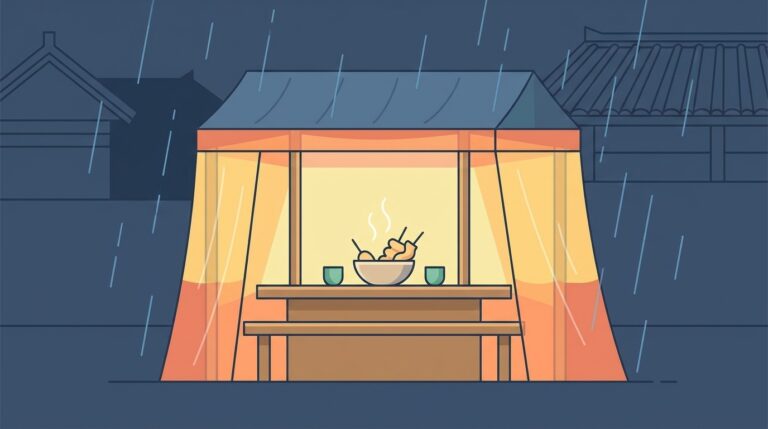
The Setting: It’s 9:30 PM on a rainy Tuesday in Mapo, Seoul. You and your friendly Korean coworker, Minjun (민준), are sitting at a cozy, glowing pojangmacha (포장마차 – street food tent). The steam from a fresh bowl of fishcake soup (어묵탕) rises between you, and the sound of rain patters against the orange plastic tarp.
Your Role: You are trying to figure out if Minjun is talking about you, himself, or someone else in this classic high-context conversation.
[Cast: Minjun & You]

1. 민준: (🎭 Smiling warmly, holding a small cup of soju)
   오늘 진짜 수고했어. 아, 기분 좋다!
   (Oneul jinjja sugohaesseo. Ah, gibun jota!)
   "You really worked hard today. Ah, I feel so good!"

2. You: (🎭 Clinking glasses)
   맞아요. 비 오니까 운치 있고 좋네요.
   (Majayo. Bi onikka unchi itgo jonneyo.)
   "That's right. Since it's raining, it has a nice vibe."

3. 민준: (🎭 Taking a sip, looking thoughtful)
   근데... 요즘 참 열심히 하더라.
   (Geunde... yojeum cham yeolsimhi hadeora.)
   "But... lately, really working hard."
   *(Wait, who is working hard? Him? Me? Or the new intern?)*

4. You: (🎭 Tilting head slightly, using your Nunchi)
   저요? 아니면 민준 씨요?
   (Jeoyo? Animyeon Minjun ssiyo?)
   "Me? Or you, Minjun?"

5. 민준: (🎭 Laughing softly, waving his hand)
   에이, 당연히 너지! 지난주 프로젝트 발표 진짜 멋졌어.
   (Ei, dangyeonhi neoji! Jinanju peurojekteu balpyo jinjja meotgyeosseo.)
   "Hey, of course you! Last week's project presentation was really cool."

6. You: (🎭 Blushing slightly, smiling)
   감사합니다. 아직 많이 부족해요.
   (Gamsahamnida. Ajik mani bujokhaeyo.)
   "Thank you. I still have a lot of room for improvement."

7. 민준: (🎭 Setting down his cup, looking at the rain)
   ...옆에 있으면 늘 든든해.
   (...yeope isseumeon neul deundeunhae.)
   "...When nearby, always feel reassured/supported."
   *(Uh oh! The subject is completely missing! Who feels reassured by whom?)*

8. You: (🎭 Feeling the dramatic tension rise like a K-Drama)
   *What do you say next to clarify the subject gracefully?*
🔀 Decision Point: Choose Your Path!
- Option A: “누가 든든해요? 정확히 말해주세요!” (Nuga deundeunhaeyo? Jeonghwakhi malhaejuseyo! / “Who feels supported? Please tell me exactly!”)
- Option B: “제가 옆에 있어서 든든하다는 뜻이에요?” (Jega yeope isseoseo deundeunhadaneun tteusieoyo? / “Do you mean you feel supported because I am by your side?”)
- Option C: (🎭 Smiling gently, pouring him another drink) “저도 민준 씨가 옆에 계셔서 든든해요.” (Jeodo Minjun ssiga yeope gyesyeoseo deundeunhaeyo. / “I also feel supported because you are by my side, Minjun.”)
💡 Choice Analysis
- Best Choice: Option C!
Instead of forcing him to explicitly say “I” or “you” (which breaks the cozy, polite mood), you used your Nunchi to assume the context and echoed back your support using his name (민준 씨) and honorifics (계셔서). This is the gold standard of B2-level natural conversation. It keeps the warm flow alive! - Risk Choice: Option B.
While grammatically correct, explicitly asking “Do you mean I…” can sound a bit self-absorbed or overly analytical in a relaxed casual setting. It puts Minjun on the spot to define the pronouns. - Bad Choice: Option A.
Yikes! Demanding “Speak precisely!” sounds like a police interrogation. It completely destroys the soft, high-context harmony of the rainy evening.
Phase 6: 10-Second Emotion Shadowing Drill
Bring your Korean to life! Practice these phrases. Pay attention to the pauses (/) and really lean into the emotional cues.
- [🥺 Appreciative & Soft]
- “진짜… / 고마워.”
- Pronunciation: Jin-jja… / go-ma-wo.
- English: “Really… / thank (you).” (No “I” or “you”—just pure gratitude flowing between friends).
- [😊 Teasing & Warm]
- “요즘 / 연락 / 진짜 안 하더라?”
- Pronunciation: Yo-jeum / yeon-rak / jin-jja / an ha-deo-ra?
- English: “Lately / contact / really / didn’t do?” (Translation: “You haven’t been keeping in touch lately, have you?”)
- [😤 Decisive & Reliable]
- “걱정 마. / 내가 / 해결할게.”
- Pronunciation: Geok-jeong ma. / Nae-ga / hae-gyeol-hal-ge.
- English: “Don’t worry. / I / will solve (it).” (Here, the subject “I” [내가] is deliberately stated to show strong, protective ownership of the action!).
Phase 7: K-Culture Mini Dictionary
| Word (Korean + RR) | Target Meaning | Cultural Insight & Usage |
|---|---|---|
| 눈치 (Nunchi) | Tact / Room-reading | The ultimate survival skill in Korea. Having “quick Nunchi” (눈치가 빠르다) means you can instantly decode who is being talked about without them ever saying a pronoun. |
| 맥락 (Maengnak) | Context | In Korean linguistics, 맥락 is king. Without it, a single verb like “해요” can mean “I do,” “You do,” “Let’s do it,” or “Please do it.” |
| 우리 (Uri) | We / Our / Us | Koreans prefer 우리 over “my.” They say “our mom” (우리 엄마) or “our country” (우리 나라) even when speaking as an individual. It emphasizes the collective “we” over the individual “I.” |
| 속마음 (Songmaeum) | Inner mind / True feelings | The unspoken thoughts. Because Korean is indirect, understanding 속마음 requires you to listen to what is not said in the empty spaces of subjectless sentences. |
| 눈빛 (Nunbit) | Eye-expression / Eye glow | When subjects are omitted, the eyes speak. Koreans pay close attention to 눈빛 to read sincerity or hidden meaning during conversations. |
Phase 8: Traveler’s Survival Kit
No matter where you go in Korea, these three subjectless phrases will save your day. Pop them out of your pocket like a pro!
Survival Cards
- Card 1: 카드 돼요? (Kadeu dwaeyo?)
- Literal: Card works?
- Real Meaning: Do you accept credit cards?
- Pro Tip: No need to say “Do you accept…” Just show your card, smile, and ask this. It works in taxis, cafes, and markets!
- Card 2: 화장실 어디예요? (Hwajangsil eodiyeyo?)
- Literal: Restroom where is?
- Real Meaning: Where is the restroom?
- Pro Tip: Keep it simple. Don’t add “Can I go to…” Just say the place and 어디예요.
- Card 3: 추천해 주세요. (Chucheonhae juseyo.)
- Literal: Recommend, please.
- Real Meaning: What do you recommend here?
- Pro Tip: Say this to a server at a trendy restaurant in Hongdae. They will bring you their best-selling dish!
📌 Editor’s Travel Note
When navigating Seoul, you need the right tools. Skip Google Maps—it doesn’t update well in Korea. Instead, download the Naver Map App for flawless subway and walking directions. Need a taxi at 11 PM in Gangnam? Use the Kakao T App to call a ride safely. Remember, there is virtually no tipping culture in Korea; trying to tip at a restaurant can actually cause polite confusion, so just a warm “잘 먹었습니다” (Jal meogeotseumnida – “I ate well”) as you leave is the best tip you can give!
Phase 9: Deep Thoughts — “One Step Deeper”
Why does English cling so tightly to “I,” “You,” “He,” and “She,” while Korean lets them drift away like cherry blossoms in spring?
Linguists and sociologists suggest that Western cultures historically favor individualism, where the individual agent (“I”) must take clear, explicit responsibility for the action. Korean culture, deeply rooted in collectivism and relationship-centered thinking, views individuals not as isolated islands, but as nodes in a shared network. Stating “I” too often can make you sound self-important or confrontational. By dropping the subject, Korean speakers allow the relationship and the shared atmosphere to take center stage.
In a way, omitting the subject is an act of ultimate trust. It says: “I trust that you and I are connected enough to understand each other without spelling out every single word.”
💬 Your Turn: How does your native language handle subjects? Do you feel rude or overly direct when you have to say “I” and “You” all the time? Let us know in the comments below!
Phase 10: FAQ & Common Mistakes
Q: If there’s no subject, how do I know if someone is talking about me or themselves?
A: Look at the sentence endings! Korean honorifics do the heavy lifting. If the verb has an honorific insert like -si- (e.g., “어디 가셔요?” – Eodi gasyeoyo?), the speaker is showing respect to the subject. Since you don’t show honorific respect to yourself, the subject must be you (the listener) or a respected third party. If they say “어디 가요?” (Eodi gayo?) in a casual tone, context and eye contact will guide you.
Q: Can I use “당신” (Dangsin) when translating “You” from English songs?
A: No, avoid it in daily life. While you hear it in emotional K-Pop ballads or see it in written poetry, using 당신 to a stranger on the street or a coworker is highly unnatural and can even sound confrontational (like saying “Hey, you!”). Instead, use the person’s name + title (e.g., “민준 씨” – Minjun-ssi) or their professional title (e.g., “대리님” – Daerinim).
Q: Is it grammatically incorrect to keep using “저는” (Jeoneun – I) in every sentence?
A: It is not grammatically wrong, but it sounds highly unnatural and repetitive. If you start every sentence with “저는… 저는…”, you will sound like you are reading a self-introduction essay. Once you establish that you are the one speaking, drop the “저는”!
🚨 Common Mistakes Warning Board
- Mistake: Saying “너” (Neo – You) to an older person or a boss.
- Correct Action: Omit the pronoun completely! Just use their title + 님 (e.g., 사장님, 선생님).
- Mistake: Answering “밥 먹었어?” with just a cold, literal “응” (Yeah) and walking away.
- Correct Action: Realize it’s a social greeting. Ask them back: “네, 먹었어요. 민준 씨는 요?” (Yes, I ate. How about you, Minjun?)
- Mistake: Translating “I like this” as “저는 이것을 좋아합니다” to a friend.
- Correct Action: Keep it casual and drop the pronouns: “이거 좋다!” (Igeo jota! – “This is good!”)
Phase 11: Action Mission & Engagement
Ready to put your high-context skills to the test? Take on our Daily Hangul Challenge!
- 🥉 Bronze (The Mirror Challenge): Stand in front of a mirror. Practice saying “보고 싶어” (Bogo sipeo) with three different emotions: sad, playful, and loving. No pronouns allowed!
- 🥈 Silver (The Social Media Hunt): Go to your favorite K-Drama clip on YouTube or Instagram. Look at the comments written by Korean fans. Count how many comments completely omit the subject. Write down one phrase and translate it based on context.
- 🥇 Gold (The Street Test): The next time you order at a Korean restaurant or talk to a language exchange partner, consciously delete “저는” (I) and “당신은” (You) from three sentences. Feel the breezy flow of natural Korean!
🎮 K-Culture Mission: Watch any episode of the hit drama Crash Landing on You or Business Proposal. Find a scene where a character confesses their feelings. Did they say “I like you,” or did they just say “좋아해”? Let us know the episode number in the comments!
Phase 12: Interactive Quiz Challenge
Let’s test your high-context intuition!
1. Situation Judgment
You are at an office dinner (회식). Your boss looks at the empty grill and says, “고기 더 시킬까?” (Gogi deo sikilkka? / “Shall order more meat?”). Who is the subject of “order”?
* A) The boss himself is going to pay and order.
* B) He is asking if we (the group) want to order more meat together.
* C) He is ordering you specifically to go get the meat.
Click for Answer & Explanation
Correct Answer: B
In a collective dining culture, “시킬까?” (-lka? ending) implies “Shall we do this?” He is checking the group’s desire before making a decision. Read the collective room!
2. Fill in the Blanks
Fill in the blank of this natural conversation between close friends:
- A: “내일 영화 볼래?” (Naeil yeonghwa bollae? – Want to watch a movie tomorrow?)
- B: “미안, 내일은 ( ) 바빠.”
(Choose the most natural option that fits the blank)
* A) 내가 (Naega)
* B) 당신이 (Dangsini)
* C) (Leave it blank! No pronoun needed)
Click for Answer & Explanation
Correct Answer: C
Since A asked B a direct question, B’s response about being busy obviously refers to B. Adding







