

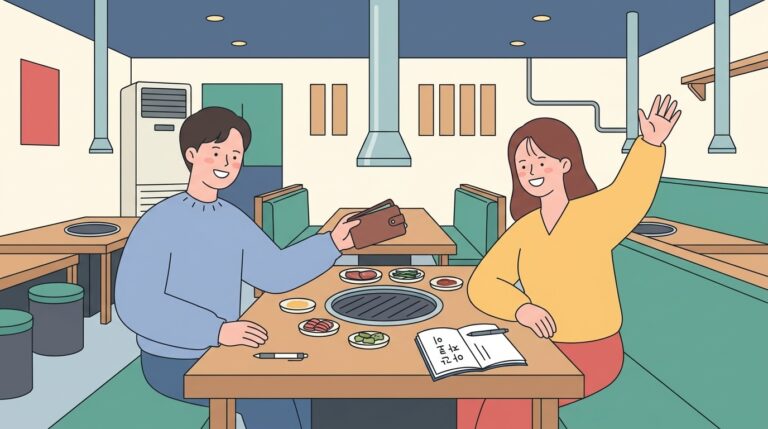
Master the Art of Korean Gratitude: How to Say “I’ll Treat You Next Time!”
안녕하세요! (Annyeonghaseyo!) Welcome back to Daily Hangul. I’m your lead editor and your Korean cultural navigator. If you’ve ever shared a meal with Korean friends or colleagues, you’ve probably experienced that warm, slightly chaotic moment at the end of the night: the battle for the bill.
In many Western cultures, splitting the bill down to the exact cent is standard. But in Korea, the philosophy of 가ᄱ사랴ᄵ 보다ᄱ (Gamsa-wa Bodap – Gratitude and Reciprocation) runs deep. It’s fueled by 거ᅡ (Jeong – affection and bonding). If a colleague or senior (sunbae) treats you to dinner today, saying a simple “thank you” is polite, but promising to repay the favor in the future is how you build a lasting relationship.
Today, we are going to dive deep into how to say “I will definitely treat/repay you next time” like a true local. You will learn the subtle nuances of intermediate-level expressions, explore real-world cultural context, and master the physical etiquettes that make Korean dining so charming!
Phase 2: Deep Dive into 3 Core Expressions
To navigate these situations naturally, you need options that match your relationship with the other person. Here are the three most common and practical ways to make this promise.
1. 다그ᄱ게 게가 꼬ᄀᄳ 사ᄱ게거 (Da-eum-e je-ga kkok sal-ge-yo)
- Pronunciation: [Da-eum-eh jeh-gah kkok sahl-geh-yoh]
- Meaning: “Next time, I will definitely buy (it) for you.”
- K-Culture Moment: You will hear this in almost every office K-Drama (like Misaeng or Business Proposal) when a junior employee gets treated to a comforting bowl of beef soup (gukbap) by their team leader after a long work shift.
- Editor’s Insight: This is the most versatile, standard expression for intermediate learners. The word 꼬ᄀᄳ (kkok – surely/definitely) is critical here. It adds a layer of warm sincerity, signaling that you aren’t just making a empty polite gesture, but that you genuinely intend to follow through.
- Situation Spectrum:
- Casual (내가 꼬ᄀᄳ 사ᄱ게): ✅
- Semi-formal (colleagues): ✅
- Formal (bosses/elderly): ✅
- 햐ᄢ Think About It: Notice how Korean uses the verb 사다 (sada – to buy) instead of “pay” or “split” when expressing gratitude. Why do you think treating someone directly carries more emotional value than just dividing the monetary cost?
2. 다그ᄱ게 게가 꼬ᄀᄳ 가ᄑ게셔스ᄱ니다 (Da-eum-e je-ga kkok gap-get-seum-ni-da)
- Pronunciation: [Dah-eum-eh jeh-gah kkok gahp-ghet-seum-nee-dah]
- Meaning: “I will surely repay you next time.”
- K-Culture Moment: Think of heavy human dramas like My Mister, where characters carry a strong sense of moral obligation and gratitude for major life favors or emotional support.
- Editor’s Insight: This uses the verb 가ᄑ다 (gapda – to pay back/repay). It carries a heavier, highly respectful weight. Avoid using this for a cheap cup of coffee, as it might make the other person feel awkward, as if you are viewing your relationship as a transactional ledger. Save this for big favors, expensive meals, or times when someone went out of their way to help you.
- Situation Spectrum:
- Casual: 보
- Semi-formal: ☀그
- Formal: ✅
- 햐ᄢ Think About It: How does your native culture differentiate between repaying a formal debt of honor and casually catching the next round of drinks?
3. 다그ᄱ에니거 게가 소ᄱ게거! (Da-eum-en je-ga ssol-ge-yo!)
- Pronunciation: [Dah-eum-en jeh-gah ssohl-geh-yoh]
- Meaning: “Next time, I’m shooting (treating)!”
- K-Culture Moment: Picture a group of close friends cheering and clinking glasses over chimaek (chicken and beer) in a casual late-night pub in Hongdae.
- Editor’s Insight: The verb 소다 (ssoda) literally means “to shoot (an arrow/gun)”, but in slang, it means to treat someone! It’s highly expressive, energetic, and perfectly captures intermediate conversational confidence. It shows you want to spoil your friends.
- Situation Spectrum:
- Casual (다그ᄱ에니거 내가 소ᄱ게!): ✅
- Semi-formal (close colleagues): ✅
- Formal: 보
- 햐ᄢ Think About It: Why does “shooting” someone lunch sound so much warmer and more exciting than just saying “I’ll pay”?
Phase 3: Textbook Korean vs. Real-world Korean
Let’s compare the stiff, robotic sentences found in older textbooks with what native speakers actually use in modern-day Seoul.
Scenario A: Promising to buy lunch next time
- 호 버개서 하ᄃ개어: 다그ᄱ 기허메 게가 거ᄱ시ᄱ가ᄱ으ᄱ 지버ᄱ하게셔니다. (I will pay the price of lunch at the next opportunity.)
- 퍼 지내차 하ᄃ개어: 다그ᄱ에니거 게가 바햐 하너 사ᄱ게거여! (Next time, I’ll treat you to a meal!)
- 히 애다르ᄑ까?: Koreans rarely use formal business jargon like “지불하다” (to pay/disburse) in personal gratitude. Saying 바햐 하너 사다 (bap han beon sada – to buy a meal once) is the ultimate warm invitation to meet up again.
Scenario B: Repaying a significant favor
- 호 버개서 하ᄃ개어: 귀하의 으ᄢ혜에 배다하게셔니다. (I will repay your grace.)
- 퍼 지내차 하ᄃ개어: 시ᄠᅡ세 마니 저새거여. 조ᄱ가나거 마시새느더 가대재하게셔니다! (I owe you so much. I will treat you to delicious food soon!)
- 히 애다르ᄑ까?: “은혜” (grace/favor) sounds like an ancient historical drama. Modern Koreans prefer admitting they “owe someone” (시ᄠᅡ세ᄡᄳᄱ 지다 – sinse-reul jida) and promising to treat them to delicious food (대재하다 – daejeop-hada).
Phase 4: K-Culture Deep Dive & Non-Verbal Manners
4-1. The “Wallet Dance” and Bowing Manners
In Korea, non-verbal gestures speak louder than words. When the bill arrives, even if you know your companion is going to pay, you must perform the “Wallet Dance” (지가ᄇᄳ 미ᄠ당 – jigap mildang).
1. Reach for your wallet or phone (for mobile pay) immediately when moving toward the register.
2. Offer to pay once with a smile: “게가 내거여!” (I will pay!)
3. If they push your hand away and insist on treating you, bow your head slightly (about 15 degrees) and say, “아, 자ᄅᄳ 모가게셔니다! 다그ᄱ에니거 게가 꼬ᄀᄳ 사ᄱ게거여!” (Ah, I will eat well! Next time I will definitely buy!)
4-2. Understanding
Frequently Asked Questions (FAQ)
Q: What does "다그ᄱ게 게가 꼬ᄀᄳ 사ᄱ게거 (Da-eum-e je-ga kkok sal-ge-yo)" mean in Korean and how do you pronounce it?
A: In Korean, "다그ᄱ게 게가 꼬ᄀᄳ 사ᄱ게거 (Da-eum-e je-ga kkok sal-ge-yo)" is pronounced [Da-eum-eh jeh-gah kkok sahl-geh-yoh] and means: "Next time, I will definitely buy (it) for you."
Q: What does "다그ᄱ게 게가 꼬ᄀᄳ 가ᄑ게셔스ᄱ니다 (Da-eum-e je-ga kkok gap-get-seum-ni-da)" mean in Korean and how do you pronounce it?
A: In Korean, "다그ᄱ게 게가 꼬ᄀᄳ 가ᄑ게셔스ᄱ니다 (Da-eum-e je-ga kkok gap-get-seum-ni-da)" is pronounced [Dah-eum-eh jeh-gah kkok gahp-ghet-seum-nee-dah] and means: "I will surely repay you next time."
Q: What does "다그ᄱ에니거 게가 소ᄱ게거! (Da-eum-en je-ga ssol-ge-yo!)" mean in Korean and how do you pronounce it?
A: In Korean, "다그ᄱ에니거 게가 소ᄱ게거! (Da-eum-en je-ga ssol-ge-yo!)" is pronounced [Dah-eum-en jeh-gah ssohl-geh-yoh] and means: "Next time, I’m shooting (treating)!"







