

Speak Like a Local at Lotte World: Your Ultimate A1 Korean Roller Coaster Survival Guide
Phase 1: Overcoming the Amusement Park Panic
안녕하세요! (An-nyeong-ha-se-yo!) Hello there, my dear friend! I am your Chief Editor at Daily Hangul, your cozy Korean-speaking bestie.
Imagine this: You are standing under the dazzling neon lights of Lotte World (롯데월드) or walking through the massive, thrilling grounds of Everland (에버랜드). K-Pop music is blasting, the smell of butter-grilled corn is in the air, and your Korean friends are pointing excitedly at the towering, loops-of-steel beast: the roller coaster.
Suddenly, your heart drops. Not because of the height, but because your friend turns to you with glowing eyes and asks: “같이 탈래?” (Ga-chi tal-lae? / Want to ride together?)
You want to scream “I’m scared!” or “Let’s do this!”, but your mind goes completely blank.
This is a classic “Pain Point” my actual A1 student, Sarah, faced last spring. She knew how to say “hello” and “thank you,” but when stood in front of Everland’s famous T-Express, she froze. She ended up sitting on a bench alone, missing out on a golden bonding moment.
We don’t want that for you! Learning just three simple phrases will completely change your experience. It will turn a scary moment into a laughter-filled memory, and your Korean friends will be absolutely charmed by your cute, natural expressions. Let’s dive in!
Phase 2: The Top 3 “Adrenaline-Rush” Phrases
Here are the three magic phrases you need when facing a giant roller coaster in Korea.
1. 무서워요! (Mu-seo-wo-yo!)
- Pronunciation: Moo-suh-wo-yo! (Sounds like “Moo” like a cow, followed by “seo” as in Seoul, and “wo-yo” like war-yo)
- Meaning: I’m scared! / It’s scary!
- K-Culture Moment: You will hear this phrase screamed at least 50 times in any K-Pop variety show (like Run BTS! or Going Seventeen) when idols are forced to ride high-thrill attractions.
- Editor’s Insight: This is polite but incredibly cute. It is the perfect way to show your vulnerability without sounding overly dramatic.
- Situation Spectrum:
- Friends & Casual: ✅ (You can drop the “요” and say “무서워!” to close friends)
- Semi-formal (Coworkers): ✅
- Formal (Bosses/Elders): ⚠️ (Grammatically correct, but maybe don’t show too much fear to your boss!)
- 🤔 Think About It: In English, we say “I am scared” (focusing on the person). In Korean, “무서워요” can mean both “I am scared” and “It is scary.” Why do you think Korean frequently drops the subject “I”? It’s because Korean is a highly context-dependent language!
2. 같이 타요! (Ga-chi ta-yo!)
- Pronunciation: Gah-chee tah-yo! (Be careful: “같이” is spelled with a ‘t’ sound, but it is pronounced as gah-chee! Sound-alike: “Got-chee”)
- Meaning: Let’s ride together!
- K-Culture Moment: In classic K-Dramas, this is the line the energetic male or female lead uses to drag their shy, serious partner onto a ride, breaking the ice.
- Editor’s Insight: “타요” (ta-yo) comes from the verb “타다” (ta-da), meaning to ride. Saying “같이 타요” instantly shows you are a team player who wants to share the thrill.
- Situation Spectrum:
- Friends & Casual: ✅ (Casual: “같이 타자!” – Ga-chi ta-ja!)
- Semi-formal: ✅
- Formal: ✅
- 🤔 Think About It: “같이” (together) is one of the warmest words in the Korean language. It highlights the community-focused nature of Korean culture. Doing things “together” is always preferred over doing them alone!
3. 진짜 재밌어요! (Jin-jja jae-mit-eo-yo!)
- Pronunciation: Jin-jja jae-mee-suh-yo! (Sound-alike: “Jin-ja” like ginger, “jae-mit-suh-yo”)
- Meaning: It’s really fun! / This is awesome!
- K-Culture Moment: The post-ride interview on K-variety shows where stars are catching their breath, hair messy, laughing hysterically while saying this to the camera.
- Editor’s Insight: “진짜” (jin-jja) means “really” or “real.” It adds a natural, modern flavor to your sentences.
- Situation Spectrum:
- Friends & Casual: ✅ (Casual: “진짜 재밌어!”)
- Semi-formal: ✅
- Formal: ✅
- 🤔 Think About It: Many learners only learn “재밌어요” (It is fun). Adding “진짜” shows genuine emotion. What is your go-to word for “really” in your native language?
Phase 3: Textbook Korean vs. Real-World Korean
Let’s look at how the textbook can sometimes make you sound like a robot, and what real Koreans actually say!
Situation 1: Suggesting to ride the roller coaster
- 📖 Textbook Korean: “롤러코스터에 탑승합시다.” (Rol-leo-ko-seu-teo-e tap-seung-hap-si-da.)
- Translation: “Let us board the roller coaster.”
- 🗣️ Real Korean: “우리 저거 타요!” (U-ri jeo-geo ta-yo!)
- Translation: “Let’s ride that one over there!”
- 💡 Why is it different? Nobody says “board” (탑승) in casual conversation unless it is an automated airport announcement. Real Koreans use the simple verb “타다” (to ride) and point with “저거” (that thing over there).
Situation 2: Expressing fear as the coaster climbs
- 📖 Textbook Korean: “저는 지금 두려움을 느낍니다.” (Jeo-neun ji-geum du-ryeo-um-eul neu-kkim-ni-da.)
- Translation: “I am currently experiencing feelings of dread.”
- 🗣️ Real Korean: “엄마야! 진짜 무서워요!” (Eom-ma-ya! Jin-jja mu-seo-wo-yo!)
- Translation: “Oh my goodness! I’m so scared!”
- 💡 Why is it different? “엄마야” (Eom-ma-ya) is the Korean equivalent of “Oh my gosh!” or “Yikes!” (literally meaning “Oh, mother!”). It is natural, emotional, and highly expressive.
Phase 4: K-Culture Deep Dive & Theme Park Manners
4-1. The “Animal Headband” Rule (머리띠 매너)
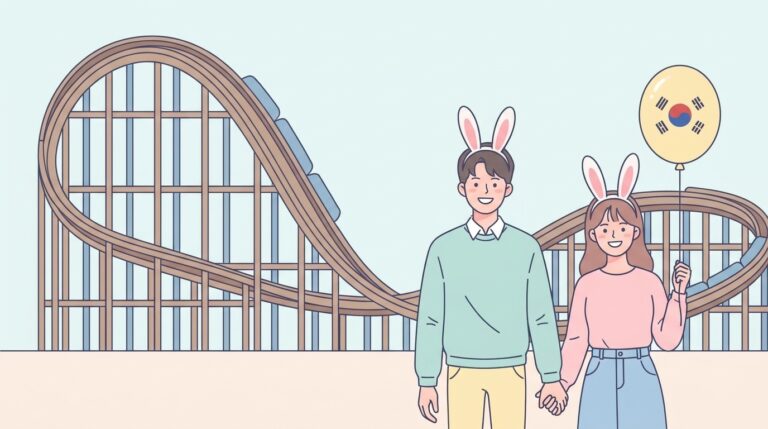
When you step into Lotte World, you will notice something fascinating: teenagers, couples, business people in suits, and even grandmas are all wearing cute animal ears (머리띠 – meo-ri-tti).
- The Vibe: In Korea, letting your guard down and matching the playful energy of the park is highly respected. Don’t try to look “too cool.” Buy the bunny ears. Wear the silly hat. It shows you have Nunchi (눈치)—the social sense to match the mood of the group!
4-2. Everland’s Iconic T-Express
Everland is home to the T-Express, one of the world’s steepest wooden roller coasters. In Korea, riding the T-Express is a rite of passage. If you ride it and survive, you are officially initiated into the Korean thrill-seeker club! Keep an eye out for “Cast Members” (staff) who dance and do rhythmic hand-clapping while you wait in line. Joining the clap is a great way to blend in.
Phase 5: The Lotte World Challenge (Roleplay)
- The Setting: You are standing in the middle of Lotte World’s outdoor area, Magic Island. The castle glows pink behind you. The sound of the “Gyro Drop” screaming down echoes in the air.
- Cast:
- You (Excited but slightly nervous traveler)
- Minjun (Your super energetic, headband-wearing Korean friend)
- Minjun: (Pointing excitedly at the French Revolution coaster) 우와, 저거 진짜 빨라요! 우리 저거 타요!
(U-wa, jeo-geo jin-jja ppal-la-yo! U-ri jeo-geo ta-yo!)
(🎭 Jumping up and down with excitement)
“Wow, that is really fast! Let’s ride that!” -
You: 저거요? 우와… 줄이 진짜 길어요.
(Jeo-geo-yo? U-wa… jul-i jin-jja gil-eo-yo.)
(🎭 Looking at the long line with wide eyes)
“That one? Wow… the line is really long.” -
Minjun: 괜찮아요, 금방 빠져요! 너 롤러코스터 좋아해?
(Gwaen-chan-ah-yo, geum-bang ppa-jyeo-yo! Neo rol-leo-ko-seu-teo jo-ah-hae?)
(🎭 Smiling reassuringly)
“It’s okay, it moves fast! Do you like roller coasters?” -
You: 음… 좋아해요. 하지만 조금 무서워요!
(Eum… jo-ah-hae-yo. Ha-ji-man jo-geum mu-seo-wo-yo!)
(🎭 Smiling nervously, playing with your fingers)
“Um… I like them. But I’m a little scared!” -
Minjun: 하하, 걱정 마요. 내가 같이 탈게요! 머리띠 살까요?
(Ha-ha, geok-jeong ma-yo. Nae-ga ga-chi tal-ge-yo! Meo-ri-tti sal-kka-yo?)
(🎭 Pointing to a cart with cute hairbands)
“Haha, don’t worry. I’ll ride with you! Shall we buy headbands?” -
You: 네, 귀여운 머리띠 같이 사요!
(Ne, gwi-yeo-un meo-ri-tti ga-chi sa-yo!)
(🎭 Nodding happily)
“Yes, let’s buy cute headbands together!”
(15 minutes later, you are buckled into the front row of the coaster…)
- Minjun: 오! 이제 출발해요! 준비됐어요?
(Oh! I-je chul-bal-hae-yo! Jun-bi-dwaet-eo-yo?)
(🎭 Waving your hands in the air)
“Oh! Starting now! Ready?” -
You: 엄마야! 진짜 무서워요! 손잡이 잡을래요!
(Eom-ma-ya! Jin-jja mu-seo-wo-yo! Son-jab-i jab-eul-lae-yo!)
(🎭 Gripping the safety bar tightly)
“Oh my gosh! I’m really scared! I’m holding the bar!” -
Minjun: 아아악! 내려간다! 소리 질러요!
(Ah-ah-ak! Nae-ryeo-gan-da! So-ri jil-leo-yo!)
(🎭 Screaming as the coaster drops)
“Ahhh! Going down! Scream!” -
You: 진짜 재밌어요! 아아악!
(Jin-jja jae-mit-eo-yo! Ah-ah-ak!)
(🎭 Laughing and screaming at the same time)
“This is so fun! Ahhh!”
🔀 Decision Point: What do you say after the ride stops?
- Choice A: “어지러워요. 집에 가요.” (Eo-ji-reo-wo-yo. Jip-e ga-yo.)
- Meaning: “I am dizzy. Let’s go home.”
- Choice B: “진짜 재밌어요! 한 번 더 타요!” (Jin-jja jae-mit-eo-yo! Han beon deo ta-yo!)
- Meaning: “That was amazing! Let’s ride it one more time!”
- Choice C: “무서웠어요. 저는 이제 안 타요.” (Mu-seo-wot-eo-yo. Jeo-neun i-je an ta-yo.)
- Meaning: “That was scary. I’m not riding anymore.”
🏆 Choice Breakdown:
- Best Choice – Choice B: This shows high energy and keeps the fun amusement park spirit alive. Your Korean friend will love your enthusiasm!
- Risk Choice – Choice A or C: While perfectly honest and okay to say if you genuinely feel sick, saying “집에 가요” (Let’s go home) right away might kill the happy mood. If you need a break, say: “조금 쉬어요!” (Jo-geum swi-eo-yo! / Let’s rest a bit!).
Phase 6: 10-Second Emotion Shadowing Drill
Try reading these out loud. Pay attention to the slash / marks—they show you where to take a micro-pause to sound incredibly natural!
- [🥺 Real fear but cute tone]
- 엄마야! / 진짜 / 무서워요!
- Eom-ma-ya! / Jin-jja / mu-seo-wo-yo!
- [😊 Super excited invitation]
- 저거 / 진짜 / 재밌겠다! / 같이 타요!
- Jeo-geo / jin-jja / jae-mit-get-da! / Ga-chi ta-yo!
- [😤 Relieved and proud after the ride]
- 휴~ / 안 무서워요! / 진짜 / 재밌어요!
- Hyu~ / an mu-seo-wo-yo! / Jin-jja / jae-mit-eo-yo!
Phase 7: K-Culture Mini Dictionary
| Word (Hangul / Romanization) | Meaning | How it’s used in real life |
|---|---|---|
| 머리띠 (Meo-ri-tti) | Cute Headband | Essential accessory bought immediately after entering Lotte World or Everland. |
| 대기 시간 (Dae-gi si-gan) | Waiting Time | The digital boards showing how many minutes (분) you have to wait. |
| 점검 (Jeom-geom) | Maintenance Check | If a ride is “점검 중” (jeom-geom-jung), it is temporarily closed for safety checks. |
| 야간개장 (Ya-gan-gae-jang) | Night Opening | Theme parks look magical at night. Many people buy cheaper “Night Passes” just for this. |
| 매직패스 (Mae-jik-pae-seu) | Magic Pass | Lotte World’s fast-track skip-the-line ticket system. |
Note: Ticket and Magic Pass prices are subject to seasonal changes. Check the official park websites before booking.
Phase 8: Traveler’s Survival Kit (Amusement Park Edition)
Top 3 Survival Phrases
- 화장실 어디예요? (Hwa-jang-sil eo-di-yeo-yo?)
- Meaning: Where is the restroom?
- Pro Tip: Keep this handy after drinking large theme park sodas!
- 몇 분 기다려야 해요? (Myeot bun gi-da-ryeo-ya hae-yo?)
- Meaning: How many minutes do we have to wait?
- 사진 좀 찍어주시겠어요? (Sa-jin jom jjig-eo-ju-si-get-eo-yo?)
- Meaning: Could you take a picture of us, please?
- Pro Tip: Hand your phone to any Korean couple. They are famous for taking professional-grade photos for strangers!
📌 Editor’s Travel Note
Before heading out, download the Naver Map App to navigate subway exits directly to Lotte World (Jamsil Station, Exit 4). Uber works in Seoul, but calling a taxi via the Kakao T App is much faster and cheaper in Korea!
Phase 9: Deep Dive — Why Do Koreans Love Scare-Dates?
Have you ever wondered why amusement parks are considered the absolute No. 1 date spot in South Korea?
It is actually based on a psychological theory called the “Suspension Bridge Effect” (흔들다리 효과). When you ride a terrifying roller coaster, your heart races and adrenaline pumps. Your brain sometimes confuses this physiological fear with the excitement of falling in love with the person sitting next to you!
By screaming together and holding hands, couples feel closer. It breaks down social barriers faster than a quiet dinner in Gangnam ever could.
💬 Your Turn: Is going to an amusement park a popular date activity in your country? What is the ultimate “first date” spot where you live? Let us know in the comments below!
Phase 10: FAQ & Spotting Mistakes
Q: Is “무서워요” polite enough to use with strangers?
A: Yes! The “요” ending makes it perfectly polite. You can say it to staff, strangers in line, or your colleagues without sounding rude.
Q: Can I use “타다” for walking or taking a walk?
A: No. “타다” (ta-da) is strictly for boarding vehicles, rides, horses, or bicycles. For walking, use “걷다” (geot-da).
Q: What should I say if I want to sit out because I am too scared?
A: Simply say: “저는 밑에서 기다릴게요!” (Jeo-neun mit-eo-seo gi-da-ril-ge-yo!), which means “I will wait down here!” It’s polite and clear.
🚨 Common Mistakes Alert!
- Mistake 1: Saying “롤러코스터를 먹어요” (I eat the roller coaster) instead of “타요” (I ride). Remember, “타다” is for rides!
- Mistake 2: Screaming “엄마!” (Mom!) instead of “엄마야!” (Yikes!). “엄마!” just sounds like you are literally calling your actual mother to save you. “엄마야!” is the correct exclamation.
Phase 11: Your “Daily Hangul” Action Mission
- 🥉 Bronze (At-Home Challenge): Record yourself saying “엄마야! 진짜 무서워요!” on your phone. Make sure to sound genuinely terrified!
- 🥈 Silver (Social Challenge): Share a photo of your favorite roller coaster on Instagram/Twitter and caption it: “같이 타요!” and tag #DailyHangul.
- 🥇 Gold (Real-world Challenge): Next time you watch a K-Drama or Variety Show, listen closely for the words “무서워” or “진짜.” Write down the timestamp and leave it in our blog comments!
Phase 12: Interactive Quiz Challenge
Test your new skills! Click the boxes below to reveal the answers.
1. Which phrase means “Let’s ride together!”?
- A) 진짜 재밌어요!
- B) 같이 타요!
- C) 화장실 어디예요?
Click to reveal the Answer! 💡
Correct Answer: B) 같이 타요! (Ga-chi ta-yo!)
– A means “It’s really fun!”
– C means “Where is the restroom?”
2. True or False: In Korea, wearing cute headbands (머리띠) at theme parks is only for toddlers.
Click to reveal the Answer! 💡
Correct Answer: FALSE!
Adults, couples, and friends of all ages wear headbands to fully immerse themselves in the fun, happy atmosphere! It’s a great K-Travel cultural experience.
See you in the next lesson! Until then, keep practicing and stay curious!
– Your Daily Hangul Editor






