

Sing Like a Local: How to Find the Hottest Korean Noraebang Hits Without Getting Lost in Translation
Phase 1: Welcome to the Neon-Lit Magic of the Korean Noraebang!
안녕하세요! (Annyeonghaseyo!) Hello there, my dear friend! I am your lead editor and cultural navigator from Daily Hangul.
Picture this: You are walking down a bustling street in Hongdae or Sinchon on a cool Friday night with your Korean friends. The air is thick with the mouth-watering scent of Korean fried chicken, and the bright neon signs are reflecting off the pavement. Suddenly, someone says, “Let’s go to a Noraebang (노래방 – karaoke room)!”
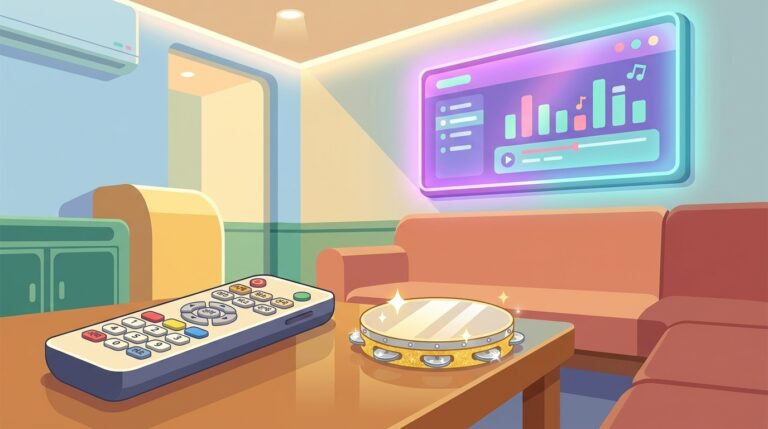
You step into a cozy room filled with flashing disco lights, tambourines, and a massive screen. Your friend hands you a giant, spaceship-like remote control (리모컨 – rimokeon) entirely covered in Korean letters, and says:
“요즘 인기 많은 곡 예약해 줘!”
(Yo-jeum in-ki man-eun gok ye-yak-hae jwo!)
“Reserve a popular song these days!”
Your heart drops. You love K-pop, but how do you search for the latest music charts when the buttons look like a complex matrix?
Don’t worry! This is a classic “frozen in the headlights” moment that almost every intermediate learner goes through. In fact, just last month, my student Sarah confessed that she spent 15 minutes of her precious karaoke hour flipping through a dusty, 500-page songbook because she didn’t know how to navigate the digital chart menu.
By the end of this guide, you won’t just survive your next karaoke night—you will confidently lead your friends straight to the trendiest hits of the week and earn some major “Inssa” (인싸 – insider/popular person) points!
Phase 2: Master the 3 Essential Noraebang Search Phrases
Let’s dive deep into the three most powerful Korean expressions you need to confidently search the latest charts on any Korean karaoke machine.
1. 요즘 무슨 노래가 제일 잘나가요? (Yojeum museun noraega jeil jalnagayo?)
- Pronunciation: [Yo-jeum moo-seun no-rae-ga je-il jal-na-ga-yo?]
- Meaning: “What song is doing the best these days?” (Real-world nuance: “What’s the absolute trendiest song right now?”)
- K-Culture Moment: You will hear this expression constantly in K-dramas when coworkers gather for a lively second round (2차 – i-cha) of drinks and entertainment.
- Editor’s Insight: The verb 잘나가다 (jal-na-ga-da) literally means “to go out well,” but in casual speech, it is the ultimate way to describe a person, song, or trend that is highly successful and popular.
- Situation Spectrum:
- Casual (Friends): ✅
- Semi-formal (Coworkers): ✅
- Formal (Bosses/Elders): ⚠️ (Better to use: “요즘 어떤 노래가 가장 인기 있습니까?”)
- 🤔 Think About It: Why does Korean use physical metaphors like “going out well” (잘나가다) to describe abstract popularity? How does this compare to your native language’s idioms for trends?
2. 인기 차트에서 골라봐야겠어요. (Inki chateueseo gollabwayagesseoyo.)
- Pronunciation: [In-gi cha-teu-e-seo gol-la-bwa-ya-get-seo-yo]
- Meaning: “I think I should choose from the popular chart.”
- K-Culture Moment: This is the perfect phrase to murmur to yourself or say to your friends as you confidently take hold of the giant remote control.
- Editor’s Insight: This sentence uses the B1-level grammar pattern -어/아 봐야겠다 (eodiseo gol-la-bwa-ya-get-da), which expresses a newly made decision (“I think I should try to…”). It sounds highly natural and polite without being stiff.
- Situation Spectrum:
- Casual (Friends): ✅
- Semi-formal (Coworkers): ✅
- Formal (Bosses/Elders): ✅
- 🤔 Think About It: How does adding “try doing” (-어/아 보다) soften your sentence in Korean compared to simply saying “I will choose” (고를 거예요)?
3. 신곡은 어디서 검색해요? (Sin-gogeun eodiseo geomsaekhaeyo?)
- Pronunciation: [Shin-go-geun eo-di-seo geom-saek-hae-yo?]
- Meaning: “Where do I search for new releases?”
- K-Culture Moment: Use this when you want to sing that K-pop track that dropped literally three days ago. Korean karaoke machines are updated daily via the internet!
- Editor’s Insight: 신곡 (sin-gok) is a Hanja (Sino-Korean) word combining 신 (new) and 곡 (song). Its counterpart is 명곡 (myeong-gok – classic masterwork).
- Situation Spectrum:
- Casual (Friends): ✅
- Semi-formal (Coworkers): ✅
- Formal (Bosses/Elders): ✅
- 🤔 Think About It: Hanja combinations make expanding your vocabulary incredibly easy. If “곡” (gok) is song, and “신” (sin) is new, can you guess what “신입생” (sin-ip-saeng) means?
Phase 3: Textbook Korean vs. Street-Smart Real Korean
In textbooks, you learn how to speak to a grammar examiner. In the real neon lit world of Seoul, you need to speak with speed, rhythm, and natural emotion.
Situation 1: Suggesting to search the chart
- 📖 Textbook Korean: “인기 곡 목록을 확인하고 노래를 선택합시다.” (Let us check the popular song list and select a song.)
- 🗣️ Real Korean: “우리 인기 차트 좀 볼까?” (Shall we take a look at the popular chart?)
- 💡 Why the difference? The textbook sentence sounds like a robotic manual. Real Koreans use the soft suggestion ending -을까? (-eul-kka) to check the group’s vibe and keep things collaborative.
Situation 2: Asking your friend to queue up a song
- 📖 Textbook Korean: “제가 부를 노래를 입력 장치에 예약해 주십시오.” (Please reserve the song I will sing in the input device.)
- 🗣️ Real Korean: “나 이거 예약해 줘!” (Reserve this for me!)
- 💡 Why the difference? In a lively Noraebang, brevity is key. The compound verb 예약하다 (ye-yak-ha-da) is shortened in command form to 예약해 줘 (ye-yak-hae jwo) when speaking to friends.
Phase 4: K-Culture Deep-Dive: Noraebang Etiquette & Chart Ecosystem
4-1. The Art of “Nunchi” (눈치) in the Room
Nunchi—the Korean art of reading the room—is your absolute shield in a Noraebang. If your friends just sang an energetic dance song by BTS or NewJeans, do not immediately queue up a heartbreaking, 6-minute slow ballad. It will completely kill the vibe (분위기 깨다 – bun-wi-gi kkae-da)! Keep the energy balanced.
4-2. The Big Two: TJ vs. Geumyoung (금영)
In Korea, two giant companies dominate the karaoke machine industry: TJ Media and Geumyoung.
* TJ Media is highly popular among the younger generation because of its sleek interface, high-definition K-pop instrumental backings, and rapid chart updates.
* The “Popular Chart” button is usually a bright, easy-to-spot color on the remote. Look for “인기차트” (Inki Chateu) or “신곡안내” (Sin-gok An-nae) to instantly skip browsing and see what the nation is singing!
Phase 5: Interactive Noraebang Roleplay Scenario
The Setting: You are inside “Su Noraebang” in Hongdae. The tambourines are sparkling, and the green laser lights are bouncing off the walls. Your close Korean friend, Min-jun, is sipping on cold barley tea and looking at you expectantly.
Characters:
- You (A cool, B1-level explorer)
- Min-jun (민준 – Your high-energy Korean wingman)
Dialogue:
- Min-jun: (Grinning widely, hands you the remote control)
야, 네가 먼저 한 곡 골라봐! 뭐 부를래?
(Ya, ne-ga meon-jeo han gok gol-la-bwa! Mwo bu-reul-lae?)
“Hey, you choose a song first! What do you want to sing?” -
You: (Holding the heavy remote control bravely)
우와, 리모컨 진짜 크다! 요즘 무슨 노래가 제일 잘나가?
(U-wa, ri-mo-keon jin-jja keu-da! Yo-jeum museun noraega jeil jal-na-ga?)
“Wow, this remote control is really huge! What song is the most popular these days?” -
Min-jun: (Points enthusiastically to the top of the remote)
요즘은 당연히 아일릿(ILLIT)이랑 데이식스(DAY6)가 대세지! 인기 차트 버튼 눌러봐!
(Yo-jeum-eun dang-yeon-hi A-il-rit-i-rang De-i-sik-seu-ga dae-se-ji! In-gi cha-teu beot-eon nul-leo-bwa!)
“These days, of course ILLIT and DAY6 are the trend! Press the popular chart button!” -
You: (Squinting at the remote control keys)
아, 여기 노란색 버튼이 인기 차트구나! 눌렀어. 와, 노래 진짜 많다!
(A, yeo-gi no-ran-saek beot-eon-i in-gi cha-teu-gu-na! Nul-leot-eo. Wa, no-rae jin-jja man-ta!)
“Ah, this yellow button here is the popular chart! I pressed it. Wow, there are so many songs!” -
Min-jun: (Shaking the tambourine)
좋아! 거기서 부르고 싶은 거 아무거나 골라봐. 번호 누르고 ‘예약’ 누르면 돼.
(Jo-a! Geo-gi-seo bu-reu-go si-peun geo a-mu-geo-na gol-la-bwa. Beon-ho nu-reu-go ‘ye-yak’ nu-reul-myeon dwae.)
“Great! Just pick anything you want to sing from there. Type the number and press ‘Reserve’.” -
You: (Searching the screen)
앗, 내가 좋아하는 노래 찾았다! 근데 이 노래 시작하기 전에 바로 예약하면 돼?
(At, nae-ga jo-a-ha-neun no-rae chat-at-da! Geun-de i no-rae si-jak-ha-gi jeon-e ba-ro ye-yak-ha-myeon dwae?)
“Ah! I found the song I like! But do I just reserve it directly before this song finishes?” -
Min-jun: (Nodding vigorously)
응! ‘예약’ 버튼 누르면 뒤에 대기 상태로 들어가니까 걱정 마.
(Eung! ‘Ye-yak’ beot-eon nul-reu-myeon dwi-e dae-gi sang-tae-ro deul-eo-ga-ni-kka geok-jeong ma.)
“Yep! If you press the ‘Reserve’ button, it queues up next, so don’t worry.” -
You: (Tapping the buttons carefully)
좋아, 예약 완료! 다음 곡은 민준이 네가 신곡으로 하나 골라줘.
(Jo-a, ye-yak wan-ryo! Da-eum gok-eun Min-jun-i ne-ga sin-gok-eu-ro ha-na gol-la-jwo.)
“Okay, reservation complete! For the next song, Min-jun, you pick a new release.” -
Min-jun: (Takes the remote back with a dramatic flourish)
오케이! 내가 요즘 완전 꽂힌 신곡 보여줄게. 가자!
(O-kei! Nae-ga yo-jeum wan-jeon kkot-hin sin-gok bo-yeo-jul-ge. Ga-ja!)
“Okay! I’ll show you a new song I am absolutely obsessed with lately. Let’s go!”
🔀 Decision Point: What do you say when the mic is handed to you?
Now it is your turn to sing! Min-jun holds out the microphone to you. What is your move?
- A) “나 너무 떨려서 못 부르겠어!” (Na neo-mu tteol-ryeo-seo mot bu-reu-ges-seo! – “I’m too nervous to sing!”)
- B) “에이, 분위기 띄우게 신나는 노래로 가자!” (E-i, bun-wi-gi tti-u-ge sin-na-neun norae-ro ga-ja! – “Hey, let’s go with an upbeat song to pump up the room!”)
- C) “미안하지만 노래방 책 좀 다시 주세요.” (Mi-an-ha-ji-man noraebang chaek jom da-si ju-se-yo. – “I am sorry, but please give me the karaoke book again.”)
Choice Analysis:
- Best Choice: B — This shows incredible “Nunchi” and a fantastic social spirit! Pumping up the atmosphere with a fun, fast song is the ultimate way to win hearts in Korea.
- Risk Choice: A — It’s okay to be shy, but saying this repeatedly might make the host feel bad. Just close your eyes and go for it!
- Boring Choice: C — Going back to the book ruins the digital momentum. Rely on the screen and your friends!
Phase 6: 10-Second Emotion Shadowing Drill
Bring your Korean to life! Practice these sentences out loud, paying close attention to the pause markers / and the emotional cues.
Drill 1: [😊 Excited and eager to sing]
“요즘 / 인기 많은 곡 / 예약해 줘!”
[Yo-jeum / in-ki man-eun gok / ye-yak-hae jwo!]
Drill 2: [🤔 Thoughtful, looking at the remote]
“인기 차트는 / 도대체 / 어디서 / 보는 거지?”
[In-gi cha-teu-neun / do-dae-che / eo-di-seo / bo-neun geo-ji?]
(“Where on earth do I see the popular chart?”)
Phase 7: K-Culture Mini Dictionary
| Word | Pronunciation | English Meaning | Cultural Insight |
|---|---|---|---|
| 간주 점프 | [Gan-ju Jeom-peu] | Skip Interlude | The magical button on the remote that skips the long instrumental parts of a song so you can sing more songs within your hourly limit! |
| 서비스 | [Seo-bi-seu] | Free Service / Extra Time | When the Noraebang owner gives you 10, 20, or even 30 free minutes at the end of your session because they like your energy. |
| 떼창 | [Tte-chang] | Unison Singing | The beautiful Korean phenomenon of an entire group (or crowd) singing the chorus together at the top of their lungs. |
| 애창곡 | [Ae-chang-gok] | Go-to Song / Favorite | Your signature song that you always perform when you go to karaoke. |
Phase 8: Traveler’s Survival Kit
If you find yourself in the middle of Seoul tonight, keep these three phrases in your back pocket:
- “마이크 커버 두 개 주세요.”
- [Ma-i-keu keo-beo du gae ju-se-yo.]
- “Please give us two microphone covers.” (Excellent for hygiene!)
- “서비스 더 주시면 안 돼요?”
- [Seo-bi-seu deo ju-si-myeon an dwae-yo?]
- “Could you possibly give us some more free service time?” (Slightly cute, highly effective!)
- “예약 취소해 주세요.”
- [Ye-yak chwi-so-hae ju-se-yo.]
- “Please cancel the reservation.” (Use this if you accidentally queued the wrong song.)
📌 Editor’s Travel Note
When navigating the streets of Seoul to find a neat, soundproof karaoke venue, don’t rely on global maps. Instead, use the Naver Map App on iOS or the KakaoMap App on Android to search for “코인노래방” (Coin Noraebang) near you. They are inexpensive, exceptionally clean, and perfect for practicing solo!
Note: Local business hours and pricing may vary slightly depending on the district.
Phase 9: Think Deeper: “Heung” (흥) and Collective Joy
Why are Koreans so passionate about Noraebang? In western cultures, karaoke is often seen as something you do only after a lot of liquid courage, sometimes resulting in friendly teasing. In Korea, however, singing together is a deep-seated cultural practice linked to Heung (흥)—a unique Korean emotional state of collective joy, passion, and release of stress (한 – Han).
When Koreans sing together, there is no judgment. Whether you are pitch-perfect or tone-deaf, what matters is your energy, sincerity, and participation in the collective wave of emotion.
💬 Your Turn!
What is your absolute go-to karaoke song in your home country? If you had to perform one Korean song right now to get the room dancing, what would it be? Let us know in the comments below!
Phase 10: FAQ & Avoiding Common Mistakes
Q: Can I find English songs on a standard Korean TJ or Geumyoung machine?
A: Yes! Absolutely. Every modern machine has a massive database of international pop classics. Simply press the “국가별” (Country Selection) or “팝송” (Pop Song) button to access the English charts.
Q: What is the difference between a standard Noraebang and a Coin Noraebang (코노)?
A: Standard Noraebangs charge by the hour (approx. 15,000 to 30,000 KRW) and are great for big groups. Coin Noraebangs (코인노래방) charge by the song (typically 500 KRW for 1 or 2 songs), which is ideal for travelers or solo practice.
Q: Is it okay to hit the “Cancel” (취소) button while someone else is singing?
A: Absolutely No! This is considered highly rude unless the singer explicitly asks you to cancel it because they don’t know the lyrics.
🚨 Common Mistakes Warning Board
- Mistake 1: Pressing 시작 (Start) instead of 예약 (Reserve).
- What happens: It instantly cuts off the current singer and starts your song!
- Correct Action: Always look for the blue or white 예약 button to queue your song safely.
- Mistake 2: Monopolizing the mic.
- What happens: Your friends will quietly get bored.
- Correct Action: Share the mic, shake the tambourine, and sing backup vocals!
Phase 11: Your Interactive Action Missions
Ready to put your knowledge into real action? Choose your tier and start practicing!
- 🥉 Bronze Mission (My Bedroom): Practice saying “요즘 무슨 노래가 제일 잘나가요?” in front of your mirror with an excited, bright smile 5 times.
- 🥈 Silver Mission (Social Media): Go to YouTube, search for “TJ 노래방” (TJ Karaoke Channel), find a K-pop song you love, and practice singing along with the lyrics on the screen.
- 🥇 Gold Mission (In Real Life): Go to a real Coin Noraebang in Korea or a Korean town near you, use the remote control to navigate directly to the 인기차트 (Popular Chart), and reserve a song from the Top 10!
Phase 12: Interactive Quiz Challenge
Let’s test your Noraebang mastery with a quick mini-quiz!
1. Which button should you press if you want to skip a long, boring instrumental break in the middle of a song?
- A) 예약 (Ye-yak)
- B) 시작 (Si-jak)
- C) 간주 점프 (Gan-ju Jeom-peu)
🔍 Click here to check the answer!
Correct Answer: C! ‘간주 점프’ is your best friend when you want to save time and skip straight to the next verse.
2. True or False: TJ Media and Geumyoung update their karaoke systems with new songs daily.
🔍 Click here to check the answer!
Correct Answer: True! They are connected to the internet and updated every single day with the latest hits.
3. If a Korean restaurant or Noraebang owner gives you “Service” (서비스), what should you do?
- A) Pay them extra money.
- B) Bow deeply, smile, and say “감사합니다!”
- C) Reject it politely.
🔍 Click here to check the answer!
Correct Answer: B! ‘서비스’ is a warm expression of hospitality. Simply smile, thank them, and enjoy the extra time or free side-dish!







